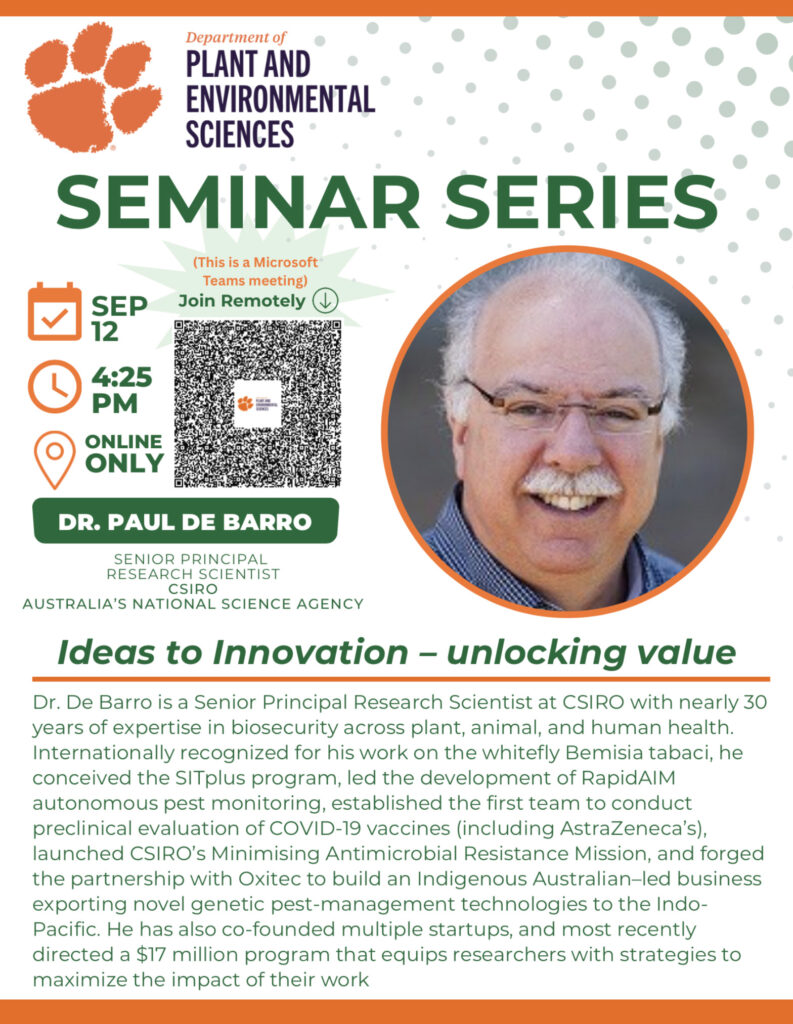
Join us for a seminar hosted by the Department of Plant and Environmental Sciences featuring Paul De Barro, senior principal research scientist, CSIRO – Australia’s National Science Agency.
- Date: Sept. 12
- Time: 4:25 p.m.
- Online Only, Remote Access: Microsoft Teams

In the world of science and innovation, few individuals embody the journey from idea to impact as profoundly as De Barro. With nearly 30 years of experience in biosecurity spanning plant, animal and human health, his career is a masterclass in translating scientific insight into real-world solutions.
Internationally acclaimed for his pioneering work on the whitefly Bemisia tabaci, De Barro has consistently pushed the boundaries of what’s possible in pest management and disease prevention. His vision led to the creation of the SITplus program, a groundbreaking initiative aimed at controlling insect populations through sterile insect techniques. He also spearheaded the development of RapidAIM, an autonomous pest monitoring system that revolutionized how we track and respond to agricultural threats.
When the COVID-19 pandemic struck, De Barro was at the forefront, establishing CSIRO’s first team to conduct preclinical evaluations of vaccines, including the AstraZeneca candidate. His leadership helped accelerate Australia’s response to the global health crisis, demonstrating the power of agile, science-driven innovation.
But his impact doesn’t stop there. Recognizing the growing threat of drug-resistant infections, De Barro launched CSIRO’s Minimizing Antimicrobial Resistance Mission, a strategic effort to curb one of the most pressing challenges in modern medicine. He also forged a landmark partnership with Oxitec, enabling the creation of an Indigenous Australian–led enterprise focused on exporting novel genetic pest-management technologies to the Indo-Pacific region—an inspiring model of inclusive innovation.
Beyond his scientific achievements, De Barro is a serial entrepreneur, having co-founded multiple startups that bridge the gap between research and commercialization. Most recently, he directed a $17 million program designed to equip researchers with the tools and strategies needed to maximize the impact of their work—ensuring that great ideas don’t just stay in the lab but reach the communities and industries that need them most.
De Barro’s journey is a testament to the transformative power of science when paired with vision, collaboration, and a relentless drive to solve real-world problems. His work continues to unlock value across disciplines, proving that innovation isn’t just about discovery—it’s about delivering meaningful change.
-END-