Clemson Division of Research

Sept. 2018 VPR Message: Investing in you

Tanju Karanfil

Welcome back to campus! I hope you had a restful summer break and are settling into the busy pace of another successful semester at Clemson University.

With the rush of beginning a new semester now behind you, I hope you will take a look at several new services and resources the Division of Research has created over the summer to help advance your research and scholarship.

First, we have created a new R-Initiative funding program that will provide access, at no cost, to our core research facilities, including the Electron Microscope Facility, High Performance Computing, Light Imaging Facility, Godley-Snell Research Center, Micro Fabrication Facility and the Aquatic Animal Research Lab. These facilities offer cutting-edge technologies, high-end instrumentation, technical support and educational services.

Godley-Snell Research Center

This Clemson University Core Incentivized Access program is intended to help you build research data that will supplement a new grant proposal, while increasing your awareness of the core facilities available to you. The program is detailed in the Call for Proposals here.

Our various R-Initiative programs have aided numerous faculty research projects. We awarded nearly $2 million in R-Initiative program funding last fiscal year to support projects involving 67 faculty members from 27 departments. This summer, we awarded 23 Doctoral Dissertation Completion grants, another R-Initiative, to help students from 16 different programs complete their degrees. This is the second year the Division has awarded such grants. I appreciate and encourage everyone’s participation in these R-Initiative programs.
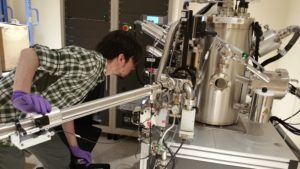
Electron Microscope Facility

Secondly, we have completed an expansion at our Electron Microscope Facility to add state-of-the-art combined X-ray Photoelectron Spectroscopy (XPS) and Auger Electron Spectroscopy (AES) equipment. This represents a significant investment and adds capability that has been highly sought by Clemson researchers working on advanced materials, bio-materials, advanced manufacturing, healthcare, digital and information technology and environmental projects, among other projects. Visit the EMF webpage for more information on this facility.

Third, we have compiled internal policies related to research into a new digital Research and Sponsored Activities Policy Manual that you can view online here. The document includes links to internal policies governing proposal development and submission and more. Please bookmark this page.

Fourth, the Office of Strategy and Analytics, with the aid of the Grants and Contracts Administration and Public Service and Agriculture, has developed a new Faculty Business Information Systems tool (FBIS) available here. FBIS allows Principle Investigators to see all of their associated Fund 20 projects, along with a snapshot of their budgets, actuals, project balances, and project life percent. The new FBIS tool preserves all the original site’s capabilities, including a list of user’s Fund 20 projects upon login, projects’ direct budget balances, and payroll and journal entry drill down capabilities. However, the navigation has been updated to be more simplistic and intuitive.

Fifth, we have posted the 2018-19 Research Reference Guide available here to recap our institutional research advancements and goals and to provide an introduction to each office within the Division of Research. The Reference Guide includes numerous links to important documents, resources and services that the Division provides to help increase your research activity.

I hope you will find these resources useful. We’re always working to improve our services to you. If you have any suggestions, please email vpr@clemson.edu.

Best wishes for a successful semester.

Go Tigers!

Tanju


June 2018: Don’t rest on past success

In the past four years, we have seen unprecedented growth in our research enterprise. Grant awards hit an all-time high of $109 million in the 2017 academic year, an astonishing 40 percent increase over a four-year period.
With two months remaining in the current fiscal year, we have already exceeded last year’s totals, reaching $118 million as of April 30.

This growth has been critical to our Carnegie R1 classification. Reaching that goal in 2016 was just the start, not the end. To maintain our R1 status among the nation’s top research universities, we must remain steadfast in our pursuit of funded research.

This year, our proposal submissions have softened. Increased student enrollment and added workload from the research projects we have added the past few years have undoubtedly left you with less time to prepare grant proposals. I expect to end the fiscal year with around $450 million in proposal submissions, a drop from around $560 million a year ago.

More submissions mean more opportunities to be funded, and this year, there will be opportunities. Federal budget analysts say the recently approved omnibus spending bill provides the largest year-over-year spending increase for federal research agencies since the 2009 American Recovery and Reinvestment Act, which was a significant boon for university research.

Universities across the country will also be competing for these investments. At Clemson, we have been highly competitive and our awards have grown greatly even as total federal investments in university R&D have been relatively flat.

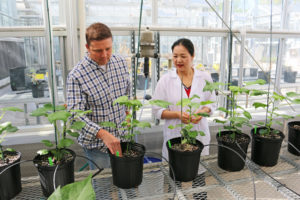
Clemson University associate professor of plant and environmental sciences Christopher Saski (left) is among the recipients of this year's R-Initiative grants.
Clemson University associate professor of plant and environmental sciences Christopher Saski (left) is among the recipients of this year’s R-Initiative grants.

To help you seize this opportunity, we are investing nearly $2 million (up from $1.5 million a year ago) in our R-Initiative programs that provide seed funding and grants to support proposal submissions, the hiring of postdocs and research associates, the purchase of equipment, and other research endeavors. Read more about that here.

We have also launched Faculty Insight, an online portal that will help you identify collaborators and search for funding opportunities specific to your area of expertise. The customizable database of funding opportunities is a new, highly valuable feature in this new Faculty Insight system, which replaces the Research Expertise Discovery Suite. Please check out this new platform and see how it can help you advance your research.

Additionally, we are implementing a single-rate tuition schedule for graduate students that will reduce administrative burden and provide a competitive level of support to graduate students. One of the major benefits of sponsored awards is the support provided to graduate students in the form of graduate assistantships and tuition remission/Graduate Assistant Differential. More information on single-rate tuition is available here.

I want to thank everyone who participated in the recent Research Symposium and the organizing committee led by Brian Powell for putting together a great event. The Symposium connects researchers from across campus in hopes of sparking inter-disciplinary collaboration. We had representatives from each college and more than 40 departments participate in the various research presentations this year. Attendance has grown each year, and I appreciate your willingness to spend a day meeting colleagues and exploring opportunities to collaborate on impactful research. You can view the presentations here.

At this year’s symposium, we also recognized the university’s most accomplished faculty members with University Research, Scholarship and Artistic Achievement Awards (URSAAA). URSAAA is an exclusive award reserved for faculty members who reach the highest levels of national and international achievement in their fields. Less than 7 percent of Clemson faculty were awarded URSAAA status. View the full list of awardees and watch a video of the event here.

Thanks to all of you for your commitment to research and scholarship at Clemson University.

Go Tigers!

Tanju

May 2018: A Rare Opportunity

A Rare Opportunity

There are fewer than 300 living Nobel laureates in the world, so the chance of meeting one is very rare. But a Nobel laureate was on campus last month, meeting with faculty and students, answering their questions and sharing knowledge. These are the types of activities and opportunities available at universities that display the highest levels of research activity, at Carnegie R1 universities.

After spending the morning meeting privately with faculty and graduate students, Nobel laureate Robert Grubbs spoke to a packed crowd at the Watt Family Innovation Center auditorium, providing an overview of the metathesis method in organic synthesis. Grubbs was co-recipient of the Nobel prize for chemistry in 2005 for his discovery of this metathesis method. Metathesis is an organic reaction that allows chemists to replace certain atoms in a compound with atoms from another compound to create customized molecules with specialized properties. Metathesis has paved the way for the development of new polymers, pharmaceuticals, plastics and other materials.

https://youtu.be/oK20OxTBbfo

In addition to detailing the science, Dr. Grubbs walked the audience through some of the surprise findings made along the way and the many collaborations that led to his discovery. Read more about his visit here and watch the video to hear Dr. Grubbs speak about failures, successes, surprises, career choices and more.

I encourage you to pursue collaborations as Dr. Grubbs has. Wednesday’s Research Symposium at the Watt Family Innovation Center offers a great opportunity for you to find collaborators with similar interests. There will be numerous panel discussions on research. Visit the Symposium website to view a schedule of events and read the abstracts for the presentations. The Symposium serves as the conclusion of Research Innovation Month, in which we celebrate our research accomplishments and the impact scientific discovery has on the human condition.

In that spirit, President Clements and I will present our most accomplished faculty with University Research, Scholarship and Artistic Achievement Awards (URSAAA) during the Symposium. This newly created awards program recognizes faculty who have achieved the highest levels of national and international recognition. As an institution, we should do more to recognize the outstanding work of our faculty to remind them that their work is important, that it is appreciated, and that their accomplishments are something for other faculty members to aspire to. In academia, our purpose is to make a positive impact on society. We do that by educating students and by creating new knowledge. When our scientists are recognized nationally and internationally at the highest levels, it confirms that impact and encourages us to keep going, to keep pursuing new knowledge.

Also at the Symposium, you can demo Faculty Insight, a new online portal that will connect you to collaborators and funding opportunities. Faculty Insight will replace the Research Expertise Discovery Suite (REDS) with some great new features, including:

–           A targeted database of funding opportunities customized to your expertise;

–           Data from multiple sources for a far more accurate, complete view of Clemson research and of opportunities available;

–           A comprehensive, editable pre-populated research profile for Clemson faculty.

Faculty Insight, developed in partnership with Academic Analytics, will be posted to the Division of Research website and available to anyone with Clemson login credentials on Wednesday. An Academic Analytics representative will be at the Research Symposium to answer your questions and provide an overview of this new platform. I encourage you to come see what opportunities Faculty Insight can unlock for you.

An exciting new feature of the Faculty Insight platform is the ability to find funding opportunities customized to your research expertise. The time to apply for funding is now. Federal budget analysts say the recently approved omnibus spending bill provides the largest year-over-year spending increase for federal research agencies since the 2009 American Recovery and Reinvestment Act, which was a significant boon for university research. The American Association for the Advancement of Science estimates this could bring an additional $20 billion in federal R&D spending in fiscal year 2018 (or nearly $177 billion in total).

Universities across the country will also be competing for these investments. At Clemson, we have been very competitive. Since the 2009 Recovery Act, total federal investments in university R&D have been relatively flat. During that time, however, our research expenditures and grant awards have greatly increased. We are consuming a larger piece of the pie, a testament to the strength of your proposals. Let’s continue this momentum and take advantage of this great opportunity.

Go Tigers!

Tanju

April 2018: Recognizing Research; Building Collaborations

To become one of the nation’s premiere research institutions, we must break down silos and work collaboratively – with our peers, with industry and with each other. Solutions to complex global problems require new knowledge created by collaborative, interdisciplinary teams of scientists with unique perspectives and ideas.

We are collectively building these teams at Clemson, and I want to thank everyone who is engaging in collaborative research, seeking new discoveries, and working to make Clemson a leader in transformational research.

We can do more, and we want to help facilitate connections with your colleagues. Research Innovation Month and the upcoming Research Symposium offer great opportunities for this.

Research Innovation Month draws attention to the many great achievements by faculty, students and staff that have contributed to our designation as a Carnegie R1 university of the highest research activity. Events throughout Research Innovation Month raise awareness of varying research projects happening across Clemson’s campuses. I encourage you to view the Research Innovation Month calendar of events, attend an event, meet a colleague and begin sharing ideas.

Additionally, the Research Symposium on May 9 will feature numerous panel discussions and presentations designed to encourage multidisciplinary research collaboration. These panel topics have been chosen by a faculty member organizing committee for their relevance and impact. At the Symposium, the Division of Research also will announce the first recipients of the new University Research, Scholarship and Artistic Achievement Awards, a new awards program created to honor faculty who have achieved the highest levels of national and international recognition.

Collaborations with industry also are important to the ongoing success of our research enterprise. As a faculty member at Clemson, you have access to numerous tools to help facilitate successful industry collaboration through the University Industry Demonstration Partnership (UIDP), a membership-driven organization that includes many of the world’s finest companies and research universities. Our organizational membership in UIDP allows you to participate in UIDP events and webinars; to access UIDP publications and reports; to take advantage of numerous networking opportunities; and to receive valuable insights from experts. Sign up to receive insights and information from UIDP here, and visit the organization’s website here to learn more about the benefits of our membership. Anyone with a Clemson.edu email address can access members-only materials by clicking on the “Members-Only Area” button on the homepage and clicking on “Register” to set up an account.

Thank you for your ongoing commitment to research and innovation at Clemson University.

Go Tigers!

Tanju

March 2018: Be ready when opportunity arises

Be ready when opportunity arises

Following decades of steady increases, federal R&D funding hit a plateau in 2011 as Congress cut discretionary spending as part of the Budget Control Act. This year, however, Congress and President Trump have discussed a budget deal that would raise the discretionary spending caps by $143 billion in fiscal year 2018 and $153 billion in fiscal year 2019.

This does not guarantee a spending increase for all federal funding agencies. But there are reasons to be optimistic that increased federal funding will equate to more grant awards to fund university research. We need to be more aggressive now in preparing and submitting our proposals, so we will have competitive proposals lined up at the agencies if or when the additional funding becomes available. Let’s seize the opportunity.

Successful accreditation

I am happy to report a successful site visit from AAALAC International, a nonprofit organization that promotes the humane treatment of animals in teaching and research through voluntary accreditation and assessment programs. This accreditation distinguishes our already strong agricultural and biomedical programs and signals to the public, to funding agencies and to others that Clemson is committed to the ethical treatment of animals and to responsible animal research. In fact, Clemson is one of the few universities that accredits its agricultural programs.

An AAALAC team including representatives from Duke University, University of North Carolina, Penn State, the Medical University of South Carolina, and the U.S. Department of Agriculture’s Agricultural Research Service spent three days touring all of our animal research facilities and meeting with our faculty and administrators. The team has informed us they support our continued accreditation and commented favorably on the commitment and dedication demonstrated by our outstanding team of animal researchers, staff, facility managers and administrators.

Because of our participation in the AAALAC accreditation process, we operate at a higher standard, and I want to thank everyone involved for making this accreditation a success.

Don’t miss these events

We have two exciting speakers visiting campus this semester. Noted autonomous-vehicles expert Chris Gerdes will speak at 2 p.m. March 28 at the Watt Family Innovation Center. Dr. Gerdes served as the first chief innovation officer at the U.S. Department of Transportation and was part of the team that developed the Federal Automated Vehicles Policy. Details on his visit are available here.

Renowned chemist Robert H. Grubbs, who won a Nobel prize for unlocking the door for new customizable polymers and other advanced materials, will speak at Clemson University April 11. Few Nobel laureates have spoken on campus, so this is a rare opportunity for students, faculty and staff to hear from a gifted scientist whose work continues to drive innovations across many disciplines. I encourage you to attend.

Collaborate with peers

I encourage faculty from every college to submit abstracts by March 26 to participate in one of the discussions at the 2018 Research Symposium on May 9. The symposium is meant to increase interactions and collaboration between Clemson faculty, so your participation is key to the symposium’s success. The full list of session topics is listed in the call for abstracts. I hope to see you there.

Go Tigers!

Tanju

February 2018: Exploring New Opportunities

Exploring new opportunities

We have steadily grown our research enterprise the past few years despite a plateau in federal investments in higher education R&D. Collaborations with industry or private foundations may offer alternative opportunities for you to advance your work. The Division of Research can help.

This semester, our Office of Industry Contracts – with support from the Clemson University Research Foundation and the Watt Family Innovation Center – has made a webinar series available to the campus community to help you initiate and navigate industry collaborations. The webinars bring valuable insights from top academic institutions and private industry. I encourage you to take a look at the schedule online and see how the Office of Industry Contracts can facilitate an industry collaboration for you.

Also this month, the Office of Research Development and the Office of Corporate and Foundation Relations continue their Foundation Spotlight event series with a Feb. 21 presentation on the Spencer Foundation, which invests in research on education policy and practice.

We are investing in your research, too. The Division of Research is accepting applications for internal funding from the university’s SEED program until March 7. Last year, the SEED program provided grants to faculty in every college, helping them to initiate new research or complete a scholarly project. More information is available online here.

We have been successful securing federal funding in what has been a very competitive environment. I want to remind you that some federal funding agencies require you to complete Responsible Conduct of Research training. Our Office of Research Compliance will provide opportunities in March and April for you to obtain credit hours toward this training by attending one of its Brown Bag seminars. More details are available here.

The Division of Research offers numerous events and programs throughout the year to help you advance your work. We want our events and programs to be meaningful to you and would like to hear your feedback. Please send comments, suggestions and ideas to vpr@clemson.edu. In the meantime, I hope to see you at one of our events.

I was proud to report numerous achievements to the Board of Trustees this month:

  • Our performance in all Carnegie R1 metrics have improved over the past two years, with the university’s overall average ranking for R1 metrics moving up nine spots from 101 in 2014 to 92 in 2016.
  • Through Jan. 1, federal grant awards were the highest of the past five years at $65 million.
  • The past several years, our research expenditures have grown steadily even as federal R&D investments flattened under discretionary-spending limits put in place by the Budget Control Act of 2011.

You are doing great work. Assistant art professor Todd Anderson recently joined Pablo Picasso, Francisco Goya and David Hockney with work on display at The Metropolitan Museum of Art. History professor Edwin Moïse, meanwhile, had a lengthy article in the New York Times to discuss a key event of the Vietnam War.

This great work, and more like it, will continue to put Clemson on a world stage. Thank you for your dedication to scientific discovery and scholarship.

Go Tigers!

Tanju


January 2018: Hit the Ground Running

Hit the Ground Running 

Welcome back! As you all prepare for another successful semester, I want to remind you of ways to engage with the Division of Research to ensure your research advances smoothly, to encourage you to apply for internal funding under the University’s R-Initiatives, and to invite you to join me at the Watt Family Innovation Center for a special event in May.

The deadline to apply for funding under the SUCCEEDS program is Feb. 14. Grants of up to $35,000 are available to position inter-disciplinary faculty teams to compete in major external funding opportunities. Don’t miss the opportunity to collaborate with your colleagues and advance your research. This is just one of four R-Initiatives providing funding this semester. Details are online here.

One of the roles of the Division of Research is to support your success by establishing research policies designed to make your work progress smoothly by mitigating various risk. I appreciate your adherence to these policies. Our website has a repository of Division of Research Policies at this page. We are working hard to update this page, so I encourage you to bookmark it as it will be your resource for policy updates. We expect several updates to the site soon. If you have any questions or suggestions, please contact the Division of Research or one of its departments.

Additionally, our Conflict of Interest office is working hard to ensure you comply with federal requirements for grant proposals. More federal agencies are requiring researchers that submit grant requests to file annual conflict of interest disclosures. Additionally, the University requires all faculty to complete training on conflicts of interest every four years and to file a disclosure form. Currently, about 85 percent of faculty have completed this requirement. Thank you. The training takes around 30 minutes and will soon be moving to the University’s Bridge Training Management System. All of the information on these policies, training requirements and disclosure forms is available on the Conflict of Interest webpage.

I want to remind you that the Grants and Contracts Administration is now operating as part of Finance and Operations. The move better positions the University to identify and address potential risks before they result in reportable issues by putting the administration under the guidance of the office responsible for internal accounting controls, financial reporting, and coordination of external audits. The Grants and Contracts Administration continues to work very closely with the Division of Research and remains in its current Strom Thurmond Institute location. I appreciate the patience and support you’ve shown during the transition.

I am excited for us to continue our research growth this semester with even more collaboration across disciplines. Faculty from every college is invited to our 3rd Annual Clemson University Research Symposium 8:30 a.m. to 5 p.m. May 9 at the Watt Family Innovation Center. This event provides a platform for faculty from all colleges to tell their stories and find colleagues who may share similar or complementary interests. This is the venue to make the connections that lead to fruitful interdisciplinary collaborations. We have had fantastic participation at past symposiums, and I look forward to seeing you there this May.

Go Tigers!

Tanju

December 2017: Building upon our successes

Building upon our successes

The end of the semester offers a great opportunity to reflect on the progress we’ve made in advancing scientific discovery and scholarship at Clemson University, while taking stock of opportunities that will help us maintain momentum into 2018 and beyond.

Several opportunities will be available to you this spring through the university’s R-Initiatives programs:

R-Initiatives foster cross-disciplinary, team-focused research and lay a foundation for future success with support for faculty and infrastructure investments to make that work possible. In the last fiscal year, a quarter of Clemson faculty participated in R-Initiative applications and nearly $1.5 million was invested in research on prenatal care, computational genomics, dietary therapy for gluten sensitivities, childhood education, emotional expressions, painting in the digital age, and much more. A list of last year’s recipients is posted within each grant program on the R-Initiatives webpage.

I greatly appreciate the participation in our R-Initiatives. I look forward to seeing more applications this spring and learning about the achievements supported by this funding. I encourage you take a moment to learn about the R-Initiatives and begin to plan your proposal.

The Division of Research is working to enhance the quality of scholarly endeavors and growth of research programs with direct input from faculty. The newly created Research Advisory Board (RAB) held its first meeting in November. The board will provide input on a range of matters affecting research and scholarship at Clemson. I value input from faculty and thank our advisory members for their involvement. I would like to introduce the RAB members and I ask that you engage with them on matters affecting research at Clemson.  Share ideas and constructive and innovative suggestions for improvements. The board will meet monthly, with members serving three-year terms. Research Advisory Board members, selected by their colleges, are:

During the break, I hope you will spend some time catching up on some of the exciting research news happening across our campuses:


These are just a few of the great accomplishments and fascinating work done by our faculty at Clemson. You can read more online here.

Congratulations to all of you on another successful semester. Have a happy and safe holiday season.


Go Tigers!


Tanju


November 2017: Create. Collaborate. Impact.

Create. Collaborate. Impact.

This is our motto at the Division of Research. Solutions to complex global problems require new knowledge created by collaborative, interdisciplinary teams of scientists with unique perspectives and ideas. We are building these teams at Clemson. I want to thank everyone who is engaging in collaborative research, seeking new discoveries, and working to make Clemson a leader in transformational research.

Funding agencies are rewarding our collaborative efforts:

  • Clemson joins a team of researchers at nine other universities in the new MADE in SC program supported by a recent $20 million federal grant. The Clemson team, led by Dr. Raj Bordia, will support education at all levels and will develop materials for next generation computing systems, materials that can self-heal, and biomaterials that can interact with the human body to improve health care outcomes. Six academic departments at Clemson alone are part of the project.


  • In another grant, a Clemson team led by Dr. Sarah Harcum received $6 million to lead researchers in three states on a project that seeks lower-cost treatments for some of the world’s most debilitating ailments. At Clemson, the project involves faculty from bioengineering, sociology and anthropology, and genetics and biochemistry.


  • In a $2 million federal grant received this year, faculty from engineering will work with colleagues in psychology and education to reimagine the training of civil engineers in a way that allows students to work on projects with real-world impact. The endeavor, led by Drs. James R. Martin and Sez Atamturktur, will result in a national model of engineering curriculum.

This kind of interaction among academic disciplines is critical to impactful research that meets the evolving societal needs of the 21st Century. To facilitate more of this interdisciplinary collaboration, the Office of Research Development and I invite faculty from all colleges to participate in the formulation of a proposal to become an Engineering Research Center with the National Science Foundation. I want to thank everyone for participating in our first ERC meeting and encourage you all to remain engaged or to attend an upcoming ERC event if you haven’t already. We need researchers from across humanities, social sciences, science and engineering to bring their ideas to this process. For more information, watch this video. Please come meet your colleagues from across campus and begin sharing ideas for transformational research. Or, if you have a major interdisciplinary research project in mind, share your ideas with me at vpr@clemson.edu.

I also encourage you to attend the first event of the ORD Speaker Series created to provide valuable insight on working successfully with the National Science Foundation. These events will give you the tools to become more competitive on grant proposals. This is one of many events ORD is planning to provide useful resources to faculty. A series of CAREER Academy workshops for junior faculty begin Nov. 10. Check the ORD website for information on these events and other opportunities.

As we work to become a perennial Carnegie R-1 institution, we have added a number of R-Initiatives to mentor young faculty, graduate more doctorates, fund more research, increase our competitiveness for large grants of global significance, and promote collaboration across all of Clemson’s campuses. I want to thank everyone for the strong participation in these programs. In 2016-2017, more than one-quarter of Clemson faculty participated as PIs or Co-PIs in the first round of internal funding opportunities – an investment of about $1.5 million – available through R-1 initiatives. Additionally, we awarded $170,000 through our Doctoral Dissertation Completion Awards program, which provides financial support to students as they complete their dissertations. I am excited for these promising students to receive their doctorates in May 2018.

I look forward to your participation in our R-1 Initiatives this spring and hope to see you at an ERC meeting or another upcoming event. Let’s keep the momentum going!


Go Tigers!

Tanju


October 2017: A Year of Historic Events

A Year of Historic Events

This has been a historic year to remember in many respects for Clemson. In January, our football team won the NCAA Division I Football Championship, a truly remarkable accomplishment. A couple of weeks ago, the total eclipsenasa-350x350eclipse over Clemson was another historic event; more than 50,000 people shared the eclipse on campus with us. It was more than an eclipse, it was a day to celebrate science and art – our art students had their own impressive displays of work.  I applaud Amber Porter. Just last year Amber received her PhD in astronomy from Clemson. She was charged with organizing events for the eclipse while still a student. She reached out to the community with trips to schools, media interviews and as many opportunities as possible to present Clemson’s plans. Thanks to Dr. Porter, Mark Leising and Jim Melvin in the College of Science, for their many efforts to present Clemson, and Clemson Research, as champions.

From a research point of view, FY 17 was a record-breaking year for Clemson in several research metrics. Here are a few of them:

  • New proposal submissions reached $561M, the highest in the past five fiscal years and a 45% increase compared to FY13 ($386 M),
  • Large proposal submissions (more than $1M) totaled 116, the highest in the past five fiscal years and a 75% increase compared to FY13 (66 submissions),
  • New research awards totaled $109M, the highest in the past five fiscal years and a 37% increase compared to FY13 ($78M),
  • Research expenditures were $89M, the highest in the past five fiscal years and a 12% increase as compared to FY13 ($75M),
  • Junior faculty received 7 new CAREER awards, the highest in the past five fiscal years and a 75% increase compared to FY13 (4 awards).

Congratulations to you all. This is a testament to the quality and hard work of our faculty, students, and staff, showing their caliber and character as members of a Carnegie R1 University.

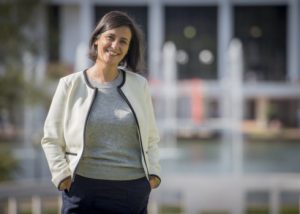
In order to build on this momentum, to continue strengthening our research enterprise, and to become a perennial Carnegie R1 institution, I am pleased to announce the formation of the new Office of Research Development in the Division of Research. Dr. Sez Atamturktur, an engineer and a leader among our faculty, will serve as the director of this office and the Assistant Vice President for Research Development. You can read more about this new office and Sez’s role here.

(Photo by Ken Scar)
(Photo by Ken Scar)

Sez has proven time and again that she knows how to build collaborative networks and bring complex, comprehensive grants to Clemson that establish us as a place of excellence. She will build the resources necessary to make us competitive, and she will mentor faculty to build long-term success over the course of their careers.

During the past year, I have been working with the Faculty Senate to form the VP of Research Advisory Board. This board will provide me direct faculty input to enhance the quality of scholarly endeavors and growth of our research programs. Colleges were asked to determine their nominees and forward their names to me by September 15. I look forward to working with this group in the new academic year.

This is very exciting and promising progress for Clemson research, scholarship and impact, which should make us very proud and encourage us to accomplish much more. Thanks for all you do to support this endeavor.

Go Tigers !

Tanju