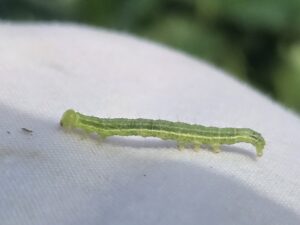
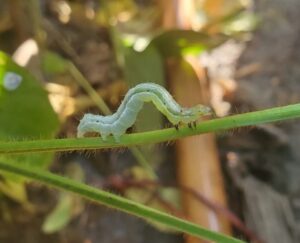
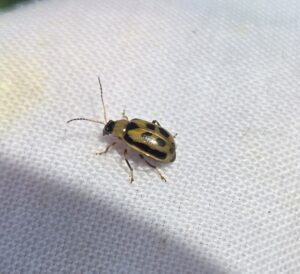
Entomologists at Clemson University have been sampling soybean fields across the state of South Carolina for soybean defoliators, podworms (Helicoverpa zea) and their natural enemies. Common soybean defoliators include the soybean looper, green cloverworm, velvetbean caterpillar, yellow stripped armyworm and the bean leaf beetle (Fig 1). The most predominant natural enemies include big-eyed bugs, assassin bugs, damsel bugs, spined soldier bug, and several lady beetle species. This research has several goals, including quantifying the spatial variability in insect densities and defoliation levels during full bloom and pod-filling stages, associating defoliation levels with defoliator species, and using landscape cropping area around soybean fields and field management information to predict insect densities and defoliations levels. Management of defoliators and podworms is primarily performed by chemical insecticide applications during pod set growth stage (R3). The ultimate goal of this project is to optimize insecticide usage by informing growers of the risk of infestations in their fields.
Fig 1:Green cloverworm, soybean looper and bean leaf beetle (from left to right), common soybean defoliators in SC.
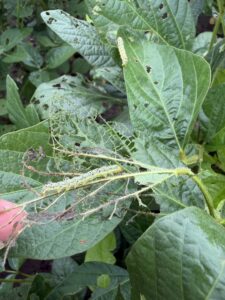
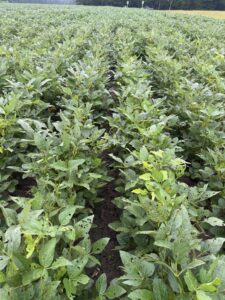
Fig 2 (left): Soybean field defoliated in Marion County. Fig. 3 (right): pod worms present in the same field.
A total of 46 fields were sampled this year. Most fields did not reach the defoliation threshold, but some did for the corn earworm. In most cases, our visual estimates of defoliation levels in a field overestimated actual defoliation levels. This field in Marion County (Fig 2) was estimated to be around 10% defoliation when observing the canopy, and pod worms far exceeded the threshold number of 3 per 10 sweeps (Fig 3). However, when using software to accurately estimate defoliation based on photos of leaves, the field was at 3.4% defoliation only. None of the scouted fields have reached the defoliation threshold level for reproductive stages to date, but more fields remain to be scouted this year.
The Pee Dee Research and Education Center is going to hold a field day on September 3.
The event will begin at 9:30 am and lunch will be served after a field tour.
The tour will cover all the research and extension activities performed in the Pee Dee, especially in row crops. Topics that will be covered include the cover crops, soil microbiology, research focused on sorghum yield, the cotton OVT trials, Insect pest management in corn, crop rotation, breeding butter bean and peas and many other agronomic subjects. Please join the community and meet the experts that work at the Pee Dee Research and Education Center!
The Edisto Research and Education Center at Blackville invites you to learn the most recently findings of research in corn and soybean pathology, entomology, soil and crop science in South Carolina. Come join us in the Corn and soybean field day organized at the Edisto Rec on July 30, from 9:00 am to 12:00 pm, and hear from the experts of Clemson University!
Registration begins at 8:30am.
The event is free and lunch will be provided.
Location: Clemson Edisto Research and Education Center, 64 Research Road, Blackville, SC 29817
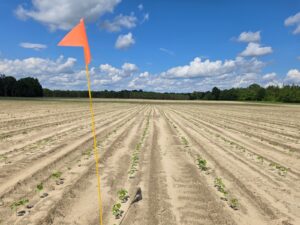
Researchers at Clemson University are investigating the distribution of two-spot cotton leafhopper (a.k.a. ‘cotton jassid’) in cotton fields in South Carolina. This species is native to Southeast Asia and was detected in the U.S. (Florida) during 2024 and in South Carolina during July 2025, reaching high population levels in some cotton fields. Research trials at the Pee Dee and Edisto Research and Education Centers and growers’ fields will be conducted to characterize distributions of the two-spot cotton leafhopper in cotton over the growing season, aiming to optimize IPM strategies for this pest. Although the species has not been reported in the U.S. during 2026, populations of the insect are likely to infest cotton fields later in the season; researchers will then initiate weekly grid sampling in cotton fields to describe within-field patterns of distribution for nymphs and adults (Figure 1). This will help develop a sampling plan for research on thresholds for two-spot cotton leafhopper in the U.S. and ultimately assist cotton growers with control decisions.
Figure 1: Cotton field ready for sampling two-spot cotton leafhopper during the 2026 field season.
Two-spot cotton leafhopper Extension handout
An Extension handout was developed by the Clemson Cotton IPM team to illustrate and summarize current information about the two-spot cotton leafhopper. The handout contains information on the insect’s life cycle and identification, injury to cotton, sampling, and the preliminary threshold based on data collected in 2025. The handout is free and available through THIS LINK. More information on two-spot cotton leafhopper can also be found in the MyIPM for Row Crops app!
The South Carolina Cotton Grower Meeting will be next week, on January 27th.
Among the topics discussed related to cotton production, the two-spot cotton leafhopper will be one of the highlights. This invasive species has worried growers in the southeast since its arrival last season.
The event will take place at the Santee Conference Center, 1737 Bass Drive/US-15, Santee, 29142.
Registration opens at 8:15 a.m., with the program beginning at 9 and concludes at 2pm.
More than 80% of field corn grown in the U.S. has been genetically engineered to express one or more insecticidal toxins from Bacillus thuringiensis, called Bt toxins. Bt corn was first commercialized in the U.S. in 1996, expressing a single Bt toxin to control the European corn borer. Newer Bt corn hybrids express two or more Bt toxins, which has increased the number of target pests to include the corn earworm and the fall armyworm. Benefits of planting Bt corn can include protecting yield from insect damage, reducing the need to use insecticide, and improved grain quality. However, such benefits can be impacted by the development of resistance in target insects.
Funded by a grant from the South Carolina Corn Board, Drs. Francis Reay-Jones (Clemson Pee Dee REC, Florence, SC) and Michael Plumblee (Clemon Edisto REC, Blackville, SC) conducted field trials in 2025 to evaluate the efficacy of Bt traits and the impact Bt toxins have on the survival of corn earworm, with implications on resistance development. Trials were planted in Florence on 14 April and on 25 June, and in Blackville on 17 April. The following Bt products were used, in addition to non-Bt hybrids from the same hybrid families:
Bt product
Bt toxins expressed
Pioneer Optimum Intrasect
Cry1F + Cry1Ab
Pioneer Optimum Leptra
Cry1F + Cry1Ab + Vip3A
Genuity VT Double Pro
Cry1A.105 + Cry2Ab2
Trecepta
Cry1A.105 + Cry2Ab2 + Vip3A
At the whorl stage, corn can sometimes be infested with fall armyworm, as was the case in May 2025 in the trial in Blackville (Figure 1). While an average of 4% of plants were infested in a non-Bt corn hybrid, no larvae were found in any of the Bt hybrids tested. In Florence, fall armyworm infestations were found only in the late planted trial, with a range of 14-28% plants infested in the non-Bt hybrids. Again, no Bt plants were infested, underlining the efficacy of Bt corn in South Carolina with this insect.
Figure1: Corn infested with fall armyworm, Blackville, SC, 8 May 2025
Dr. Reay-Jones has been conducting field efficacy trials with a range of Bt corn traits since 2009. Since then, some traits have become less effective over time because corn earworm has developed resistance. We saw in particular a shift in 2015 when resistance to some of the Cry toxins expressed in Bt corn became more widespread not just in South Carolina, but across the southeastern U.S. In 2025, only hybrids expressing Vip3A provided excellent levels of control. As an example of the data collected in the early planted trial in Florence, Bt traits without Vip3A provided either no suppression or limited suppression of kernel injury (Figure 2).
Figure 2: Corn earworm injury in a corn trial in Florence, SC, 2025. Green bars are non-Bt hybrids. Grey bars are for Optimum Intrasect (P1366YHR), Optimum Leptra (P1366VYHR), VT Double Pro (DKC63-57VT2P and DKC65-95VT2P), and Trecepta (DKC65-99TRE).
Survival of corn earworm was determined by placing corn ears with large larvae in plastic boxes with soil, which were then sifted to collect cocoons or pupae. A total of 282 and 717 pupae were collected in 2025 in early and late planted corn, respectively, in Florence. Pupal weights were generally lower in Bt than in non-Bt corn. No pupa was collected from corn expressing Vip3A. Pupae from Optimium Intrasect had similar weights to non-Bt corn, suggesting limited impacts on the insect. Pupae from VT Double Pro were significantly lighter than on non-Bt corn, suggesting sublethal effects that may play a role in insect resistance management.
Yields did not vary among Bt and non-Bt traits in both early and late trials in Florence. In Blackville, yield of P1366YHR (144.4 bu/ac) was significantly greater than P1366R (122.9 bu/ac), with an intermediate yield for P1366VYHR (130.6 bu/ac). While insect pressure was light in these trials, the value of planting Bt corn for growers in the southeast is due to its ability to suppress damage from a range of potential target pests, which are generally minor pests or are less common than for instance corn earworm. Although corn earworm is generally not a significant economic pest of field corn, the same species is a serious pest in cotton, where it is known as bollworm. Because Bt cotton expresses the same or similar toxins as Bt corn, selection for resistance in Bt corn is likely driving resistance issues to Bt cotton. While Vip3A remains effective, reports of unexpected injury in recent years in the mid-south underline the need for continued resistance monitoring. Vip3A toxins are also expressed in new Bt cotton varieties, and planting of non-Bt refuge in corn is crucial, since only a single Bt toxin is currently available with very good activity for this key pest. Continued monitoring of efficacy of Bt corn in field trials is important to detect potential changes in susceptibility to Bt toxins among key pests, in order to provide timely recommendations to growers in South Carolina.
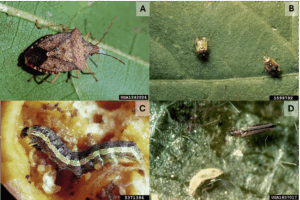
Cotton insect pests caused an estimated $798 million in yield losses plus management costs in the U.S. in 2024. Many insects can cause damage to cotton, including the bollworm, stink bugs, thrips, and tarnished plant bugs (Figure 1).
Figure 1. Cotton pests, the brown stink bug (A, Russ Ottens, University of Georgia, Bugwood.org), tarnish plant bug (B, John C. French Sr., Retired, Universities: Auburn, GA, Clemson and U of MO, Bugwood.org), cotton bollworm (C, Gyorgy Csoka, Hungary Forest Research Institute, Bugwood.org) and thrips (D, Jack T. Reed, Mississippi State University, Bugwood.org).
As cotton pest management changed over the years, so did the importance of these pests. For example, before the introduction of cotton plants expressing Bacillus thuringiensis (Bt), cotton bollworm caused severe yield losses, leading growers to spray insecticides several times over the season to control this pest. Nowadays, with the widespread use of cotton cultivars expressing Bt toxins, yield losses and insecticide sprays to control bollworm significantly decreased.
Entomologists at Clemson University, represented by Dr. Reay Jones, Dr. Greene and the student Igor Schardong, collaborating with cotton entomologists from North Carolina, Virigina, Georgia, Alabama, Florida, and Oklahoma are distributing a survey about cotton pest management targeting growers, consultants and extension agents. The goal of the survey is to document current insect pest status in cotton, its management strategies in the southeastern states and the implementation of IPM in the Southeast US.
If you are a grower, extension personnel and consultant who grow or monitor cotton fields, please help us responding to the survey scanning the following QR code. It is important to mention that the survey is anonymous, it only takes a couple of minutes.
Figure 2. QR code to access the cotton pest management survey.
Clemson University appreciate you taking your time to help on this important matter!
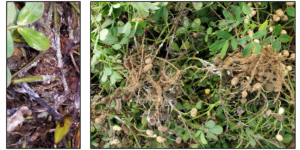
The combination of warmer temperatures and stress from dry conditions for rainfed fields is a reminder that if our fields have some history of stem rot/white mold disease (Figure 1), we can proactively protect them during our earlier fungicide applications. This can be as simple as adding tebuconazole in with the 45-day spray or coming in earlier 30/35 DAP with Elatus/Excalia/Lucento, or we may also consider swapping fungicides during latter applications for increased control. Not all fields need the extra attention, but it is a helpful tool at our disposal where we are looking for additional management. Likewise, earlier applications are less subject to canopy interference of spray penetration/ground deposition. Rain is our friend for many things including fungicide wash in, but its contribution rapidly drops off with increasing time after application. Two days after an application, rain will help some but is at that point more modest than monumental. Rain-in the day of application or a day after improves wash in, but this often comes at the expense of foliar leaf spot coverage/control. A persnickety predicament, or rather, a reminder of fine tuning one way or another. If we are coming due for an application where soil disease control is a priority and we can wait a day to two/three days to take advantage of a coming rain we can consider doing so, keeping in mind the suggestive rather than absolute nature of forecasts. This is more helpful later in the season when canopy size is larger. However, an application without rain is better than no application at all. We cannot wait indefinitely to take advantage of a possible rainfall, and we do well to keep in mind the importance of effective leaf spot management at the same time, as both our soil and foliar diseases are best managed in a preventative rather than reactive manner.
From work across eleven experiments conducted from 2015 to 2023 evaluating the efficacy of several different fungicides for stem rot/white mold control, maximum label rates of benzovindiflupyr plus azoxystrobin (Elatus) and inpyrfluxam (Excalis) were estimated as conferring the greatest returns over the chlorothalonil-only control (Bravo-only).
Control efficacy of maximum labeled rates of flutolanil (Convoy) and prothioconazole plus tebuconazole (Provost Silver) were also effective in managing this disease. While an application of tebuconazole alone for soil disease control was among the most efficient in terms of % stem rot control per fungicide product application cost, that active ingredient also conferred the least total amount of control at its maximum label rate. This makes tebuconazole an important and efficient fungicide to keep in our overall disease management programs, but other fungicides or tank mix combinations are capable of providing greater control where we could benefit from it due to specific fields having a history of increased white mold disease pressure, weather conditions during the year favoring its development, or application windows preceding a timely rain or irrigation allowing us to capitalize on increased efficacy.
Check out the paper about white mold management published in MDPI by Daniel Anco, the extension peanut specialist at Clemson University.
Figure 1: Peanut plants showing symptoms of white mold disease.
The Clemson University Cotton/Soybean Insect Newsletter is in its 20th year of distribution/circulation to stakeholders needing regular and timely information about important arthropod pests of cotton and soybeans in South Carolina and the southeastern USA. The newsletter includes information from contributors (Extension agents, consultants, industry reps, etc.) about the situation in their areas of the state, weekly observations in cotton and soybeans, frequent data from current or past research trials, current numbers of important insects caught in pheromone traps, insect identification aids, and much more.
Anyone can request to receive the newsletter by emailing Jeremy Greene at greene4@clemson.edu to request inclusion. Please include your role (producer, consultant, industry rep, etc.) in South Carolina or elsewhere to ensure you are added in the correct email category.
Clemson Cooperative Extension is hosting two Corn and Soybean field days in July! The events will start at 8:30am and end around 12:00pm.
After presentations, free lunch will be served! The events are free, and topics will include key information on corn and soybean production and management practices. See the flier below.