Integrated Pest Management

Coastal Research and Education Center Vegetable Field Day on June 10, 2026

The Coastal Research and Education Center at Clemson hosted a vegetable field day last week. Pre- and post-harvest, weed, insects and disease management of watermelon and leafy greens, tomato resistant varieties and weed management of green onions, were all topics discussed during the field day.

The postharvest lab led by Dr. Karin Albornoz and her graduate students presented ongoing research on predicting watermelon harvest timing using multispectral cameras mounted on drones. This management tool aims to improve fruit quality for consumers and reduce food waste. Dr. Albornoz also discussed postharvest factors that affect the shelf life and nutritional content of collard greens (Figure 1). Specifically, she shared results from an experiment using the variety ‘Top Bunch 2.0’ to simulate cooling delays of 2, 6, and 8 hours. The 8-hour cooling delay increased leaf yellowing and reduced nutritional content compared with the 2-hour delay. These results indicate that growers should cool and store their produce as soon as possible after harvest to maintain quality for a longer period.

Figure 1. Dr. Albornoz and Zenaba Abdissa (lab technician) during the CREC Vegetable field day in Charleston, 2026.

Anaerobic soil disinfestation driven weed management for watermelons and onions was discussed by Dr. Matthew Cutulle and his graduate students. They showed plots where polymer mulch were flooded with water to become an anaerobic environment sufficient to suppress weed populations. After that, they cultivated watermelon in one experiment and green onion in another experiment with a similar design. The method also helped suppress some diseases, and the untreated plots were heavily infested with competing weeds and anthracnose (Figure 2). Further studies are being carried out to manipulate environment to suppress weed and disease as an alternative to growers who grow organic watermelons and green onions.

Figure 2. Untreated plot where the watermelon plant was competing with weeds and was infested with anthracnose.

Dr. Tom Bilbo underlined the preliminary recommendations to manage two-spot cotton leafhopper in okra and eggplants (Figure 3). The two-spot cotton leafhopper was found in South Carolina last year in July and August, and extension agents are still looking for them this year around the state. This insect feeds primarily on plants that belong to the Malvaceae family, like okra, egg plants and cotton. Feeding symptoms on okra and eggplants include yellowing of the leaves commonly named as “hopperburn” and leaf curling. Dr. Bilbo mentioned that the cultivars can be more susceptible than others. Fors instance, ‘Clemson Spineless” is more susceptible than ‘Jambalaya’. He also pointed out chemical control options available and the importance of using selective insecticides to conserve natural enemies.

Dr. Bilbo’s graduate students Sabina Parajuli and Pragya Kiju presented their research on the use of cover crops and weeds to improve pest management in cucurbit crops and brassica. Growing zucchini on rye residues helped suppressing cucumber beetles during the summer, and on sudex residue helped suppressing aphids, whiteflies and two-spot cotton leafhopper during the fall. For brassica, wild radish supported diamond back moth, but also its natural enemies, which ultimately improves biocontrol in the field. More research is needed on these topics to consolidate these alternative management practices.

Figure 3. Dr. Tom Bilbo sharing information to growers about pest management in cucurbits and brassica during the CREC Vegetable field day.

Dr. Anthony Keinath showed a field trial of fungicides for watermelon (Figure 4). During his talk he focused on management of anthracnose, a foliar disease that was introduced into the area shown in the field day. Dr. Keinath also mentioned practices to improve spraying performance, for example, spraying when vines begin to run and no later than when the first male flowers open. Another practice is to spray every seven to ten days during vine run until mid-May. During this time, diseases can attack if a crop goes without fungicide for more than a week. Dr. Keinath recently published a new watermelon fungicide guide in the Land Grant Press by Clemson Extension containing the most updated recommendations of fungicides and programs needed to manage watermelon foliar diseases. The guide is free for download and can be found here.

Figure 4. Dr. Anthony Keinath speaking during the CREC Field day about watermelon disease management.

Clemson’s Vegetable Entomology Program

Dr. Tom Bilbo, Clemson’s vegetable and strawberry entomologist stationed at the Coastal Research and Education Center in Charleston, began his research and extension program late in 2021. Since starting here at Clemson, Dr. Bilbo has rapidly expanded his program and has started addressing a number of different economically important pest concerns for vegetable and strawberry growers. “The primary goal of my research program is to enhance sustainable food production through protection of yields from crop pests and enhancement of yields through conservation of beneficial insects” Dr. Biblo says. The primary areas of focus for his research are 1) developing new biological control strategies for key pests, 2) reducing pest potential through modification of farming practices and systems, and 3) improving insecticide use and managing insecticide resistance. When it comes to Extension and stakeholder interaction, focus areas include 1) identifying key entomological issues in vegetables and strawberries, 2) encouraging adoption of improved practices through demonstration of efficacy and profitability, and 3) improving stakeholder knowledge of advances in IPM and IRM.

Headshot of a man with brown hair.
Dr. Tom Bilbo, Clemson’s vegetable entomology specialist

“Overall, my research uses our understanding of insect ecology to reduce pest problems and enhance the role of beneficial species, especially predators and parasitoids” Dr. Bilbo says, “much of my research is conducted on commercial farms in coordination with local growers.” The reason for much of the research being conducted with collaborating growers in twofold. 1) Insect ecology entails insects moving around, and insects don’t care about the arbitrary plot borders researchers construct. So small plot experiment station trials make it difficult to tease apart treatment effects as well as not being a realistic representation of how insects behave on vegetable and fruit farms. 2) On-farm trials allow Dr. Bilbo to build relationships with growers to understand the pest problems better and create management strategies that are feasible, economical, and effective.

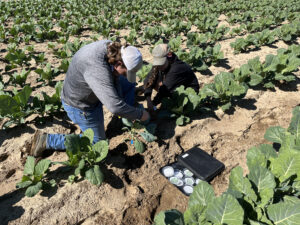
A man and a woman working in a field of leafy greens
Research assistants Wyatt Witman and Caroline Dukes artificially infesting collard plants with diamondback moth larvae to determine parasitism rates at varying distance from flower strips.

Some of Dr. Bilbo’s on-going projects include pest management in brassicas, strawberry, tomato, watermelon, and cucurbits. In brassicas, the primary focus is effective integrated management of the diamondback moth, the major economic pest of most brassica crops worldwide. His work on diamondback moth includes determining how predator and parasitoid activity varies with the use of intercropped flowers (to optimize flower plantings), evaluating mating disruption as a potential management strategy, and determining which plants are best at attracting natural enemies of diamondback moths and other pests in both spring and fall crops. Much of this diamondback moth research is conducted in collaboration with specialists at NC State, Virginia Tech, and Tennessee State University. These types of regional efforts allow for a greater understanding of pest status and management options on a larger spatial scale.

A woman working in a field of leafy greens.
Research assistant Lindsey Newton setting up diamondback moth pheromone dispensers as part of a mating disruption experiment.

In strawberry, his primary research focus is on enhancing the role of beneficial predatory mites to manage spider mites. A survey of commercial farms for the presence of these beneficial mites will provide a baseline level of knowledge on their natural occurrence and role in suppressing pest mites. Other projects include evaluation of tomato and watermelon cultivars for spider mite preference, evaluating pheromone traps for pickleworm moth in cucurbit crops, continued Bt resistance monitoring in corn earworm, and conducting insecticide trials to evaluate new and existing products for important pests. All of this research and subsequent extension work to disseminate the results of these studies will directly benefit vegetable growers in South Carolina by maximizing their pest management and providing a full range of tools to effectively address those pests.

A man and a woman working on insect traps.
Research assistants Wyatt Witman and Caroline Dukes setting up a trapping experiment for pickleworm moth in zucchini