Integrated Pest Management

Ongoing two-spot cotton leafhopper research at Clemson University

Researchers at Clemson University are investigating the distribution of two-spot cotton leafhopper (a.k.a. ‘cotton jassid’) in cotton fields in South Carolina. This species is native to Southeast Asia and was detected in the U.S. (Florida) during 2024 and in South Carolina during July 2025, reaching high population levels in some cotton fields. Research trials at the Pee Dee and Edisto Research and Education Centers and growers’ fields will be conducted to characterize distributions of the two-spot cotton leafhopper in cotton over the growing season, aiming to optimize IPM strategies for this pest. Although the species has not been reported in the U.S. during 2026, populations of the insect are likely to infest cotton fields later in the season; researchers will then initiate weekly grid sampling in cotton fields to describe within-field patterns of distribution for nymphs and adults (Figure 1). This will help develop a sampling plan for research on thresholds for two-spot cotton leafhopper in the U.S. and ultimately assist cotton growers with control decisions.
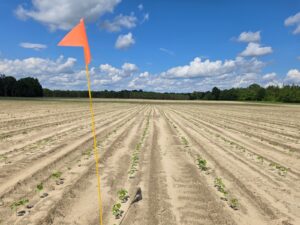
Figure 1: Cotton field ready for sampling two-spot cotton leafhopper during the 2026 field season.

Two-spot cotton leafhopper Extension handout

An Extension handout was developed by the Clemson Cotton IPM team to illustrate and summarize current information about the two-spot cotton leafhopper. The handout contains information on the insect’s life cycle and identification, injury to cotton, sampling, and the preliminary threshold based on data collected in 2025. The handout is free and available through THIS LINK. More information on two-spot cotton leafhopper can also be found in the MyIPM for Row Crops app!

Upcoming South Carolina Cotton Growers Meeting

The South Carolina Cotton Grower Meeting will be next week, on January 27th.

Among the topics discussed related to cotton production, the two-spot cotton leafhopper will be one of the highlights. This invasive species has worried growers in the southeast since its arrival last season.

The event will take place at the Santee Conference Center, 1737 Bass Drive/US-15, Santee, 29142.

Registration opens at 8:15 a.m., with the program beginning at 9 and concludes at 2pm.

For more information, contact Clemson’s extension cotton specialist, Mike Jones (majones@clemson.edu), or see the event announcement.

Cotton pest management survey in the Southeast U.S.

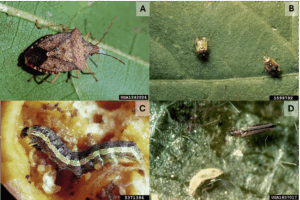
Cotton insect pests caused an estimated $798 million in yield losses plus management costs in the U.S. in 2024. Many insects can cause damage to cotton, including the bollworm, stink bugs, thrips, and tarnished plant bugs (Figure 1).

Figure 1. Cotton pests, the brown stink bug (A, Russ Ottens, University of Georgia, Bugwood.org), tarnish plant bug (B, John C. French Sr., Retired, Universities: Auburn, GA, Clemson and U of MO, Bugwood.org), cotton bollworm (C, Gyorgy Csoka, Hungary Forest Research Institute, Bugwood.org) and thrips (D, Jack T. Reed, Mississippi State University, Bugwood.org).

As cotton pest management changed over the years, so did the importance of these pests. For example, before the introduction of cotton plants expressing Bacillus thuringiensis (Bt), cotton bollworm caused severe yield losses, leading growers to spray insecticides several times over the season to control this pest. Nowadays, with the widespread use of cotton cultivars expressing Bt toxins, yield losses and insecticide sprays to control bollworm significantly decreased.

Entomologists at Clemson University, represented by Dr. Reay Jones, Dr. Greene and the student Igor Schardong, collaborating with cotton entomologists from North Carolina, Virigina, Georgia, Alabama, Florida, and Oklahoma are distributing a survey about cotton pest management targeting growers, consultants and extension agents. The goal of the survey is to document current insect pest status in cotton, its management strategies in the southeastern states and the implementation of IPM in the Southeast US.

If you are a grower, extension personnel and consultant who grow or monitor cotton fields, please help us responding to the survey scanning the following QR code. It is important to mention that the survey is anonymous, it only takes a couple of minutes.

Figure 2. QR code to access the cotton pest management survey.

Clemson University appreciate you taking your time to help on this important matter!

Cotton and soybean insect newsletter

The Clemson University Cotton/Soybean Insect Newsletter is in its 20th year of distribution/circulation to stakeholders needing regular and timely information about important arthropod pests of cotton and soybeans in South Carolina and the southeastern USA.  The newsletter includes information from contributors (Extension agents, consultants, industry reps, etc.) about the situation in their areas of the state, weekly observations in cotton and soybeans, frequent data from current or past research trials, current numbers of important insects caught in pheromone traps, insect identification aids, and much more.

Anyone can request to receive the newsletter by emailing Jeremy Greene at greene4@clemson.edu to request inclusion.  Please include your role (producer, consultant, industry rep, etc.) in South Carolina or elsewhere to ensure you are added in the correct email category.
