The Parks, Recreation and Tourism Management (PRTM) Blog

Intersections Between Tourism and Society

Clemson’s first-ever study abroad trip to Cuba demonstrates the importance of tourism to the country’s economy and culture

Last month, a group of students led by Clemson University Parks, Recreation and Tourism Management (PRTM) faculty member Dr. Lauren Duffy and the Director of Diversity and Inclusion at the Gantt Multicultural Center, Dr. Kendra Stewart-Tillman, took part in Clemson’s first-ever study abroad program in Cuba.
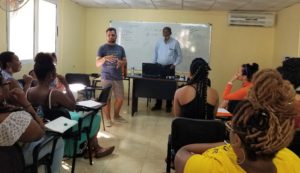
Students learn about Cuba’s economy and Afro-Cuban heritage from a guest speaker at the Center for José Martí Studies in Havana.

The program studied the intersections of tourism and society, from the historic to the modern, and applied a critical lens to how the travel and tourism industry interfaced with social structures and norms that influence daily life for many Cubans, such as race, gender, class, and sexual orientation.

Lauren feels this study abroad program was particularly timely, as it allowed students to see first-hand the impact tourism can have on a society. “In Cuba, tourism is an important industry sector, and the country is largely dependent on revenue from inbound travelers,” she says.

The visit came during a period of instability between Cuba and the U.S., with political issues including increased travel restrictions and a drawback from a once thawing relationship. Lauren says that these challenges, combined with political unrest in allying countries, has resulted in an economic downturn in Cuba, with food shortages in key household items, such as meat, eggs, and flour. “Being in Cuba during these events gave students valuable insight into both the impact tourism can have on a country’s economy, infrastructure, quality of life, and culture, as well as how intertwined Cuba-U.S. relations have been historically,” she says. “It also allowed students to critically challenge popular narratives regarding this relationship.”
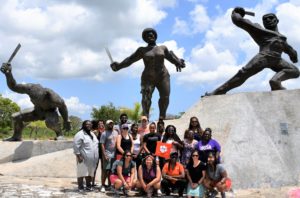
The study abroad cohort in front of the Monument to the Slaves’ Rebellion at the Triunvirato Sugar Mill in the province of Matanzas, where they learned about the nation’s history of slavery and how it continues to shape Cuban heritage and tourism

Before they left for the trip, students studied the history of travel and tourism in Cuba, and socio-political considerations. This ensured students had the background they needed to be able to assess the current state of tourism, while also considering how it has been shaped by a history of colonialism, slavery, racism, and gender ideology.

“Understanding a country’s past and how it impacts its present and future state helps students apply a different lens to their travel experience,” Lauren continues. “When you understand a country’s history and heritage, you are better equipped to understand how key tourism topics such as conservation, preservation, and economic impact cannot be addressed with one-size-fits-all solutions.”

While in Cuba, the students experienced the country’s rich Afro-Cuban heritage, with visits to colonial, pre-Revolution, and post-Revolution interpretative sites. Discussions with guest speakers through the Center for José Martí Studies helped students unpack the complexities of living in a socialist country with an evolving mixed-economy that is largely spurred by growth of private sector enterprises within tourism – a change that has allowed for a classist society to re-emerge within Havana.

The program was developed through a partnership between the Gantt Multicultural Center and PRTM, with scholarship support being provided by the Gantt Center to increase underrepresented student participation in study abroad programs.

“We were able to support several students as the inaugural cohort of Gantt Study Abroad Fellows, which provided funding assistance for underrepresented student populations that do not typically study abroad at high rates,” said Stewart-Tillman. “This was the first time Clemson sponsored a trip to Cuba and we hope this becomes a regular opportunity for our students in the future.”

A Study in Racing Heritage

Graduate student Felipe Tobar assesses Ayrton Senna’s international legacy

When Parks, Recreation and Tourism Management (PRTM) graduate student Felipe Tobar was five years old, Ayrton Senna, a Brazilian Formula One championship winning driver and national hero, died while racing in the San Marino Grand Prix.

Even at that early age, Felipe understood the sense of loss to his country and the racing community. “Brazilian media covered Senna’s death and memorial for several days,” he says. “We were a nation in mourning.”

Photo of a crowd at the Ayrton Senna memorial event on May 1, 2019.
Thousands of people attended the celebration of Ayrton Senna’s life in São Paulo on May 1, 2019.

May 1 marked the 25th anniversary of Senna’s death. The Senna Institute, a foundation led by the driver’s family, organized a celebration of his life and legacy in São Paulo, including 5K and 10K races around the race track where he’d won the Grand Prix, memorabilia displays, and other activities. The event celebrated his life and international legacy.

Although a Brazilian and lifelong Senna fan himself, Felipe says the commemoration ceremonies are of particular interest to him from a research perspective.

“When we consider heritage, particularly when commemorating an international national sport hero, we look at how the past informs, and is reinterpreted by, the present,” says Felipe. “I am eager to know how they are using the legacy of Senna to tell the history of this driver and his importance, and the effects of nostalgia on his legacy over time.”

Felipe is assessing media coverage of the event, both local and international, and how the Senna Institute chose to frame the commemoration activities. He finds it of particular interest, for example, that the commemoration events focused on celebrating his life and legacy, instead of his death.

As the event is also organized by the Senna family for Senna fans, Felipe is paying close attention to how Brazil’s government and racing confederation, and the Fédération Internationale de l’Automobile (FIA) which governs the Formula One, choose to recognize the celebration, if at all.

“Senna is such an important figure in Brazil. He has streets, public schools and a main road named after him in São Paulo alone,” says Felipe. “It is interesting to me that there is no tangible official presence in the lead up to the event. I am also measuring if, and how, that changed over the course of the event and the discourse that followed.”

Felipe Tobar on the Senna curve during his 5K run.
Felipe on the Senna curve during his 5K run around the track inSão Paulo where Senna won a formula one championship.

Felipe also participated in some nostalgia of his own, as he ran in the 5K race around the track where Senna won a formula one championship, and which contains a curve named for the driver. When runners crossed the finish line, they were serenaded by people on the sidelines singing the song that played every time Senna won a race.

Felipe’s Doctoral Program Committee Chair, PRTM Associate Professor Dr. Gregory Ramshaw, is also interested in the official and unofficial conversations surrounding the event. “Most forms of sport-themed heritage are about celebration – for example, celebrating a remarkable sporting achievement or championship. It is somewhat rare for sport heritage to deal with death, disaster, and tragedy. Senna’s untimely death at San Morino was particularly tragic for Brazilians – and not just for fans of motor sport – though, perhaps as the years have passed, the memories of Senna are not about his death, but about his achievements in life and his role as a cultural icon for the country.”

Ramshaw is working with Felipe to compare the memorialization of Senna with that of another Formula One champion, Canadian driver Gilles Villeneuve, who died at the Belgian Grand Prix in 1982.

“In some ways, the memory of Senna lives on, particularly through events like that in São Paulo, as well as through attaching Senna’s name to numerous commercial products – everything from souvenir t-shirts to high-end sports cars,” says Ramshaw. “Villeneuve is not remembered in the same way, even in his home country.”

Ramshaw notes that, like Senna, Villeneuve is still memorialized in different locations, such as in his home province of Quebec, as well as at the Zolder racing circuit in Belgium where he died. However, unlike Senna, Villeneuve appears to be more a part of the sport’s past than its present.

Photo of Senna memorabilia, which was an important part of the celebration.
Senna memorabilia was an important part of the celebration.

“Senna might still be one of the most popular Formula One drivers in the world, and he’s been dead for twenty-five years. That really speaks to his cultural importance and legacy.”

Felipe agrees. “Senna’s legacy is particularly interesting to me, not just because of where I’m from, but because it is a valuable case study in sport heritage and nostalgia, and how it can connect us to a collective identity,” says Felipe. “Our nostalgia for Senna, and the golden age of Brazilian auto racing, is a way for Brazilians, and Senna’s international fans, to use our memories to create connections with people that we don’t even know. Senna is an important part of Brazilian patriotism, our national and cultural identity.”

PRTM Students at the NFL Draft

Last month, 15 students took a five-day trip to Nashville to volunteer as Draft Ambassadors at the NFL Draft – part of an independent study course that includes three volunteer experiences at major sport events. A Draft Ambassador’s role is to welcome and help guests by answering questions and guiding them through various positions throughout the park, including the:

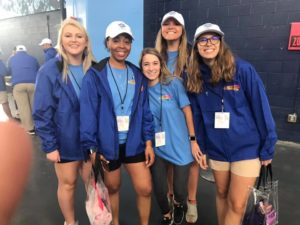
Photo of PRTM student NFL draft ambassadors
PRTM students prepare for their Draft Ambassador duties during the NFL Draft in Nashville, Tennessee in April.
  • Main stage
  • AFC & NFC locker rooms
  • Autograph stage
  • Vince Lombardi Trophy
  • Other parts of the NFL Draft Experience

The event had a marked impact on several of the students. One of the students remarked on their course evaluation, “Just being around some of the most dedicated NFL fans, to seeing the athletes and their families faces and smiles when their names were called, to the workers, all the way to the runners in the marathon made me realize why athletics is the spot for me.”

The trip also included a tour of Nissan Stadium (home of the Tennessee Titans) and meetings with stadium staff and Clemson alumni. The students also visited other Nashville sport facilities to meet with:

  • The Vice-President of Marking and Communication for the Nashville Soccer Club, a Major League Soccer expansion team.
  • Vanderbilt Athletic Department staff, including the ticket office, compliance, athlete development, and marketing and promotions.

After the draft, the students volunteered at the Music City Marathon, where they provided finish line support. This event draws 30,000 runners every year, and illustrates a different type of sport management than working for a professional team.

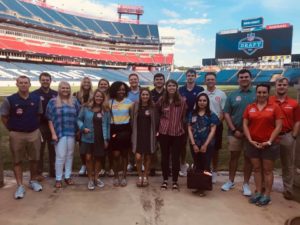
Photo of PRTM students at Nissan Stadium
PRTM students on their behind-the-scenes tour of Nissan Stadium.

Before their Nashville trip, the class participated in the USA Triathlon Duathlon National Championships in Greenville, where they learned about the role of the national governing bodies in Olympic sports, national event planning, the Paralympic movement and working with international federations. Four guest speakers from USA Triathlon – their Chief Operating Officer, National Events Manager, Paralympic Program Manager and Team USA & Research Manager – met with the students in small groups to discuss their specific roles.

Class experiences are designed to highlight different considerations involved in sport management, and give students behind the scenes experience into the complexity of managing major sport events.

The experiences gave students valuable insight into sports management jobs. “The professionals who we met with were being pulled in many different directions, and their jobs were far more multi-dimensional than a typical desk job,” said another student. “They were assigned various duties, and some of those tasks did not even deal with sports. The sport business appears to be more difficult than I ever imagined, so I must be sure that it is what I want to do.”

Above all, the class is intended to help students build connections in the sports management professional community and see where they might be able to fit into the industry. As one student says, “Overall, I believe my greatest takeaway from Nashville is my new sense of professionalism…Money can come and go but connections are priceless!”

Why We Hike

Research on First Day Hike Participants Examines Hiker Motivations

Kristen Grissom enjoys the peacefulness that comes with long walks in remote places. An avid hiker, she can often be found on the trails several days a week after work and on weekends.

“I enjoy the freedom of it and the feeling of satisfaction after spending a day in the woods and conquering a difficult trail,” Kristen says. “My family does not enjoy hiking though, so I go on my own or with friends, if possible.”

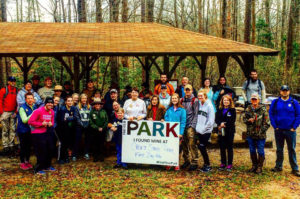
Photo of first day hikers at Croft State Park in South Carolina.
First day hikers at Croft State Park in South Carolina.

Kristen is among 45 million Americans aged six and older that went hiking last year, with per capita participation increasing steadily over the past decade. Day hiking is consistently ranked as one of the most popular recreation activities in the United States for adults and children, making it an important marketing and management consideration for local, state, and national parks. However, although we know people enjoy the act of hiking, we know less about why they choose to hike, particularly among different sociodemographic groups.

Researchers from North Carolina State University and Clemson University recently conducted a research project to find out who hikes, why, and how those motivations might vary among different groups of people. Results were recently published in the Journal of Park and Recreation Administration.

“Most of the research we have seen to date has focused on the environmental impacts of hikers and visitor use management along trails,” says Sarah Wilcer, interpretive park ranger at Grand Teton National Park, who led this research project while earning her master’s degree at Clemson University. “Few studies have focused specifically on the motivations of hikers – what gets them out, how they decide where to go, and who they prefer to hike with, even though these are important resource management and marketing considerations for park leaders.”

The study focused on First Day Hikes on January 1, 2016, in three state park systems that were among the top 10 in terms of the total number of first day hikers in 2016: Georgia, Massachusetts, and South Carolina. Before they started their hike, adult park visitors were asked to complete a questionnaire that asked if it was their first hike or first experience at a park site, the size of their group and who they were with, and why they chose that specific hike. Respondents were also asked to provide their zip code to gauge the distance travelled to the park.

In all, the study sampled a total of 114 first day hikes, with group sizes ranging from 2 people to more than 300 participants on the most crowded hikes, and about two-thirds of the hikes taken were classified as “easy” by hike leaders. About 60% of respondents were participants on their first-ever First Day Hike, though almost all of them had already been on other hiking experiences. The majority of respondents also identified as Caucasian and were highly educated.

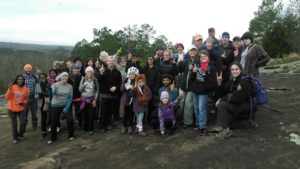
Photo of first day hikers at F.D. Roosevelt State Park in Georgia.
First day hikers at F.D. Roosevelt State Park in Georgia.

Overall findings demonstrated that different groups of people do, in fact, hike for different reasons. First time hikers, for example, were more likely to hike to try something new, while older participants were more likely to hike for exercise. Groups with children wanted to spend time together. The most popular reason, however, was to enjoy time in nature.

Other motivations included the uniqueness of the day and hike location. For example, female hikers were more likely than male hikers to be motivated to hike by the First Day Hike event, and close hikes were also preferred destinations for those coming to celebrate the New Year. Hikers choosing moderate or strenuous hikes further from home, however, were more likely to be motivated by trying something new.

“Our results show that different groups of hikers are seeking different types of recreation experiences, which provides valuable insight to park managers creating trails or marketing opportunities,” says Lincoln Larson, Assistant Professor at North Carolina State University. “If managers know who is using their trails and how far they are traveling to reach them, they can influence use patterns or create new trails with hikers’ needs in mind.”

The group is considering future research to build on the study results. “The study’s findings demonstrate that park managers can market and manage day hikes as a way to improve health, strengthen social bonds, connect with nature, and learn and experience new things in novel settings, but there’s much more we can learn about underrepresented groups,” said Jeff Hallo, Professor and Graduate Program Coordinator for Clemson University’s Parks, Recreation and Tourism Management department. “This research serves as a base we can build on to explore and contrast motivations of other groups, including those who may not have been on a hike yet, but would consider it.” Faculty at Clemson University are currently seeking graduate students – both in their online and on-campus M.S. and Ph.D. programs – to study and explore these topics and other current issues in park management.

A New Clemson Ph.D. Leads the Way

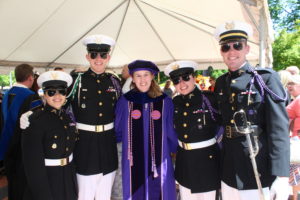
Haley Griffiths Earns First-Ever Recreational Therapy Ph.D. through Clemson University’s Parks, Recreation and Tourism Management department

Haley Griffiths, the first student to earn a Ph.D. through Clemson University’s new online recreational therapy cognate area doctoral program, doesn’t appear to be able to slow down. She only recently found the time to really look back on her studies during a long overdue family holiday just after she defended her dissertation.

Picture of Haley Griffiths, Ph.D., posing with the Clemson tiger and her mother.
Posing with the Clemson tiger after the hooding ceremony.

Like many students in online graduate programs, Haley worked full-time while she studied. She spent her days working with psychologists, social workers, counsellors and inmates as the only recreational therapist at a nearby prison, and spent many of her evenings, weekends and summers in the air, keeping up with her required flying hours with the National Guard. All National Guard pilots are required to get in 48 hours of flight time every six months, whether or not they’re on active duty.

Haley decided to pursue her Ph.D. after working as an adjunct professor for the University of Tennessee, and realizing she wanted more. “Although I was already teaching with my master’s degree, I wanted to work in academia full-time,” Haley says. “To do that, I needed a Ph.D.”

The online format worked well for Haley, who says that keeping to a schedule, working on assignments early and taking advantage of the support of her fellow students was key. “I didn’t want to miss a deadline because I was called in [by the Guard],” Haley explains. “Planning and organization helped me be able to look ahead, so if I was helping to fight fires, I didn’t fall too far behind.”

Marieke Van Puymbroeck, Ph.D. and program coordinator for the recreational therapy program, says Haley was well equipped to take on so many different responsibilities at once. “The best way to describe Haley is steadfast. She has nerves of steel,” Van Puymbroeck says. “Working as a recreational therapist in a prison, and flying for a medical evaluation unit, require grit and resilience. She has those qualities in abundance.”

Resilience is also a central focus of Haley’s research, which explored how summer camps targeting military youth and families influence their resilience and development. Camp experiences targeting youth in military families have long been seen as promising interventions for building healthier families and resilience in their youth participants, but rigorous research into these experiences was limited.

Haley sought to fill this research gap. She found that bringing youth in military families together into a camp environment was beneficial, though their resilience remained unchanged – findings she wants to explore in greater detail.

“Although their resilience remained constant, we also found that bringing together campers with shared experiences helped them experience a sense of belonging – or relatedness – that may not have been possible back home, where they are likely the only kids in their school with deployed parents,” says Haley. “I would like to understand and unpack more about resilience, and what it means, especially to this group of people.”

Picture of Haley Griffiths with members of Clemson's Pershing Rifles Company C-4.
Photo courtesy of Clemson University’s Pershing Rifles Company C-4.

Haley’s resilience is about to be put to the test, as she heads to Kosovo this summer to fly a Blackhawk helicopter for a medical evacuation unit. When she’s completed her deployment, she plans to look for a faculty position in the recreational therapy field, while continuing to serve.

“Serving in the National Guard, and being able to serve my community, is something I really love,” says Haley. “It’s challenging and exciting, but also really rewarding.”

Collaboration with Zambian partners benefits academic research, student learning

Last week, a delegation from Zambia’s Copperbelt University and its Governing Council visited Clemson University to broaden the scope of their existing relationship and explore new opportunities to work together in the future.

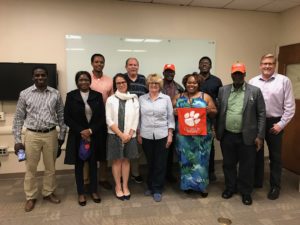
Picture of members of Clemson's Parks, Recreation and Tourism Management Department with the Zambian delegation on May 2.
Members of Clemson’s Parks, Recreation and Tourism Management Department met with the Zambian delegation on May 2.

The visit reciprocated a trip to Zambia last February from Parks, Recreation and Tourism Management Department (PRTM) Chair Wayne Freimund and PRTM faculty members for similar discussions.

“Our university management made a decision that this is the right time to visit, so we can show our colleagues that we appreciate the relationship, and would like to find ways to entrench and strengthen it through new areas of collaboration,” says Dr. Jacob Mwitwa, who spearheaded the trip.

The delegates met with several different parts of the university during their two-day stay, learning more about Clemson University’s land grant mission, its existing research in Africa and academic and research work of interest to the delegation, including agricultural and natural resource programs and the university’s greenhouses, packaging and agricultural science laboratory facilities, the Clemson Experimental Forest and the School of Architecture.

Picture of the Zambian delegation at the School of Architecture.
The Delegation visits Clemson University’s School of Architecture.

“Although we already have a successful partnership with these universities, and have already done a substantial amount of work and research together, our focus has largely been on parks, recreation and tourism,” says Freimund. “The delegation’s visit creates an invaluable opportunity to expand what has been a successful and enriching partnership for everyone involved to other parts of the university, creating a more fulsome array of potential projects in the future.”

Mwitwa says that international partnerships between academic institutions are increasingly important, as many major issues require a global lens. “If someone is teaching about international development, conservation, tourism or climate change, a primary focus of your work is going to be with other countries,” he says. “Although it’s important to understand science from a local perspective, having a global perspective enriches the conversation. After all, science doesn’t have political boundaries.”

New wheelchair tennis team creates opportunity for Clemson University students

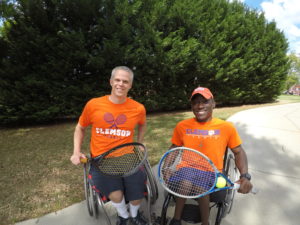
Pic of Clemson's first-ever intercollegiate tennis team - Jeff Townsend and Marsden Miller.
Clemson’s first-ever intercollegiate wheelchair tennis team members Jeff Townsend and Marsden Miller.

This week marks an important first for adaptive sports in Clemson. The university is launching a new competitive wheelchair tennis team, who are competing at their first-ever national event on Thursday.

The team consists of Parks, Recreation and Tourism Management faculty member Jeff Townsend and Clemson LIFE student Marsden Miller, who are representing Clemson for the first time in the 2019 Collegiate Wheelchair Tennis National Championships in Orlando, Florida.

Over the past few weeks, Townsend and Miller have been training daily with Chuck McCuen, Clemson’s Director of Tennis Operations – often meeting early in the morning to practice.

Miller says the hard work is worth it, because their involvement is creating opportunities for other wheelchair athletes at Clemson, and throughout its surrounding communities, that weren’t always available to him as a kid.

Miller grew up with a love of sport. But because he uses a wheelchair, as a child he had to travel to find sport and recreation opportunities he could take part in.

“I had the opportunity of playing wheelchair basketball, but it was four hours away from my home,” Miller says. So he registered in local sports teams, in hopes they would give him a shot on the field.

“I was a part of a baseball team, even though I couldn’t play,” continued Miller. “I dressed out like my team and mainly hung out in the dugout, praying they would put me in one day.”

According to Dr. Jasmine Townsend, an Assistant Professor in Recreational Therapy, Miller’s experience is typical of most children with disabilities growing up in smaller communities.

“Although larger cities tend to offer more inclusive sport and outdoor recreation program options, the smaller the town you’re in, the less recreational opportunities tend to be available,” she says. “There are even fewer opportunities for athletes with disabilities to compete at a higher level. Clemson University’s new wheelchair tennis team is an important step towards growing competitive opportunities for children and young adults with disabilities who want to play.”

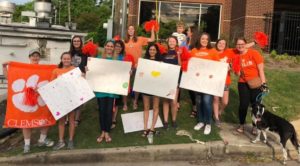
Photo of Clemson University Recreational Therapy Student Club members.
PRTM staff and students cheered the team on as they left for the competition this morning.

Miller may not be playing baseball, but he is active in campus sports – working as part of the university’s Athletics department, and playing on an intramural wheelchair basketball team. Increasing athletic and recreational opportunities for students with disabilities on campus is important to Miller, which is why he signed up for wheelchair tennis as well. As he sees it, increasing adaptive sport opportunities on campus goes a long way towards making Clemson an outstanding place to live, learn, and work for everyone.

“There may be other students in wheelchairs that want to attend Clemson, but also want to play sports,” says Miller. “Clemson is already a great school to attend, but this program helps us make sure no one feels left out.”

McCuen agrees. He also sees the team as an opportunity to send a clear message about Clemson’s continued efforts to grow as an inclusive, accommodating, and integrated institution. “Any opportunity for Clemson to participate on a national stage is an opportunity to share Clemson University’s values and commitment to excellence,” he says. “This team is no different, and we are looking forward to competing and representing Clemson in this new arena! We hope that by increasing the adaptive sports opportunities at Clemson, we are increasing the ways that diverse students can engage, interact, and enrich Clemson and our community.”

You can follow the team’s progress on the Clemson Adaptive Sports Facebook page!

Welcome to PRTM!

Clemson University’s Parks, Recreation and Tourism Management (PRTM) department provides:

  • High-impact, faculty-led educational experiences
  • Cutting-edge foundational and applied research
  • Innovative solutions in a rapidly changing environment
  • Outreach activities that prepare our students to serve the citizens of South Carolina and our national and global constituents

Our academic areas of focus include:

  • Community Recreation, Sport and Camp Management
  • Leisure Skills
  • Nonprofit Leadership
  • PGA Golf Management
  • Park and Conservation Area Management
  • Public Administration
  • Recreational Therapy
  • Travel and Tourism
  • Youth Development

We’ve started this blog to share some of our stories – about our research, events, achievements and other updates.

You’ll find information about our academic programs, our people, and our centers and institutes, including the:

Watch this space to learn more about one of the most innovative, comprehensive, and successful Parks, Recreation and Tourism Management programs in the nation. You can also visit the PRTM website for details.