The Parks, Recreation and Tourism Management (PRTM) Blog

EDGE Field Trip Helps Students See Parks, Recreation and Tourism Agencies in Action

What do Disneyworld, the US Tennis Association’s National Campus and Camp Boggy Creek have in common?

They are all sites visited by Parks, Recreation and Tourism Management (PRTM) students as part of a multi-day field trip in June that gave students an opportunity to speak directly with professionals in the field about the challenges and successes involved with operating different types of industry organizations.
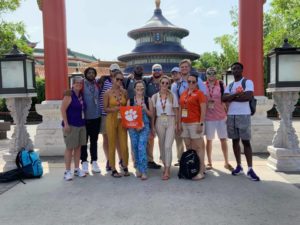
PRTM EDGE program faculty and students at Epcot Center in Florida last month.
PRTM EDGE program faculty and students at Epcot theme park in Florida last month.

The trip is part of the department’s Engaging in Diverse, Guided Experiences (EDGE) program, an innovative, immersive experience for sophomores that takes a collaborative approach to delivering core parks, recreation and tourism management content.

Unlike a traditional semester with several classes, the EDGE program incorporates the content of those classes into one learning experience. Learning is reinforced through lectures, small group work, individual assignments, readings, field trips, research and collaborations on real-world issues.

Field trips are designed to get students out of the classroom to see parks, recreation and tourism agencies in action, says Dr. Teresa Tucker, PRTM EDGE Program Coordinator and Senior Lecturer.

“Seeing concepts they’ve learned in the classroom being applied in the field, and in different settings, gives our students a better understanding of the qualifications and skills they’re going to need to succeed after they graduate,” she added.
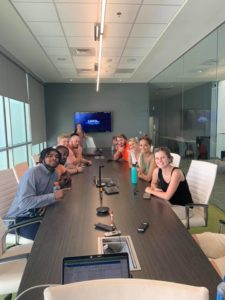
PRTM EDGE program students before meeting with executives of the US National Tennis Association.
Students met with executives of the US National Tennis Association and were given a tour of the facility.

The trip was planned to focus on topics that affect all parks, recreation and tourism management agencies, such as facility operations, administration, finance, marketing, programming and risk management. Students traveled to Orlando and Eustis, Florida to learn about leadership strategies from the Disney business model, tour the US Tennis Association’s national campus, and talk to Camp Boggy Creek Director David Mann about managing a camp for children and families with serious illnesses.

Tucker says that students left with a well-rounded understanding of the different challenges these organizations face and how they address them, and that the trip also helped to create lasting relationships between students and program faculty.

“This trip helps reinforce core concepts in our field, which is important,” says Tucker. “But it’s also rewarding to see these trips help our students create lasting bonds with their fellow students and faculty – relationships that can help them succeed with their degree, and that they can continue to rely on as they build their careers after graduation.”

Read more about the EDGE program:

Clemson Students Travel to Sweden to Explore Best Practices in Sustainability

A group of Clemson undergraduate students are spending five weeks in Kalmar, Sweden, this summer to learn about what makes the area one of the most sustainable regions in the world.

From July 10 to August 13, the students will live and study at the Linnaeus University Summer Academy in Kalmar, where they will explore topics such as sustainable shipping, farming, water treatment, water, energy, transportation, infrastructure, local foods, environmental impacts, business and economics, policy and ecology.

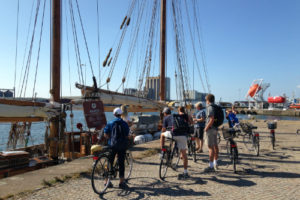
Clemson students riding bicycles in Sweden
Students bicycling by the Swedish coast during last year’s study abroad program.

The study abroad program is organized by Lori Dickes, Chair of Clemson University’s Master of Public Administration program and Jeffery Allen, director of the South Carolina Water Resources Center.

The program responds to a new global environment, with governments, businesses and other organizations across the globe considering how they can be more sustainable. Sustainability impacts a wide variety of management issues, such as overdevelopment, environmental issues, municipal services – such as water, trash, transportation and power – public health and high-quality nutrition, access to green space and concerns of over tourism.

“The concept of sustainability is increasingly vital for students to understand regardless of their study focus,” says Dickes. “Students participating in this study abroad program will have a unique opportunity to experience a city that is at the top of the sustainability game, and to consider how they can apply these lessons to their studies and their communities in the United States.”

Sweden consistently tops the RobecoSAM Country Sustainability Ranking, a semiannual survey that ranks 65 countries based on several environmental, social and governance indicators. The country’s green technology industry produces revenues of approximately  $3.5 billion annually and employs more than 40,000 people.

The study abroad program includes field work, class field trips, case study sites throughout the region, and research and group projects with students from other universities. The program uses an integrated systems and interdisciplinary approach to teach students how to learn about and consider research, behavior and social norms around sustainability.

Students are placed in teams to complete group projects, and will also expected to write blog posts and share presentations about what they’ve learned on a wide variety of sustainability topics. When they’re not in the classroom, they’ll also be given the option of experiencing Swedish culture in a different way, by participating in cultural and extracurricular activities, attending lectures by internationally-renowned speakers and experiencing other popular recreational activities in the area, such as biking, hiking, kayaking, canoeing and swimming.

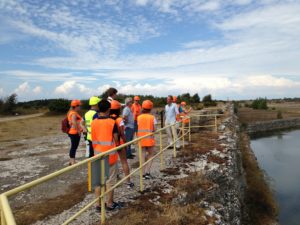
Students learning about water management.
Students learn about several different sustainability topics throughout their month in Sweden.

Students will also study and assess best practices from local, regional, national and international perspectives, with an emphasis on the transfer of knowledge across regions. Dickes says that this is particularly important, as it helps students understand how the scale of a sustainability initiative can impact its planning, implementation and ongoing management to reflect specific regional, social and cultural needs.

“Sustainability is often complex and culturally-influenced, so there is no single, one-size-fits-all approach to solutions,” says Dickes. “Being able to see what is working in Sweden and what challenges they’ve faced, while also being immersed in that culture, can help students understand why certain initiatives were framed or developed in a certain way for that specific population.”

The ability to consider the cultural context for a sustainability initiative, including an understanding of what motivates people to change patterns of behavior, can help students better adapt and apply best practices to challenges faced in the United States and throughout North America. The program also enrolls students from universities around the world, helping its participants see sustainability initiatives through the lens of other cultures, and to discuss sustainability experiences through a global perspective.

Dickes feels that having students from different areas of study – and different countries – take part in the program reflects the need for every sector with a stake in the issue to come together to find multi-faceted solutions.

“Because sustainability is a broad topic with many dimensions, it requires an interdisciplinary lens and understanding of the breadth of topics that fall under this broad umbrella,” she says. “We need many different types of academic and professional backgrounds to work together if we’re going to solve the complex environmental, social, organizational and policy problems of the world.”

PRTM Students at the NFL Draft

Last month, 15 students took a five-day trip to Nashville to volunteer as Draft Ambassadors at the NFL Draft – part of an independent study course that includes three volunteer experiences at major sport events. A Draft Ambassador’s role is to welcome and help guests by answering questions and guiding them through various positions throughout the park, including the:

Photo of PRTM student NFL draft ambassadors
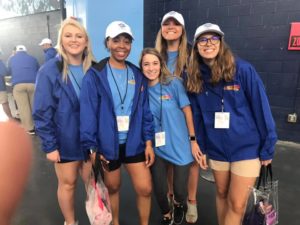
PRTM students prepare for their Draft Ambassador duties during the NFL Draft in Nashville, Tennessee in April.
  • Main stage
  • AFC & NFC locker rooms
  • Autograph stage
  • Vince Lombardi Trophy
  • Other parts of the NFL Draft Experience

The event had a marked impact on several of the students. One of the students remarked on their course evaluation, “Just being around some of the most dedicated NFL fans, to seeing the athletes and their families faces and smiles when their names were called, to the workers, all the way to the runners in the marathon made me realize why athletics is the spot for me.”

The trip also included a tour of Nissan Stadium (home of the Tennessee Titans) and meetings with stadium staff and Clemson alumni. The students also visited other Nashville sport facilities to meet with:

  • The Vice-President of Marking and Communication for the Nashville Soccer Club, a Major League Soccer expansion team.
  • Vanderbilt Athletic Department staff, including the ticket office, compliance, athlete development, and marketing and promotions.

After the draft, the students volunteered at the Music City Marathon, where they provided finish line support. This event draws 30,000 runners every year, and illustrates a different type of sport management than working for a professional team.

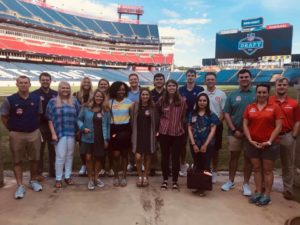
Photo of PRTM students at Nissan Stadium
PRTM students on their behind-the-scenes tour of Nissan Stadium.

Before their Nashville trip, the class participated in the USA Triathlon Duathlon National Championships in Greenville, where they learned about the role of the national governing bodies in Olympic sports, national event planning, the Paralympic movement and working with international federations. Four guest speakers from USA Triathlon – their Chief Operating Officer, National Events Manager, Paralympic Program Manager and Team USA & Research Manager – met with the students in small groups to discuss their specific roles.

Class experiences are designed to highlight different considerations involved in sport management, and give students behind the scenes experience into the complexity of managing major sport events.

The experiences gave students valuable insight into sports management jobs. “The professionals who we met with were being pulled in many different directions, and their jobs were far more multi-dimensional than a typical desk job,” said another student. “They were assigned various duties, and some of those tasks did not even deal with sports. The sport business appears to be more difficult than I ever imagined, so I must be sure that it is what I want to do.”

Above all, the class is intended to help students build connections in the sports management professional community and see where they might be able to fit into the industry. As one student says, “Overall, I believe my greatest takeaway from Nashville is my new sense of professionalism…Money can come and go but connections are priceless!”