By Nathan Inman

Clemson Formula SAE has been engineering its 2026 race car, Tiger 26, over the last several months, and the finishing touches are nearing completion. Tiger 26 will make its debut when the team hits the track at Michigan International Speedway on May 13.
Launched in 1998, Clemson FSAE is a student-run race team partnered with the College of Engineering, Computing and Applied Sciences. The organization provides students with real-life experience that cannot be replicated in the classroom, with opportunities in areas such as aerodynamics, business, chassis, electrical, powertrain and suspension. The event in May is part of the international FSAE series, which is hosted by the Society of Automotive Engineers (SAE). The series serves as a way for students to see their hard work come to life and compete with other students from around the globe.
With the annual event hosting thousands of students interested in engineering and motorsports, representatives from those industries attend the event to network with students and see what they are capable of firsthand. Peter Gaspich, suspension lead for Clemson FSAE, says that members of the organization have been able to gather connections at these events that later boosted them into roles with professional racing teams.
“One of our alumni is a performance engineer at [General Motors’] IndyCar program,” Kelly said. “We had a simulation performance engineer at Red Bull F1, and another simulation performance engineer at Alpine F1.”

With the opportunity to meet with industry professionals at these events, the work back at the shop in Clemson becomes even more important. When the team hits the track in Michigan, they will be facing a large variety of tests, such as skid pad, acceleration, autocross and endurance. During the several months spent engineering and building the car, the team must find the happy medium of all four of those areas to ensure their ability to be competitive throughout the entire event.
Gaspich explained that in the skid pad test, the car must complete two figure 8s of constant radius, which evaluates the “steady-state cornering ability,” which is essentially testing how much grip the car is able to make in a low-speed corner. It also evaluates the team’s ability to set up the car and make the best use of the tires. The acceleration competition is more self-explanatory. The acceleration test is practically a short drag race to evaluate how the car can accelerate from being stopped. Gaspich added that on a good day, their car goes from 0 to 60 miles per hour in about 3.5 seconds and has even gotten down to around 3.3 seconds at times.
From there, the event transitions into the autocross competition. In this event, a half-mile course is set up, and the team gets two chances with two different drivers to complete one lap and set the fastest time.
“Autocross courses, especially at Michigan, are insanely difficult,” Gaspich said. “There are even some teams out there that’ll even have a professional driver, because as long as they are a student currently enrolled at your university, they are allowed to drive the car.”
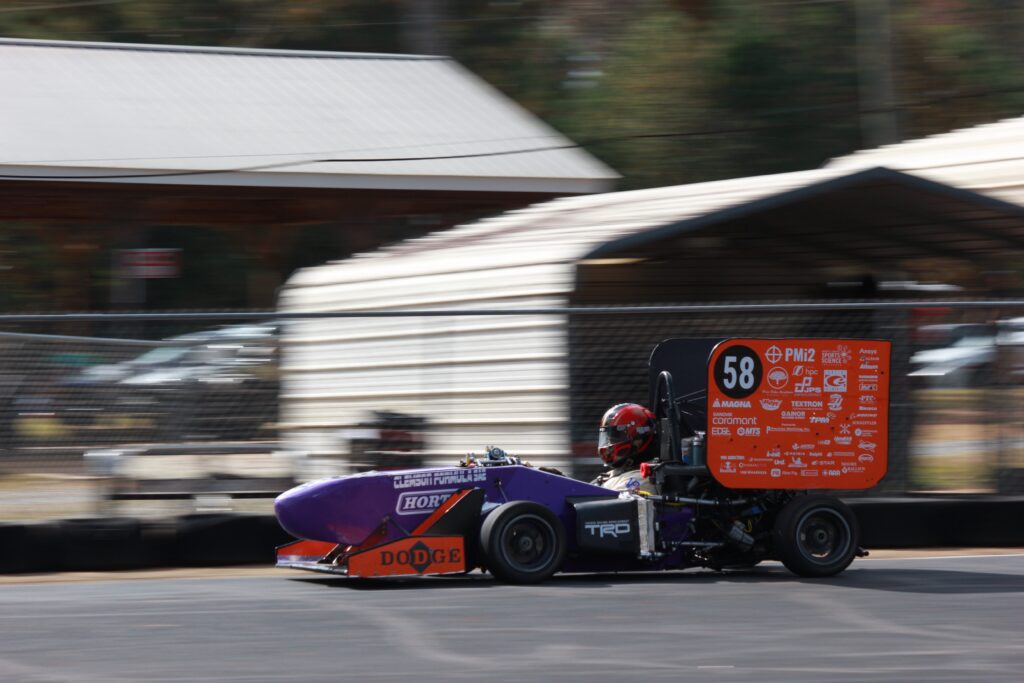
Once the autocross event is complete, the competition transitions into the final event: endurance. The endurance event is the largest test of how well the car was built and engineered. The event is 30 straight minutes of racing, and while that doesn’t sound like much, Gaspich emphasized that at the end of the day, these cars are still completely student-built and aren’t professional-grade.
The event has been a tough one for Clemson SAE in recent years, as the team has not finished the full 30 minutes since 2022. Even then, though, the car overheated and severely reduced the top speed. The team came close to finally getting the monkey off its back in last year’s event, but fate had other plans.
“We had a pretty heartbreaking finish to endurance last year,” Gaspich said. “We were doing really good in all of our events, looking to finish at least top 20. We came in after our first stint of endurance to do the driver change, and suddenly we hear over the radio, ‘guys, we’re disqualified.’”
As it turns out, the car had been leaking just a few drops of oil, and the rules for the event specify that the cars cannot leak any fluid whatsoever. As a result, the team was told their day was done, and the chance to finally finish the endurance event had been snatched away from them once again.
As Clemson FSAE completes its Tiger 26 build, the team is optimistic about their chances to run well in and complete all the events in May. When that time comes, they are ready for the challenges and look forward to getting back on track. Students interested in joining Clemson FSAE can find them on TigerQuest or visit https://www.clemsonfsae.com/join-the-team.
