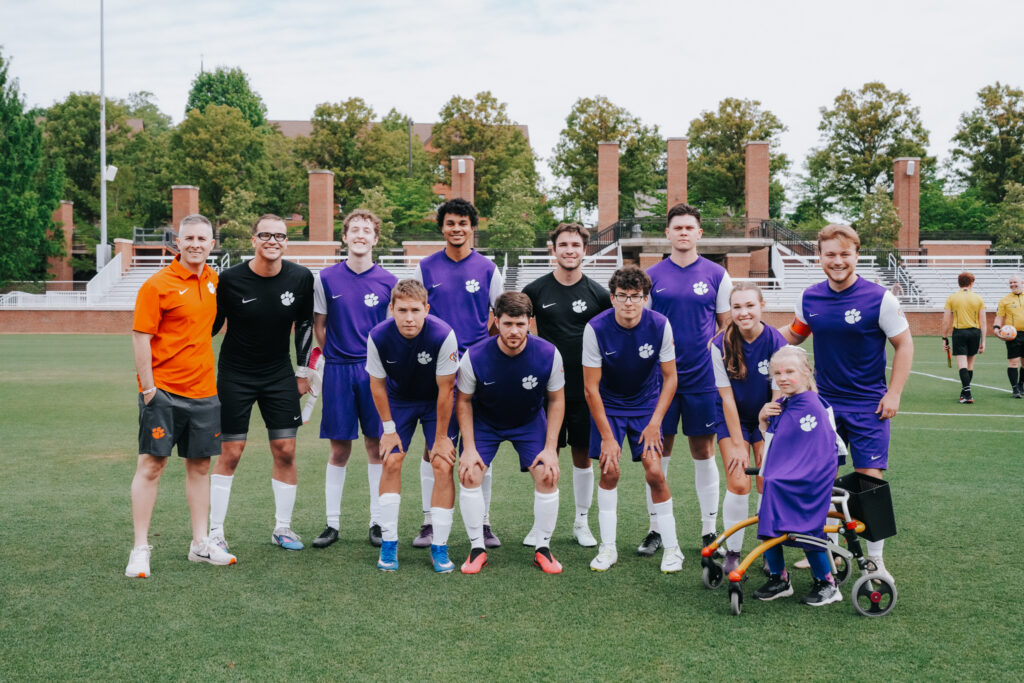
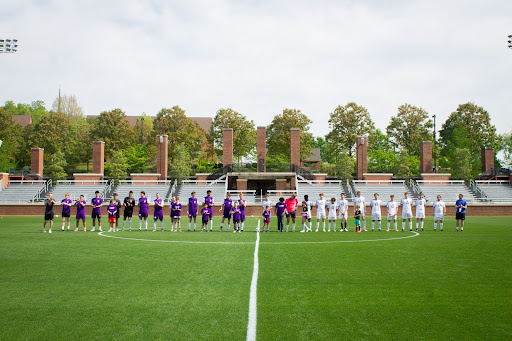
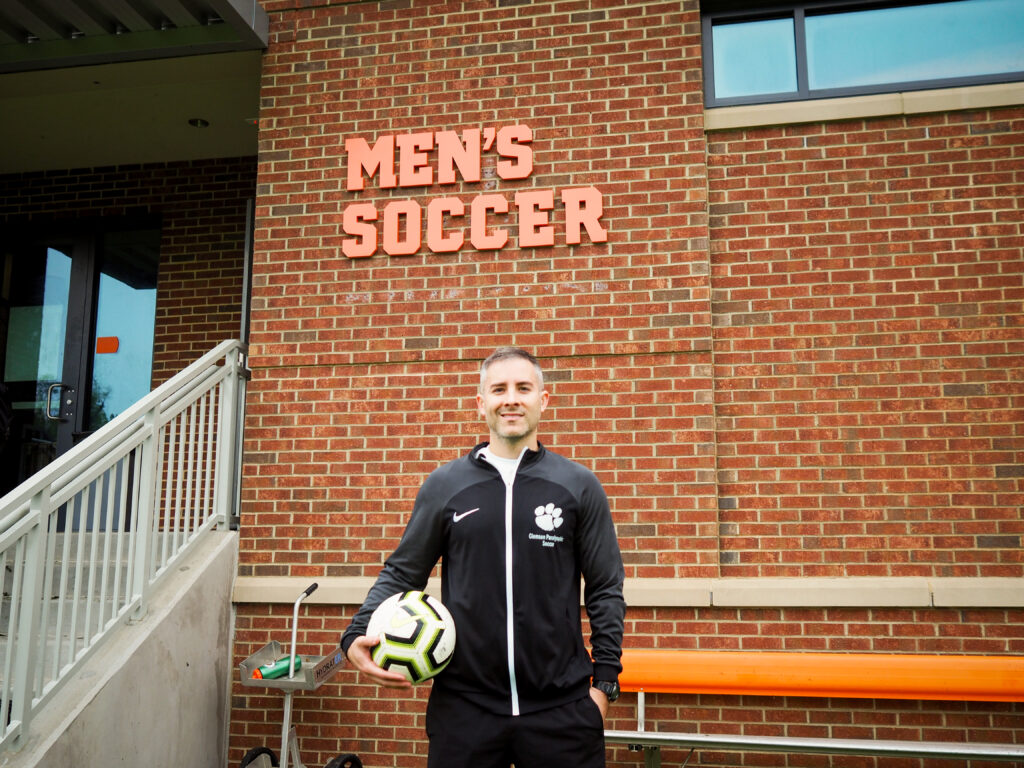
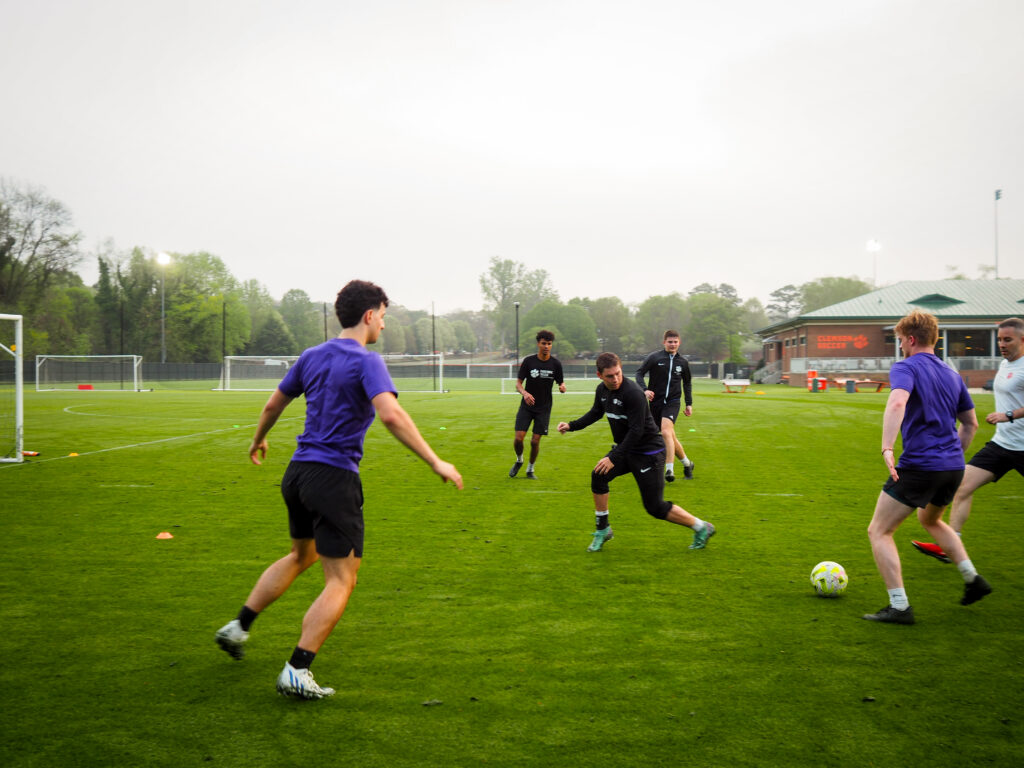
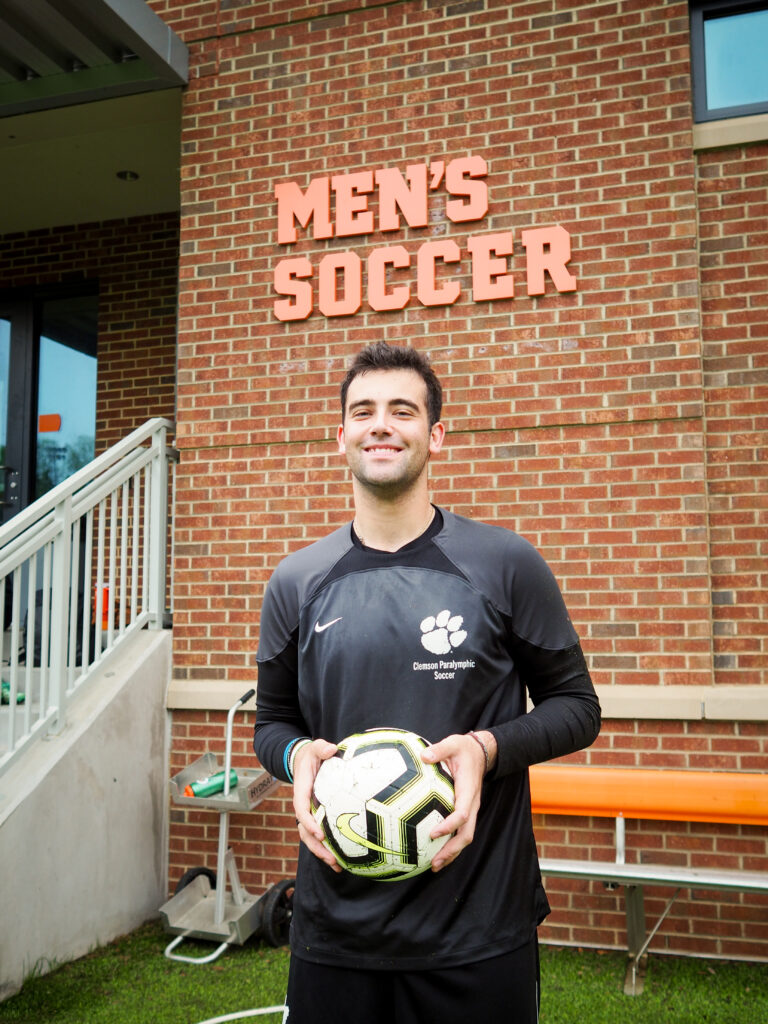
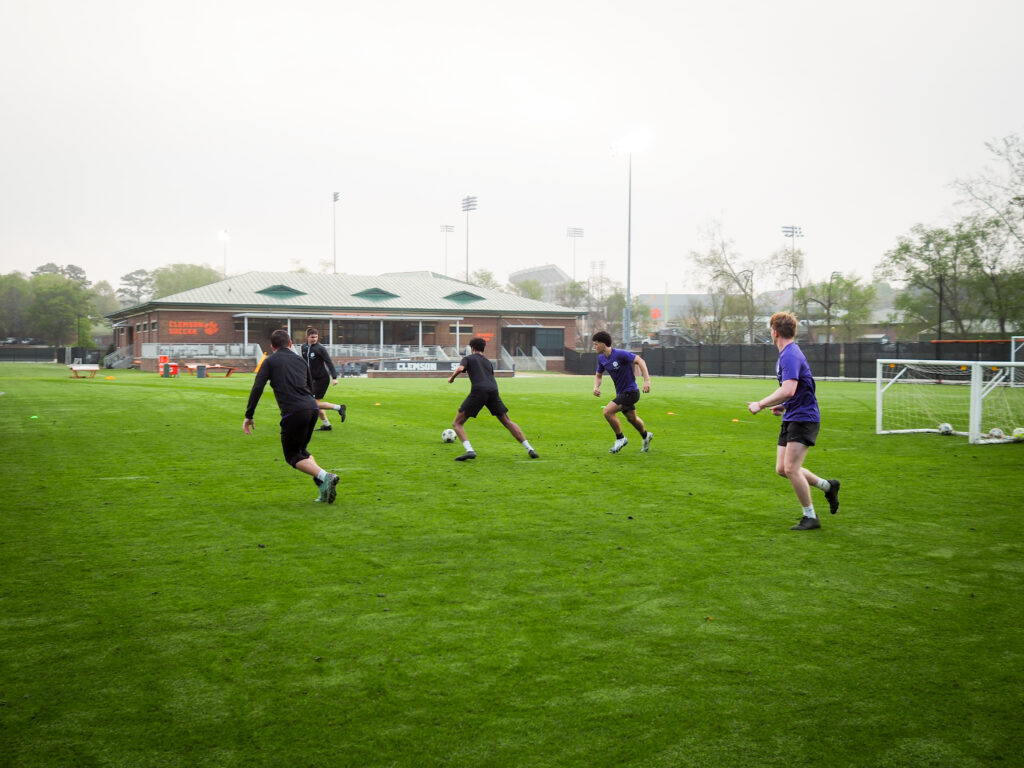
Head Coach, Felipe Tobar, and Clemson Paralympic Soccer players gather at Riggs Field.
For the second year in a row, Clemson Paralympic Soccer went head-to-head in an official match against the CP (Cerebral Palsy) Soccer All-Stars at Clemson University’s Historic Riggs Field on Saturday, April 25, 2026. This event marks the second time in U.S. college history that two Cerebral Palsy soccer teams have competed against each other in a university stadium.
The match was close, with the score tied 1-1 for most of the game. But in the end, the Clemson team scored an additional goal in the second half to secure a victory.
Check out this instant replay of the game-winning goal, captured by Drew Landon Media, by Player of the Match, Shae Hammond.
Post-event surveys showed that, at the start, around 43% of attendees were unaware of the sport and, by the end of the match, over 60% of attendees’ perceptions of Paralympic athletes had positively changed. 88% of fans expressed an interest in supporting adaptive sports in the future.
“Clemson University is inarguably a trailblazer in the world of adaptive soccer,” head coach and faculty fellow of the Institute, Felipe Tobar, said.
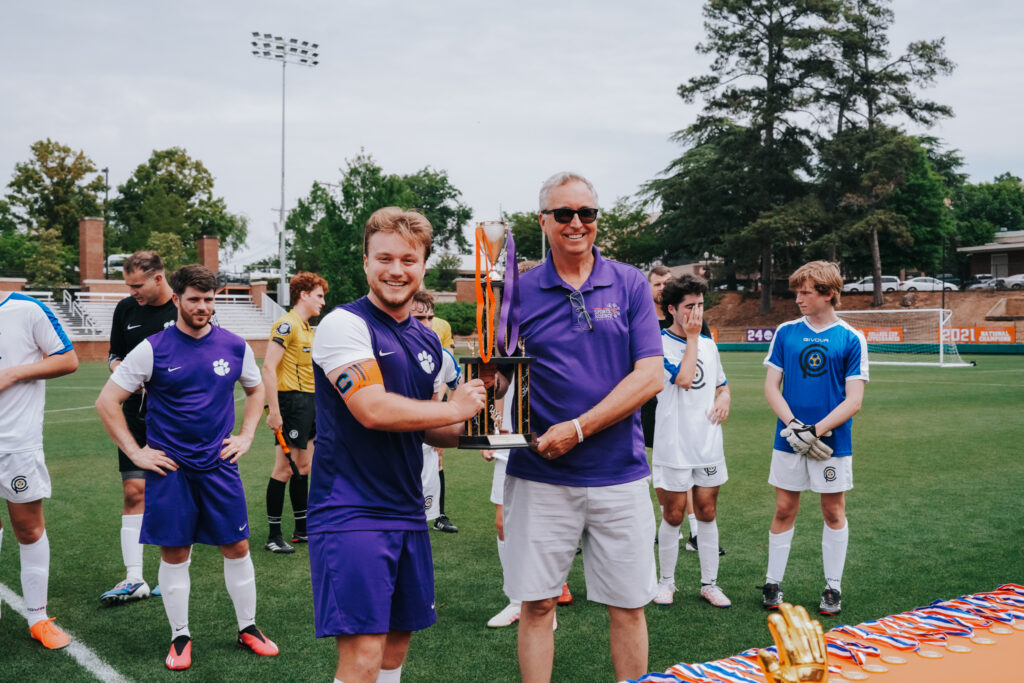
Player of the Match, Shea Hammond, and RHBSSI Director, John DesJardins, pose with the game-winning trophy after the match.
The team at the Robert H. Brooks Sports Science Institute (RHBSSI) thanks Clemson Paralympic Soccer for involving the Institute in its activities as a sponsor.
“So much positive energy and goodwill,” RHBSSI Director John DesJardins said. “I’m so happy for the program, faculty, staff and students that it supports.”
To learn more about Clemson Paralympic Soccer within the Department of Parks, Recreation and Tourism Management at Clemson, click here.
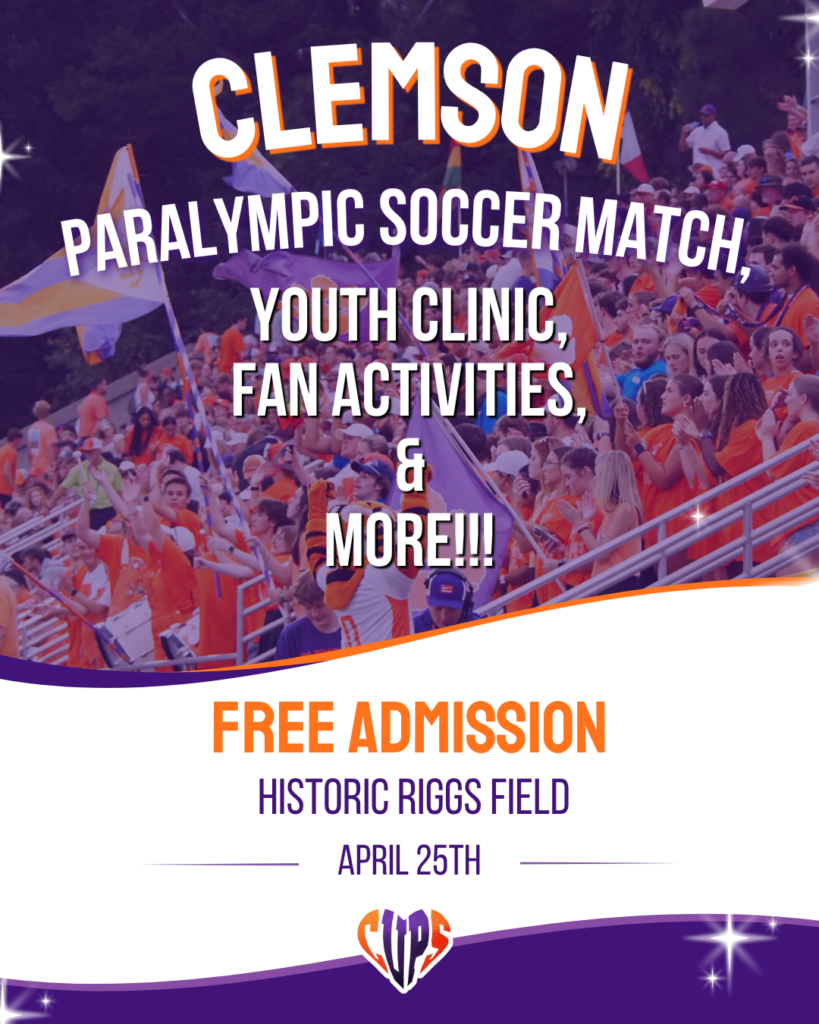
The Clemson University community is invited to attend a landmark celebration of inclusive sport at the Clemson Paralympic Soccer Fest, to be held at the historic Riggs Field on April 25th. This event marks only the second time in U.S. college history that two Cerebral Palsy soccer teams have competed against each other in a university stadium.
Organized by the Clemson University Paralympic Soccer Program and presented by the Robert H. Brooks Sports Science Institute, the event promises a full morning of engagement, inclusion, and community celebration.
The day will begin with a soccer clinic for children and youth with physical and intellectual disabilities from 8:00 AM to 9:20 AM, providing participants with an opportunity to learn, play, and connect in an empowering environment.
Following the clinic, fans and families can enjoy a wide range of interactive “soccer stations” leading up to kickoff, including:
Four-square fun
Soccer golf challenges
Immersive virtual reality soccer experiences
Jumbotron games
A themed photo station
Face painting
The featured match between Clemson University Paralympic Soccer and Cerebral Palsy All Stars will kick off at 11:00 AM, showcasing elite Cerebral Palsy soccer talent in a historic setting that continues Clemson’s tradition of leadership in sport and inclusion.
At halftime, attendees will be entertained by the Clemson Rally Cats, who will perform, engage with fans, and lead interactive experiences. Spectators will also enjoy giveaways and have the chance to participate in two public halftime games.
This event represents a unique opportunity for the Clemson community to support adaptive athletics, celebrate diversity in sport, and be part of a historic moment in U.S. collegiate soccer.
Admission is free and open to the public.
For more information, please contact the Clemson University Paralympic Soccer Program at @cuparasoccer on Instagram. The Clemson University Paralympic Soccer Program is part of the Department of Parks, Recreation and Tourism Management at the College of Behavioral, Social, and Health Sciences.
CTR team members with Clemson alumnus Dr. Shannon Kennedy
By Nathan Inman
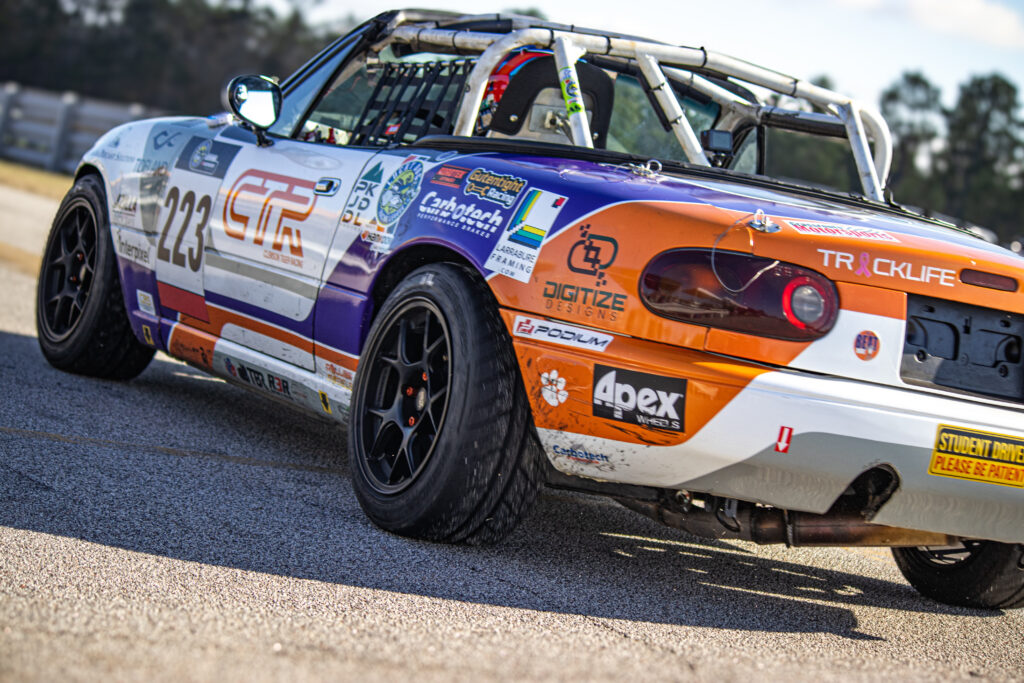
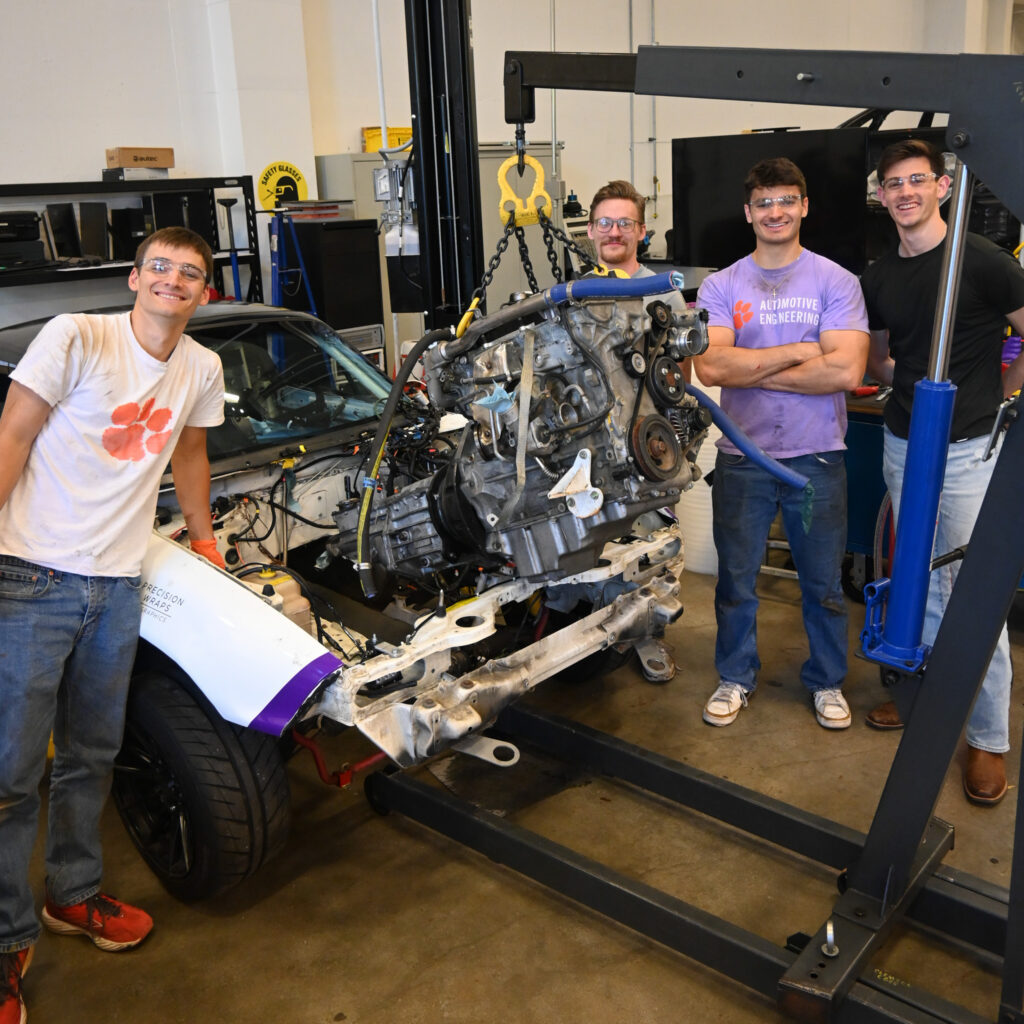
February 28 was a day that was nearly three years in the making for Clemson Tiger Racing. After being established in 2023, CTR finally ran its first-ever endurance race late last month.
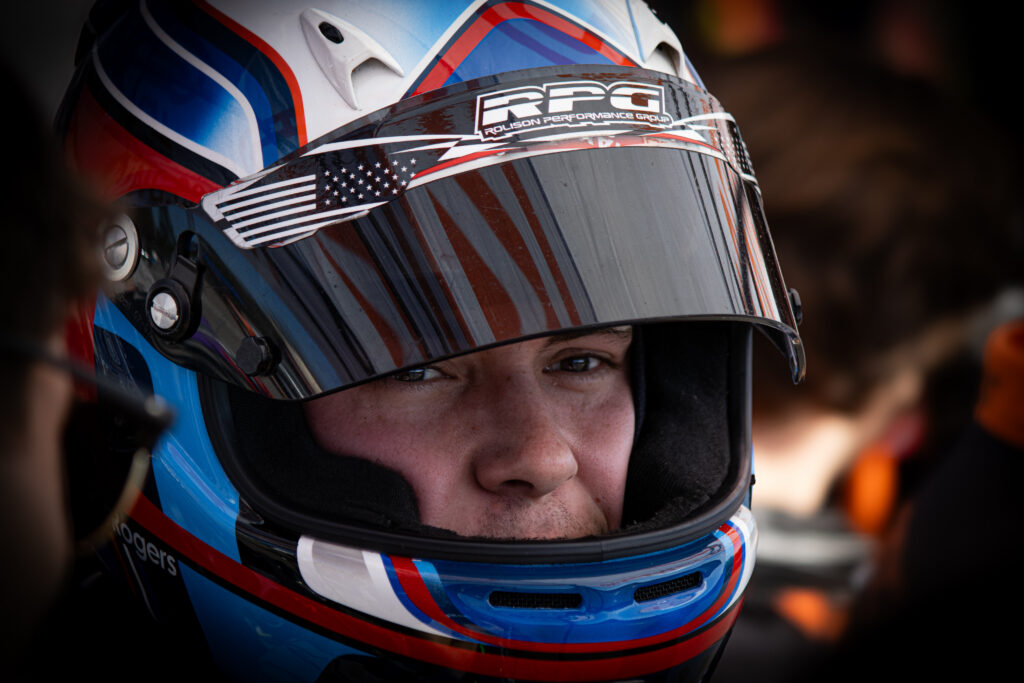
It could have been easy for the team to take it easy and just log laps to gain experience, leaving car number 223 to be an afterthought to its competitors. Instead, though, everyone knew they were there. The team finished fourth in the Saturday race after a solid showing throughout the day, leaving CTR with a shot at a podium finish. Unfortunately, the team was unable to cross the finish line, as the car ran out of gas and slowed to a stop out of the final corner.
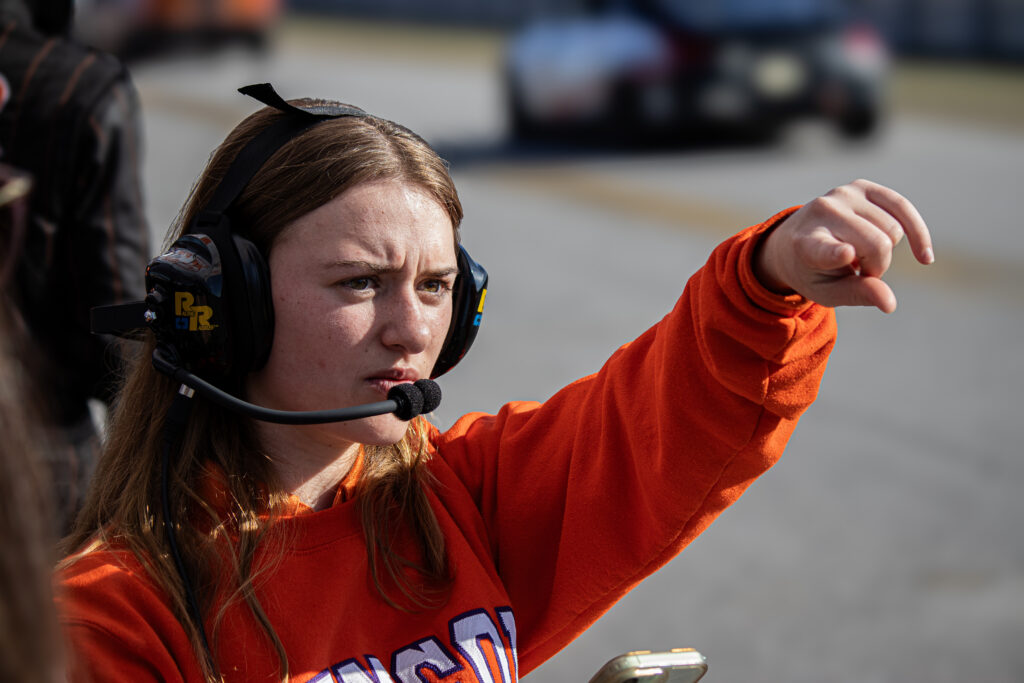
Hadley Smith on the team radio as race engineer.
While the race finished in heartbreaking fashion, the result was still one the team could be proud of. “I think we were all flabbergasted that we made it through,” said Hadley Smith, a sophomore engineering major and race engineer for CTR. “We were so incredibly excited and proud of ourselves that we made it through the first day.” The pride Smith mentioned was echoed by several of her fellow team members.
“It’s hard for me to put this feeling into words,” said Macy Jersek, graduate student and operations lead for CTR. “I’m just so happy and really proud of this team. I think we all were just thrilled to see the car finish, and to be so successful and to be competitive with our little Miata with 80 horsepower.”
Kieran Rogers prepares to enter the car for the final stint of Saturday’s race.
“I’m also very proud of everyone,” added Kieran Rogers, junior automotive engineering student who is the race engineer lead and a driver for CTR. “There’s a lot of work that went into it, so it’s very rewarding when you see we’re able to go on for as long as possible.”
As Saturday drew to a close, the focus shifted to Sunday, when the team would hit the track once more for the second race of the weekend. After the learning experience of their first race, the team was hopeful they could compete for a podium position once again.
Not only did CTR compete for a podium in Sunday’s race, and the team also led at the break after the first hour and held the lead for several hours afterwards. It appeared that CTR was going to have a shot at winning a race in its first-ever race weekend. Unfortunately, with roughly 90 minutes remaining, the car suffered a failure in the rear differential. With so little time remaining and the car extremely hot, CTR was unable to make repairs and was forced to retire from the race.
CTR leaves the pit lane following the final pit stop on Saturday.
While the end result was not what the team had hoped for, the team members had every reason to hold their heads high and mark the weekend as a success. A car fully engineered, maintained and driven by college students lasted an impressive 341 laps and nearly 13 hours throughout the two races, leaving the expectations heading into the weekend in the dust. Even more impressive was that the parts built and installed by the team stayed in shape, and the only thing that prevented the team from completing all 14 hours and potentially earning a race win or podium was one that was never touched by the students besides fluid changes, serving as a testament to the work of the mechanics.
“I think it just really shows how hard every single one of the mechanics has been working,” said Matthew Flaim, an automotive engineering graduate student, as well as driver and lead mechanic for CTR. “Just the effort that has been going in to make sure that we’re making, not only a consistent and competitive race car, but also a safe race car.”
With CTR’s first race finally in the books, the team is now looking ahead to more races and hopes to be back on track in May at Atlanta Motorsports Park. With the experience of the first race weekend and the knowledge gained from it, the sky is now the limit for the team’s future success.
Clemson FSAE members with Tiger 25 at the 2025 competition in Michigan.
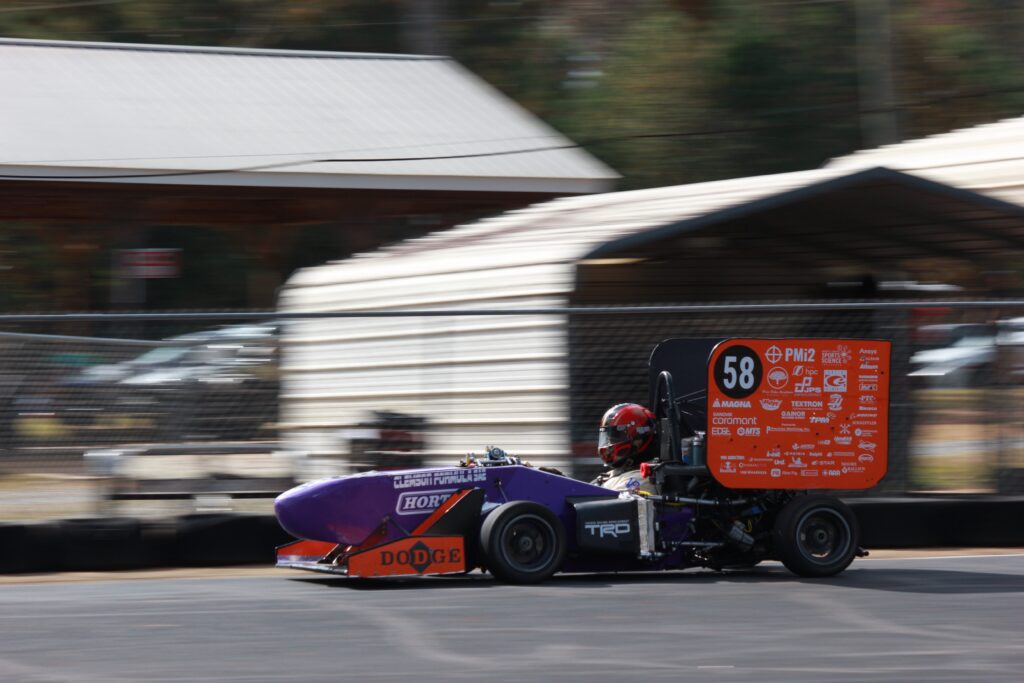
Clemson Formula SAE has been engineering its 2026 race car, Tiger 26, over the last several months, and the finishing touches are nearing completion. Tiger 26 will make its debut when the team hits the track at Michigan International Speedway on May 13.
Launched in 1998, Clemson FSAE is a student-run race team partnered with the College of Engineering, Computing and Applied Sciences. The organization provides students with real-life experience that cannot be replicated in the classroom, with opportunities in areas such as aerodynamics, business, chassis, electrical, powertrain and suspension. The event in May is part of the international FSAE series, which is hosted by the Society of Automotive Engineers (SAE). The series serves as a way for students to see their hard work come to life and compete with other students from around the globe.
With the annual event hosting thousands of students interested in engineering and motorsports, representatives from those industries attend the event to network with students and see what they are capable of firsthand. Peter Gaspich, suspension lead for Clemson FSAE, says that members of the organization have been able to gather connections at these events that later boosted them into roles with professional racing teams.
“One of our alumni is a performance engineer at [General Motors’] IndyCar program,” Kelly said. “We had a simulation performance engineer at Red Bull F1, and another simulation performance engineer at Alpine F1.”
Clemson FSAE team members working on the frame of Tiger 26.
With the opportunity to meet with industry professionals at these events, the work back at the shop in Clemson becomes even more important. When the team hits the track in Michigan, they will be facing a large variety of tests, such as skid pad, acceleration, autocross and endurance. During the several months spent engineering and building the car, the team must find the happy medium of all four of those areas to ensure their ability to be competitive throughout the entire event.
Gaspich explained that in the skid pad test, the car must complete two figure 8s of constant radius, which evaluates the “steady-state cornering ability,” which is essentially testing how much grip the car is able to make in a low-speed corner. It also evaluates the team’s ability to set up the car and make the best use of the tires. The acceleration competition is more self-explanatory. The acceleration test is practically a short drag race to evaluate how the car can accelerate from being stopped. Gaspich added that on a good day, their car goes from 0 to 60 miles per hour in about 3.5 seconds and has even gotten down to around 3.3 seconds at times.
From there, the event transitions into the autocross competition. In this event, a half-mile course is set up, and the team gets two chances with two different drivers to complete one lap and set the fastest time.
“Autocross courses, especially at Michigan, are insanely difficult,” Gaspich said. “There are even some teams out there that’ll even have a professional driver, because as long as they are a student currently enrolled at your university, they are allowed to drive the car.”
Clemson FSAE on track in the 2025 event at Michigan International Speedway.
Once the autocross event is complete, the competition transitions into the final event: endurance. The endurance event is the largest test of how well the car was built and engineered. The event is 30 straight minutes of racing, and while that doesn’t sound like much, Gaspich emphasized that at the end of the day, these cars are still completely student-built and aren’t professional-grade.
The event has been a tough one for Clemson SAE in recent years, as the team has not finished the full 30 minutes since 2022. Even then, though, the car overheated and severely reduced the top speed. The team came close to finally getting the monkey off its back in last year’s event, but fate had other plans.
“We had a pretty heartbreaking finish to endurance last year,” Gaspich said. “We were doing really good in all of our events, looking to finish at least top 20. We came in after our first stint of endurance to do the driver change, and suddenly we hear over the radio, ‘guys, we’re disqualified.’”
As it turns out, the car had been leaking just a few drops of oil, and the rules for the event specify that the cars cannot leak any fluid whatsoever. As a result, the team was told their day was done, and the chance to finally finish the endurance event had been snatched away from them once again.
As Clemson FSAE completes its Tiger 26 build, the team is optimistic about their chances to run well in and complete all the events in May. When that time comes, they are ready for the challenges and look forward to getting back on track. Students interested in joining Clemson FSAE can find them on TigerQuest or visit https://www.clemsonfsae.com/join-the-team.
Clemson Tiger Racing team with their car in front of ICAR
On January 24, the American motorsports season officially kicked off with the running of the Rolex 24 at Daytona International Speedway. Among the attendees at the event was Tyson Tucker, team principal of Clemson Tiger Racing (CTR).
CTR is Clemson’s student-run endurance motorsport team, giving students of all majors and backgrounds a chance to work on a race car, and even potentially drive one. Tucker recently sat down for an interview with the Robert H. Brooks Sports Science Institute to explain the history of the organization and give insight into what this semester looks like for the team.
CTR was founded in 2023 and has continued to grow ever since. Over the previous two years, CTR has participated in track days, which are solo test runs with no real competition, to build up to their goal of endurance racing. This month, that goal comes to fruition.
“This February will be our first ever wheel-to-wheel race,” Tucker said. “That’s kind of our biggest thing for this semester. We’ve been promising this is the point we want to get to, and now we’re actually able to do that, which is really awesome.”
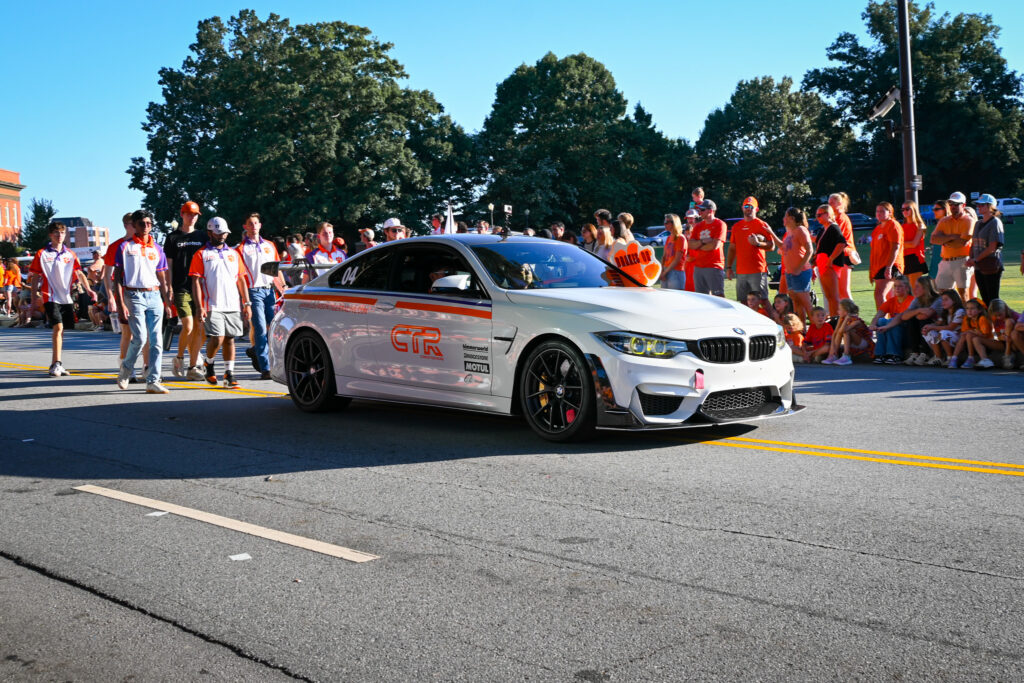
CTR car at the First Friday parade
The event will take place on February 28 at the Carolina Motorsports Park in Kershaw, South Carolina. The journey to the track has not been easy, though; as anyone familiar with the racing scene would attest to, entry into motorsports can be a costly endeavor. For that reason, teams in all facets of racing rely on sponsorship to fund their programs, and CTR is no different.
Most recently, CTR signed its newest sponsorship with Celsius to become the official energy drink of the team. Tucker explained that the continued growth of the organization is what has allowed CTR to sign deals such as this one. When he first joined the team, Tucker said there were maybe 25-30 members. As of the Spring semester, CTR is home to 100-plus students.
“It has grown immensely over the last couple of semesters, which is amazing,” Tucker added. “It’s allowed us to do a lot of really cool things, and with some of these new members we’re bringing, we’re able to reach more sponsors.”
Pictured left-to-right: Samuel Desantis, Noah Miller, Matthew Flaim, Tyson Tuckerin front of their car
As the organization has grown, students with prior racing experience have been able to help prepare the team for the upcoming event. From karting to Spec Miata, there are several team members with a background in racing who hope to have the team set up for success later this month.
In addition to drivers with on-track experience, CTR is also partnered with the Collegiate Racing Series (CRS), which was co-founded by Jack Hobbs, a recent Clemson graduate and founding member of Clemson Tiger Racing. CRS partners with organizations from schools across the country, providing students with educational tools to learn about race craft, fundraising and managing a race team. Along with these resources, CRS also leases Miata race cars to student organizations to assist them in getting their program started.
With the chance to earn hands-on experience with a race team and connections to a large network within the industry through the Collegiate Racing Series, Tucker says CTR can provide amazing opportunities for students looking to find their way into motorsports. Students interested in joining or learning more about Clemson Tiger Racing can find more information on TigerQuest, or at clemsontigerracing.com.
Members of AWSM gather outside the Nieri Family Student-Athlete Enrichment Center’s studio before conducting their photoshoot in October.
By Katie Gerbasich
‘Awesome’ is now a four-letter word for many female students: AWSM, or the Association of Women in Sports Media. AWSM is dedicated to empowering and supporting women interested in sports media. The Clemson chapter, advised by Department of Communication Assistant Professor and Robert H. Brooks Sports Science Institute Faculty Fellow Rikishi Smith-Rey, Ph.D., is part of the nationally recognized AWSM network of schools.
“I’m really excited to be with them now, because I feel like I have a lot to bring to them, whether it’s sharing my network or what I know about sport and media,” Smith-Rey said.
Department of Communication student Erin Mason has always had a passion for supporting women in sports. She joined AWSM as a first-year student, dreaming of the day she could work in the industry.
Erin Mason, AWSM president, stands on the field at the Tax Slayer Bowl in 2023.
“Growing up around sports, I saw how male-dominated the field was and witnessed women in sports be doubted and pushed to the side,” Mason said. “Seeing this made me want to make a positive impact on women in the industry and women looking to break into the industry.”
She initially described the club in her first year as having only a couple of meetings a semester, featuring guest speakers. Now, as president, she has helped AWSM expand.
“Watching this club grow over the years has been truly amazing,” Mason said. “Now, AWSM has over 140 active members, bi-weekly meetings, as well as drop-in meetings and other events. We provide professional development opportunities & resources consistently to all active members.”
A highlight for Mason has been the launch of its new athletic credentialing program last semester. Members now have the opportunity to apply for an accredited photo or press pass for athletic events. Following the event, members must promptly create and publish media.
The organization worked with Jeff Kallin, Senior Associate Athletic Director for Communications, to establish the importance of getting students in front of cameras and working with cameras in front of coaches. Additionally, having to learn what the sports world is like, with a quick turnaround on product time. AWSM covered 46 events across 55 different credentialed members last semester.
Kendall Lampman sits in the press box as a credentialed member for AWSM at the Clemson vs FSU football game. Lampman got to ask head coach Dabo Swinney a question during the post-game press conference.
“It’s a competitive process to be able to get a pass, but we have someone at every single sporting event,” Smith-Rey said.
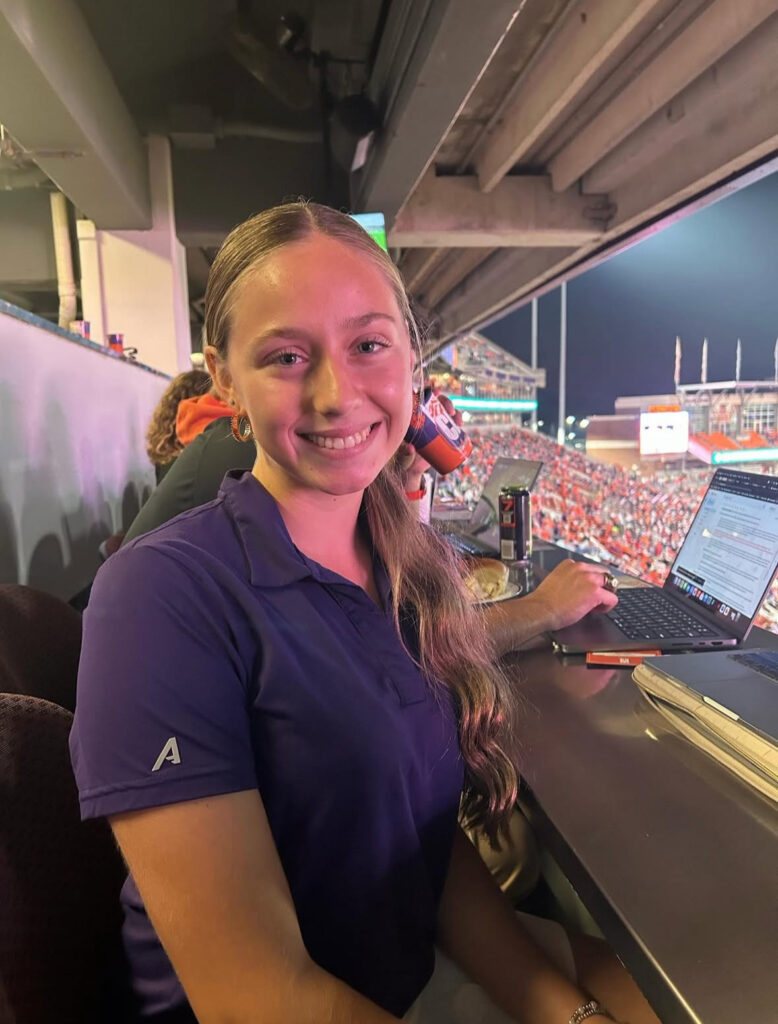
Community Outreach Chair, Caity Eng, has been managing the credentialing experience.
“Our members have put in so much hard work, and it has been so wonderful to see them shine, whether it is their first sports photography or reporting experience, or to expand their current skills and portfolio,” Eng said.
“Seeing and hearing about everyone’s passion for sports media and their time working on the sidelines and the press box has been so fulfilling.”
Last semester, the club participated in a professional photoshoot utilizing the Nieri Family Student-Athlete Enrichment Center’s studio. Members received a camera workshop before the event. Exclusive experiences like this are what Smith-Rey believes make the organization unique.
“These students wouldn’t ever really have that opportunity if this association didn’t exist,” Smith-Rey said. “I love that it’s specific to females to give them a voice and a chance to grow.”
Female students across all majors can connect through the common thread of sport.
“You see business students talking with sports communication students, talking with engineering students, and it’s a really cool way for them to be like, ‘Oh, I didn’t think we had anything in common, but you love sports, and I love sports,’” Smith-Rey said.
Looking ahead, the organization hopes to continue strengthening its relationship with Clemson Athletics to make a greater impact on students’ professional development and the community.
“In such a male-dominated field, women in sports must stick together, support one another no matter what, and unite on issues that pertain to us,” Mason said. “As female representation continues to grow in the sports industry, I hope to be a voice and supportive figure for women in the industry.”
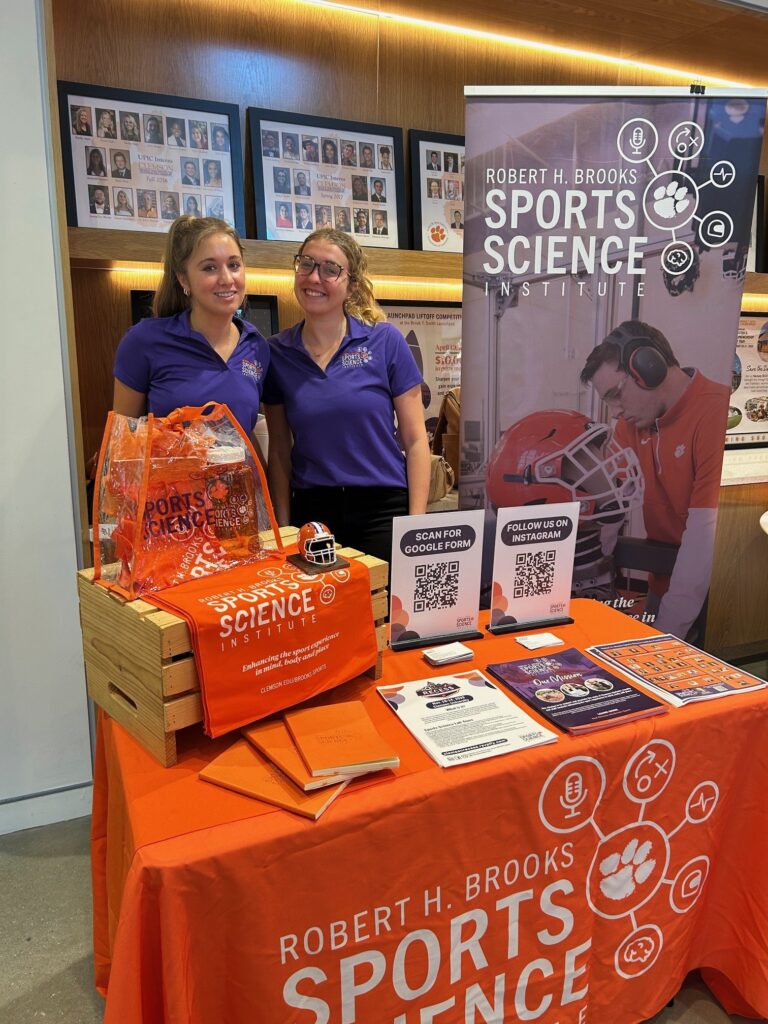
Institute interns, Evy Lane (left) and Lucy Hart (right) manage a table at the Sports Entrepreneurship Symposium.
On Friday, October 17, Clemson University’s Brook T. Smith Launchpad hosted its second-annual Sports Entrepreneurship Symposium in downtown Clemson.
From the Launchpad on LinkedIn, “Today we held our annual Sports Entrepreneurship Symposium at Clemson’s Brook T. Smith Launchpad. Clemson-affiliated leaders and experts shared their stories, discussed the latest developments in the field, and bonded together as Tigers. Almost 200 students, faculty, staff, and community members will benefit from the wisdom that was dispensed and new personal connections that were formed.”
John DesJardins presents on behalf of the Institute at the Symposium.
Affiliates from Clemson’s Robert H. Brooks Sports Science Institute (RHBSSI) presented and attended the symposium.
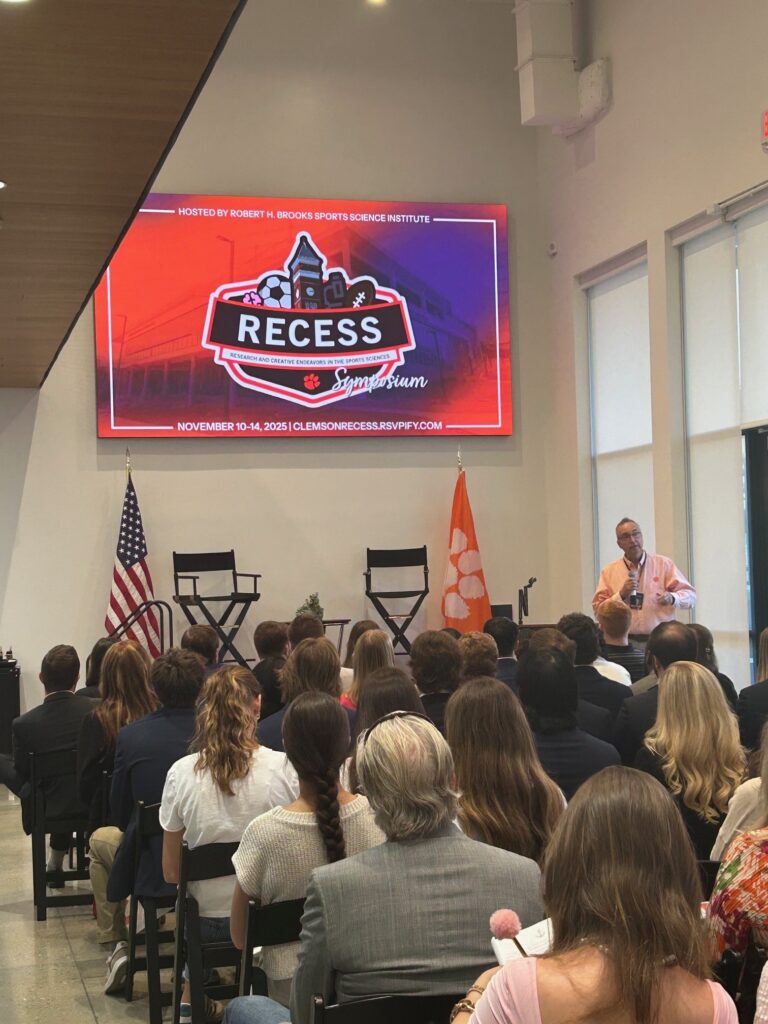
John DesJardins, Ph.D., interim director of the Institute, shared about academic opportunities in sport at Clemson, noting that there are more than 30 faculty, 55 courses and 2,500 students learning about sport through the lens of various disciplines each year. He also invited guests to attend the Institute’s upcoming RECESS symposium the week of November 10 to learn more about the academic side of sport at Clemson.
Graduate student supported by the Institute, Connor Moore, presents his research on a panel.
Graduate student in the Department of Bioengineering supported by the Institute, Connor Moore, presented with a panel on sports analytics and the sports tech industry. Moore has studied how analytics can have an impact on athlete performance and injury prevention in baseball.
“We are grateful to the Launchpad for inviting RHBSSI to have a presence at their sports entrepreneurship event,” thanked Kayla Rogers, assistant director of the Institute. “We met some wonderful Clemson students interested in studying sport and made connections with attendees with unique backgrounds from across the sports industry.”
An early morning photo of the pasture outside of Clemson’s Equine Center from the Center’s website
Leona Ransdell
RHBSSI staff fellow, Leona Ransdell, leads 4-H Equine programming for youth at Clemson University. The South Carolina 4-H Program is participating in and hosting a number of events this summer for equestrians, young and old, from the Special Olympics Equestrian State Show to STEM workshops and more.
Ransdell and the South Carolina 4-H Equine Program work in close partnership with the Clemson University Equine Center. The goal of the Clemson University Equine Center is to be a student-centered, self-sustaining enterprise that serves as a leader in the South Carolina horse industry. The Center caters to the needs of students through various means including:
Animal and Veterinary Science classes and labs
The Clemson Equine-Assisted Therapy (CLEAT) Program
Two IHSA equestrian teams
Student employment
Graduate research opportunities
Boarding
2024 South Carolina 4-H Horse Program Southern Regional Delegation
They also take seriously their responsibility to our community. Current outreach programs include:
Summer riding camps for high school students
Educational seminars and other continued learning opportunities
Applied research on industry-relevant topics
Private sales of young horses
The South Carolina 4-H Program and the Clemson University Equine Center will be hosting and working with the following events this summer:
Special Olympics State Equestrian Show (May 30-June 1)
Hosted at Clemson’s T. Ed Garrison Arena, the Special Olympics State Equestrian Show begins with an Opening Ceremony at 5 p.m. on Friday, May 30 and ends with the Equestrian Competition at 1 p.m. on Sunday, June 1. The weekend also includes a western hoedown, pole bending and barrel competition, trail competition, stall decorating contest and more.
Click here to learn more about the Special Olympics State Equestrian Show for South Carolina.
State 4-H Horse Show (June 10-14)
Hosted by the Clemson University College of Agriculture, Forestry and Life Sciences’ Cooperative Extension program, the State 4-H Horse Show incorporates indoor and outdoor activities for all levels, rookie to senior. The event features a Parade of Counties and Opening Ceremony on Wednesday, June 11 roughly 30 minutes after the morning events.
Click here to preview the tentative schedule for the State 4-H Horse Show.
State 4-H Congress (July 8-11)
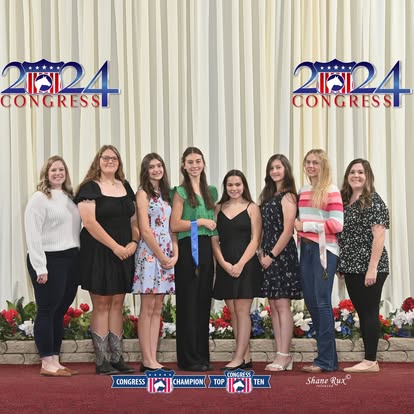
A photo from the 2024 State 4-H Congress
Hosted by the South Carolina 4-H Youth Development Program, qualified 4-H members (see website), aged 14-18 are invited to attend this year’s State 4-H Congress on Clemson University campus. The event is themed, “Beyond Our Time.” Join 4-H members from across the state as you represent your county at State 4-H Congress.
Youth will stay in the dorms, visit campus facilities and see the amazing work being done at Clemson. State 4-H Congress will celebrate the accomplishments and talents of our senior 4-H members, elect next year’s State 4-H Teen Council and provide a platform to engage in the head, heart, hands and health of 4-H through service, learning, connection and more.
Click here to learn more about the State 4-H Congress.
STEM Fest (July 19)
STEM Fest is a three-hour, community-based celebration of science, technology, engineering and math for up to 1,000 students and parents. Attendees participate in 50 hands-on stations, perform experiments, watch demonstrations and meet professionals from all different career backgrounds. Each station is manned by collegiate and professional volunteers. The upcoming event on July 19 will take place in Greenville, SC.
According to Leona, people interested in 4-H and Equine activities locally to them can reach out to their local county offices and most, if not all, offer multiple summer camps.
“For example, Newberry County has engineering camp in June, Crafty clover camp in July, Farm tour camp in July, general 4-H camp in July!” she said. “Pickens County has a Butterfly Habitat Workshop May 31 Horseless Horse Camp June 16!”
Ransdell ’12, is a Clemson Animal Science graduate passionate about horses, her community and education. She returned to Clemson in 2024 to take on her current role, which combines all of her passions into one.
“Everything we do at South Carolina 4-H and the Clemson University Equine Center is near and dear to my heart and I hope you will find one or more event this season that interests you!” said Ransdell.
For more information on youth programming at the Equine Center, contact Leona Ransdell at leona@clemson.edu. Click here to follow the Center on Facebook and click here to follow the South Carolina 4-H Livestock and Equine Program!
The team played and defeated the CP Soccer All Stars 6-1 at Historic Riggs Field at their first real match in program history.
Goalkeeper Max Alberici celebrates a goal with midfielder Chile Chitulangoma, who scored.
While the players lifted a trophy for the win, they weren’t just thrilled with the hardware: they were ecstatic that they even had the opportunity to play.
Shea Hammond is a graduate student in communication who has been with the team for several years, the first undergraduate player in the program’s history. Seeing the event come together was enough to inspire a win.
“It’s the name of the field. It’s historic,” Hammond said after the game. “To finally play on this field, it’s historic. It’s indescribable.”
Head coach and assistant professor in the Department of Parks, Recreation and Tourism Management, Felipe Tobar, watched his players’ dreams come true that afternoon. Many of them had dreamed of playing collegiate sports after high school, a period where many athletes with cerebral palsy (CP) stop playing.
“We’d like to say thank you to the community and the fanbase who supported us,” Tobar said. “They had a dream to play in a college stadium and they accomplished it.”
Graduate student Shea Hammond scored a hat-trick on Saturday morning.
Four different Clemson players scored, while Hammond scored a hat-trick with all three of his goals coming in the second half. One player, Tyler Bennett, is a team alumnus and one of the first two players to join the program in 2017. Bennett brought practices featuring movements, passing and other workouts from the U.S. CP National Team.
It was a new Clemson experience for Bennett, coming back to campus and playing in a full game of soccer with CP rules.
“I think it went well for the program,” Bennett said. “They showed that if you’re training here full-time, you’re going to do pretty well.”
Many faces from the Clemson Men’s and Women’s Soccer teams were present. Flags flew and celebrations commenced in the stands whenever a player scored. The entire women’s lacrosse team attended, surprising goalkeeper Max Alberici, the team’s manager.
That wasn’t the best moment of the game in Alberici’s opinion, however. His favorite experience came from watching substitute goalkeeper, Ethan Donahue, play. He joined the team several weeks before the match after Hammond recruited him on campus. Donahue and his disability were welcomed by the team in open arms.
“I was more happy to get him in the game,” Alberici said.
“There’s no relationship like an adaptive sport relationship,” Hammond said, “and like a CP soccer family.”
The match was the last that this team will play all together, as they say goodbye to Hammond following five seasons with the program. As he graduates from Clemson, Hammond looks forward to working with cerebral palsy and Paralympic athletes in the future.
The Robert H. Brooks Sports Science Institute sponsored the match’s trophy, which the Clemson CP team raised following its win.
“That’s a lifetime of work that I’m going to commit to and making sure that we can grow this program in this sport as much as possible,” Hammond said.
For Tobar, the practices and cultivation of this match proved to be a great success. Earlier in the week, the team played Daniel High School in a scrimmage to prepare for the game. Now, Tobar and his team are “blessed and honored” to have the opportunity to represent Clemson.
“That’s the only official game that we will play as a team,” Tobar said. “I could not be more proud.”
Click here to check out more photos from the match.
The Clemson Paralympic Soccer team gathers outside the Clemson Soccer practice facility in their new uniforms to prepare for the historic match on April 19. (Photo by Natalie Bell)
Clemson professor of sport and recreation management in the Department of Parks, Recreation and Tourism Management (PRTM), Skye Arthur-Banning, was at the London Paralympic Games in 2012 with a group of students when an idea came to him.
Five years later, that idea would form Clemson Paralympic Soccer, the only collegiate program of its kind in the nation. Now, on April 19 at 11 a.m., the team will be playing their first-ever match in front of a crowd at Historic Riggs Field.
Several Clemson Paralympic Soccer players receive national team call-ups by the U.S. Men’s CP National Team, where they play around the country and even across the globe.
History of Clemson Paralympic Soccer
Arthur-Banning was a soccer referee in 2012 working various professional leagues and U.S. Open cup games. Following the 2012 Paralympic Games, he decided to devote his time to Para soccer, seeing the high performance of blind and cerebral palsy (CP) soccer players during that time.
“Instantly, I knew that was my next step,” he said. “There’s my next opportunity to continue refereeing, but also begin to support those with disabilities in sport environments.
Clemson Paralympic Soccer Head Coach, Felipe Tobar (Photo by Natalie Bell)
Felipe Tobar, assistant professor in the PRTM department, is head coach of the team. Arthur-Banning took notice of Tobar in 2021 while he was assistant coach for Daniel High School’s varsity soccer team.
“They needed a coach, so they needed structured training sessions,” Tobar recalled. “Since I was doing that at Daniel, he invited me to join the program as a head coach. I immediately said yes.”
Strength through adversity
The team is gearing up for its first-ever match on April 19 at Historic Riggs Field at 11 a.m. They practice three times a week to prepare.(Photo by Natalie Bell)
Strength through adversity is the team’s motto. Tobar encourages the team to play and live by this every day.
Currently, the team is made up of six players who have cerebral palsy, a neurological condition that can affect movement and posture. They also welcome players who have suffered a stroke or any severe brain injury.
Tobar has a connection with brain injury through his mother who had a stroke in 2011. He took care of her for eight years in Brazil before moving to the U.S. to earn his Ph.D. in parks, recreation and tourism management at Clemson.
“I saw what a stroke can do to a person, and I empathize with the players,” he said. “I had this background with my mom in which you can’t treat them as victims, you have to really see them as equals.”
Tobar pushes his players with drills and feedback three mornings a week.
“We keep the sessions intense and I don’t treat them differently,” he said.
Goalkeeper Max Alberici is the team’s starter, who saw an opportunity to play sports at the collegiate level and joined Clemson Paralympic Soccer.(Photo by Natalie Bell)
The players expend three times the amount of energy on the field as able-bodied soccer players due to quicker muscle fatigue – therefore, their recovery process takes longer.
For goalkeeper Max Alberici, who has spastic diplegia which affects more than one limb, he burns almost four times more energy than the average player. Alberici is a senior sports communication major who grew up playing lacrosse but saw this as an opportunity to continue playing sports in college, which was his dream.
“I hadn’t played organized soccer since eighth grade and I just go ‘okay, I’m doing this,’” Alberici said when he first heard about the program.
Now as the team’s starting goalkeeper, he embraces the training sessions and their intensity.
“There is definitely an intensity that I do enjoy and I had to learn to enjoy,” Alberici said. “But I think overall, I think having a game to work towards is going to make this a lot easier, mentally, for me.”
Because this program at Clemson is unique, four of the team’s six players are also part of the player pool for the U.S. Men’s Cerebral Palsy National Team, where they are regularly picked to play.
Chile Chitulangoma is a defensive midfielder that has been with the team for three years, becoming a regularly called-up player on the U.S. Men’s CP National Team. (Photo by Natalie Bell)
Midfielder Chile Chitulangoma, a junior mechanical engineering major, is one of those players who joined in the fall of 2022. He is hemiplegic on the left side of his body affecting his strength and coordination, but takes advantage of playing quickly to overcome these obstacles. He describes the practices as tactical.
“A lot has to do with technical ability being refined with your technique on the ball,” Chitulangoma said. “So, a lot of the work we do has to do with a lot of different passing patterns and precise movements.”
In the beginning years of the program, the team would practice at local recreational fields like Nettles Park and the Snow Family Outdoor Fitness and Wellness Complex. Since 2024, the team practices at Clemson Soccer’s men’s and women’s practice facilities with help from Clemson Athletics.
“Athletics has given a lot of support to us,” Tobar said. “That elevated the level of our training sessions.”
As the only U.S. school with this type of program, Clemson allots eight scholarships that allow out-of-state players to pay in-state tuition — the only university in the world that does so for CP soccer.
The match
Tobar describes the upcoming match as a debut for everyone — the first time Clemson Paralympic Soccer will play against other Paralympic soccer players from across the country for a trophy.
“We hope this game will bring attention to our program and the University this week,” Tobar said.
Players who have recently been admitted to play for the Tigers next season will also be on this all-star team of contenders. The captain of the U.S. Men’s Cerebral Palsy National Team, Josh Burnais, will be coaching the opposing team.
CP soccer rules are slightly different from traditional soccer rules. The game will be played in two halves, each 30 minutes long. Compared to soccer’s standard 11-on-11 format, CP soccer is played 7-on-7 with field dimensions and goal sizes a little smaller.
Clemson Paralympic Soccer Team practicing for the upcoming match (Photo by Natalie Bell)
Throw-ins can change to simply rolling the ball in underhand. If the ball unintentionally hits the CP-impacted hand in a natural position, there is no handball offense. These changes were made based on how the body functions for a CP player.
The event on April 19 will also be open to children with disabilities in the Upstate to have a one-hour clinic with the team from 9 to 10 a.m. to meet and play together. During the starting lineups, they will enter the field with the players.
“We want them to see their future on the pitch, so they can reflect and see that although there are barriers that they are going to face, it’s still possible to strive and succeed,” Tobar said.
For many of the players, it is a dream come true. Alberici grew up wanting to play in a stadium, and now his dream is becoming a reality.
“My main goal was always to be a college athlete,” Alberici said. “The soccer piece was much later than almost every single one of my teammates, but I’d never thought I’d play college sports in a college stadium.”
Meanwhile, for players like Chitulangoma, educating the public about overcoming adversity is what is most exciting.
“I think it’s a very unique opportunity to [educate about my disability] with a game of soccer,” Chitulangoma said. “I don’t think there’s a better way we could show our game and our disability to the community.”
Clemson Athletics is supporting the event. The day will see several Clemson Men’s and Women’s Soccer players making an appearance, with some taking part in halftime promotions.
Tobar also plans to auction signed soccer balls and other items to fundraise for the team.
That same weekend, Clemson Adaptive Sports and Recreation will be hosting the Palmetto Games, a regional adaptive sport event featuring track and field, swimming and air rifle competitions.
“We want to have as many people as possible,” Tobar said. “There are no other sports that are going to be playing that morning, so it’s a full day of Para sports.”
With kickoff set for 11 a.m. on April 19, Arthur-Banning, Tobar and the team are ready for their first organized CP game in program history, hoping to spread more awareness about Para sports and the work that the players have put in.
“I think this game provides that opportunity for them to showcase all the hard work that they’ve put in, all the skill and talent that they have and, hopefully, be able to do that in front of not only their Clemson peers, but their community at large,” Arthur-Banning said.
“This gives them that opportunity to show that off a little bit and feel like this is their payback, if you will. This is their moment.”
Arthur-Banning and Tobar are faculty fellows of the Robert H. Brooks Sports Science Institute at Clemson, sponsor of the trophy for the historic Paralympic soccer match.