Sports Insight

Clemson Baja SAE partnering with Construction Science and Management department to construct new test track

By Nathan Inman

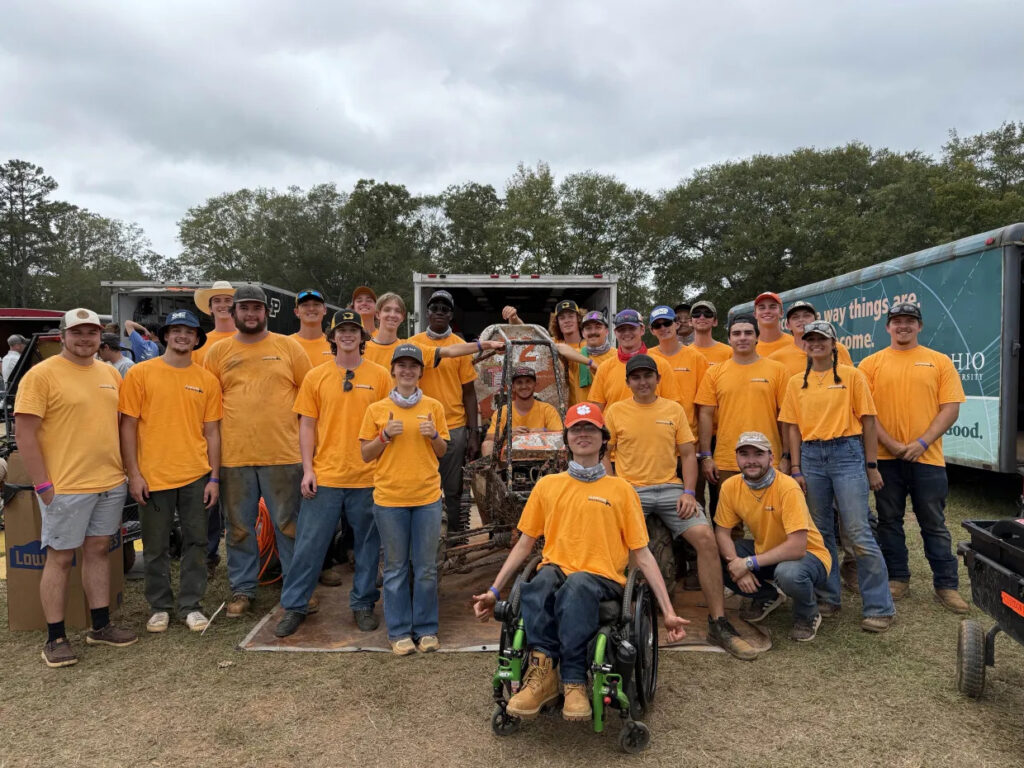
Clemson Baja SAE team picture at competition

As the semester progresses for Clemson Baja SAE, the team is working towards building its newest vehicle for competition later this year. However, the new vehicle is not the only thing the organization is constructing this semester.

Clemson Baja SAE was founded in 1978 and is a student-run engineering organization that designs and builds custom off-road vehicles to compete in the national Baja SAE Collegiate Design Series. The organization had become dormant following the COVID-19 pandemic, but a group of eight dedicated students were determined to bring the organization back to life in 2023.

Clemson Baja SAE racing on dirt track

Since its revival, Baja has utilized a test track in the woods behind their race shop to ensure their student-built vehicles were primed and ready to compete. Recently, though, the track was cleared and logged, completely destroying the course and making it unusable for the race team. The occurrence left Baja without a way to test their vehicles, meaning they would be unable to be sure that there were no mechanical or safety defects before traveling for competitions. That’s when Blanchard CAT and the Department of Construction Science and Management stepped in.

“This semester, we are partnering with the Construction Science department,” Tyler Odgers, president of Baja SAE, said in an interview. “Right now, they have drone scanned the entire block and they’re designing a track on their computers.”

Odgers added that Blanchard CAT has donated equipment for the construction of the track, something that would have been unfeasible for the team to afford. Just as it does for many professional race teams, funding for Clemson Baja often comes at a premium. With the need for funding, the organization cannot focus solely on engineering and manufacturing their vehicles. Odgers says that the team has begun developing a large business team in order to afford those aforementioned costs.
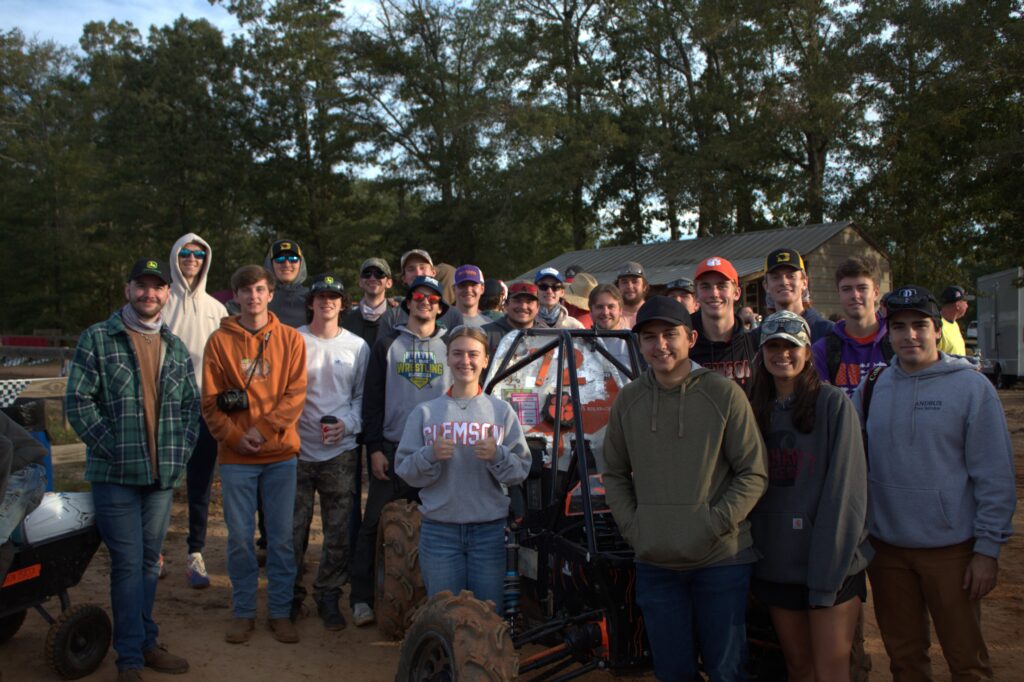
Team picture with Clemson Baja SAE car

“Obviously, we need funding, right?” Odgers said. “We have a team that is essentially putting together a packet presentation that we can just go out and give to businesses. There’s a very big communications, marketing type of thing trying to get our name out there.”

Odgers went on to say that he sees opportunities for practically any major, and that “there are very few majors that I think can’t do something with us.” As the team continues to prepare for competition and the construction of its new race vehicle and test track, emphasis will still remain on the business and communications side of the organization. Any students interested in joining Clemson Baja SAE can find them on TigerQuest or go to https://cecas.clemson.edu/bajasae/join/

Clemson Tiger Racing is hitting the track for first-ever endurance race

By Nathan Inman

Clemson Tiger Racing team with their car in front of ICAR

On January 24, the American motorsports season officially kicked off with the running of the Rolex 24 at Daytona International Speedway. Among the attendees at the event was Tyson Tucker, team principal of Clemson Tiger Racing (CTR).

CTR is Clemson’s student-run endurance motorsport team, giving students of all majors and backgrounds a chance to work on a race car, and even potentially drive one. Tucker recently sat down for an interview with the Robert H. Brooks Sports Science Institute to explain the history of the organization and give insight into what this semester looks like for the team.

CTR was founded in 2023 and has continued to grow ever since. Over the previous two years, CTR has participated in track days, which are solo test runs with no real competition, to build up to their goal of endurance racing. This month, that goal comes to fruition.

“This February will be our first ever wheel-to-wheel race,” Tucker said. “That’s kind of our biggest thing for this semester. We’ve been promising this is the point we want to get to, and now we’re actually able to do that, which is really awesome.”

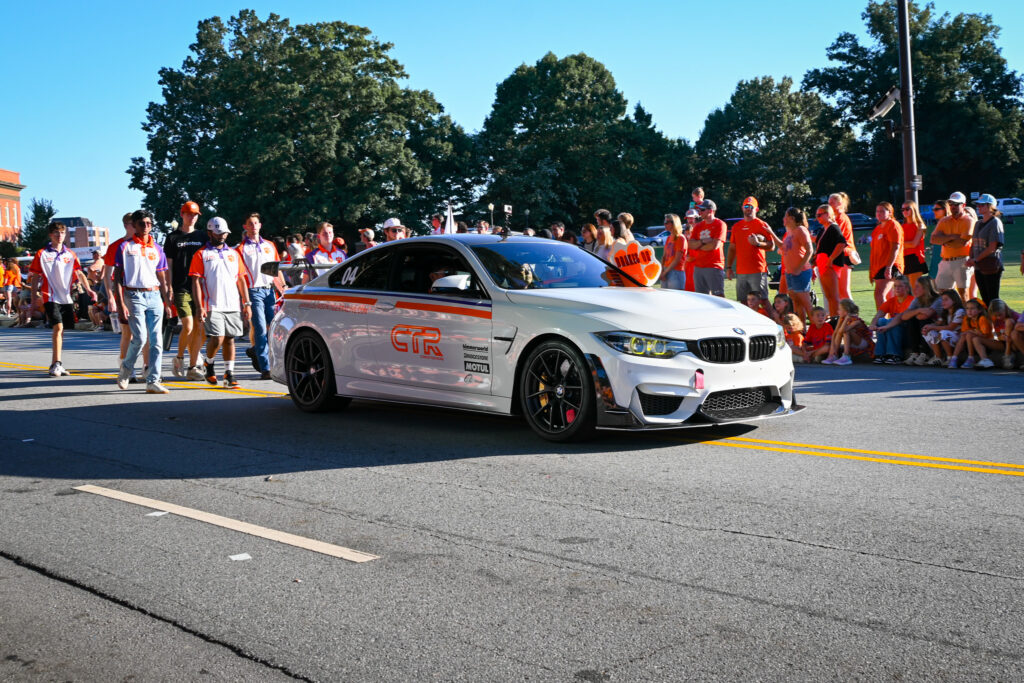
CTR car at the first friday parade
CTR car at the First Friday parade

The event will take place on February 28 at the Carolina Motorsports Park in Kershaw, South Carolina. The journey to the track has not been easy, though; as anyone familiar with the racing scene would attest to, entry into motorsports can be a costly endeavor. For that reason, teams in all facets of racing rely on sponsorship to fund their programs, and CTR is no different.

Most recently, CTR signed its newest sponsorship with Celsius to become the official energy drink of the team. Tucker explained that the continued growth of the organization is what has allowed CTR to sign deals such as this one. When he first joined the team, Tucker said there were maybe 25-30 members. As of the Spring semester, CTR is home to 100-plus students.

“It has grown immensely over the last couple of semesters, which is amazing,” Tucker added. “It’s allowed us to do a lot of really cool things, and with some of these new members we’re bringing, we’re able to reach more sponsors.”

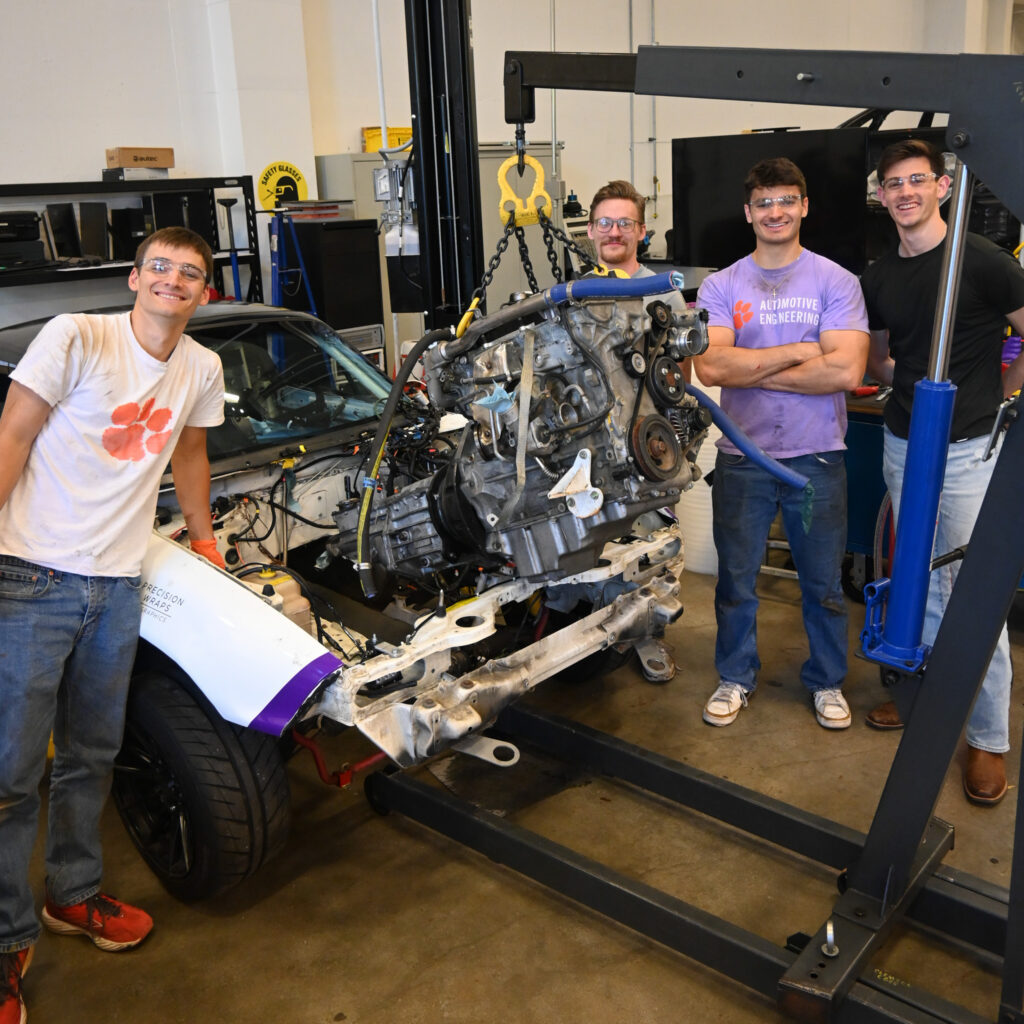
Pictured left-to-right: Samuel Desantis, Noah Miller, Matthew Flaim, Tyson Tucker in front of their car

As the organization has grown, students with prior racing experience have been able to help prepare the team for the upcoming event. From karting to Spec Miata, there are several team members with a background in racing who hope to have the team set up for success later this month.

In addition to drivers with on-track experience, CTR is also partnered with the Collegiate Racing Series (CRS), which was co-founded by Jack Hobbs, a recent Clemson graduate and founding member of Clemson Tiger Racing. CRS partners with organizations from schools across the country, providing students with educational tools to learn about race craft, fundraising and managing a race team. Along with these resources, CRS also leases Miata race cars to student organizations to assist them in getting their program started.

With the chance to earn hands-on experience with a race team and connections to a large network within the industry through the Collegiate Racing Series, Tucker says CTR can provide amazing opportunities for students looking to find their way into motorsports. Students interested in joining or learning more about Clemson Tiger Racing can find more information on TigerQuest, or at clemsontigerracing.com.

An ‘AWSM’ opportunity empowering Clemson women in sports media

Members of AWSM gather outside the Nieri Family Student-Athlete Enrichment Center’s studio before conducting their photoshoot in October.

By Katie Gerbasich

‘Awesome’ is now a four-letter word for many female students: AWSM, or the Association of Women in Sports Media. AWSM is dedicated to empowering and supporting women interested in sports media. The Clemson chapter, advised by Department of Communication Assistant Professor and Robert H. Brooks Sports Science Institute Faculty Fellow Rikishi Smith-Rey, Ph.D., is part of the nationally recognized AWSM network of schools. 

“I’m really excited to be with them now, because I feel like I have a lot to bring to them, whether it’s sharing my network or what I know about sport and media,” Smith-Rey said. 

Department of Communication student Erin Mason has always had a passion for supporting women in sports. She joined AWSM as a first-year student, dreaming of the day she could work in the industry.

Erin Mason, AWSM president, stands on the field at the Tax Slayer Bowl in 2023.

“Growing up around sports, I saw how male-dominated the field was and witnessed women in sports be doubted and pushed to the side,” Mason said. “Seeing this made me want to make a positive impact on women in the industry and women looking to break into the industry.” 

 She initially described the club in her first year as having only a couple of meetings a semester, featuring guest speakers. Now, as president, she has helped AWSM expand. 

“Watching this club grow over the years has been truly amazing,” Mason said. “Now, AWSM has over 140 active members, bi-weekly meetings, as well as drop-in meetings and other events. We provide professional development opportunities & resources consistently to all active members.”

A highlight for Mason has been the launch of its new athletic credentialing program last semester. Members now have the opportunity to apply for an accredited photo or press pass for athletic events. Following the event, members must promptly create and publish media.

The organization worked with Jeff Kallin, Senior Associate Athletic Director for Communications, to establish the importance of getting students in front of cameras and working with cameras in front of coaches. Additionally, having to learn what the sports world is like, with a quick turnaround on product time. AWSM covered 46 events across 55 different credentialed members last semester. 

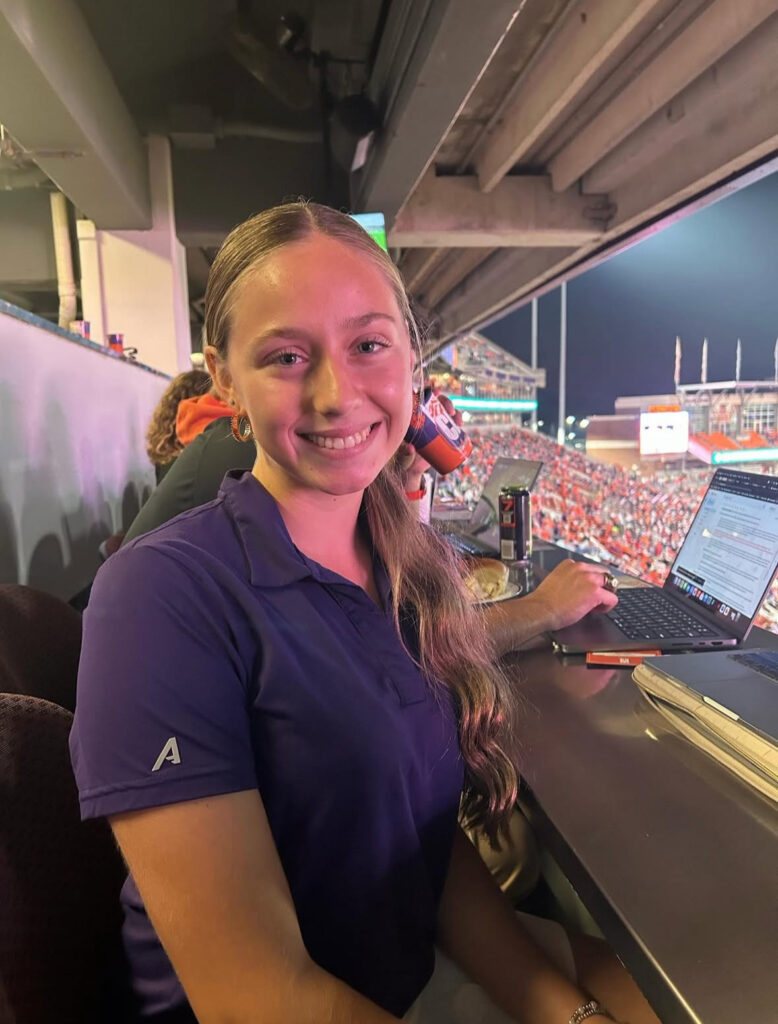
Kendall Lampman sits in the press box as a credentialed member for AWSM at the Clemson vs FSU football game. Lampman got to ask head coach Dabo Swinney a question during the post-game press conference.

 “It’s a competitive process to be able to get a pass, but we have someone at every single sporting event,” Smith-Rey said. 

Community Outreach Chair, Caity Eng, has been managing the credentialing experience.

“Our members have put in so much hard work, and it has been so wonderful to see them shine, whether it is their first sports photography or reporting experience, or to expand their current skills and portfolio,” Eng said. 

“Seeing and hearing about everyone’s passion for sports media and their time working on the sidelines and the press box has been so fulfilling.”

Last semester, the club participated in a professional photoshoot utilizing the Nieri Family Student-Athlete Enrichment Center’s studio. Members received a camera workshop before the event. Exclusive experiences like this are what Smith-Rey believes make the organization unique. 

“These students wouldn’t ever really have that opportunity if this association didn’t exist,” Smith-Rey said. “I love that it’s specific to females to give them a voice and a chance to grow.” 

Female students across all majors can connect through the common thread of sport. 

“You see business students talking with sports communication students, talking with engineering students, and it’s a really cool way for them to be like, ‘Oh, I didn’t think we had anything in common, but you love sports, and I love sports,’” Smith-Rey said.

Looking ahead, the organization hopes to continue strengthening its relationship with Clemson Athletics to make a greater impact on students’ professional development and the community. 

“In such a male-dominated field, women in sports must stick together, support one another no matter what, and unite on issues that pertain to us,” Mason said. “As female representation continues to grow in the sports industry, I hope to be a voice and supportive figure for women in the industry.”

Meet RHBSSI’s student interns for Spring 2026

By Katie Gerbasich

Happy New Year, from the Robert H. Brooks Sports Science Institute. For the Spring 2026 semester, RHBSSI welcomed three new and two returning student interns. Additionally, through the UPIC Beyond the Game program, two student-athlete interns will join the group. These students bring a multitude of experiences that will help drive new ideas that support the Institute’s mission. 

Evy Lane, Communications Lead

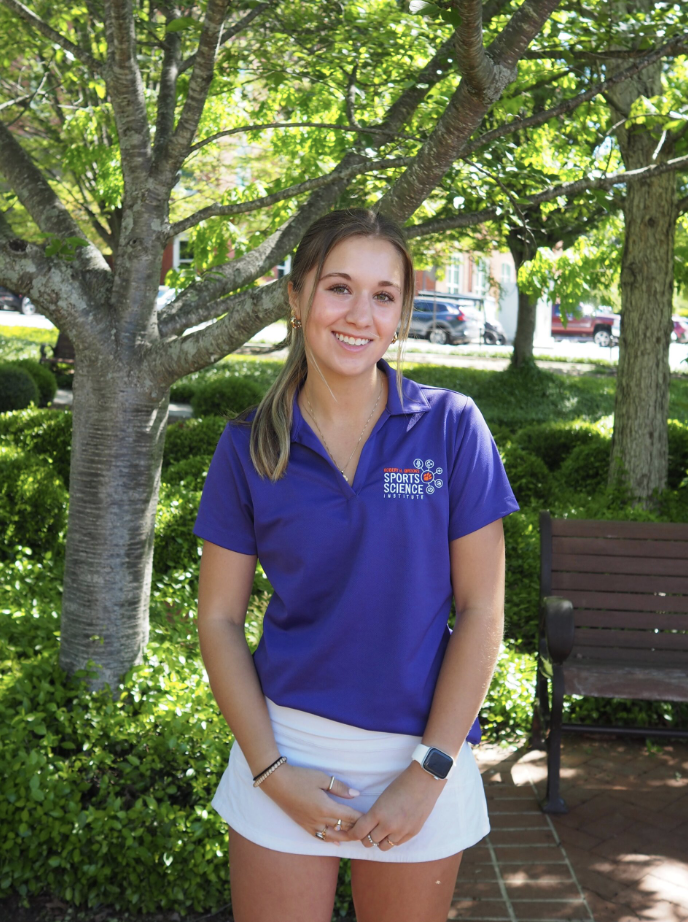
Evy Lane is a senior Marketing major and Spanish minor from Piedmont, South Carolina. In her fourth semester with the Institute, she will serve as the Communications Lead, which entails creating a content calendar and editing or posting blogs across RHBSSI social media handles. Lane has two cats, Otto and Lottie, whom she adores dearly.

Katie Gerbasich, Writer/Editor

Katie Gerbasich is a senior Sports Communication major and Women’s Leadership minor from Houston, Texas. In her third semester with the Institute, she will be assisting the team in detailing the stories of sports science endeavors. Gerbasich has prior experience with Clemson Baseball’s Sports Analytics team and has written sports articles for Tiger View Media.

Nathan Inman, Writer/Editor

Nathan Inman is a junior double majoring in Sports Communication and Marketing from Spartanburg, South Carolina. He has been involved with The Tiger student newspaper for three years and was recently appointed Assistant Sports Editor. This semester, Inman looks forward to continuing to grow as a writer and collaborating with the rest of the team.

Sofia Cordi, Events Lead

Sofia Cordi is a senior at Clemson University pursuing a B.S. in Management with an emphasis in Human Resources, a concentration in Entrepreneurship, and a Global Leadership Certificate. She serves as the Events Lead intern for The Robert H. Brooks Sports Science Institute, where she supports the planning and execution of events that foster collaboration, innovation, and community engagement across sports science and performance disciplines.

Previously, Sofia worked with Incora Health, a women’s health startup developing patented smart earrings that capture real-time biodata, where she supported community engagement, content strategy, and cross-functional initiatives. Her experience also includes work with Kognitos, a generative AI company in healthcare automation, and Clemson’s Brook T. Smith Launchpad. Sofia is passionate about innovation, strategic planning, and building meaningful connections through events and community-focused initiatives.

Katie Colton, Graphic Designer

Katie Colton is a Graphic Communications major with a minor in Brand Communications from York, South Carolina. This past year, she worked with Clemson Creative Inquiry and Undergraduate Research’s Decipher Magazine. Colton traveled to Italy over winter break.

Shanque Williams, Beyond the Game Intern

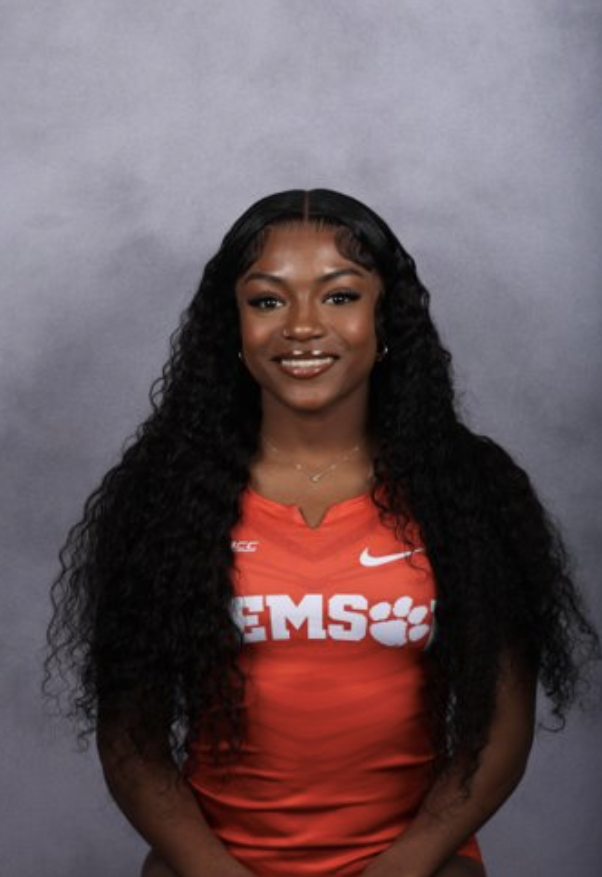
Shanque Williams is a sophomore Psychology major with a minor in Business Management. Williams is a track and field athlete from Jamaica. She’s excited to meet the team and begin working.

Kevin Collins, Beyond the Game Intern

Kevin Collins is a senior Economics major with a Minor in Business Administration from Waldorf, Maryland. He competes in shorts sprints with track and field.

Clemson professor’s NIL research cited in Tennessee legislation

By Katie Gerbasich

Kathryn Kisska-Schulze, J.D., LL.M., a Robert H. Brooks Sports Science Institute Faculty Fellow and the Elliott Davis Associate Professor in the School of Accountancy in The Wilbur O. and Ann Powers College of Business, recently published work on athlete name, image and likeness (NIL) rights that was relied upon by the Tennessee legislature in 2025. Her article, An Evolving Landscape: Name, Image and Likeness Rights in High School Athletes, co-authored by Adam Epstein from Central Michigan University and Nathaniel Grow from Indiana University, was cited as a research reference and practice aid in drafting Tenn. Code Ann. § 47-25-1103, which addresses NIL rights.

The article examines the evolving NIL landscape for high school student-athletes, identifying potential financial risks and proposing a framework to better protect minor student-athletes entering endorsement agreements.

“This honor showcases the impact our research can have on major state legislative interests,” Kissaka-Schulze said.

In spring 2024, Kisska-Schulze launched the School of Accountancy’s first undergraduate sports law course. She also teaches a graduate sports law course for the College of Business’ Master of Science in Sports Business and Analytics program.

Kisska-Schulze has served as chair of the Sports and Entertainment Law Section of the Academy of Legal Studies in Business, represents the College of Business on Clemson University’s Faculty Athletic Council, and was recently named a Brooks Sports Science Institute Fellow.

Campbell professor publishes timely study on drug of concern

Individuals who suffer from chronic pain have increasingly come to rely on kratom, a Southeast Asian plant whose principal psychoactive alkaloids, mitragynine and 7-hydroxymitragynine (7-OH), may soon become Schedule I Controlled Substances in the United States. The two compounds bind to, and partially activate, opioid receptors in the brain.

Bryan Denham, Ph.D., Charlie Campbell endowed professor of sports communication, Clemson University Department of Communication

“People in Southeast Asia have long relied on teas brewed from kratom leaves not only to manage pain but to ease the symptoms of opiate withdrawal,” said Bryan E. Denham, Ph.D., Campbell Professor of Sports Communication in the Department of Communication at Clemson. “Although kratom is not entirely safe, it appears to be less hazardous than concentrated, synthetic versions of 7-OH, manufactured by unscrupulous firms. Synthetics are sold at gas stations and vape stores and are packaged to attract the attention of high-school and college-aged individuals.”

Denham’s study appears in the Journal of Substance Use and addresses the extent to which kratom use correlates with health concerns and signs of dependency on other substances. One finding showed that individuals struggling to quit prescription pain relievers were more than four times as likely as others to have used kratom, a substance the Drug Enforcement Administration (DEA) considers “drug of concern.” In July 2025, the Food and Drug Administration (FDA) advised the DEA to add mitragynine and 7-OH to the list of Controlled Substances, and the DEA is currently considering that recommendation.

“It will be interesting to see what the DEA chooses to do in the coming months,” Denham said. “It announced plans in 2016 to ban mitragynine and 7-OH, but it received significant pushback from kratom users. This time, the FDA has made it a point to state plainly that its recommendation does not include the kratom plant itself. It is primarily interested in the two alkaloids and especially the hazardous synthetic products. A trade group, the American Kratom Association, has endorsed the recommended actions on mitragynine and 7-OH.”

Denham studies the media, health, and policy aspects of substance use in sport and society. He said that in sport, athletes have used kratom to increase energy and to recuperate from intense exercise. Some athletes believe it enhances their focus during competition, and some experiment with it for pain relief. Technically, kratom is not a banned substance, but the United States Anti-Doping Agency advises athletes to avoid using it given potential side effects. Athletes and non-athletes alike should appreciate that kratom is a drug, not a dietary supplement, and they should be aware of manipulative labels on synthetic substances.

In addition to his study in the Journal of Substance Use, Denham has examined the agenda-building function of mass media on kratom policy, exploring how coverage in major national news outlets and regional news organizations has impacted regulatory action. Denham said the Tampa Bay Times, in particular, has examined kratom use in depth, and its reporting has impacted coverage elsewhere in addition to policy conversations at the state and national levels.

Four Brooks research assistants are changing the game within the Departments of Communication, Marketing

By Griffin Barfield

Each year, the Robert H. Brooks Sports Science Institute supports Clemson’s student body by expanding access to scholarships and enhancing experiential learning opportunities, providing funding to various undergraduate and graduate students who are studying sport in their disciplines.

Through annual research awards and professorship funding endowed to faculty in the Departments of Automotive Engineering, Communication, Marketing and Parks, Recreation and Tourism Management, graduate students are hired to engage in research activities affecting the field of sports science.

This year, two of the Institute’s ‘legacy professors’ – Bryan Denham, Ph.D., in the Department of Communication in the College of Behavioral, Social and Health Sciences and Angeline Scheinbaum, Ph.D., in the Department of Marketing in the Wilbur O. and Ann Powers College of Business – funded two graduate students each at Clemson University. 

These students are four of the seven graduate students that the Institute has supported over the last academic year. 

Within the Department of Communication, two research assistants have been analyzing social networks and sports on a global scale with sports communication faculty. 

Cassidy Gruber, graduate student, Department of Communication

Cassidy Gruber and Erin Knight have been researching social media responses that have been presented during the PGA Tour and LIV golf merger, looking to find the role of care during organizational changes. After reworking the literature review, they aim to have a manuscript titled Understanding the role of care in communicating organizational change: A social network analysis of the PGA Tour-LIV golf controversy, published in the Social Media + Society journal.

Assistant professors, Virginia Harrison, Ph.D., and Brandon Boatwright, Ph.D., will be spearheading the manuscript. 

“The Robert H. Brooks Sports Science Institute has given me a unique and rewarding opportunity to incorporate my strategic communication background into sports science research this semester,” Gruber said. “I have thoroughly enjoyed being a part of a motivated research team and contributing to meaningful projects!” 

Knight is also working to understand the social media conversation of sportswashing and nation branding, which has become a rising issue from the political lens of sports. This is her first assignment as a research assistant, and she will continue her work into the Spring 2026 semester. 

Erin Knight, graduate student, Department of Communication

“It’s been really exciting to be a part of the research process in this way,” Knight said, “especially with such an interesting focal point.” 

Boatwright and Harrison are also faculty fellows of the Institute. 

In the Department of Marketing, research assistants Sairah Abraham and Cara Levin work closely with Dr. Scheinbaum, the Institute’s Dan Duncan Endowed Professor of Sports Marketing. 

The two have centered their research on sports marketing and consumer behavior, focusing on Corporate Social Responsibility over the last year with their team. The pair have been examining sport sponsorship as a form of corporate community involvement, investigating how local consumers view sponsor brands and exploring their feelings of gratitude. 

Their team has found outcomes through four large-scale field studies across three professional sports: automotive racing, PGA golf, and USA professional cycling. The research project under the direction of Dr. Scheinbaum found that consumer-corporate identification perceptions help the sponsor-event fit, and the consumer intentions to support sponsor brands, allowing the results to assist with local sponsor brands’ strategies.

“As a Brooks RA, it’s exciting to see how psychology, sports and marketing can team up,” Abraham said. “Each brings unique strengths to interdisciplinary studies that advance research that captures both the science of people and the spirit of the game!” 

Levin has also looked into how sponsorship and community engagement initiatives influence consumer perceptions of the brand’s authenticity, ethical leadership and trust. She has a background in Industrial-Organizational (I/O) Psychology, using that to see how corporate strategy and stakeholder response are affected.

“Clemson’s drive powers both our athletics and research,” Levin said.

As their research wraps up and the semester comes to a close, the students will be reporting on any outcomes or taking their work into 2026.

Fall 2025 interns share their experiences with the Institute

By Lucy Hart

With the Fall semester coming to an end, we are sad to say goodbye to two valuable interns, Griffin Barfield and Lucy Hard, who will be graduating this December, but luckily, interns Katie Gerbasich and Evy Lane have signed on for another semester with the Institute. From writing articles and designing graphics to testing grip strength and hosting lab tours, these interns have impacted every corner of the Institute. 

GRIFFIN BARFIELD

Griffin Barfield is a senior Sports Communication major and Spanish minor from Oceanport, New Jersey, and was the Institute’s Co-Writing and Editing Lead this semester.

“My experience with RHBSSI has helped me grow as an intern,” Barfield said. “Professionally, the Institute helped me understand my role in group work, assisted with my confidence when interviewing faculty and students, and allowed me to form positive relationships with all of the people that I worked closely with over the course of the last two semesters. It’s been an honor to represent them, and I’m excited to see the work that is presented with the next group in the spring!”

After graduating, Griffin plans to work with the Clemson Tigers on Sports Illustrated, where he will transition into a full-time beat writer role, assisting and managing their website and social media platforms to drive engagement. Moving forward, Griffin intends to interview and apply for positions at various sports clubs and franchises nationwide. The Institute wishes Griffin the best of luck!

LUCY HART

Lucy Hart is a senior Sports Management major with a double minor in Youth Development and Business Administration from Rock Hill, South Carolina , and was the Institute’s Events Lead this semester.

“Interning for the Institute has been an incredibly valuable experience for me,” Hart mentions. “Being able to plan and execute events like the RECESS symposium will go a long way in my professional development skills, and I am grateful for the opportunity to work with such a supportive team!” 

Post-graduation, Lucy has secured an internship in Savannah, Georgia, managing part-time employees for an exhibition baseball team. She plans to return to Clemson to pursue a Master’s in Public Administration after her internship. Although we are sad to see her leave the RHBSSI, we are excited to have her back on campus in the future! 

KATIE GERBASICH

Katie Gerbasich is a senior Sports Communication major and Women’s Leadership minor from Houston, Texas, and was the Institute’s Co-Writing and Editing Lead.

“I think this semester has truly expanded my skillset. While I loved the research writing I did, I also worked with new design programs, video, and other social media aspects that I had never used before.” 

Katie will continue to stay with the Institute next semester as a writer. “I plan to graduate in May, so I’m so excited to finish out my Clemson journey with the amazing people here.” 

EVELYN LANE

Evelyn Lane is a senior Marketing major and Spanish minor from Piedmont, South Carolina, and she was the Institute’s Communication Lead this semester. 

“My experience with the RHBSSI has shaped me in so many ways,” she says. “As this is my third semester, I have had the opportunity to work with numerous interns from diverse backgrounds and skill sets, which has taught me how to grow and adapt in my teamwork skills depending on what each person needs from me.” She also notes, “I am thrilled to continue with the Institute and look forward to learning from future interns and further developing myself.”

Evelyn will also be staying on with the Institute for her fourth semester, making her the longest-serving intern in recent RHBSSI history!

Interview with Brooks Scholar alumna, Sarah Buford

By: Griffin Barfield

Sarah Buford graduated from Clemson in May 2025 with a B.S. in Marketing and a double minor in Accounting and Sports Communiction. She received the Markvan Bellamy Endowed Scholarship in Sports Marketing in 2024. During her time at the University, she worked with IPTAY and Clemson Athletics Marketing and Fan Experience teams.

How have you utlilized your major/concentration in sports to help your career?

I have utilized my Sports Communication minor to help with my career sports many times, especially when I speak with Season Ticket Holders about why they love coming to Drive games. Throughout the classes I took in my minor, sports being a unifying factor was always something we discussed, and it is very evident in my career.

What is your role, where, and what do you do?

Currently, I am an Account Executive at the Greenville Drive. My main responsibilities include working with our Season Ticket Holders, selling new season tickets, groups, and hospitality spaces, and creating relationships with people throughout the Greenville area.

What was your journey like since graduating from Clemson?

Four days after graduating from Clemson, I began working at the Drive since baseball season had already started. It was a very quick transition, but I was able to jump in and start helping soon after because of the knowledge I gained from my time at Clemson and previous internships.

What advice would you give to future Brooks scholars as they approach post-grad?

My biggest piece of advice is to find a job that interests you and go for it because you never know what opportunities could come from it.

Clemson faculty explore hidden struggles of D1 athletes competing with chronic illness

By Katie Gerbasich

Division 1 student-athletes already battle the complexities of balancing classes with practices and a social life. When medical conditions emerge, the situation is elevated to a new level. Using funding from the Robert H. Brooks Sports Science Institute (RHBSSI), Department of Communication faculty and RHBSSI fellows, Brandon Boatwright, Ph.D., and Rikishi Simith-Rey, Ph.D., are conducting an exploratory study, hoping to illuminate student-athletes’ challenges as they compete at a high level while managing chronic illnesses and autoimmune diseases. 

Brandon Boatwright, Ph.D. headshot
Brandon Boatwright, Ph.D.

His own journey with an autoimmune disease inspired Boatwright. After a conversation with former Division Ⅰ athlete, Smith-Rey, the idea for the study was born. The two are now working with students Marissa Bennett and Ava Quallen, from the Departments of Communication and Health Science, respectively, to find ways to assist these athletes. 

“Life as a student-athlete is complicated and complex already, but to feel like you’re fighting against your own body in the context of being a college student and trying to navigate your schedule builds the stresses of all that,” Boatwright said. 

A key point in the research has been identifying what resources are available for these individuals. There is a fluctuation in availability among Division Ⅰ programs, and an even greater disparity when comparing Division Ⅰ  to Division Ⅱ.  

“When we think about resources here at Clemson, student-athletes have some of the best stuff, but not everyone goes to Clemson,” Smith-Rey said. “Not everyone, even if you are D1, has the same resources, so how can we identify what resources student athletes need? What ways can we assist them in communicating their needs to other stakeholders in their lives?”

Rikishi Simith-Rey, Ph.D. headshot
Rikishi Simith-Rey, Ph.D.

The study is currently in the data collection process. The team has spoken with different student-athletes across various sports with Type 1 Diabetes, rheumatoid arthritis, and Crohn’s disease, among other illnesses. 

“The folks we have spoken with have been incredible people and athletes competing at such a super high level,” Boatwright said. “They are just incredible people for having to deal with the things that they have dealt with and still preserving.”

Smith-Rey commends these interviews for being a space where these student-athletes feel seen. Often, chronic illnesses or autoimmune diseases have an element of invisibility that makes communication a challenge. 

After speaking with the team, these athletes feel like someone understands their unique story. Boatwright shared a narrative about an athlete with Rheumatoid Arthritis. 

“They would just have to wake up and tell players, teammates, coaches or someone that it’s not gonna happen because I can’t get out of bed,” Boatwright said. “‘I physically just can not sit up enough to get out of bed. It’s just one of those days.’” 

Athletic programs and teams can become better advocates by better understanding the challenges these athletes face due to their medical conditions. 

“We can be that support button right now,”  Smith-Rey said. “Someone is speaking up for you and looking for ways to assist you in this.” 

If you are or were an athlete who competed at the Division Ⅰ  to Division Ⅱ level, are no more than five years removed from your sport, and were diagnosed with a chronic illness or autoimmune disease before competing in college, click here to set up an interview.