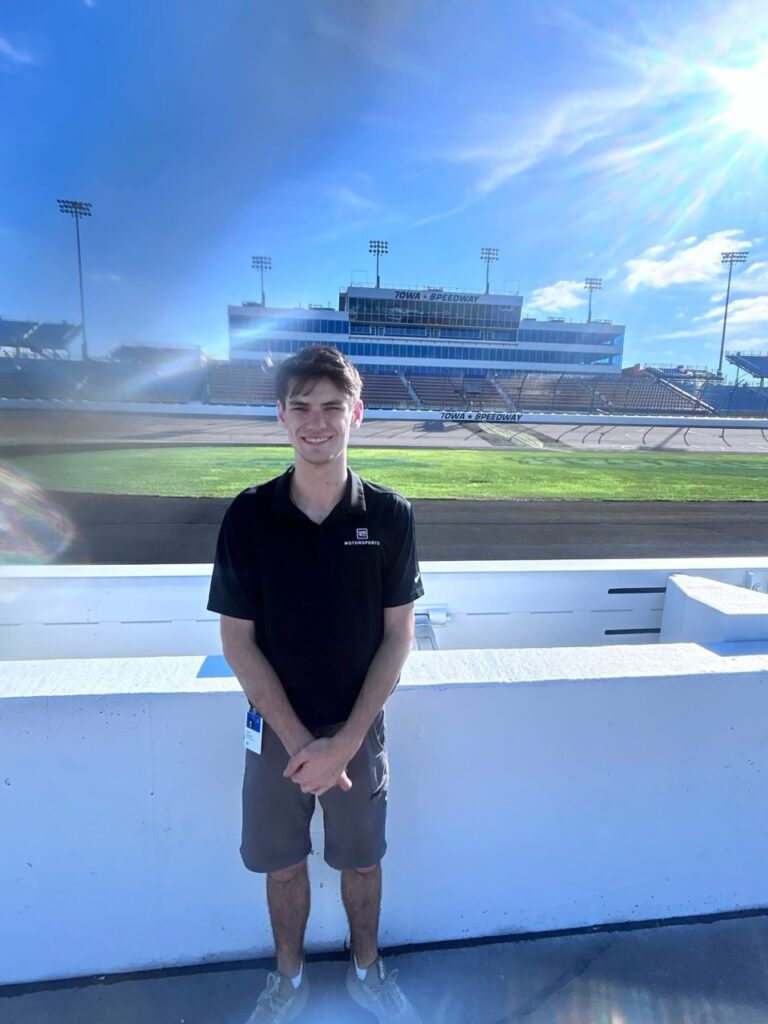
Peter Gaspich is a current Automotive Engineering student graduating in May 2026. He received the Markvan Bellamy Brooks Endowed Scholarship in 2024. He is currently the Suspension Division Lead for Clemson Formula SAE, leading a team of student engineers, and over the summer he was a General Motors Motorship Tires R&D Intern in Concord, North Carolina.
How have you utilized your major/concentration in sports to help you throughout internships?
Most of the skills I use today were gained from my experience as the Suspension Lead for Clemson Formula SAE. My involvement gave me valuable experience in vehicle dynamics, simulation, team management, data analysis, vehicle tuning, and so much more. Almost every skill I apply at work was gained from my experience on the team. I also have the Department of Automotive Engineering to thank to help give me the connections and interpersonal skills needed to excel in the industry.
What was your internship and where were you located?
The track in Iowa
Over the summer I was a Motorsports Tire R&D Intern at General Motors. My role involved testing, modeling, and simulating tire performance to better predict and optimize vehicle performance going into the race weekend. GM Motorsports has afforded me a unique opportunity to work in a variety of series, including NASCAR, Cadillac LMDh in IMSA/WEC, and even the brand new TWG-Cadillac F1 Team!
What advice would you give to future Brooks Scholars as they approach post-grad?
While I haven’t graduated, I would encourage anyone pursuing a career in motorsports to never be intimidated and remain dedicated to their passion. The most important factor in my success wasn’t my GPA or my proficiency in mathematics, physics, dynamics, or any other schoolwork, it was my dedication to my passion and my willingness to sacrifice my time to participate in a hands-on motorsports experience, such as Formula SAE. A crucial skill in any engineering field is knowing how to apply your knowledge, which from my experience, is a skill that cannot be learned within the limits of the classroom.
To kick off the fall 2025 semester, the Robert H. Brooks Sports Science Institute welcomes three returning and two new interns. These students enter with impressive skills gained from a variety of experiences to offer innovative ideas that will advance the mission of the Institute.
EVY LANE
Evy Lane is a senior Marketing major and Spanish minor from Piedmont, South Carolina. In her third semester with the Institute, she will serve as the Communications Lead, which entails creating a content calendar and editing or posting blogs across RHBSSI social media handles.
This past summer, she got the opportunity to write blog posts for the Institute, allowing her to interview faculty and alumni and further explore writing.
“For this semester, I am so excited to be back on campus and create content with our team that will promote the RHBSSI mission, and to learn new skills to help grow our social media,” Lane said.
LUCY HART
Lucy Hart is a senior graduating in December 2025, studying Sports Management with a double minor in Youth Development and Business Administration. From Piedmont, South Carolina, Hart joins the Institute as the Events Lead intern. Her responsibilities will include coordinating the second annual RECESS Symposium and other campus promotional events.
Most recently, she worked as a Destination Experiences Intern with VisitGreenvilleSC, the Destination Marketing Organization for Greenville, South Carolina. In this role, her main project was managing all the volunteers for the SEC Women’s Basketball Tournament hosted in Greenville.
On campus, Hart also serves as the Vice President of CHANGE, Clemson’s student ethics organization. CHANGE creates ethical programming at the University-wide and college-wide levels while exposing students to real-life applications of ethical decision-making and ethical leadership.
“I am an enthusiastic leader who brings positivity and motivation to any team I work with, and I am very passionate about serving my community and working with people,” Hart said. “I hope to encourage others to help bring the community together.”
GRIFFIN BARFIELD
Returning as Writing and Editing Lead Intern, Griffin Barfield is a senior Sports Communication major and Spanish minor from Oceanport, New Jersey. Barfield will work throughout the semester to produce articles highlighting research outcomes from faculty fellows and other important members of the sports science community.
Barfield is also Sports Editor of The Tiger, Clemson’s Student Newspaper. This role involves managing a team of student reporters to cover a variety of Clemson athletics. Additionally, he will be writing for Clemson Tigers on Sports Illustrated, mainly focusing on Clemson football and recruiting.
“I’m so excited to be returning to the Institute for my final semester at Clemson,” Barfield said. “I was able to learn more about our Brooks Faculty Fellows, and I’m looking forward to telling more stories about the advances that happen around campus.”
KATIE GERBASICH
Katie Gerbasich is a senior Sports Communication major and Women’s Leadership minor from Houston, Texas. She will be the Institute’s co-writer for the fall semester, assisting the team in detailing the stories of sports science endavors.
Gerbasich previously worked with the Institute in the fall of 2024 as an Events & Writing Assistant. Here, she helped organize the first-ever RECESS Symposium and curated posts on faculty members for the Sports Insight Blog.
In the spring, Gerbasich worked with Clemson Baseball’s Sports Analytics team and wrote sports articles for Tiger View Media. These experiences allowed her to explore different avenues of college athletics while expanding her communication skills.
“I’ve loved watching the Institute grow so much in the last year,” Gerbasich said. “I’m so excited to be back, joining this amazing team and further promoting the development of sports sciences.”
KATHERINE MANN
Katherine Mann is a junior Graphic Communications major and a Business Administration minor from Fort Mill, South Carolina. As Graphic Design lead, she will assist the Institute in creating visual elements for social media and branding purposes.
Mann is heavily involved in her sorority, Delta Gamma, on campus. Previously, Mann served as Director of Social Media putting her in charge of their Instagram and TikTok accounts. Now, she is Vice President of Programming where she helps plan the calendar, sisterhood events, alumnae relations, and DEI events.
“I am so excited to put my design skills to test and see them featured on the socials,” Mann said. “I am also hoping I can help with growing the social media and gain more engagement.”
RHBSSI team (from left to right) Dr. John DesJardins, Evelyn Lane, Maria Pocorobba, and Kayla Rogers
By Evelyn Lane
As the Summer semester comes to an end, the interns of the Robert H. Brooks Sport Science Institute share the opportunities and projects they had, as well as giving us a peek as to what they will be doing in the Fall semester. As the summer team was small and spread across the country for much of the semester, these interns were thrust into new and exciting roles and successfully tackled new challenges and tasks in order to uphold the RHBSSI mission and goals.
Maria Pocorobba
Maria Pocorobba is a senior communications major and business and brand communication minor from Albany, New York, who was the Institute’s content creator this summer. She assisted enhancing Institute manuals, designing content, and creating logos for the Robert H. Brooks Sports Science Institute to help communicate effectively with their audience and future interns.
“Working with the Robert H. Brooks Sports Science Institute this summer has been an incredible learning experience. One of my favorite projects was designing the new logo and branding materials for the Institute’s fall research symposium – RECESS. I also had the opportunity to contribute to social media content and assist with the Institute’s promotional video,” Pocorobba said. “Each project challenged me to think creatively, adapt quickly, and sharpen my design skills. It’s been a pleasure to work with such a supportive team, and I’m excited to watch the Institute continue to grow and thrive this year.”
In the Fall semester, Pocorobba will be working with Clemson Athletics as both a Graphic Design Intern and a Marketing/Fan Experience Intern. These positions will help her further develop her creative design skills, gain hands-on experience in the sports industry, and play a meaningful role in enhancing the Clemson fan experience, “I’m grateful for the opportunity to contribute to such a passionate and talented athletic department!”
Evelyn Lane
Evelyn Lane is a senior marketing major and Spanish minor from Piedmont, South Carolina, and was the Institute’s communications lead this summer. She helped format, create and enhance the Insitute’s sports science content through their social channels, along with analyzing analytics to help grow their online presence. She also partook in interviewing RHBSSI faculty fellows and alumni to develop the Sports Insight blog posts highlighiting their research, travels, and career endeavors.
“Getting to continue to work with the Institute this summer has helped me grow in so many different facets of my life and develop new skillsets. Having to take on the role of writing blog posts was so scary at first but I am so thankful now that I tackled it head on,” Lane said. “I got to speak to various members of RHBSSI Faculty Fellows and learn more about their travels around the world which was such an enriching experience for me. I was so lucky to get to learn and write about their stories, because along with learning new things about sports research around the world, I also was able to develop my writing skills and learn how to turn a messy blurb of notes into a cohesive and engaging story for the audience. I am so grateful for the new opportunities I got this summer and will take the skills I learned with me in the future.”
In the Fall semester, Lane will continue with the Institue for a third semester as the communications lead. She is excited to continue growing her communication skills along with learning from her future peers and working with them to enhance and uphold the Institute’s mission.
As summer begins, the Robert H. Brooks Sport Science Institute is excited to introduce the two interns who will be assisting the Institute throughout the summer. Meet Evelyn Lane and Maria Pocorobba, who bring a mix of returning knowledge and new ideas to the summer team.
Evelyn Lane
Evelyn Lane, senior marketing major and Spanish minor from Piedmont, South Carolina, is the Institute’s communications lead this summer. She will format and enhance sports science content, promoting the RHBSSI mission through social channels. She will also help develop and write content for the Institute’s Sports Insight blog.
“I am so happy to be returning to the Institute to continue to promote the sports research and newest developments of Clemson faculty, staff and students,” Lane said. “I am also so excited to improve my writing and communication skills through creating articles for the Sports Insight blog.”
Evelyn has previously worked as an account manager and brand strategist with Cadency, Clemson’s student-led agency, and is a returning intern with the RHBSSI from the Spring 2025 semester. She is excited to take her experience from the past semester and continue to help grow the Institute’s social media presence, and is eager to work with her fellow intern and see what they can accomplish.
Maria Pocorobba
Maria Pocorobba, senior communications major and minor in business and brand communication from Albany, New York, is the Institute’s content creator this summer. She will be assisting with strategizing, writing and designing content for the Robert H. Brooks Sports Science Institute to help communicate effectively with their audiences and promote upcoming events and initiatives.
“I am excited to continue combining my passion for design with sports, and gain more hands-on experience creating engaging visuals that bring RHBSSI’s mission to life and connect with the campus community,” Pocorobba said.”I am excited to bring my creative background and skills to RHBSSI this summer!”
She interned with the Brooke T Smith Launchpad as an Analyst in Residence, was a Creative Designer for Cadency, and is a Graphic Design intern for Clemson Athletics. In these roles, she creates social media content, branding elements, and promotional materials.
In 2025, Clemson’s Headgear Impact Performance (CHIP) Lab continues pushing boundaries in helmet safety research, making significant progress through innovative, student-engaged projects. Led by Dr. John DesJardins, professor of bioengineering and interim director of the Robert H. Brooks Sports Science Institute (RHBSSI), and Dr. Greg Batt, associate professor of packaging science and faculty fellow of RHBSSI, the lab focuses on enhancing how protective headgear is tested and developed, particularly for high-impact sports like football. The goal: bring greater accuracy and real-world relevance to helmet testing systems to better protect athletes from concussions and traumatic brain injuries.
In recent years, the team received a patent for their novel testing method and a Technology Maturation Grant from the Clemson University Research Foundation (CURF), the technology transfer and innovation office for Clemson, to make a benchtop testing machine that they can market. Within just the first few months of 2025, Clemson students achieved the publication of three research articles (featured at the bottom of this post) showcasing this momentum. Much of the content was centered around improvements to testing equipment, especially the crash test dummy.
Anthony Marino working in the CHIP Lab
One significant contribution came from the lab’s involvement in a collaborative, multi-site study comparing two standard neck models used in helmet testing, one produced by Humanetics and the other by Jasti Co., both manufacturers of anthropometric test devices (ATDs). Although both neck forms meet federal safety standards, little has been done to compare their performance under sports-specific conditions. Working alongside the University of Southern Mississippi, Clemson Ph.D. student Anthony Marino conducted impact tests with each neck form and found subtle, yet meaningful, differences in how the head accelerated and moved. These insights are critical, especially for labs that standardize results across different testing setups.
Building on this, the student-engaged team set out to improve how realistic and reliable these test dummies are. Many commonly used models, like the Hybrid III, were initially designed for car crash testing, not the unpredictable, multi-directional impacts seen in sports. To address this, the Clemson group experimented with modifications to the dummy’s neck, adjusting cable stiffness and accounting for asymmetrical design features. Even minor tweaks led to significant changes in how the head moved during impact, offering a deeper understanding of how minor variations can influence helmet safety data. These findings help fine-tune testing protocols to reflect real-world conditions on the field.
Madysn Cardinal (left) and Anthony Marino (right)
Meanwhile, a separate research group took testing innovation even further by designing a new method for future concussion research. Led by Ph.D. student Madysn Cardinal, they developed and validated an inverted testing fixture, essentially flipping the dummy upside down to better simulate the effects of brain fluid movement during impacts. This setup could be especially valuable when using cadaveric specimens to study how cerebrospinal fluid and blood shift in response to trauma. After running a full comparison between the inverted and traditional upright test methods, they found strong alignment in critical measurements like angular velocity and linear acceleration. This confirmed the new system’s reliability and potential to support more advanced brain injury studies.
Now with the Technology Maturation Grant from CURF, the team is working to turn their initial patent claims into a working prototype. They are focused on developing a new testing setup specifically designed to evaluate the safety of faceguards, a critical but often overlooked component of protective sports gear. A new Clemson Master’s students will play a key role in advancing this project, gaining hands-on experience while pushing innovation forward in the field of sports science.
Together, these projects highlight Clemson’s growing role as a leader in sports safety research. By challenging outdated standards, refining testing tools and fostering cross-lab collaboration, the CHIP Lab is redefining how we evaluate helmet performance. The CHIP Lab deeply engages its graduate and undergraduate student members, gaining hands-on experience while directly contributing to the future of athlete protection. With continued leadership from Dr. DesJardins, Dr. Batt and support from the Robert H. Brooks Sports Science Institute, Clemson is helping make sports safer, one carefully measured impact at a time.
Check out these recent publications from Spring 2025:
Marino AP, Jesunathadas M, Landry T, Piland SG, DesJardins JD, Batt GS. Comparison of dynamic performance of Jasti and Humanetics neckforms with an inter-lab validation. Proceedings of the Institution of Mechanical Engineers, Part P: Journal of Sports Engineering and Technology. 2025;0(0). doi:10.1177/17543371241312829
Cardinal MD, Marino AP, DesJardins JD, Batt G. Development and validation of inverted head form orientation for helmet testing using a pneumatic linear impact system. Proceedings of the Institution of Mechanical Engineers, Part P: Journal of Sports Engineering and Technology. 2025;0(0). doi:10.1177/17543371241309998
Marino AP, Cardinal MD, Garrison A, Batt GS, DesJardins JD. Effects of varied stiffness and design asymmetry of neck anthropometric test devices on quasi-static and dynamic loading response to football head impacts. Proceedings of the Institution of Mechanical Engineers, Part P: Journal of Sports Engineering and Technology. 2025;0(0). doi:10.1177/17543371251322217
The end of the Spring semester means saying goodbye to five RHBSSI interns. These interns helped uphold and spread the RHBSSI mission in various ways, such as through our social media and student-oriented events. They have left a lasting impression on the Institute and shared their insight about their time here.
Griffin Barfield, Writer/Editor
Griffin Barfield is a junior Communication major and Spanish minor. Alongside interning for the Institute, he is the sports editor of The Tiger, Clemson’s student newspaper. He utilized his skills from this position to highlight Clemson University faculty, staff, students and events that align with the Institute. He skillfully translated the work and stories of the Clemson community into captivating sports science pieces for all audiences to enjoy.
“I’m so happy with how my time with the Institute ended up this semester,” Barfield said. “From forming great connections to connecting with Clemson’s campus more, I’m proud of the work I accomplished here this spring.”
Barfield will be graduating from Clemson in December of 2025. This summer, he plans to go back home and continue improving his writing and editorial skills in New Jersey.
“I hope to come back to the Institute next fall as a writing intern again, and as for this summer, I’ll be looking at freelance writing for my local publications in New Jersey.”
Evelyn Lane, Communications Lead
Evelyn Lane is a junior Marketing major and Spanish minor. Before interning at RHBSSI, she was a brand strategist and account manager for Cadency, Clemson’s student-led brand agency. She used her knowledge of social media strategies and analytics to aid the Institute in growing its social media presence and maintaining a cohesive brand image.
“My time with RHBSSI has helped me grow in many different aspects of my life,” Lane said. “I was able to collaborate with people from all different majors and backgrounds; I learned how to be confident in my ideas, and incorporate the ideas of others into the social media plan, and allow everyone to feel heard.”
Lane will stay in Clemson and continue her internship with the Institute this summer.
“I am so excited to continue working with RHBSSI, watching our media presence grow, and figuring out how to utilize each platform to the best of our abilities.”
Natalie Bell, Graphic Designer
Natalie Bell is a graduating senior Graphic Communications major with a minor in Brand Communications. While interning with RHBSSI, she was also Cadency’s creative director. This semester marks the end of her two semesters with the Institute, where she has been able to showcase her creative talent.
“I have loved my past two semesters with the Robert H. Brooks Sports Science Institute. Since I am a Graphic Communications major and Brand Communications minor, I am not in the sports realm. This internship allowed me to participate in the athletics and research side of Clemson University,” Bell said. “I have gotten to be a part of some fantastic opportunities, such as photographing Clemson’s first Paralympic soccer match and designing mini golf scorecards for our Research Symposium. RHBSSI has made me a more well-rounded graphic designer!”
Bell is graduating this May, and her future endeavors are bright.
“Upon graduation on May 8, I will be starting my full-time position as a Graphic Designer for FerebeeLane in Greenville, SC.”
Nicole Souza, Technical Communications Specialist
Nicole Souza is a graduating senior Bioengineering major. During her time with RHBSSI, she conducted research surrounding Real Madrid NEXT technology partners and utilized her scientific skillset to write blog posts about Clemson’s STEM impacts and CHIP (Clemson Headgear Impact Performance) Lab outcomes.
“It’s been amazing getting to see all the behind-the-scenes work that goes into not just sports science, but also supporting the University and its students,” Souza said. “My time at RHBSSI taught me a lot about the side of science I had not seen in my classes, like marketing, communication and outreach, and I’m really grateful for that.”
Although Souza is graduating this May, she plans to continue her path as a Tiger through Clemson’s Master’s program.
“After graduation this May, I’ll be interning at Arthrex as a product management intern, working with orthopedic medical devices and instruments. Even better, I’ll be coming back to Clemson in the fall to start my Master’s of Engineering in Biomedical Engineering. Go Tigers!”
Keeleigh Bush, Events Lead
Keeleigh Bush is a graduating senior Parks, Recreation and Tourism Management major with an emphasis in Tourism and Event Management. She is also the public relations chair for the Clemson Events Planners Association. With this background, she has excelled in planning, coordinating and executing speaker events and campus activations.
“I had such a great time serving as the Events Intern this semester,” Bush said. “It was incredibly fun and inspiring to work alongside such a talented group of fellow interns.”
Bush is graduating alongside Souza and Bell this May, and it ecstatic about future opportunities.
“I’m graduating this spring and currently exploring opportunities—excited for what’s ahead and staying open to new possibilities!”
Whether they are staying in Tiger Town or taking their talents elsewhere, we know our interns will thrive in the face of any challenge and we thank them for their hard work this semester!
Former RHBSSI intern Katie Gerbasich has been working closely with Clemson Athletics as a member of the Baseball Analytics team and a writer.
by Griffin Barfield
Katie Gerbasichat RECESS 2024.
A former intern at the Robert H. Brooks Sports Science Institute, Katie Gerbasich, a junior Sports Communication major from Houston, TX, has been working closely with various teams and departments through sport, building off of what she learned from the Institute.
Following her stint in the fall of 2024 with the Institute, Gerbasich is now working with the Baseball Analytics team through Clemson Olympic Sports Science. She works specifically with the hitting team, focusing on scouting and player development from the hitter’s perspective.
“We have access to a database that stores tons of information from every single play in the game,” Gerbasich said. “It’s our responsibility to take that information, filter out what’s important, and communicate it to our coaching staff.”
Gerbasich and her team also focus on opponents for Clemson Baseball, picking out key information to highlight its opponents’ strengths and weaknesses. From there, she helps communicate this data to the coaching staff for game planning.
“It’s been super cool to experience the behind-the-scenes of our team and see how our work makes an impact,” she said.
Gerbasich has been an intern with Tiger View Media this spring, covering various sporting events, including Clemson’s spring game.
In addition, Gerbasich joined Tiger View Media as a sports writer, covering various Clemson Baseball, Softball and Women’s Lacrosse events over the course of the spring seasons. She also received an opportunity through the media group to cover the Clemson Football spring game, calling it a “highlight moment.”
From her previous experience as an event and writing assistant with the Institute, she feels that her writing skills have been elevated to another level, being able to write a lot more with Tiger View Media.
“It feels like I’m seemingly able to pump out article after article,” Gerbasich said. “I’m so much more confident now in my abilities now, thanks to the support of the Institute.”
As for the future, Gerbasich will plan to stay with both programs, staying with baseball analytics until baseball season ends this summer. Furthermore, she will continue to work in sports media with Tiger View Media, covering football for the publication in the fall.
She hopes to graduate early and begin pursuing her Master’s degree in Sports Analytics at Clemson, aspiring to work for a professional team in analytics or communication.
The team played and defeated the CP Soccer All Stars 6-1 at Historic Riggs Field at their first real match in program history.
Goalkeeper Max Alberici celebrates a goal with midfielder Chile Chitulangoma, who scored.
While the players lifted a trophy for the win, they weren’t just thrilled with the hardware: they were ecstatic that they even had the opportunity to play.
Shea Hammond is a graduate student in communication who has been with the team for several years, the first undergraduate player in the program’s history. Seeing the event come together was enough to inspire a win.
“It’s the name of the field. It’s historic,” Hammond said after the game. “To finally play on this field, it’s historic. It’s indescribable.”
Head coach and assistant professor in the Department of Parks, Recreation and Tourism Management, Felipe Tobar, watched his players’ dreams come true that afternoon. Many of them had dreamed of playing collegiate sports after high school, a period where many athletes with cerebral palsy (CP) stop playing.
“We’d like to say thank you to the community and the fanbase who supported us,” Tobar said. “They had a dream to play in a college stadium and they accomplished it.”
Graduate student Shea Hammond scored a hat-trick on Saturday morning.
Four different Clemson players scored, while Hammond scored a hat-trick with all three of his goals coming in the second half. One player, Tyler Bennett, is a team alumnus and one of the first two players to join the program in 2017. Bennett brought practices featuring movements, passing and other workouts from the U.S. CP National Team.
It was a new Clemson experience for Bennett, coming back to campus and playing in a full game of soccer with CP rules.
“I think it went well for the program,” Bennett said. “They showed that if you’re training here full-time, you’re going to do pretty well.”
Many faces from the Clemson Men’s and Women’s Soccer teams were present. Flags flew and celebrations commenced in the stands whenever a player scored. The entire women’s lacrosse team attended, surprising goalkeeper Max Alberici, the team’s manager.
That wasn’t the best moment of the game in Alberici’s opinion, however. His favorite experience came from watching substitute goalkeeper, Ethan Donahue, play. He joined the team several weeks before the match after Hammond recruited him on campus. Donahue and his disability were welcomed by the team in open arms.
“I was more happy to get him in the game,” Alberici said.
“There’s no relationship like an adaptive sport relationship,” Hammond said, “and like a CP soccer family.”
The match was the last that this team will play all together, as they say goodbye to Hammond following five seasons with the program. As he graduates from Clemson, Hammond looks forward to working with cerebral palsy and Paralympic athletes in the future.
The Robert H. Brooks Sports Science Institute sponsored the match’s trophy, which the Clemson CP team raised following its win.
“That’s a lifetime of work that I’m going to commit to and making sure that we can grow this program in this sport as much as possible,” Hammond said.
For Tobar, the practices and cultivation of this match proved to be a great success. Earlier in the week, the team played Daniel High School in a scrimmage to prepare for the game. Now, Tobar and his team are “blessed and honored” to have the opportunity to represent Clemson.
“That’s the only official game that we will play as a team,” Tobar said. “I could not be more proud.”
Click here to check out more photos from the match.
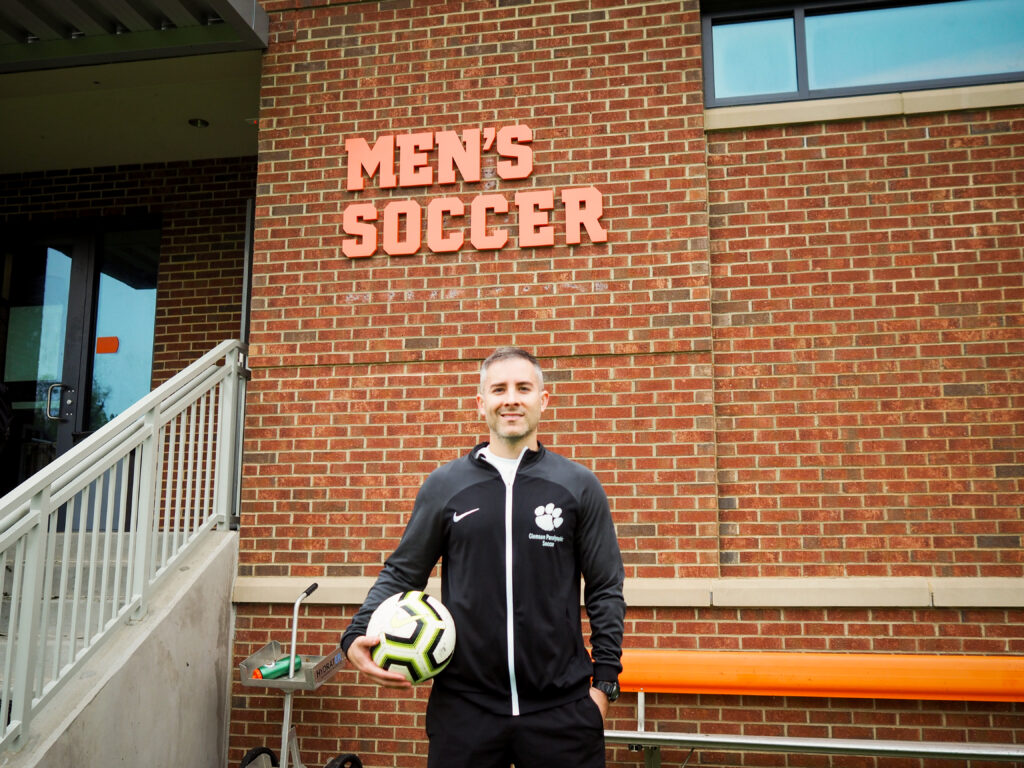
The Clemson Paralympic Soccer team gathers outside the Clemson Soccer practice facility in their new uniforms to prepare for the historic match on April 19. (Photo by Natalie Bell)
Clemson professor of sport and recreation management in the Department of Parks, Recreation and Tourism Management (PRTM), Skye Arthur-Banning, was at the London Paralympic Games in 2012 with a group of students when an idea came to him.
Five years later, that idea would form Clemson Paralympic Soccer, the only collegiate program of its kind in the nation. Now, on April 19 at 11 a.m., the team will be playing their first-ever match in front of a crowd at Historic Riggs Field.
Several Clemson Paralympic Soccer players receive national team call-ups by the U.S. Men’s CP National Team, where they play around the country and even across the globe.
History of Clemson Paralympic Soccer
Arthur-Banning was a soccer referee in 2012 working various professional leagues and U.S. Open cup games. Following the 2012 Paralympic Games, he decided to devote his time to Para soccer, seeing the high performance of blind and cerebral palsy (CP) soccer players during that time.
“Instantly, I knew that was my next step,” he said. “There’s my next opportunity to continue refereeing, but also begin to support those with disabilities in sport environments.
Clemson Paralympic Soccer Head Coach, Felipe Tobar (Photo by Natalie Bell)
Felipe Tobar, assistant professor in the PRTM department, is head coach of the team. Arthur-Banning took notice of Tobar in 2021 while he was assistant coach for Daniel High School’s varsity soccer team.
“They needed a coach, so they needed structured training sessions,” Tobar recalled. “Since I was doing that at Daniel, he invited me to join the program as a head coach. I immediately said yes.”
Strength through adversity
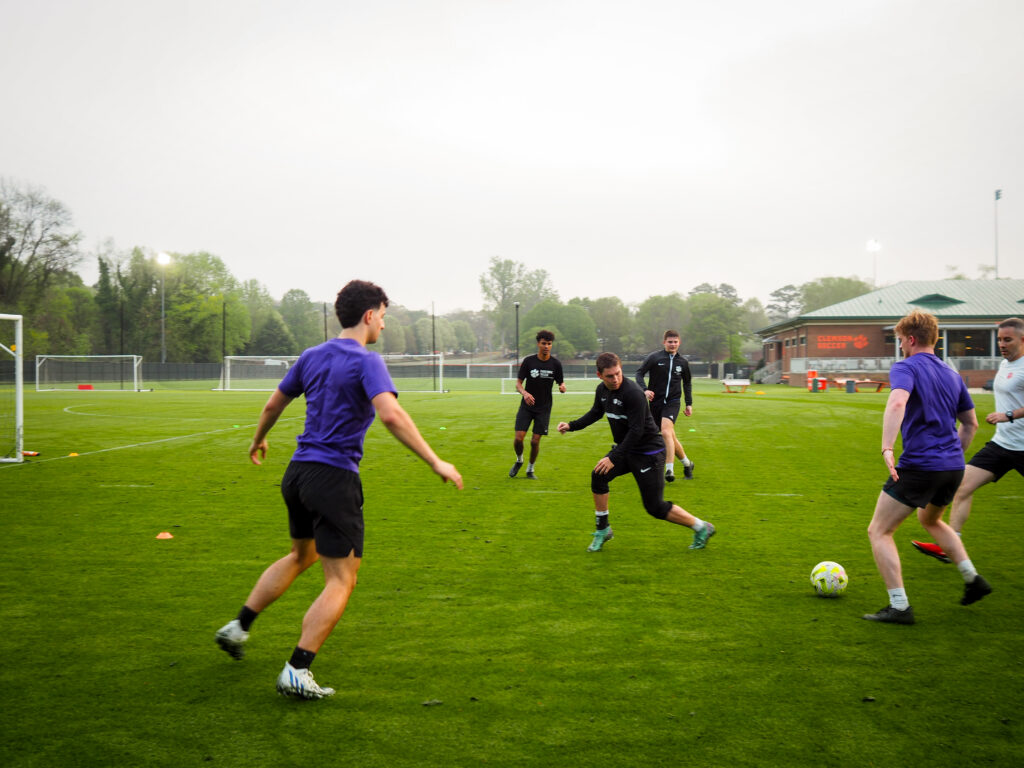
The team is gearing up for its first-ever match on April 19 at Historic Riggs Field at 11 a.m. They practice three times a week to prepare.(Photo by Natalie Bell)
Strength through adversity is the team’s motto. Tobar encourages the team to play and live by this every day.
Currently, the team is made up of six players who have cerebral palsy, a neurological condition that can affect movement and posture. They also welcome players who have suffered a stroke or any severe brain injury.
Tobar has a connection with brain injury through his mother who had a stroke in 2011. He took care of her for eight years in Brazil before moving to the U.S. to earn his Ph.D. in parks, recreation and tourism management at Clemson.
“I saw what a stroke can do to a person, and I empathize with the players,” he said. “I had this background with my mom in which you can’t treat them as victims, you have to really see them as equals.”
Tobar pushes his players with drills and feedback three mornings a week.
“We keep the sessions intense and I don’t treat them differently,” he said.
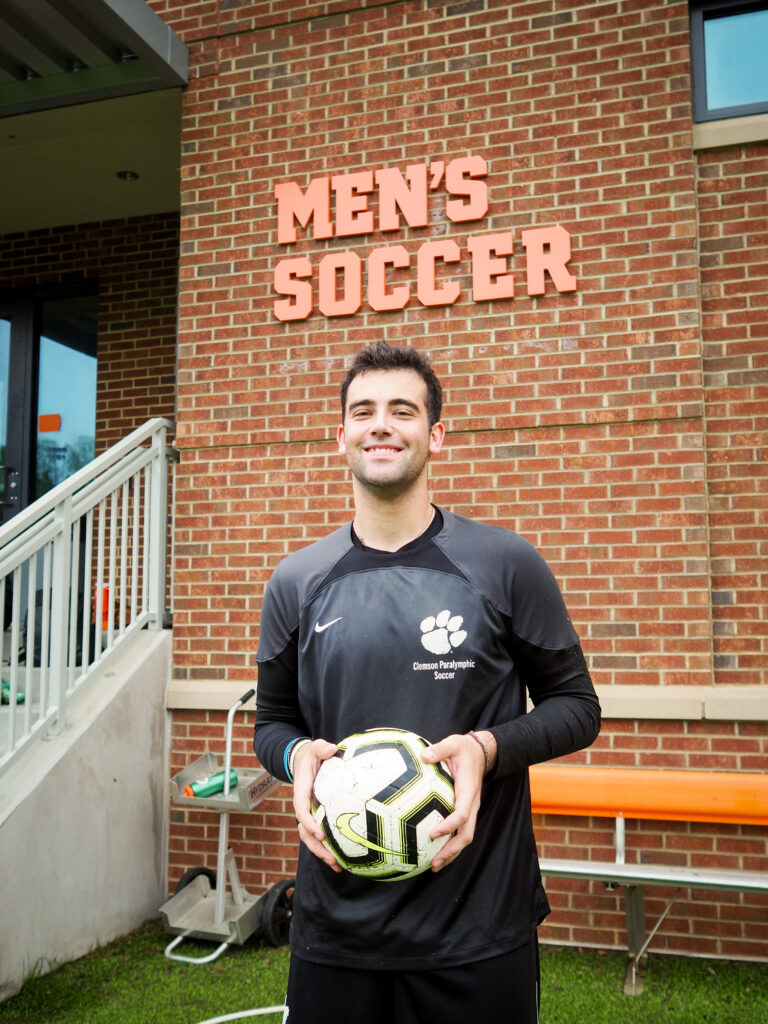
Goalkeeper Max Alberici is the team’s starter, who saw an opportunity to play sports at the collegiate level and joined Clemson Paralympic Soccer.(Photo by Natalie Bell)
The players expend three times the amount of energy on the field as able-bodied soccer players due to quicker muscle fatigue – therefore, their recovery process takes longer.
For goalkeeper Max Alberici, who has spastic diplegia which affects more than one limb, he burns almost four times more energy than the average player. Alberici is a senior sports communication major who grew up playing lacrosse but saw this as an opportunity to continue playing sports in college, which was his dream.
“I hadn’t played organized soccer since eighth grade and I just go ‘okay, I’m doing this,’” Alberici said when he first heard about the program.
Now as the team’s starting goalkeeper, he embraces the training sessions and their intensity.
“There is definitely an intensity that I do enjoy and I had to learn to enjoy,” Alberici said. “But I think overall, I think having a game to work towards is going to make this a lot easier, mentally, for me.”
Because this program at Clemson is unique, four of the team’s six players are also part of the player pool for the U.S. Men’s Cerebral Palsy National Team, where they are regularly picked to play.
Chile Chitulangoma is a defensive midfielder that has been with the team for three years, becoming a regularly called-up player on the U.S. Men’s CP National Team. (Photo by Natalie Bell)
Midfielder Chile Chitulangoma, a junior mechanical engineering major, is one of those players who joined in the fall of 2022. He is hemiplegic on the left side of his body affecting his strength and coordination, but takes advantage of playing quickly to overcome these obstacles. He describes the practices as tactical.
“A lot has to do with technical ability being refined with your technique on the ball,” Chitulangoma said. “So, a lot of the work we do has to do with a lot of different passing patterns and precise movements.”
In the beginning years of the program, the team would practice at local recreational fields like Nettles Park and the Snow Family Outdoor Fitness and Wellness Complex. Since 2024, the team practices at Clemson Soccer’s men’s and women’s practice facilities with help from Clemson Athletics.
“Athletics has given a lot of support to us,” Tobar said. “That elevated the level of our training sessions.”
As the only U.S. school with this type of program, Clemson allots eight scholarships that allow out-of-state players to pay in-state tuition — the only university in the world that does so for CP soccer.
The match
Tobar describes the upcoming match as a debut for everyone — the first time Clemson Paralympic Soccer will play against other Paralympic soccer players from across the country for a trophy.
“We hope this game will bring attention to our program and the University this week,” Tobar said.
Players who have recently been admitted to play for the Tigers next season will also be on this all-star team of contenders. The captain of the U.S. Men’s Cerebral Palsy National Team, Josh Burnais, will be coaching the opposing team.
CP soccer rules are slightly different from traditional soccer rules. The game will be played in two halves, each 30 minutes long. Compared to soccer’s standard 11-on-11 format, CP soccer is played 7-on-7 with field dimensions and goal sizes a little smaller.
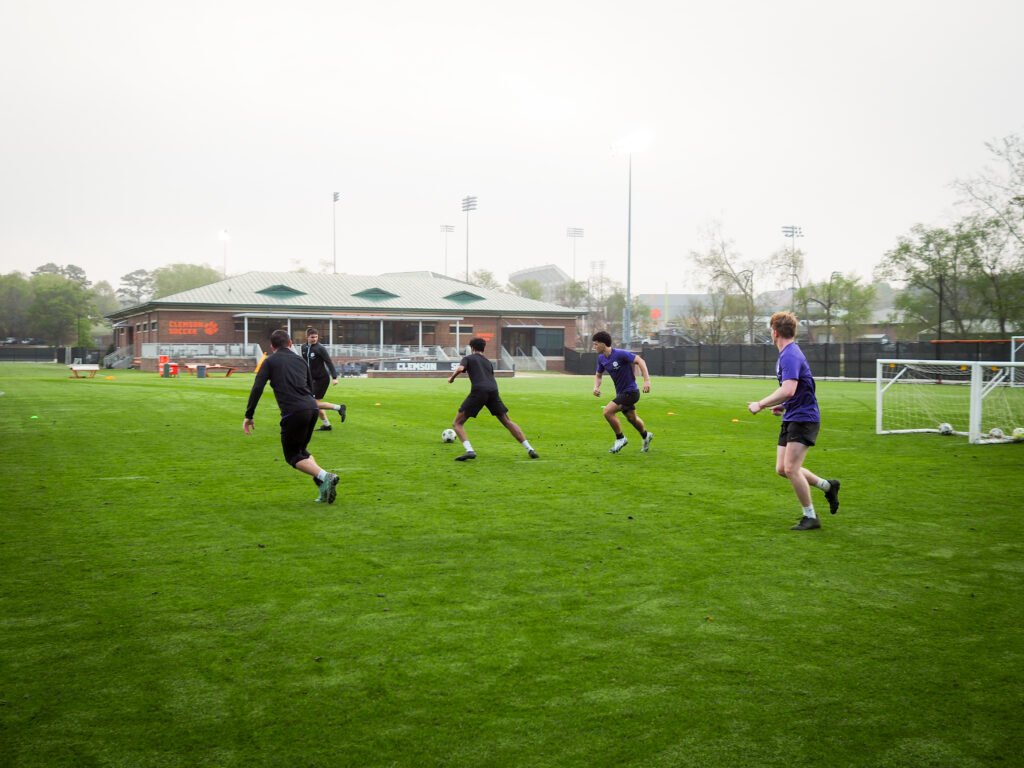
Clemson Paralympic Soccer Team practicing for the upcoming match (Photo by Natalie Bell)
Throw-ins can change to simply rolling the ball in underhand. If the ball unintentionally hits the CP-impacted hand in a natural position, there is no handball offense. These changes were made based on how the body functions for a CP player.
The event on April 19 will also be open to children with disabilities in the Upstate to have a one-hour clinic with the team from 9 to 10 a.m. to meet and play together. During the starting lineups, they will enter the field with the players.
“We want them to see their future on the pitch, so they can reflect and see that although there are barriers that they are going to face, it’s still possible to strive and succeed,” Tobar said.
For many of the players, it is a dream come true. Alberici grew up wanting to play in a stadium, and now his dream is becoming a reality.
“My main goal was always to be a college athlete,” Alberici said. “The soccer piece was much later than almost every single one of my teammates, but I’d never thought I’d play college sports in a college stadium.”
Meanwhile, for players like Chitulangoma, educating the public about overcoming adversity is what is most exciting.
“I think it’s a very unique opportunity to [educate about my disability] with a game of soccer,” Chitulangoma said. “I don’t think there’s a better way we could show our game and our disability to the community.”
Clemson Athletics is supporting the event. The day will see several Clemson Men’s and Women’s Soccer players making an appearance, with some taking part in halftime promotions.
Tobar also plans to auction signed soccer balls and other items to fundraise for the team.
That same weekend, Clemson Adaptive Sports and Recreation will be hosting the Palmetto Games, a regional adaptive sport event featuring track and field, swimming and air rifle competitions.
“We want to have as many people as possible,” Tobar said. “There are no other sports that are going to be playing that morning, so it’s a full day of Para sports.”
With kickoff set for 11 a.m. on April 19, Arthur-Banning, Tobar and the team are ready for their first organized CP game in program history, hoping to spread more awareness about Para sports and the work that the players have put in.
“I think this game provides that opportunity for them to showcase all the hard work that they’ve put in, all the skill and talent that they have and, hopefully, be able to do that in front of not only their Clemson peers, but their community at large,” Arthur-Banning said.
“This gives them that opportunity to show that off a little bit and feel like this is their payback, if you will. This is their moment.”
Arthur-Banning and Tobar are faculty fellows of the Robert H. Brooks Sports Science Institute at Clemson, sponsor of the trophy for the historic Paralympic soccer match.
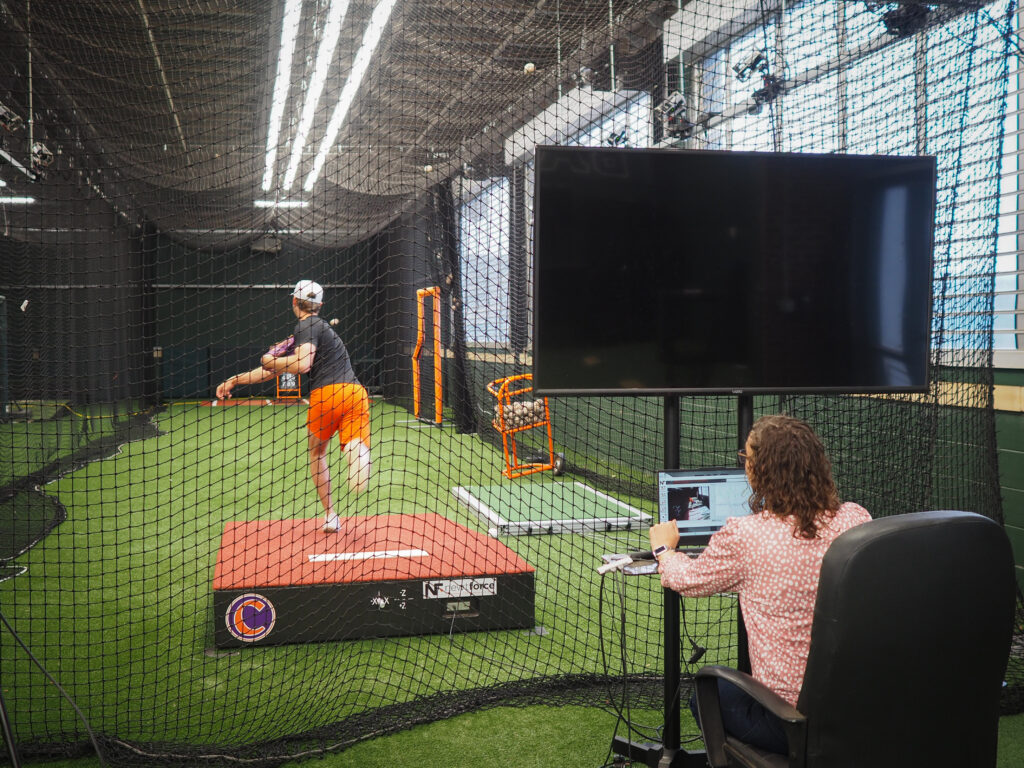
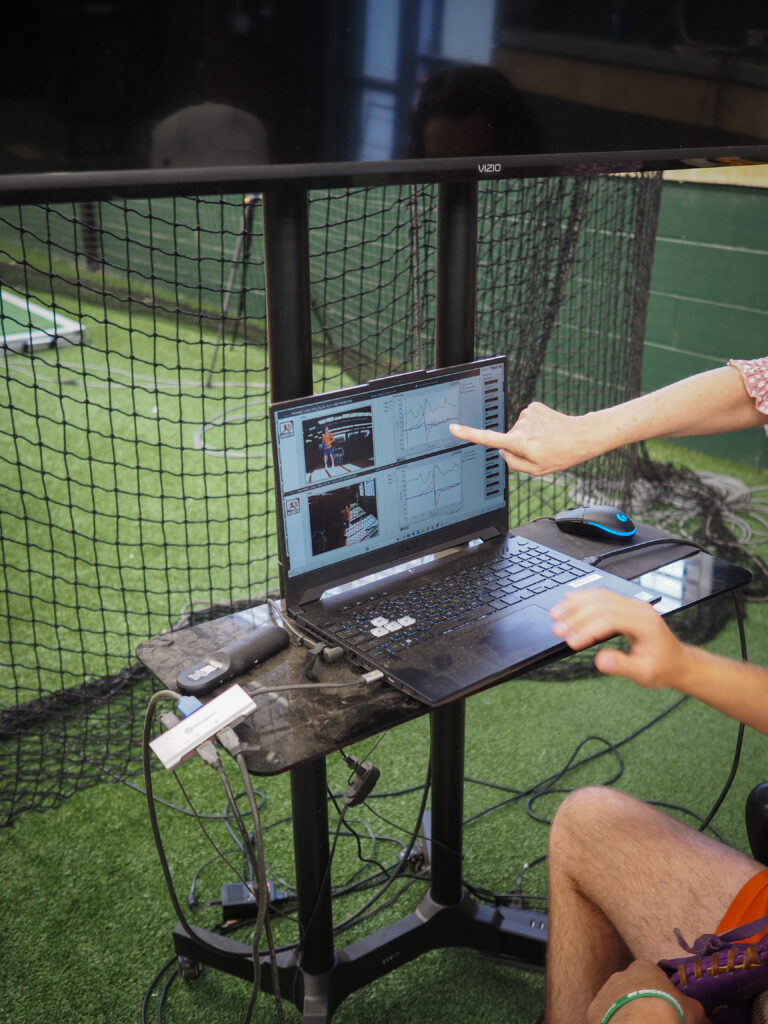
Amy Pope analyzing Lucas Mahlstedt’s pitching data (photo by Natalie Bell)
By Griffin Barfield
Lucas Mahlstedt, senior Physics major, has joined forces with Physics lecturer, Amy Pope, to analyze pitching data to examine how the mechanics of a baseball pitch relate to pitch velocity. . One of Clemson Baseball’s top relief pitchers, Mahlstedt is combining his love for the sport and physics to complete his senior thesis this semester.
Mahlstedtdemonstrating throwing motion (photo by Natalie Bell)
“Our main goal is to figure out what increases pitch velocity the most because there’s so many different ways,” said Mahlstedt. “So many different pitchers have different mechanics. You’ve got guys who throw from the side, up top, guys with different arm action.”
Mahlstedt’s throwing motion is a ‘submarine’ throw, which means his toss closely resembles an underhand throw by whipping his arm around his body, allowing the ball to come from different angles. The motion is untraditional compared to a pitcher that throws over their shoulder. Regardless of throwing motion, size and age, Mahlstedt is interested in establishing a consistent variable through physics that pitchers can use to improve their game.
“So, we’re trying to find something consistent that every pitcher could use at different levels,” he said.
The physics of sport
Pope teaches the physics of sport at Clemson. Her work intersects with different sports like football and, most recently, breakdancing which was introduced in the 2024 Paris Olympics. She has also worked closely with golf and ski jumping. This is her first time working with baseball student-athletes.
From golf to baseball, Pope describes how ball material makes this study different from one she had conducted with Clemson Golf students.
“I’ve worked with some of my students who have been in golf and we’ve looked at Trackman data for that,” Pope said. “Golf is difficult because the balls have dimples, which give a lot of additional air flow and make the ball stay in the air longer.”
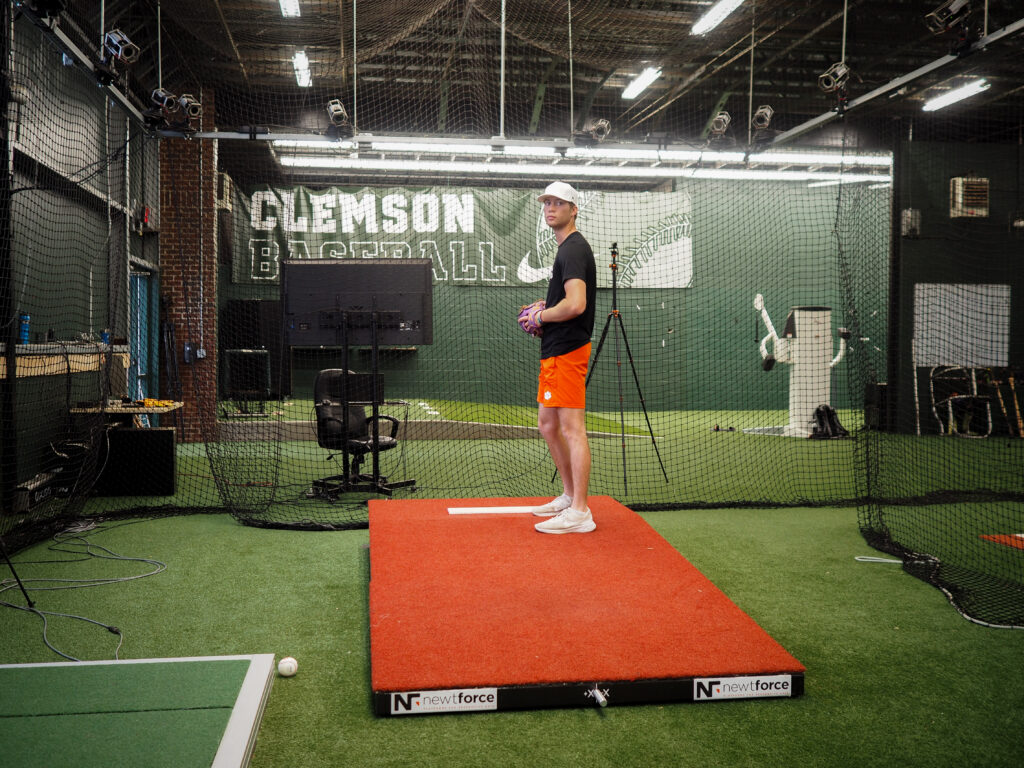
Using a Newtforce Mound to collect data, Mahlstedt has narrowed down variables that could help detect a linear relationship for faster pitches.
“The Newtforce Mound looks like a piece of plywood that’s at a little bit of an incline,” Pope explained, “and whenever you are stepping on the plate, it’s recording all of the forces that are acting on it in three dimensions at one time.”
A radar gun is also used to detect the speed of each pitch.
Mahlstedtgearing up to pitch.
With the help of these tools, Mahlstedt believes that the acceleration impulse of the pitch, or the ground force measured from the pitcher’s leg lift, could be the variable he’s been looking for.
The two compared Mahlstedt’s data with other pitchers and managers on the team, who participated in the research, and they saw a linear correlation.
“For multiple pitchers, we have observed that the larger the impulse put into the ground during the pitch, and conversely, the harder the ground pushes up on the player, the faster the exit velocity of the ball,” Pope said.
While there are various details that could be factors, such as stride length in the pitcher, their arm strength and effective kinetic chain of their arm movement, the two are putting their attention to how the ground forces affect the exit velocity of the ball.
“I think we narrowed it on mainly focusing on the lower half of the body,” Mahlstedt said.
With a full-body sport like baseball, there is high injury incidence at all levels. Baseball pitchers face risk of serious injury throughout their careers; therefore, performance cannot be fostered without a serious look at injury prevention.
“We can talk about injury prevention because if you can get that lower half of your body into it, you’re going to be able to throw the ball faster without risking your throwing arm as much,” Pope said.
“If you can generate more velocity from [your lower body], it should be less from [your upper body], at least,” Mahlstedt agreed.
The results are in
For the Clemson pitcher, the results have been working. As of April 2, the pitcher has a 1.09 earned run average(ERA), striking out 34 in 24.2 innings pitched this season, and an opposing batting average of .180. Mahlstedt has also noticed that he has “been throwing harder” over the course of this season.
Pope and Mahlstedtreviewing results
The senior has been using a larger acceleration impulse for his pitches, heightening the force that he puts in the ground from his leg lift. From this force, and according to Newton’s third law of motion, the opposite reaction that the ground gives him the force that he needs to throw faster.
If this variable is important, how, then, does an athlete train to increase their acceleration impulse?
“A lot of water bag drills,” said Mahlstedt. “It’s used for stability, but if you take a water bag and you move it and you kind of rock, you almost feel this impulse with the water sloshing back and forth. It just improves stability.”
Jumping exercises, such as one leg jumps, have helped Mahlstedt’s transfer of force, which would allow for a linear increase.
“That has led to that increase in acceleration impulse and then an increase in velocity,” he said.
As for the future, Mahlstedt and Pope will be further researching how the upper and lower body interact during a pitcher’s career progression, hypothesizing that measuring the lower half of the body could lead to more findings that will help pitcher training.
“The kinetics with the ground forces in the lower half is easier because we have to do the force itself,” Mahlstedt said.
“We’re looking at ways that we can quantitatively say that most players, if they do this, they should be throwing the ball faster,” Pope added. “Each athlete is very individualized with their body mechanics and in what they do, so we’re just trying to look at some overall metrics that a player might be able to look at to see if they can improve that metric and, thereby, improving their pitching speed.”
Injury prevention was another future topic mentioned, due to the amount of pitchers that suffer upper body injuries from body fatigue. Most of the research released about baseball pitchers is about injury prevention, and the two are interested in evaluating how their research on lower body forces can add to prevention.
“If you can focus on the lower half to increase the speed of the pitch,” Pope said, “that’s probably less damaging to the arm. Not a lot of pitchers go out because they injure the lower half.”
Whether the MLB Draft or a future in baseball is in the cards, Mahlstedt hopes that his research will be the continuation of something important, whether in pitcher development or injury prevention, on the baseball diamond.