
By Griffin Barfield
Lucas Mahlstedt, senior Physics major, has joined forces with Physics lecturer, Amy Pope, to analyze pitching data to examine how the mechanics of a baseball pitch relate to pitch velocity. . One of Clemson Baseball’s top relief pitchers, Mahlstedt is combining his love for the sport and physics to complete his senior thesis this semester.

“Our main goal is to figure out what increases pitch velocity the most because there’s so many different ways,” said Mahlstedt. “So many different pitchers have different mechanics. You’ve got guys who throw from the side, up top, guys with different arm action.”
Mahlstedt’s throwing motion is a ‘submarine’ throw, which means his toss closely resembles an underhand throw by whipping his arm around his body, allowing the ball to come from different angles. The motion is untraditional compared to a pitcher that throws over their shoulder. Regardless of throwing motion, size and age, Mahlstedt is interested in establishing a consistent variable through physics that pitchers can use to improve their game.
“So, we’re trying to find something consistent that every pitcher could use at different levels,” he said.
The physics of sport
Pope teaches the physics of sport at Clemson. Her work intersects with different sports like football and, most recently, breakdancing which was introduced in the 2024 Paris Olympics. She has also worked closely with golf and ski jumping. This is her first time working with baseball student-athletes.
From golf to baseball, Pope describes how ball material makes this study different from one she had conducted with Clemson Golf students.
“I’ve worked with some of my students who have been in golf and we’ve looked at Trackman data for that,” Pope said. “Golf is difficult because the balls have dimples, which give a lot of additional air flow and make the ball stay in the air longer.”
Using a Newtforce Mound to collect data, Mahlstedt has narrowed down variables that could help detect a linear relationship for faster pitches.
“The Newtforce Mound looks like a piece of plywood that’s at a little bit of an incline,” Pope explained, “and whenever you are stepping on the plate, it’s recording all of the forces that are acting on it in three dimensions at one time.”
A radar gun is also used to detect the speed of each pitch.
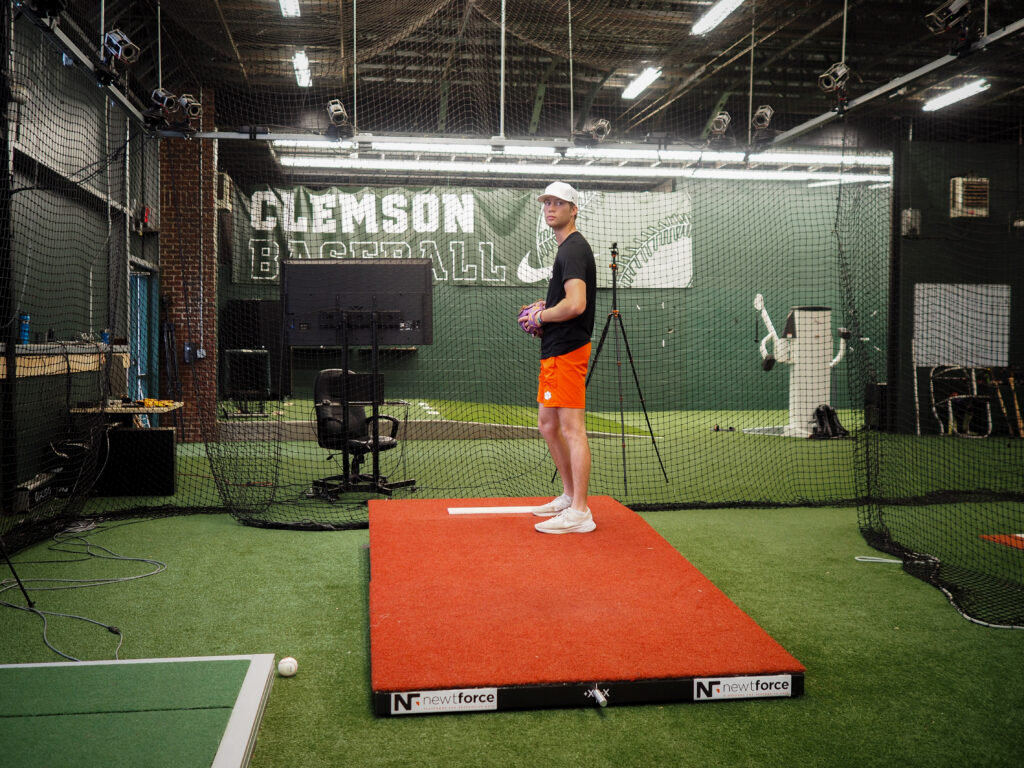
With the help of these tools, Mahlstedt believes that the acceleration impulse of the pitch, or the ground force measured from the pitcher’s leg lift, could be the variable he’s been looking for.
The two compared Mahlstedt’s data with other pitchers and managers on the team, who participated in the research, and they saw a linear correlation.
“For multiple pitchers, we have observed that the larger the impulse put into the ground during the pitch, and conversely, the harder the ground pushes up on the player, the faster the exit velocity of the ball,” Pope said.
While there are various details that could be factors, such as stride length in the pitcher, their arm strength and effective kinetic chain of their arm movement, the two are putting their attention to how the ground forces affect the exit velocity of the ball.
“I think we narrowed it on mainly focusing on the lower half of the body,” Mahlstedt said.
With a full-body sport like baseball, there is high injury incidence at all levels. Baseball pitchers face risk of serious injury throughout their careers; therefore, performance cannot be fostered without a serious look at injury prevention.
“We can talk about injury prevention because if you can get that lower half of your body into it, you’re going to be able to throw the ball faster without risking your throwing arm as much,” Pope said.
“If you can generate more velocity from [your lower body], it should be less from [your upper body], at least,” Mahlstedt agreed.
The results are in
For the Clemson pitcher, the results have been working. As of April 2, the pitcher has a 1.09 earned run average(ERA), striking out 34 in 24.2 innings pitched this season, and an opposing batting average of .180. Mahlstedt has also noticed that he has “been throwing harder” over the course of this season.
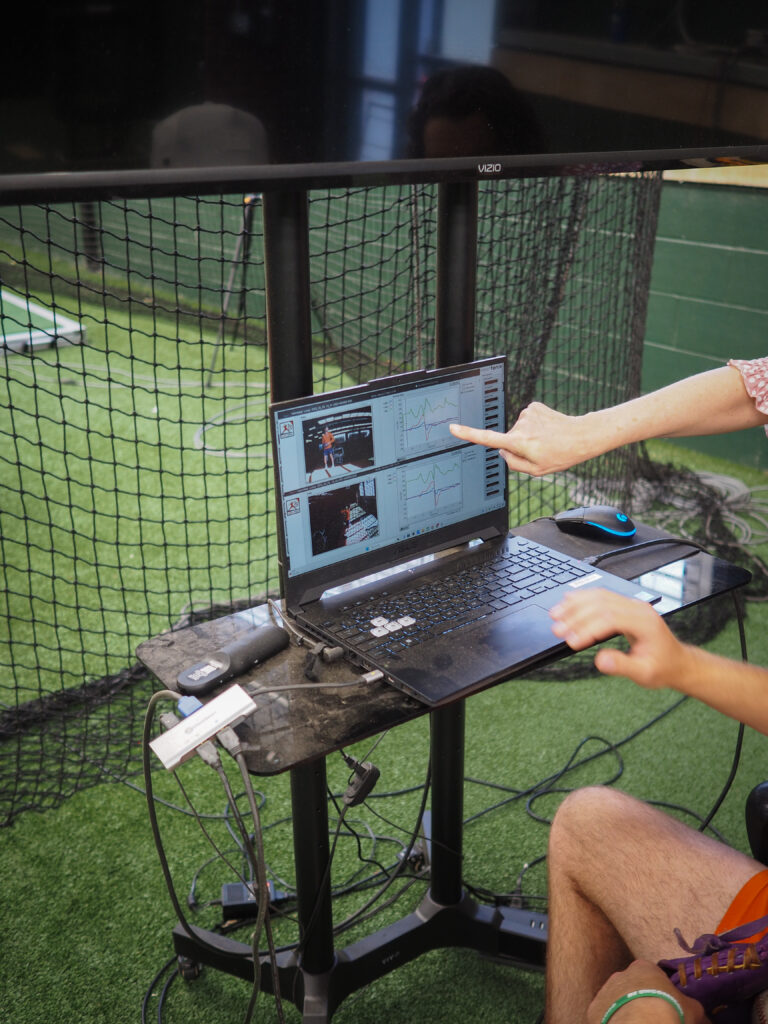
The senior has been using a larger acceleration impulse for his pitches, heightening the force that he puts in the ground from his leg lift. From this force, and according to Newton’s third law of motion, the opposite reaction that the ground gives him the force that he needs to throw faster.
If this variable is important, how, then, does an athlete train to increase their acceleration impulse?
“A lot of water bag drills,” said Mahlstedt. “It’s used for stability, but if you take a water bag and you move it and you kind of rock, you almost feel this impulse with the water sloshing back and forth. It just improves stability.”
Jumping exercises, such as one leg jumps, have helped Mahlstedt’s transfer of force, which would allow for a linear increase.
“That has led to that increase in acceleration impulse and then an increase in velocity,” he said.
As for the future, Mahlstedt and Pope will be further researching how the upper and lower body interact during a pitcher’s career progression, hypothesizing that measuring the lower half of the body could lead to more findings that will help pitcher training.
“The kinetics with the ground forces in the lower half is easier because we have to do the force itself,” Mahlstedt said.
“We’re looking at ways that we can quantitatively say that most players, if they do this, they should be throwing the ball faster,” Pope added. “Each athlete is very individualized with their body mechanics and in what they do, so we’re just trying to look at some overall metrics that a player might be able to look at to see if they can improve that metric and, thereby, improving their pitching speed.”
Injury prevention was another future topic mentioned, due to the amount of pitchers that suffer upper body injuries from body fatigue. Most of the research released about baseball pitchers is about injury prevention, and the two are interested in evaluating how their research on lower body forces can add to prevention.
“If you can focus on the lower half to increase the speed of the pitch,” Pope said, “that’s probably less damaging to the arm. Not a lot of pitchers go out because they injure the lower half.”
Whether the MLB Draft or a future in baseball is in the cards, Mahlstedt hopes that his research will be the continuation of something important, whether in pitcher development or injury prevention, on the baseball diamond.
