Dr. Erica Walker uploads the RHBSSI logo to the dye sublimation printer.
By Katie Gerbasich
Walking through downtown Clemson, it’s hard to miss the sea of orange and purple. Hundreds of t-shirt designs line storefronts using different colors, fabrics, and printing techniques. Still, fans expect one thing to remain consistent: they should be able to recognize their team instantly by color alone.
Drs. Erica Walker and Amanda Bridges in Clemson’s Department of Graphic Communications have spent the past several years studying exactly that.
“Color is a vital part of a brand’s identity, and printing consistent, durable, and accurate brand colors across different materials can be challenging for manufacturers,” Walker said.
After receiving international recognition for their Clemson-branded textile research, Walker and Bridges expanded their work to include all ACC team colors. The study evaluates 64 brand colors across multiple textile types and printing methods, including dye sublimation and direct-to-film (DTF) printing, to better understand how color accuracy, durability, and material interact in athletic apparel.
“Brand colors matter, and fans recognize when their team’s colors are not representative,” Walker said.
To test this, the research compared two printing processes, dye sublimation and direct-to-film printing, across cotton, polyester, and blended fabrics. By analyzing how each method performs on different materials, the study highlights the challenges of maintaining color accuracy at scale.
The dye-sublimation printer funded by RHBSSI is located in Dr. Walker’s lab in Godfrey Hall.To begin the printing process, the RHBSSI logo is printed onto transfer paper.The paper is placed on the garment to then be heat-sealed. Finally, the film gets peeled off the t-shirt to unveil the finished garment.
Walker, a faculty fellow of Clemson’s Robert H. Brooks Sports Science Institute, has received support from the Institute throughout this work, including funding for equipment and conference participation.
The findings show that the printing method, textile type, and color family play significant roles in color accuracy. Direct-to-film printing consistently produced more accurate color results overall, while dye sublimation performed best on 100% polyester fabrics. Across both processes, some color families proved easier to reproduce than others. Neutral tones such as black and gray, along with yellow-gold hues, showed higher accuracy across processes and textile types, whereas more saturated colors posed greater challenges.
As athletic departments continue to expand the reach and value of their brands, maintaining color consistency becomes more than simply a design challenge. It becomes part of how student-athletes and fans identify with, represent, and connect to their teams.
“Ensuring that brand colors are seen accurately across mediums, processes, and materials,” Walker said, remains a central goal of the research.
By examining how printing methods and fabrics influence color accuracy, the study offers manufacturers valuable insights for delivering consistent, high-quality products. So the next time you buy a Clemson t-shirt, take a second look to see if it is actually Clemson Orange and Regalia purple.
Drs. Erica Walker and Amanda Bridges’ research discovers different strategies to ensure the University’s brand colors remain consistent on athletic apparel
Most sports fans own at least one t-shirt donning the brand of their favorite team or jersey representing their favorite athlete. When they are preparing to join the crowd at a field, rink or stadium, sports fans expect their regalia to look on-brand.
According to Drs. Erica Walker and Amanda Bridges, Clemson faculty in the Department of Graphic Communications, “Branded athletic apparel is a multi-billion dollar business expanding year over year. Sports teams and their fans expect brand accuracy and durability across all types of textile-based products from clothing to home decor. Color is a vital part of a brand’s identity and printing consistent, durable and accurate brand colors across different materials can be challenging for manufacturers.”
Clemson Orange is printed on different textiles and laundered to see how true-to-brand the color of the Clemson paw remains.
The pair have examined the accuracy and durability of two Clemson brand colors, Clemson Orange and Regalia (purple), “specified by the brand as Pantone and CMYK values and measured as LAB values using a spectrophotometer, and printed on three textiles commonly used for clothing.”
Late in 2024, Walker and Bridges received international recognition for their research presented at conferences in Montreal, Canada (Color and Imaging Conference, October 2024) and Seville, Spain (International Conference of Education, Research and Innovation, November 2024). Additionally, they will present in Boulder, Colorado this March at the Technical Association of Graphic Arts (TAGA) conference.
Walker shared some of the challenges their research aimed to address.
“Orange is an especially difficult color to match in any medium,” she said. “Our eyes are pretty sensitive to variations in this color range so branded content creators have to be especially vigilant to ensure a consistent visual match.
Another challenge is the variety of materials and places that the color appears. We see Clemson Orange on the TV screen, on printed t-shirts, painted on the grass on the athletic fields, on the plastic seat backs, on metal decorative art outside, and so many other surfaces. Each backing material and process must be carefully chosen and controlled to ensure accurate brand color.”
During their investigation, the two provided opportunities for freshmen-level experiential learning with a direct-to-garment (DTG) printer and worked closely with Clemson Athletics to assess how the University’s brand colors are affected by commercial washing processes, looking at color degradation.
Walker shared advice for printers and manufacturers to achieve color accuracy and durability.
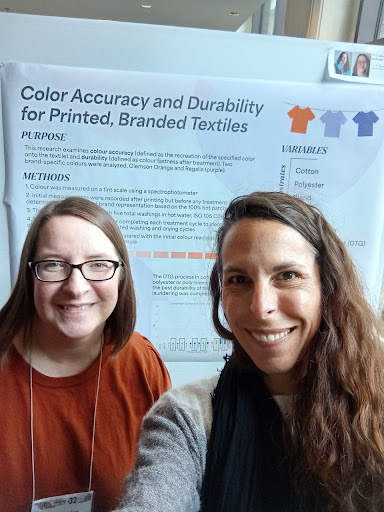
Bridges (left) and Walker (right) attended the CIC Conference in Montreal, Canada last November.
“You can never have too much quality control throughout the process. Everyone who touches the artwork or product from the beginning design to manufacturing to the sales floor has a role in ensuring brand accurate colors,” she said. “This even includes fans! How we launder brand-color products can help the colors stay accurate for longer.
There are definitely some combinations of textiles and processes that will provide more accurate colors both initially and after multiple washes, so manufacturers take that into consideration when developing new products and deciding how to manufacture them.”
At the end of the day, one question remains above all in Walker’s and Bridges’ research: How can the University engage with textile manufacturers, printers and launderers to ensure the brand stays true on apparel and other products?
“This project helped me connect my color work on screen to what the cameras actually record live—the uniforms of the players and the branded fan gear,” Walker said. “The current study attempts to back the solution up further than ColorNet, which fixed the brand colors after they were recorded on camera. Wouldn’t it be great to get the color more closely aligned both on and offscreen to provide a unified, cohesive brand experience?”
Walker has been a faculty fellow at the Robert H. Brooks Sports Science Institute for many years. The proposals she submitted for ‘director’s funding’ were reviewed and approved by RHBSSI leadership, and the Institute was pleased to fund the purchase of the DTG printer and offer financial assistance to participate in the conferences.
“It was a very [special] international conference and the first time either of us had attended it,” Walker said about CIC. “[It] would definitely be a valuable event to visit again and we really appreciate the support which allowed us to go to both CIC and TAGA this academic year.”
A view of how Clemson University’s football team’s purple jerseys appeared on televisions around the country.
The Saturday before Thanksgiving in 2018, my family and I settle into our living room to watch the Clemson Tigers play the Duke Blue Devils. I was lucky to be able to fly home a little before the break began and was thrilled to be able to watch the football game with my family. My mom prepared for the occasion, filling the coffee table with snacks usually reserved for our Super Bowl watch party. As the camera pans to the Tigers making their run down the Hill as part of the most exciting 25 seconds in college football, my brother only makes one comment: “Oh, Duke is running down the Hill!”
Emma Mayes, a Clemson student on Dr. Walker’s research team
Of course, it wasn’t Duke. There is no way an opponent would run down the Hill at a Clemson home game. But lo and behold, it appeared that way. Clemson’s purple jerseys donned to celebrate Clemson’s “Purple Out” football game in honor of its Military Appreciation Day, appeared navy blue on the screen, a similar shade to Duke’s team colors. And it wasn’t just our TV; Clemson looked to be wearing navy blue across broadcast footage and television screens. My dad and brother had a field day, cracking jokes about how Duke was playing themselves in Death Valley.
This is not a problem limited to Clemson. This brand color discrepancy is also apparent with other teams when they play, such as the Dallas Cowboys, where their silver pants appeared green during a broadcasted game. And what is a sports team without their team colors? Unfortunately, trying to correct the brand colors means all the colors in the frame would suffer. Environmental lighting and post-production color adjustments affect the entire frame of the broadcast feed. So, while the brand color could be adjusted to appear correct, the rest of the frame would be adjusted as well, ruining other colors at the expense of fixing one.
Dr. Erica Walker, a Clemson University graphic communications professor
Enter Dr. Erica Walker, a Graphic Communications professor at Clemson University, who brought together a team that asked whether the frame could be adjusted so these colors appear to brand specification, but not at the cost of the rest of the frame being adjusted as well. She partnered with the Watson in the Watt Creative Inquiry run by Dr. Hudson Smith and Dr. Carl Ehrett to work with undergraduate students to develop an AI-based solution. I ended up being one of those undergraduate students. I was thrilled to get involved with research about AI but was even more excited by this problem we would be solving, remembering that this was something my own family had commented on weeks before.
Once a week, as the ColorNet research team settles into their meeting room in the Watt Family Innovation Center and exchanges what their week looks like, Dr. Walker comes into the team room with a big smile on her face. “Hey y’all, how’s it going?” she says as she sets down her bag. It always starts the weekly meetings on a good note and the team can’t help but be excited about what they will accomplish that day.
And accomplish great things we did. With the efforts of Dr. Walker, ColorNet was developed, a patent-pending artificial intelligence (AI) technology that takes a live video feed and adjusts it frame-by-frame, pixel-by-pixel, in real-time to ensure brand color accuracy. This convolutional neural network, a type of machine learning model, was trained on numerous clips from Clemson’s football games that were manually color corrected using Adobe Premiere Pro. ColorNet learns what areas of the frame are considered brand colors and how to shift those pixels so that they appear to visually match Clemson’s brand colors without losing the distinctions between highlights and shadows and without changing the non-brand color areas.
Michelle Mayer, a Clemson student on Dr. Walker’s research team
After training the model to color correct Clemson’s orange, Pantone 165, it was time to test it. All testing took place in Littlejohn Coliseum, allowing the technology to be tested on a standard jumbotron and within the current infrastructure of a live event. The alpha test involved streaming one of Clemson’s home football games into Littlejohn and onto the jumbotron to determine if ColorNet would catch the various spots of Clemson orange in each frame and adjust these areas to be the recognizable color fans know and love. With some adjustments to the program and support provided via pizza from Dr. Walker, the alpha test proved to be a success.
The beta test took place during a live women’s basketball game, where we ran ColorNet on the jumbotron feed during the basketball game in front of a live audience of fans. The goal was to determine if ColorNet was truly targeting areas of brand color and was able to be extended to other sports or broadcast arenas. The technology proved itself once again! It correctly picked out the women’s jerseys and the splashes of Clemson orange found on the spectators in the arena. I remember walking the arena with Dr. Walker, both of us looking up at the jumbotron in wonder at what we had accomplished with ColorNet.
Our work is by no means over. The goal is to make it where we can color correct any team’s colors, not just Clemson’s. While we were able to expand ColorNet’s capabilities so it can also color correct Clemson purple along with orange, the goal is to generalize the application of the model so that it can color correct to a given color based on user input. Are we playing Alabama? Let’s correct for Crimson Tide red as well. LSU? Let’s adjust for their purple and gold. While COVID-19 makes it hard to meet and collaborate in person towards this development, the meetings are still opened the same. And the same excitement for where ColorNet will go next is tangible even through the screen, thanks to the passion of Dr. Walker.