Clemson University members receive upwards of 2,600 malicious emails each month. The Office of Information Security reminds members of the campus community to stay alert when opening emails or before clicking any links in them. If an email looks suspicious, or if it contains any identifiers that qualify it as a potential way to access your information, there are a few easy ways to ensure a timely response from the CCIT Security team:
Microsoft Outlook has a convenient button that says “Report Phishing” with a shield. Clicking on this button sends the email in question to the CCIT Security team with all the email details. They will analyze it, take action if needed, and let you know if it is harmful if you request confirmation.
If you do not see the “Report Phishing” button, you can also forward the email to phishing@clemson.edu.
The most direct way to resolve these matters is to report it directly using the Report Phishing button. You can still email or call the CCIT Support Center, but those options are not as efficient.
As always, do not click on links in questionable emails, open attachments from unknown senders, or panic. Campus members are encouraged to check the Cybersecurity Alerts page to review recently identified scams.
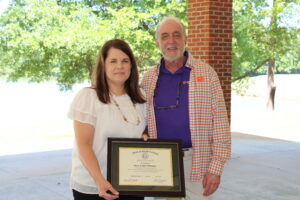
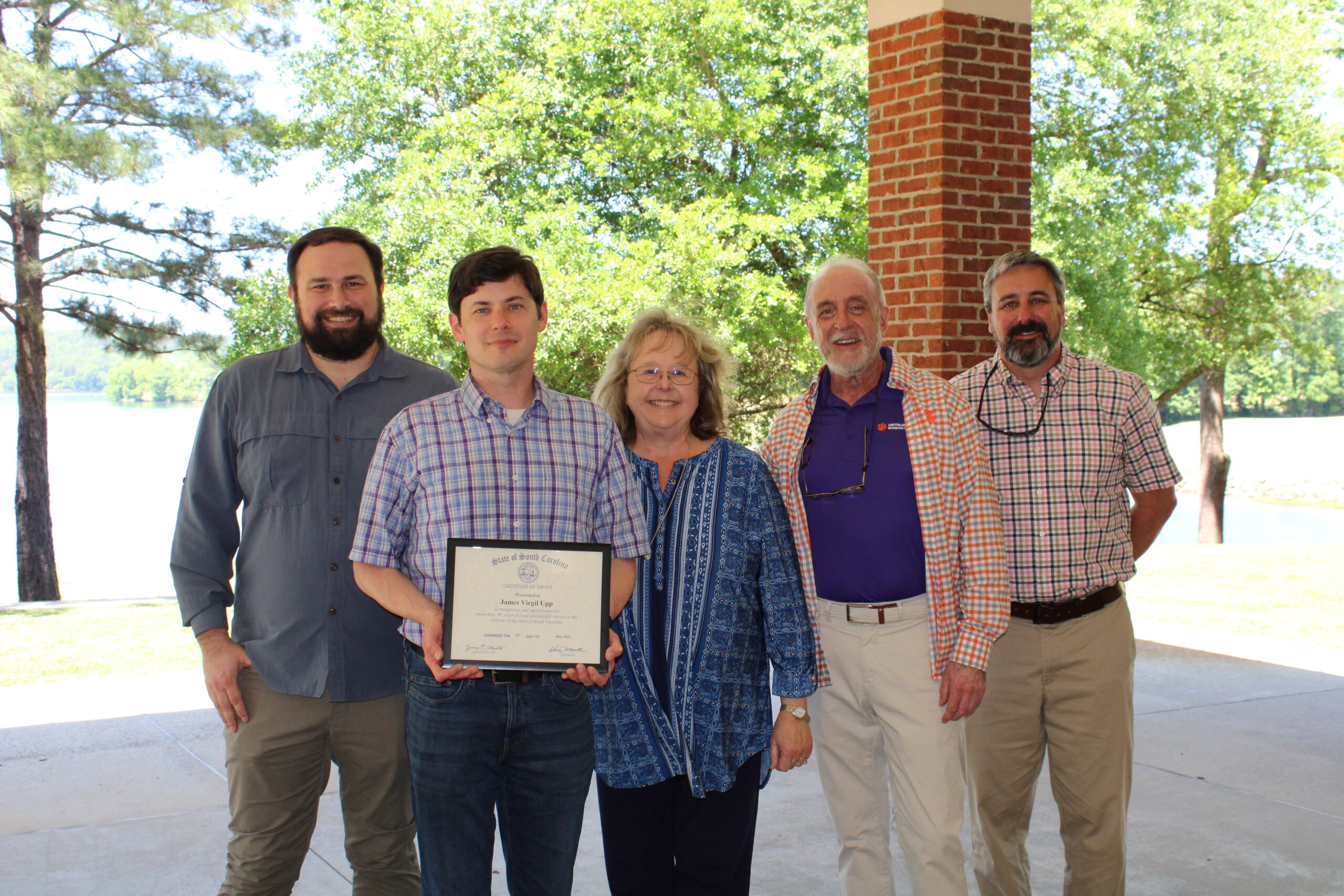
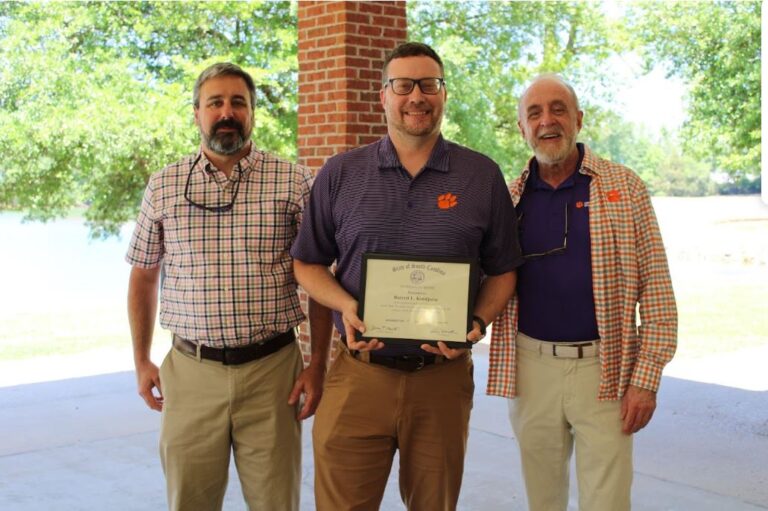
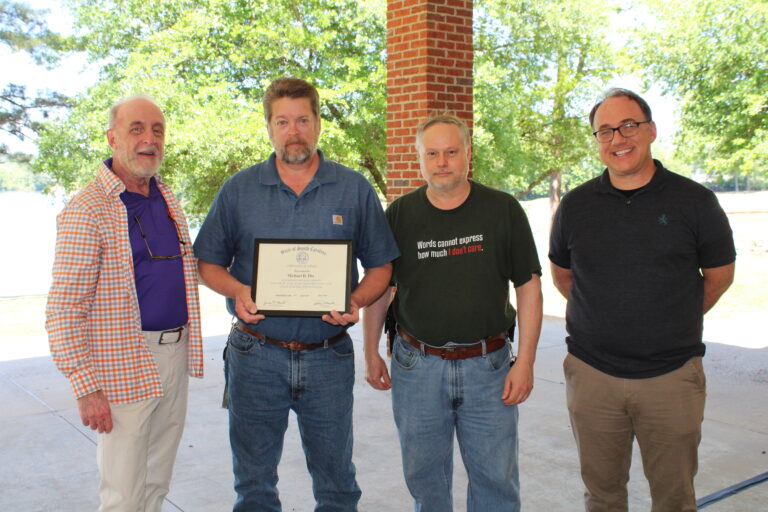
On Wednesday, May 1, 2024 the Division of Clemson Computing and Information Technology (CCIT) celebrated employees who reached milestones in university service. The annual Division gathering occurred at the Madren Center pavilion and offered a chance for employees to be recognized and congratulated for their enormous contributions and achievements. CCIT is grateful for each one of these individuals and wishes them continued success in their roles and futures.
Spring 2024 Service Award Recipients:
James Bradshaw (not pictured), Sr. Database Administrator, Infrastructure Systems and Operations, 40-year service award
Stacy Whitaker, Executive Assistant I, CIO Office, 30-year service award James Upp, IT Tech III, Enterprise Systems and Applications, 20-year service award
Tom Standridge (not pictured, retired), Network & System Admin II, Network Services, 20-year service award
Barrett Kendjoria, IT Manager IV, Enterprise Systems and Applications, 10 year service award Michael Belanger, IT Manager II, CCIT Customer Support Services, 10 year service award Tim Dickson, System Programmer/Developer IV,CCIT Customer Support Services, 10-year service award Glenn Williams, IT Consultant I,CCIT Customer Support Services, 10-year service award Michael Dix, Data Center Facilities Manager, 10-year service award
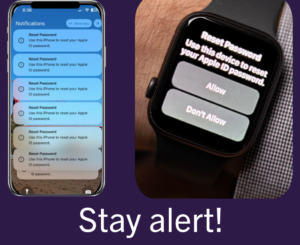
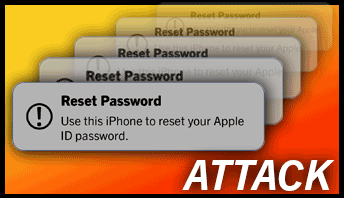
Last week, the Office of Information Security at Clemson University updated its Cybersecurity Alerts page about a recent fraudulent situation impacting Apple devices. Similar to how Clemson uses DUO to verify a person’s identity, before someone’s Apple ID can be reset, a user’s phone receives a prompt asking for verification for the reset. In this new scam, Apple device users may experience a bombardment of up to 100 prompt notifications asking them to approve or deny a password reset on their Apple ID. These requests are fraudulent and if approved, cybercriminals can change the Apple account password and lock users out.
iPhone and Apple Watches may get bombarded with notifications like this for this scam.
Even if users deny those requests, they may still get a phone call where the scammers claim to be Apple Support because they know the phone number associated with the account. Apple Support will never initiate outbound calls to customers unless those customers have requested to be contacted. The purpose of this fraudulent call is to try to initiate a reset by having users read the text message containing a one-time passcode. If the user supplies that one-time code to the fake Apple Support caller, the cybercriminals will use that information to reset the password on the account and lock the real user out of their own account. Once the scammers have control of the account, they can also remotely wipe all of the Apple devices.
If you receive a call from someone claiming to be Apple Support, it is best to hang up and contact the official Apple Support Center to see if there is an issue. It is important to continue to deny the message notification prompts for password reset if they were not initiated by the account user.
Visit the Cybersecurity Alerts page often to stay informed on all things related to scams that might impact the campus community.
CCIT is happy to announce student laptop recommendations for the 2024-2025 academic year. This year’s recommendations include products from three vendors – including Apple, Dell, and Lenovo. Please visit https://ccit.clemson.edu/support/current-students/laptops/recommended-laptops/ for a listing of the recommended models, purchasing details and additional information.
Recently, some Apple users have fallen under a cyber-attack called “Push Bombing” or “MFA(multi-factor authentication)Fatigue”.
In these attacks, Apple users are repeatedly sent a push notice to Allow or Deny a password reset on their Apple account. Sometimes, a user may receive 100 or more of these notifications, and those notifications can show up on all your Apple devices. If a user allows one of these password resets, then the scammers can change your password and lock you out of your account.
Even if a user denies all of the prompts, they may still get a phone call from scammers claiming to be from Apple Support, because the scammers know the phone number associated with the user’s Apple account.
The purpose of the scammer’s call is to try to get the user to initiate a request for an Apple ID reset code which is sent to the user’s device as a text message that includes a one-time password. If the user supplies that one-time code to the fake Apple Support caller, the attackers will use that information to reset the password on the user’s account and lock the real user out of their own account. Once the scammer has control of your account, they can also remotely wipe all of your Apple devices.
If you did not initiate a password reset yourself on your Apple device, you should always deny those prompts. And if you get a call from someone claiming to be an Apple Support person, be aware that Apple never initiates outbound calls to customers, unless the customer has first requested to be contacted. So, in those situations, hang up on the person who called you, and then contact the official Apple Support Center yourself to see if there really is an issue. You can’t trust that a caller really is who they say they are.
On Monday, March 18, 2024, CCIT engineers will conduct systems testing that will temporarily impact the functionality of systems. Systems impacted by this test will include:
PeopleSoft
Office of Human Resource’s Policies and Procedures webpage
Time Capture
OnBase-Performance
Tiger Talent
Tiger Time Trackers (Please note: Time Trackers will still work during the outage, but punches will be delayed when adding to Kronos)
The outage is scheduled to occur between 12 p.m. and 1 p.m., only lasting for an hour. Please ensure you have saved any work you may be doing before the planned outage. To see real-time updates about this test, visit CCIT’s Status Hub. We apologize for any inconvenience this may cause and appreciate your patience. If you have further questions or concerns, please contact the CCIT Support Center at ithelp@clemson.edu or at (864) 656-3494.
CCIT’s Research Computing and Data (RCD) will host an interactive Town Hall on Friday, March 15, to continue sharing information and offering updates. During this meeting, members of the RCD team will present the following updates and topics for discussion:
Palmetto Maintenance (tentatively May 6-May 10)
Introducing new RCD Staff
All new nodes and owner nodes moving to SLURM in May
ZFS File system will be retired this summer
Introducing the GLOBUS enterprise license for moving large data sets easily
… and more!
Attendance of this virtual town hall is encouraged for members of the campus community who may work directly with these topics or are curious to learn more about updates in CCIT’s RCD group.
Spring break is right around the corner and itineraries may be well underway. Now more than ever, staying safe on trips extends far beyond applying enough sunscreen, staying hydrated, and moving in groups. In fact, technology can play a key role in keeping you safe, especially when so many of our plans involve our smartphones and different applications.
Here are some quick reminders to ensure you can stay tech safe this Spring Break too:
Use Clemson VPN when connecting to “unsecured” wifi networks. This will keep others from potentially accessing what you are browsing, especially with transactions.
Seek out eduroam networks if traveling near another campus community. These are more secure and you will automatically connect to them if you use those devices on Clemson’s eduroam. There are over 33,000 eduroam connections worldwide!
Do not plug your cellphone charger directly into a USB port at the airport or on transportation. Always use a charger block and an outlet.
Passwords protect all of your devices. Do not use passwords that are easily breakable either. 1234 is a good way to have your information 123-gone. While sharing is caring in most scenarios, keep those passwords to yourself.
Disable Bluetooth when not in use. It may be tempting to keep it on all the time but this is one way to prevent unwanted device pairings/connections.
Do not fall for phishing scams or too-good-to-be-true deals for rentals of any kind. Ensure you are using a secure, legitimate service website. Cybercriminals know that Spring Break happens in March, too.
Avoid sharing your exact location on social media. Be mindful that people may be able to locate you and while it may be tempting to share exactly where you are and the cool stuff you are doing on your trip, consider how it impacts your safety and the safety of others around you.
We wish all of our Tigers a happy, healthy, and safe Spring Break. Take care of yourselves and know that we are here to support you if needed. To see the adjusted Spring Break CCIT Support Center hours, visit this page.
Clemson University employees, staff, and students who use Microsoft Outlook for email have likely noticed that some of their emails get held in quarantine. The quarantine function is part of the University’s security toolset providing proactive, immediate security for the more than 2,300 phishing and scam attempts the University receives by email each month.
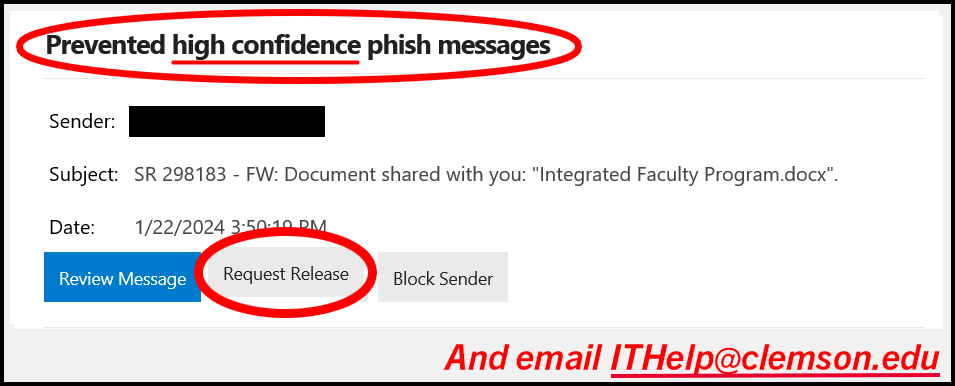
Beginning on Monday, February 26, 2024, faculty, staff, and students who receive email notifications about a “high confidence” phishing email that has been quarantined will be required to take an extra step if they would like to release that email back into their inboxes. This change involves clicking the “Request Release” button in the notification email, followed by emailing ithelp@clemson.edu to start a service ticket for the release. This change does not apply to regular quarantine emails, only those labeled as “high confidence.” The extra step further ensures the CCIT Security Team can inspect and verify if an email is malicious and should not be released. Failure to submit a ticket for a release request will result in no email release, so this step is important. Again, those with regular quarantine emails who would like to release emails back to their accounts should continue to use the regular Release process.
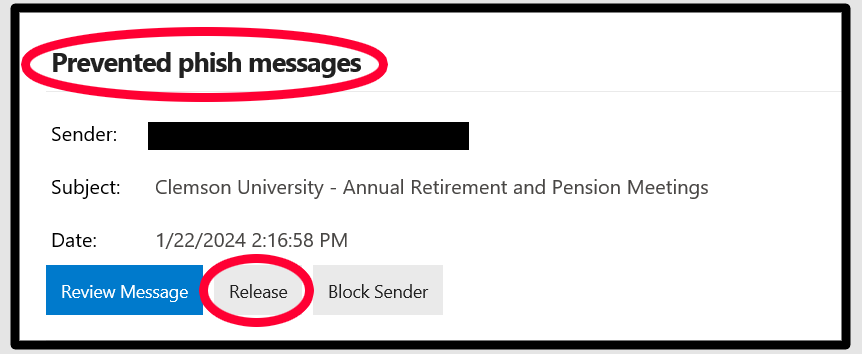
Helpful screenshots of this change and process are outlined below:
If you receive a regular Prevented type quarantine email similar to the one below, you can still click on the “Release” button as normal. No additional steps are required.
If you receive a High Confidence type quarantine email like the one below and would like the email to be released to your inbox, you will need to click the“Request Release” button and also email ithelp@clemson.edu to request the release of that message. Please include the subject line of the email you wish to release in your ITHelp email request.
If you have any questions about this process, please contact the CCIT Support Center at ithelp@clemson.edu or (864) 656-3494. Thank you for helping in keeping Clemson even more secure!
Pauline Sawadogo, IT Technician II in Clemson’s Network Operation Center (NOC)
Pauline Sawadogo made Supercomputing Conference (SC) history in 2023. Sawadogo, an IT Technician II in the Network Operations Center (NOC), was the first woman from South Carolina and Clemson University to participate in the Women in IT Networking at Supercomputing Conference (WINS) Program. Flash forward twelve months and Sawadogo is grateful she had the chance to collaborate and network with so many women in highly technical spaces spanning industry and academia.
“This gathering brought together researchers, experts from diverse fields, and professionals,” Sawadogo explained. “Being part of it provided me with the opportunity to collaborate with them, learn, and establish connections for lifelong collaboration.”
The WINS program started in 2015 to help bridge gender gaps in Information Technology spaces, with specific focus on network engineering and high-performance computing. The program also funds travel opportunities and enables women to complete S.C. projects together, gain hands-on skills and mentorship. In 2023, seven women, including Sawadogo, were selected as awardees to participate. The annual international conference was held in Denver, Colorado November 17-19, 2023, and Sawadogo attended as a member of the SCinet group of volunteers.
In her role at Clemson, Pauline describes her daily tasks as diverse; including “monitoring network devices, troubleshooting wired and wireless network connection issues, creating DNS records, and firewall rules and Network security.” Through her participation in WINS, she said she was able to further build on these skills.
“The event highlighted the latest advancements in hardware and software technologies. We gained hands-on experience with cutting-edge technology, addressing issues and optimizing performance,” Sawadogo explained. “In the edge and wireless team, we implemented zero-touch provisioning to swiftly configure numerous switches, significantly speeding up our daily tasks and minimizing errors associated with manual configurations.”
Sawadogo’s participation in the WINS program noticeably coincides with gains in her performance at Clemson, as Steve Fullerton, director of the NOC, noted.
“Since Pauline has worked with the WINS team(s) she has exhibited more confidence in her work abilities,” Fullerton said. “She is willing to explore the network further in depth to find issues and solve them. Pauline has also shown a desire to take on more work to continue her learning.”
While her time as a WINS awardee has come to an end, Sawadogo said she will fondly remember the experience and impact on her, and so many other women’s lives.
“Daily collaboration with my fantastic team members, and particularly enjoying exchanges with fellow WINS women, adds to the richness of this experience,” Sawadogo said. “Working alongside inspiring women has reinforced the understanding that women excelling in this field is not a myth. The existence of the WINS program is crucial, and if it didn’t exist, it would need to be created.”
2023 WINS Photo. Image used with permission from WINS.
Steve Fullerton is proud of the recognition Pauline has brought herself, CCIT, and Clemson through her participation in the WINS program.
“I believe the WINS program is fantastic. Pauline has made contact with people who can coach or mentor her in her career. I am sure, because Pauline was a part of the WINS program last year, and possibly in the future, CCIT will benefit from the knowledge gained. It brings great recognition to Clemson and CCIT.”
For Sawadogo, participation in this program has left her with immense gratitude.
“I am grateful to my management team for placing their trust in me to represent Clemson at this global event, and I appreciate the WINS program for providing early-career women with the chance to embark on such an exciting and valuable learning journey.”