The Parks, Recreation and Tourism Management (PRTM) Blog

Middlebury professor emeritus wins academic leadership award

Dr. Steve Trombulak, professor emeritus of biology and environmental studies at Middlebury College, was recently honored with the Benton H. Box Award by the Clemson University Institute for Parks in recognition of his academic and instructional leadership in the environmental field.
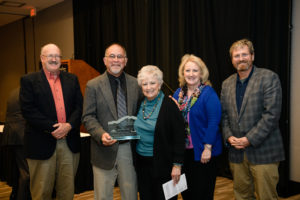
Dr. Trombulak (second from left) with members of the Box family and Dr. Rob Baldwin (right).

The institute presents the annual awards program, which is named for George B. Hartzog Jr., the seventh director of the National Park Service, to showcase leading figures in the field of conservation. Specific awards were named after visionary leaders that Hartzog respected and admired. Award recipients are following in Hartzog’s footsteps by making significant contributions to the management of parks and preservation of our natural, historical, and cultural heritage.

The Benton H. Box Award recognizes academic professionals that exemplify Dr. Box’s distinguished career as an educator and administrator. Dr. Trombulak shared this year’s award with Ryan L. Sharp, associate professor in the park management and conservation program at Kansas State University, for leadership in preserving our natural environment and inspiring in students the quest for knowledge and the development of an environmental ethic.

Robert Baldwin, endowed chair and professor of conservation biology at Clemson University, presented the award to Dr. Trombulak at a ceremony on October 22. According to Dr. Baldwin, Dr. Trombulak is a force for science-based landscape level management in the northeast United States and Canada.

“He has published over 90 scientific articles, many with Middlebury students, and his review of the ecological effects of roads has been cited 3,000 times,” he says. “For a single paper, that’s like winning the Heisman Trophy.”

Dr. Trombulak is a conservation biologist and landscape ecologist. He earned his BA in biology at UCLA and his PhD in zoology at the University of Washington in Seattle. He began his research career focusing on population and community ecology, including studies on elevational distributions of pinyon pines in the Mohave desert, territorial behavior of hummingbirds in the tropical dry forests of Costa Rica, thermoregulation of desert-dwelling beetles in the Great Basin Desert, competition between montane chipmunks in the Cascade Mountains of the Pacific Northwest, and phenotypic plasticity in life-history strategies of montane ground squirrels in both the Cascade and Sierra Nevada Mountains.
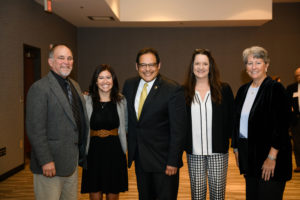
Dr. Trombulak with fellow Hartzog award winners (l to r) Dr. Jennifer Thomsen, David Vela, Dr. Carolyn Ward and Chris Lehnertz.

At Middlebury College, he developed a diverse and highly successful teaching program in conservation biology, vertebrate natural history, and environmental science.  His research program also expanded beyond ecology to embrace both conservation biology – with an emphasis on protected areas, conservation planning, and wildlands – as well as science pedagogy. He retired in June after 34 years in the field.

“I am so pleased that Steve has been recognized this award,” continues Baldwin. “Steve, like Dean Box, has set an example as a teacher and scholar, he has fostered learning environments as an administrator and also an environmental ethic, both in his community and abroad.”

###

The Clemson University Institute for Parks (CUIP) provides research, education, training, and outreach that enhances the management of the world’s parks and protected areas. It accomplishes this by providing park and protected area managers with innovative research to support science-based decision-making; and by developing current and future leaders in the park movement by providing interdisciplinary and transformative education and training programs. The Institute currently consists of 35 Fellows and 8 Scholars, including Dr. Trombulak, working on park-related research.

Visit the CUIP website for more information about the George B. Hartzog, Jr. Environmental Awards program and its recipients.
University of Montana assistant professor wins award for outstanding academic achievement

Dr. Jenn Thomsen, assistant professor of parks, recreation and tourism management at the University of Montana, was recently honored with the Dwight A. Holder Award by the Clemson University Institute for Parks in recognition of her outstanding work as a conservation researcher and teacher in the environmental field.

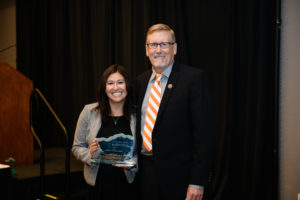
Dr. Thomsen and Clemson Parks, Recreation and Tourism Management Department Chair Dr. Wayne Freimund.

The institute presents the annual awards program, which is named for George B. Hartzog Jr., the seventh director of the National Park Service, to showcase leading figures in the field of conservation. Specific awards were named after visionary leaders that Hartzog respected and admired. Award recipients are following in Hartzog’s footsteps by making significant contributions to the management of parks and preservation of our natural, historical and cultural heritage.

The Dwight A. Holder Award recognizes academic professionals that exemplify Mr. Holder’s illustrious career as an entrepreneur and public servant, which included leading South Carolina’s parks to a new era of service. Dr. Thomsen received this award for outstanding work and sustained achievement that fosters understanding, wise use and conservation of natural and cultural resources.

Wayne Freimund, chair of the parks, recreation and tourism management department at Clemson University, presented the award to Dr. Thomsen at a ceremony on October 22. According to Dr. Freimund, Thomsen has made a significant impact on the conservation field at a relatively young age.

“Jenn already has an impressive publication and teaching record, with a research focus that requires her to pull groups together on almost intractable issues, such as livelihood versus wildlife population management,” he says. “She does it masterfully, with an unparalleled ability to find the glue that holds several different collaborators together.”

Dr. Thomsen graduated with her M.S. in Wildlife Biology from Clemson University, where she also earned her PhD in parks and conservation area management. Her research largely focuses on stakeholder collaboration associated with large landscape conservation, sustainable tourism and protected area management. Her work has involved partnerships with the Center for Large Landscape Conservation and the IUCN Connectivity and Transboundary Specialist groups to conduct surveys addressing the challenges, opportunities and outcomes associated with stakeholder collaboration and how these groups evolve over time in their transboundary ecosystem management. She also contributes to UNESCO’s biosphere reserve network and serves on the National MAB Committee.

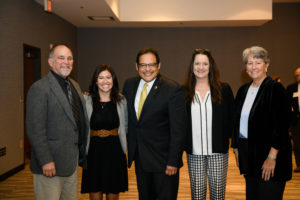
Dr. Thomsen with fellow Hartzog award winners (l to r) Dr. Steve Trombulak, David Vela, Dr. Carolyn Ward and Chris Lehnertz.
Dr. Thomsen (second from left) with fellow Hartzog award winners (l to r) Dr. Steve Trombulak, David Vela, Dr. Carolyn Ward and Chris Lehnertz.

Her work in sustainable tourism and protected area management focuses on the management of resources that balances the environmental, social/cultural and economic needs of diverse stakeholders. Her research explores unique types of tourism, such as voluntourism in Peru and Haiti, whitewater ecotourism in Bhutan and safari hunting tourism in Botswana. She’s conducted research for the US Forest Service and National Park Service and is part of the INSAKA collaborative group that brings together partners of African universities to address social-ecological issues. Dr. Thomsen is passionate about her teaching and field experiences for students, and about engaging the next generation of conservation and protected area leaders.

“Jenn’s students love her, and her faculty and collaborators love working with her,” continues Dr. Freimund. “And now as the recipient of this year’s Dwight A. Holder award, she can be rest assured that her alma mater feels the same way. I can’t wait to see where she takes her already-impressive career.”

###

The Clemson University Institute for Parks (CUIP) provides research, education, training, and outreach that enhances the management of the world’s parks and protected areas. It accomplishes this by providing park and protected area managers with innovative research to support science-based decision-making; and by developing current and future leaders in the park movement by providing interdisciplinary and transformative education and training programs. The Institute currently consists of 35 Fellows and 8 Scholars working on park-related research.

Visit the CUIP website for more information about the George B. Hartzog, Jr. Environmental Awards program and its recipients.


Conservation and Communication: A Clemson Graduate Student’s Unique Approach to Saving Tigers in the Wild

Louise Orr had finished her undergraduate degree and was working in state government, when she decided she needed a change.

“I had always loved wildlife and been interested in conservation, and had briefly considered studying zoology in college, but went a different route by studying communications instead,” she says. “I realized a few years after my graduation that not only could I still pursue that love for wildlife, but I could apply my communications background and experience to making a difference in the conservation field.”

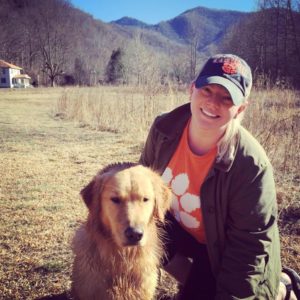
Clemson PRTM graduate student Louise Orr and her dog.
Clemson PRTM graduate student Louise Orr is combining her communications experience and love of wildlife to help save Clemson’s tigers in the wild.

Louise is now pursuing her master’s degree in parks and conservation management in Clemson University’s Parks, Recreation and Tourism Management department. Her research focuses on how our political beliefs influence what types of conservation messages are most likely to reach us, or motivate us to take action.

“Most people have never seen an animal in the wild, making them largely disassociated from problems tigers face,” says Louise. “My research is exploring several variables, such as levels of knowledge about tiger conservation, their political ideologies and their moral foundations, to find out what kind of messages they would be most receptive to, so we can help organizations working to save tigers better encourage people to get involved and learn more about the need for tiger conservation and how they can help.”

One of the variables Louise is exploring is whether a person’s connection to a tiger mascot school would have any influence on their engagement in conservation behavior. If someone is passionate about their university’s mascot, does that translate to a passion for that animal in the wild and make them more likely to participate in conservation efforts?

Louise’s research for her master’s agree transfers well to her part-time job working as an Assistant Project Coordinator for the Tigers United University Consortium. The consortium is devoted to tiger conservation and consists of four land-grant, tiger mascot universities working collaboratively on this issue – Clemson University, Auburn University, Louisiana State University and the University of Missouri.

The consortium’s universities are all raising awareness of tiger conservation through Tigers United Week, which runs from September 3 to 7 in Clemson. Several activities are planned, including a documentary screening about a man’s quest to get a Siberian Tiger on camera, a Scarcity Scavenger Hunt with a grand cash prize, and an information booth with an opportunity to meet Clemson’s First Lady Beth Clements and her daughter, Grace. The week culminates with a launch of a new, 30 second video about the consortium’s mission during the Clemson football game on Saturday, September 7. More information about Tigers United Week and its activities can be found on the Tigers United blog.

Dr. Brett Wright, dean emeritus of Clemson’s College of Behavioral, Social and Health Sciences, is the consortium’s Director and Louise’s faculty advisor. He says Louise’s background in communications and her current research focus makes her a valuable part of the consortium team.

“A big part of the work we do at the consortium is getting the message out in a way that motivates people to make a difference, and Louise’s research and communications expertise will help us figure out how to best get our message across,” he says. “After all, students, faculty and alumni chant ‘Go Tigers’ on a daily basis, but not many know the truth about the animal we hold so dear – and how close they are to extinction. Fewer still may know how they can help.”

Louise is excited to help organizations like the consortium refine their conservation messaging.

“It’s a great feeling to combine what I’m passionate about with my knowledge and experience in the communications field, and to use it to make a difference in the world” she says. “Especially since this work is critically important. If we don’t continue to work hard and do what we can – our children and grandchildren aren’t going to have tigers in the wild. They’re going to be gone.”
