
Writing down your goals and tracking progress can increase accountability and support long-term behavior change. Image Credit: Ellie Lane
New Year, New Goals
Every year, many people set New Year’s resolutions with the hope of improving their health, becoming more active, or building better habits. While the initial excitement can be motivating, maintaining those changes over time often proves to be the real challenge. Research in behavior change shows that lasting change rarely comes from willpower alone. Instead, lasting change is influenced by a combination of psychological, environmental, and social factors that support consistency over time. When people understand how behavior change actually works, they are better equipped to create goals that are both realistic and sustainable. Key factors such as motivation, confidence, goal setting, and habit development all play a major role in long-term success.
Transtheoretical Model – Stages of Change
One well-established way to understand behavior change is through the Transtheoretical Model, often referred to as the Stages of Change. This model outlines a series of steps people typically move through when adopting a new behavior: precontemplation, contemplation, preparation, action, and maintenance. Some versions also include a final stage where the behavior becomes fully integrated into daily life. Change does not happen all at once; it is usually gradual and often involves setbacks. People may move forward, stall, or even revert to earlier stages before progressing again. This framework highlights that people need different types of support depending on where they are in the Stages of Change. For example, someone preparing to change may benefit from setting specific goals, while someone maintaining a behavior may need strategies to prevent relapse.
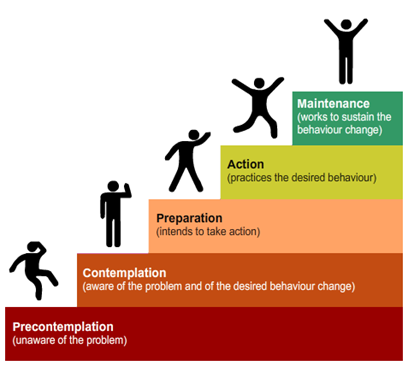
The Transtheoretical Model outlines a series of steps people typically move through when adopting a new behavior: precontemplation, contemplation, preparation, action, and maintenance. Image Credit: Chest Heart & Stroke Scotland and the University of Edinburgh
Motivation
Motivation is another key factor that influences whether a behavior will stick. It is often divided into two types: extrinsic and intrinsic motivation. Extrinsic motivation comes from external sources, such as advice from a doctor or a desire to meet certain expectations. While this can be useful for getting started, it may not be enough to sustain behavior long term. Intrinsic motivation, on the other hand, comes from within. This might include enjoying the activity itself or valuing the way it makes you feel. When people find personal meaning or satisfaction in a behavior, they are more likely to continue it. Shifting focus toward internal rewards, like increased energy, improved mood, or a sense of accomplishment, can help strengthen this type of motivation.
Self-Efficacy
Confidence in one’s ability to succeed, also known as self-efficacy, is another strong predictor of behavior change. People who believe they can overcome challenges are more likely to take action and stay committed over time. Building self-efficacy often starts with small, manageable steps. Achieving these smaller goals creates a sense of success, which can build confidence and encourage continued effort. Watching others succeed, receiving encouragement, and having a supportive environment can also reinforce this belief. Over time, these experiences help people feel more capable and resilient when facing obstacles.
SMART Goals
Setting clear and structured goals is one way to build and reinforce self-efficacy and consistency with new behaviors. Research shows that people are more successful when their goals are specific and well-defined. The SMART goal framework (specific, measurable, achievable, relevant, and time-bound) provides a helpful way to turn broad intentions into actionable plans. Instead of saying “I want to exercise more,” a SMART goal might involve walking for 20 minutes three times a week. Breaking goals into smaller steps makes them feel more manageable and allows for consistent progress. Tracking progress and adjusting goals when needed can also help individuals stay engaged and focused.

SMART goals focus on the specific actions needed to achieve a desired outcome, rather than focusing solely on the outcome itself. Image Credit: Clemson Extension MoveSC

SMART goal example for physical activity. Image Credit: Clemson Extension MoveSC
Habit Formation
Over time, behavior change becomes more sustainable when it turns into habit. Habits form when actions are repeated consistently in response to specific cues. The habit loop (cue, routine, and reward) explains this process. A cue triggers the behavior, the routine is the behavior itself, and the reward reinforces it. As this cycle repeats, the behavior becomes more automatic. For example, completing dinner can be a cue for going on a walk. The walk after dinner becomes a routine, with relaxation, better digestion, or improved mood acting as the reward. Creating an environment that supports these routines, such as scheduling activity or keeping reminders visible, can make habits easier to maintain.
Barriers
While building habits can make behavior change feel more automatic, it is important to recognize that challenges can still arise along the way. These challenges can affect how consistently you are able to follow through on your goals. Common challenges include setting goals that are too ambitious, thinking in all-or-nothing terms, or not tracking progress. Research suggests that focusing on gradual improvement rather than perfection helps people stay engaged. Flexibility is also important. Setbacks are a normal part of the process, and adjusting plans when challenges arise can help you stay on track with your goals. Regular reflection, whether through journaling or tracking activity, can increase awareness and reinforce progress.
Sustainable Change
Ultimately, lasting behavior change requires more than a strong start and good intentions. Sustainable progress is built through realistic goal setting, meaningful motivation, confidence, and consistent habits. When these elements come together, people are more likely to create changes that last beyond the initial excitement of a new year. Small, repeated actions, supported by a clear plan and a positive environment, can lead to meaningful and lasting improvements in overall health and well-being.
References:
- American Council on Exercise. (2019). The professionals guide to health and wellness coaching. (1st ed.). American Council on Exercise.
- Bandura, A. (1994). Self-efficacy. John Wiley & Sons, Inc.
- Bandura, A. (1997). Self-efficacy: The exercise of control. W H Freeman/Times Books/Henry Holt & Co.
- Deci, E. & Ryan, R. (2000). The “what” and “why” of goal pursuits: Human needs and the self-determination of behavior. Psychological Inquiry, 11(4), 227. https://doi.org/10.1207/S15327965PLI1104_01
- Lally, P., van Jaarsveld, C., Potts, H. & Wardle, J. (2010). How are habits formed: Modelling habit formation in the real world. European Journal of Social Psychology, 40(6), 998. https://doi.org/10.1002/ejsp.674
- Locke, E. & Latham, G. (2002). Building a practically useful theory of goal setting and task motivation: A 35-year odyssey. American Psychologist, 57(9), 705. https://doi.org/10.1037/0003-066X.57.9.705
- Marshall, S. & Biddle, S. (2001). The transtheoretical model of behavior change: a meta-analysis of applications to physical activity and exercise. Annals of Behavioral Medicine, 23(4), 229.
- Moore, M. & Tschannen-Moran, B. (2010). Coaching psychology manual. Wolters Kluwer Health/Lippincott, Williams & Wilkins.
- National Academy of Sports Medicine. (2022). NASM essentials of personal fitness training (7th ed.). Jones & Bartlett Learning.
- Prochaska, J. & Velicer, W. (1997). The transtheoretical model of health behavior change. American Journal of Health Promotion, 12(1), 38.
Author:
- Ellie Lane, Extension Associate, Rural Health and Nutrition
- Camden Bryan, Rural Health and Nutrition, Statewide
