Part 2 of this two-part series addresses the benefits of freshly milled flour and how flour can be milled at home.
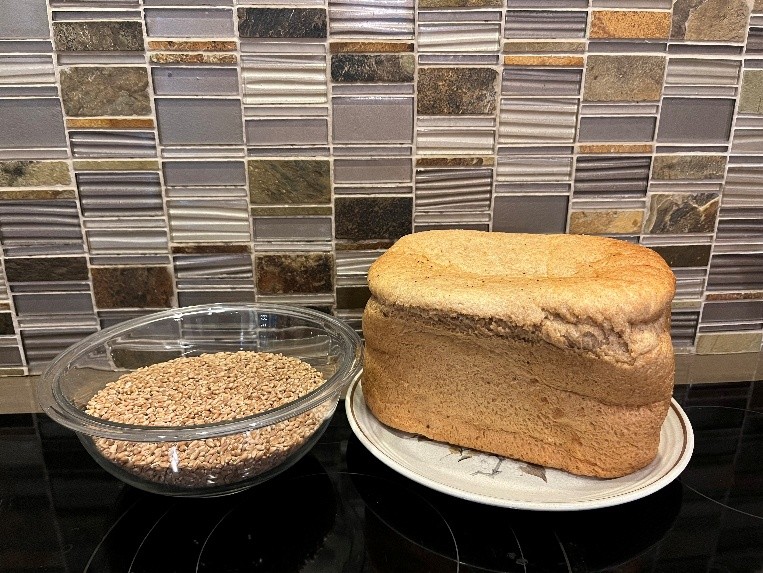
Milling wheat at home yields freshly milled flour that can be used in many baked goods like this whole wheat bread. Image Credit: RHN Picture Bank
The Benefits of Milling Flour at Home
Wheat ranks first among grains for its nutritional value, containing 40 of the 44 vital nutrients our bodies need. Not only does this high-fiber grain contain many essential B vitamins, but it is also one of the richest sources of Vitamin E. When discussing wheat, it is important to distinguish between whole wheat itself and the processed breads and other products found on store shelves.
As referenced in Part 1 of this series, wheat is composed of the bran, germ, and endosperm. When all three parts of the grain are milled and used in bread and other baked goods, the results are both delicious and nutritious. According to the USDA’s Nutrient Database, freshly ground flour has twice the calcium and phosphorus, twice the amount of crucial B vitamins, three times the iron, and four times the potassium of commercially processed “whole wheat” flour. Moreover, there are no additives or preservatives in freshly milled whole wheat flour.
Getting Started with Home Milling
While milling flour at home may seem daunting, it is actually an easy process. Milling is simply grinding whole wheat berries (the intact wheat kernel) into flour. Milling at home allows one to grind only the amount of flour needed, preserving freshness and nutritional value.
Choosing the Wheat
Selecting the right wheat berry is key to achieving the desired texture, flavor, and baking result. Wheat berries are classified by color, hardness, and growing season and should be stored in airtight containers in a cool, dry place. Different varieties are best used for different types of baking.
Hard red wheat has a robust, nutty flavor with a high protein content. This wheat is best for yeast breads, rolls, and pizza dough. With its darker color and strong flavor, this is the most common wheat used for traditional whole-wheat bread.
While hard white wheat is also high in protein, its lighter color and milder flavor make it a favorite for whole-wheat sandwich bread and tortillas.
In contrast, soft white wheat has a low protein content and a very mild flavor. Freshly milled soft white wheat is the best substitute for traditional all-purpose flour and can be used to make muffins, cakes, and quick breads.
While there are other varieties of wheat, including specialty and ancient grains, understanding these three types provides a strong foundation for home-milling.
What about Gluten?
Conversation and questions about gluten have increased in recent years. But what exactly is gluten? Gluten is the natural protein found in grains within the wheat family. Wheat contains two main proteins—glutenin and gliadin. When wheat flour is mixed with water, these proteins combine to form gluten. Gluten is the elastic, stretchy network that develops from this interaction. Kneading the dough strengthens the gluten strands and traps the yeast gas. This causes the bread to rise. Wheat, specifically hard red and hard white wheat, has the proper amount of gluten to facilitate the rising of bread dough to make soft, light loaves.
Celiac disease is an autoimmune disease. Individuals with celiac disease cannot digest gliadin, one of the proteins found in wheat that creates gluten.
Choosing a Mill
In addition to wheat, home milling requires a grain mill. Manual and electric grain mills are available for home use. Manual grain mills are more affordable and sufficient for milling small batches, whereas electric grain mills are fast and consistent and ideal for frequent use. Two of the most popular electric mills are the WonderMill and the Nutrimill. For best results, mill flour just before baking to retain freshness and nutritional value.
For over 100 years, the nutritional benefits and flavor of freshly milled flour have been sacrificed for convenience and commercial profit. Milling flour at home is a rewarding way to reconnect with food traditions while improving nutrition and flavor.
References:
- Becker, S. (2016). The Essential Home-Ground Flour Book. Robert Rose.
- Hongbin, G., Ding, J., Liang, J., & Zhang, Y. (2021). Associations of Whole Grain and Refined Grain Consumption with Metabolic Syndrome. A Meta-Analysis of Observational Studies. Frontiers in Nutrition, 8, 1-11. https://doi.org/10.3389/fnut.2021.695620
- Huang H, Lu W, Hu X, Chen X, Shu G, Wang J, Zhu M, Zhang Z, Zhang S. (2025).The impact of whole grain consumption on metabolic health: an umbrella review of systematic reviews and meta-analyses of randomized controlled trials. Food Funct. 16(23):8925-8942. doi: 10.1039/d5fo03240g
- Khan, J., Khan, M. Z., Ma, Y., Meng, Y., Mushtaq, A., Shen, Q., & Xue, Y. (2022). Overview of the Composition of Whole Grains’ Phenolic Acids and Dietary Fibre and Their Effect on Chronic Non-Communicable Diseases. International Journal of Environmental Research and Public Health, 19(5), 3042. https://doi.org/10.3390/ijerph19053042
- Swaminathan, S., Dehghan, M., Raj, J. M., Thomas, T., Rangarajan, S., Jenkins, D., …Yusuf, S. (2021). Associations of cereal grains intake with cardiovascular disease and mortality across 21 countries in the Prospective Urban and Rural Epidemiology study: Prospective cohort study. The BMJ, 372, 4948. https://doi.org/10.1136/bmj.m4948
- Oldways Whole Grain Council. (2026, January 20). Whole grains 101. https://wholegrainscouncil.org/whole-grains-101/whats-whole-grain-refined-grain
Authors:
- Roxane Cummings, Rural Health and Nutrition, Orangeburg and Bamberg Counties
- Ellory Pruitt, UPIC Intern, Rural Health and Nutrition
Reviewed by:
- Michelle Altman, Extension Associate, Rural Health and Nutrition
- Melissa Bales, Extension Associate, Rural Health and Nutrition
- Ellie Lane, Extension Associate, Rural Health and Nutrition
