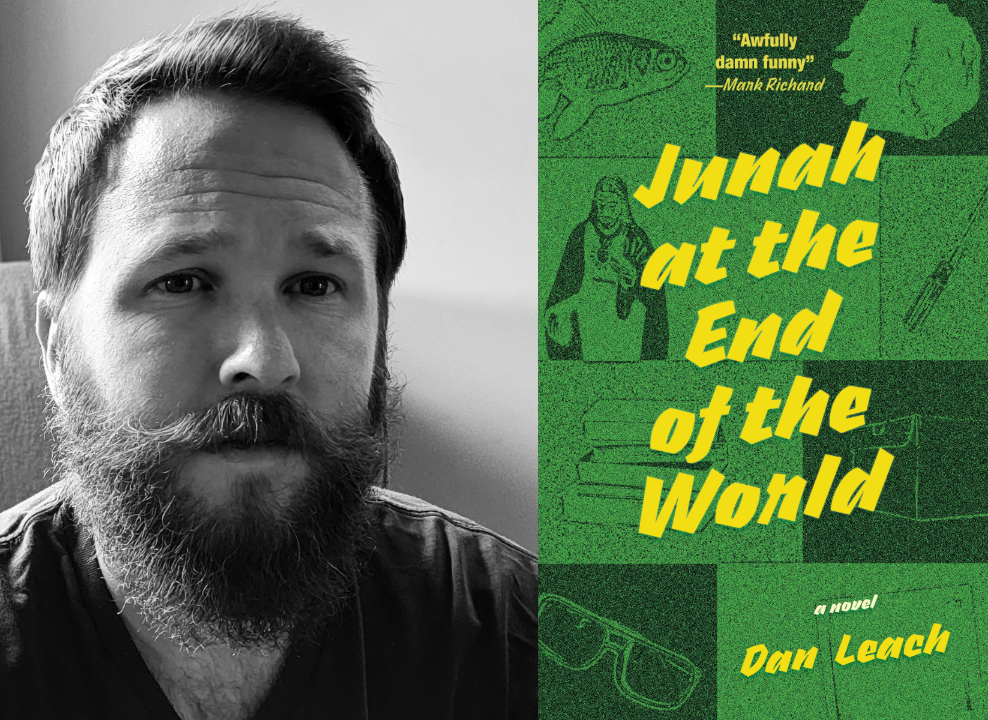
The following is an interview b/w authors Wesley Kapp and Dan Leach on the subject of Dan’s book Junah at the End of the World, (Hub City Press) which was published in the summer of 2024. Wesley and Dan are former SCR staffers, from 2019-20. Wesley went on to complete an MFA at the University of Montana; Dan completed his MFA at College of Charleston and is now a professor at Charleston Southern.
Dan Leach and I first met at Clemson University in 2018 while we both pursued a masters in English. The program had a handful of fiction writers at the time, and many of us ended up working with the South Carolina Review, including the two of us. As I got to know Dan, I quickly realized that, though he was humble, he was far beyond me in skill and generally in his career as a writer. What stood out to me the most, and has continued to stand out to me, is that he is the type of writer, and person, who will always extend a hand to those following along in that same lonely journey of being a writer. He’s realized that writing, though often a solo act, is better when you’re surrounded by community.
After observing Dan, I knew what I wanted in my own writing community as he and I veered off in different directions after completing the program at Clemson. I soon launched into studying fiction in Montana, and Dan launched into writing Junah at the End of the World, the focus of this interview.
This interview took place over the span of several weeks (months?) in the fall of 2025 and consisted of two email exchanges. This summer marks the one-year publication anniversary of Junah at the End of the World.
Wesley Kapp: First, congratulations on the release of Junah at the End of the World! Can you share a little about the book?
Dan Leach: Thanks for saying that, and thanks for talking with me. Since we both left Clemson back in 2020, I’ve missed seeing you, and (frankly) I’m jealous of all the cool places you’ve been and all the great jobs you’ve worked. I love that this book is an occasion for us to reconnect. About the book: unlike my other stuff, this project emerged out of a very specific set of circumstances, ones which initially seemed anything but generative. I started writing Junah at the End of the World about half a year into the COVID pandemic. As I’m sure you recall, things back then were looking pretty bleak. I had just finished my MFA at Warren Wilson and had moved across the state to start a teaching position at Charleston Southern. I was there, ostensibly, to start this new chapter in my life; but nothing felt new. In fact, everything felt vaguely apocalyptic. Most folks (students and faculty) had shifted online. The campus was a ghost town. Those who showed up were in masks and jumped back if you accidentally broke that six-foot radius. Socially, life felt nervy and disconnected; and, professionally, I was given a one-year contract and told that, in all likelihood, my position wouldn’t exist next year. To add insult to injury, we were living in this bland suburban monstrosity—one I believe you know from your stint in K-12—and there really wasn’t much to do that year except find some kind of work to occupy you. That work became this novel, and I tried to use being a kid during Y2K as an occasion to process being an adult during COVID. The similarities seemed uncanny to me: the conflicting political narratives, the weird religious aspects, and (most importantly) the idea that the world could be coming to an end. As with most of my stuff, I came at the subject indirectly (“through the side door” as Ed Skoog would say) and tried to make it a commentary on COVID but also a standalone coming-of-age story. This book kept me sane during that time, you know? The world was falling apart, but I was out there in Cane Bay, swinging back at the apocalypse one fragment at a time.
WK: This book seems to dwell in an in-between place—you introduce a potential binary, explore both sides, and then turn it on its head and introduce a third gray space, almost like the middle of a Venn diagram. Examples that come to my mind are Rusty’s character and (possible) demise; Junah refusing to make a choice of faith but also refusing to reject it; the humor, despair, sadness, and joy, and how we continually find ourselves in the middle of it all. Did you realize/set out to explore these middle spaces? Why do you think you dwell so much in these places?
DL: I love your notion of the “in-between” and of “middle spaces.” Junah calls it “the subjunctive mood,” and he describes it as being intoxicated by the fact that anything or nothing could happen. There’s the subjunctive nature of his lived life—the fact that his parents might (or might not) get back together; the fact that Sadie might (or might not) return his affection; the fact that the world might (or might not) end in December—but I love that you mentioned the subjunctive aspect to his time capsule. That is, Junah’s realization that he can make space for ambiguity, especially where tragedy is concerned. Rusty dies in reality, but what if he lives on in the time capsule? Meechum is fired in reality, but what if she’s still teaching in the shoebox? So on, so forth. This power to create “middle spaces” is, I think, Junah’s best talent as a storyteller. He’s willfully ambiguous and hopeful about what readers bring to the text. Also, I would be remiss if I didn’t mention The Moviegoer by Walker Percy, which was a dominant influence. I think I owe Junah’s “middleness” to Binx Bolling, the also-deeply-ambiguous first-person narrator of Percy’s novel. In fact, the final line of Junah at the End of the World is meant to (subtly) convey a philosophical solidarity with the final line of Percy’s novel. They are both, in their own way, a speaker whose judgments we’ve come to trust saying, “I don’t know, and I can’t say,” which is an existential humility that can be traced back to Kierkegaard, right?
WK: The character development often relied on short and succinct descriptions and short episodic stories, though brief, these instances provide memorable development for major and minor characters. I’m curious about how these moments and descriptions came to you. Did they flow immediately or did you have to spend a lot of time dwelling on these characters/scenes?
DL: Regarding the fragments: I blame my children. At the time of writing this, we had four kids, all under the age of 10. Oh, and we homeschool, which means our house can be a bit chaotic. My wife and I split the duties. Why mention this in connection with “short episodic stories”? Because short and episodic was all I could swing during that stretch of life. Once I had Junah’s voice (and that did come to me almost immediately), I would just stumble through our wild days and wait for something—sometimes a scene, sometimes just an aphorism or a line of dialogue—to come to me in Junah’s register. A lot of the fragments that made it into the book were written at red lights or during lunch breaks or on a voice recorder while taking the kids to a park. Although I was characteristically obsessive in the later stages of revision, the actual writing of this project took place in the “in between” spaces. Fittingly so, I guess.
WK: There were many moments when I laughed out loud while reading this book, and one of those moments was when the youth pastor’s band name, “The Sound of Our Hooves Carries News of Your Demise,” was introduced. I have to ask: was this a band you encountered in real life or are you just that good at coming up with 90s Christian metal band names?
DL: This one’s autobiographical. When I was a freshman at College of Charleston, I lived with several other full-time students in this veritable flop house way down on the bad end of Bogard Street. And we had this fifth roommate who wasn’t a student and who just kind of crashed on the couch. There’s always one wildcard in every living situation, isn’t there? A guy whose spot on the roster doesn’t really make sense? Anyway, our wildcard was a guy named was Scooter, and he was a server at Applebee’s who also played lead guitar in a variety of local thrash metal bands. His bands never lasted for more than a few months, but they would always have these wild and longish names that felt like poems in themselves. I think he jacked more than one band name from a Tolkien info dump or a verse out of The Old Testament. Anyway, I’m pretty close to certain that one of these bands was named “The Sound of Our Hooves Carries New of Your Demise.” At one point in time, I had a t-shirt with this band’s name on it, but that artifact’s obviously long gone. Funny enough, when I was writing the novel, I tried to find Scooter on social media. I had heard he had moved west and ended up as a yoga instructor in Arizona or something. I never did find him, but if he ever reads this book, maybe he can leak some demos on Bandcamp and give “The Sound of Our Hooves Carries News of Your Demise” a second life.
WK: Another moment of humor (and mystery) that really stuck with me was the goldfish. I don’t want to give away any spoilers for those who haven’t read the book yet, but the goldfish was a very Murakami/sheep man moment for me, in the sense that it’s very strange and the book doesn’t feel the need to dwell on it. Junah seems to completely forget about that moment, almost in the midst of it, but the reader (or at least this particular reader) spent a lot of time dwelling on it. The question I really want to ask is, what does it mean??? But I feel that a better question might be: what do you want to say about this moment?
DL: The goldfish moment is (for me) easily top three in the novel, and I’m honored by the Murakami comparison. Here’s what I was thinking for that scene (and I hope it doesn’t disappoint in its pragmatism). But after establishing the time capsule mechanism in the first ten pages, Junah then spends about half the book waiting to hear back from his crush. Having sent her a note, he’s now holding his breath, and (in terms of pure storytelling) there’s more suspense generated in this uncertainty than in the larger uncertainty regarding Y2K and possible apocalypse. So he waits. And he waits. And he waits. There’s a plot twist that I won’t mention here, but the situation crescendos on Halloween night. Junah’s dressed up as Fat Elvis, and he’s trying to make the best of what could be his last Halloween when, out of nowhere, his crush shows up and invites him on a date. It’s a sweet, cinematic moment and one of the few definitive victories that Junah scores in the book, but I wanted it to catch him (and the reader) completely off guard. The Elvis costume was okay in terms of Junah being discovered in a state of vulnerability and unreadiness, but I wanted something more. I wanted Junah to get caught at the absolute weirdest possible moment. Hence: the goldfish. Also, on a secondary level, I just loved how boyish that whole situation seemed. It was absolutely something I would’ve done with my friends on a night when you’re just showing off and killing time.
WK: “Why is the eye the only instrument that demands a double miracle? Anyone who tells you they know the answer to this question is liar. Anyone who tells you there is no answer is a fool” (134). The theme of eyes in this quote, along with Junah’s attempt to look at the world and collect the meaningful stories for the time capsule, and finally, with Junah’s fear of being seen—seem to point back to seeing that middle/gray area we discussed in the second question. How do you think this plays out in the work of the writer?
DL: Orwell called prose a windowpane. That was from “Why I Write,” which I still occasionally teach to my comp classes. It’s not bad as a metaphor because it illustrates what David Shields says in Reality Hunger when he talks about how a book can make you feel “human and unalone.” We know this feeling as readers, and it’s probably one of the earliest experiences that makes us want to write our own stuff. I remember feeling it as an undergraduate at Clemson when reading A Fan’s Notes by Fred Exley. I felt “seen” by that book, in particular its honesty about failure and loneliness. But what you’re asking here (if I understand you correctly) is the inverse proposition, right? That writers, too, must risk being “seen” (and possibly judged) if they really get their mind onto the page? Junah most certainly senses this. In reality, he hides behind sunglasses and feels generally creeped out by most forms of eye contact. He hides in The Pipe and pursues obscurity. In the time capsule, though, he’s doing the opposite. He’s saying, “Here’s the world, and I’m in it! There I am! Look at me!” That felt appropriate for me, mainly because I manage this contradiction in my own life. Despite working in a profession that requires public speaking, I actually hate to be looked at and listened to. I’m told this is social anxiety, but I’ve never been tested, and I’ve spent my life rigging up coping mechanisms. In my writing, however, I’m doing work that’s increasingly vulnerable/autobiographical, and I’m saying (as we all say when we seek out publication), “Here’s the world, and I’m in it! There I am! Look at me!” The more I do this (writing, I mean), the more I sense that these two contradictory urges benefit from each other. That is, the more I dislike/avoid being seen in reality, the stronger my desire is to write something honest and be seen on the page. Not a bad chemistry (if you can manage it).
WK: I’d like to acknowledge how out of control the time capsules get by the end of the book. They’re buried everywhere, but there is one, this book, that is shared with us. I like the idea of all of these stories being buried everywhere for others to stumble across one day, or perhaps not. As writers, how do you think we should choose the stories that we tell? And, in a publishing world that often seems dependent upon luck and timing as much as skill, what do you do with those stories that get buried?
DL: What a thoughtful connection. To your first question, the one about choosing the stories we tell, I’d say this: find someone specific to aim your stuff at. “Literary readers” won’t do. Too broad. A certain press or a certain genre won’t do. Too indistinct (not to mention fickle). Even writing “for yourself” introduces certain problems (at least it does for me). We don’t have to write in direct address, but I do think we need to aim our sentences at someone with a specific set of sensibilities. Junah, for instance, was aimed at my kids. I conceived of them as “survivors” of the apocalypse, and I approached the project as a way of telling them what my childhood was like. About a million times in drafting that story, I envisioned them “digging up” the time capsule and marveling at how weird life was back in their dad’s time. The book I wrote after Junah is called Married Sex, and it’s aimed at my wife, appropriately so since it’s a catalogue of all the crazy times we’ve had in our sixteen years together. Even the poems I write benefit from holding a specific reader in mind. Lately I’ve been writing them to my boss at the college where I teach. I call her Sarge, and she’s a red-haired Presbyterian with the ear of a poet and the heart of a first-century saint. I’ve got a poem coming out in the next issue of West Branch called “Big Red,” and it’s one-hundred percent for her. Your second question—the one about stories that “get buried”—I don’t know how to answer that. As you indicated, publishing is such a crapshoot. “Luck” and “timing” determine success as much as “talent” or “grit.” No one wants to admit this, but it’s true. I guess I’d have to get categorical to address this in a useful way. That is, if the work is bad, it probably needs to stay buried. If the work is good (but “luck” and “timing” weren’t on your side), it’s a shame that it’ll stay buried, but at least you know you’ve made real art, and you’re not a pretender. That’s a pretty shitty consolation prize, but it might be all you have to make sense of that kind of burial. But, finally, there’s a third category, isn’t there? The one for the good book that got buried—but only for a while, and only to resurrect at some strange and later future time in order to do the work it was meant to do. The odds are (obviously) against this, but I don’t know any real writers who live by the odds. We run on faith, or we don’t run at all.
WK: What else did you learn about writing and yourself from this book?
DL: I learned that I couldn’t write a traditional novel. The linear plot, the developed characters, the tidy sense of resolution—I never liked that stuff as a reader, and when I tried to force it on what I hoped would be my first “big book,” I ended up depressed and uninspired and (frankly) ready to quit the project altogether. It sounds like a silly epiphany to have fifteen years into your career, but I think writing this book taught me to write the kind of thing that I love (which, in this case, is a voicy little anti-novel that reads, at its best, like a mixtape).
WK: What’s next?
DL: Poems. Short ones, too. I started one this morning about some mushrooms that sprouted up in my yard overnight. Its first two stanzas read thusly:
Huddle of glum monks
praying in the tall grass
under the sugar maple.
Twelve speckled eggs
abandoned in the night
by a blind flightless bird.
Poetry collections don’t really sell anymore, but neither do anti-novels built out of lyrical fragments and middle-spaces. Here’s to obscurity, I guess. Here’s to being slightly more famous (though hopefully longer lasting) than “The Sound of Our Hooves Carries New of Your Demise.”
Dan Leach has published poems in The Massachusetts Review, The Southern Review, and The Sun. He is the 2023 recipient of the Texas Review Press’s Southern Poetry Breakthrough Award, and his collection Stray Latitudes was released in 2024. Junah at the end of the World, his debut novel, won the South Carolina Novel Prize and was released by Hub City in June 2025. He lives in the lowcountry of South Carolina and teaches poetry at Charleston Southern University.
Wesley Kapp is a writer and editor currently residing in the Appalachian Mountains of North Carolina. She primarily writes fantasy and speculative fiction, and any short story she writes is really the beginning of a novel. Wesley holds an MFA in Creative Writing Fiction from the University of Montana.
