This year’s Annual Required Training launched September 30 and covers two essential areas:
Information Security Awareness (ISA)
Conflict of Interest (COI), including disclosure if applicable
The 2025 annual required training modules are accessible through Tiger Training on September 30, 2025, with a due date of November 18, 2025. The COI and ISA modules will again feature shorter versions for those employees who previously completed training. Faculty and staff will be presented with a knowledge check in both modules. If they pass the knowledge check, they will not be required to take the remaining course content.
Additional resources are available to support your training:
Clemson is celebrating its annual Compliance & Ethics Week (CEW) on October 20–24 and we’re excited to celebrate integrity, accountability, and professional growth across our community. Check out the lineup of events for CEW:
The annual insurance open enrollment period is now underway through October 31! During open enrollment, eligible employees can enroll in or make changes to insurance coverage to take effect January 1, 2026.
The Open Enrollment deadline is October 31, 2025, at 11:59 p.m.
The South Carolina Public Employee Benefit Authority (PEBA) is the state agency responsible for administering and managing the state’s insurance programs for South Carolina’s public workforce. PEBA’s 2026 Insurance Summary (PDF) is a helpful resource for detailed information about open enrollment options.
Where to Begin
Eligible faculty and staff should review their insurance elections and benefit deductions annually, even if they don’t plan to make changes.
Use PEBA’s Open Enrollment Worksheet (PDF) to review and plan your coverage. Find more information about election options on the 2025 Open Enrollment webpage.
Verify current benefit deductions by accessing your paycheck through Employee Self-Service.
If you are satisfied with your current insurance elections and want them to continue in 2026, you don’t need to make any changes during Open Enrollment, unless you wish to continue your MoneyPlus flexible spending account. Medical Spending Account (MSA), Limited Medical Spending Account (LMSA) and Dependent Care Spending Account (DCSA) participants must re-enroll each year using the instructions below.
More information about insurance options and how to make open enrollment elections is available on the 2025 Open Enrollment Webpage.
Are you interested in learning more about Clemson’s MBA Options and the ETAP benefits available to you as a Clemson employee? Join us for an upcoming Admissions event to learn more, or if you’d prefer a virtual one-on-one meeting, please email mbaprogram@clemson.edu to get scheduled!
Clemson MBA Open House
Join us for our Fall Open House and meet with MBA staff, tour our beautiful Greenville ONE campus, and meet with a member of our Admissions team.
It has been a long few weeks. There is a lot going on globally, nationally, locally, and across Clemson. Our departments are dealing with financial changes, increasing workloads, and new systems to learn. Our people are encountering more that threatens to divide us, and I fear some of it is. My phone recently suggested to me an article with a title like, “Civility is Dead.” I chose not to read it (partly because who has time to read right now?), but the title stuck with me because I wholeheartedly disagree.
The halls of a university are the place where disagreement is not only possible; it is encouraged. When students are taught critical thinking, the implication is that they make up their own minds about the bigger questions of the day; they don’t just accept what professors or other students or scholars of the past have concluded. And when their conclusions differ from other’s conclusions, that disagreement is not ignored or catastrophized. Disagreement is just another participant in the classroom and in the research lab, a fixture that is always allowed but not allowed to take over.
Civility, then, is being able to keep working together and collaborating even when disagreement is present and when the topic is difficult and personal. You can hate a colleague’s take on current events and still greet them in the morning, ask about their sick dog, and work with them to complete a project. Civility is saying, “I’m not going to relinquish my beliefs, and I’m not expecting you to relinquish yours. But I’m going to see you as human first.”
I was recently working with some undergraduate students as they processed recent events. In this group, they had different takes. They had different heroes and villains in the narratives they told. They disagreed about a lot. And they listened. They pointed out where they agreed with each other. They acknowledged that they did not know everything and while they felt strongly, they made space for each other to argue the other side. They were civil, respectful, sometimes kind. It was an emotional meeting, and it was a productive one.
So amidst all this division, how do we stay civil? It is not easy, but it is simple:
Listen to each other.
Acknowledge what you hear others say.
Highlight your common ground and where you agree.
Separate someone’s worth from their opinions.
Do not flee or shut down at the first sign of disagreement.
Commit to creating an environment where membership on the team does not depend on people’s opinions or voting records.
It’s okay to be disappointed in someone’s stance; you can still be their friend, family member, and colleague.
Civility is hard. Sometimes it might not be possible for you. But it is not dead. In fact, we are the ones who have to keep it alive.
Box #1:
What is the Ombuds Office?
The Ombuds Office is a confidential, independent, neutral, and informal space for staff to process concerns, get information, and develop options for how to move forward in a difficult situation. I can provide education, conflict coaching, mediation, and facilitation as well as referrals to other resources across Clemson. If you are unsure how to move forward in any way, I can help you work through it.
It’s time for Celebrating All Abilities, formerly known as National Disability Employment Awareness Month (NDEAM); this university-wide initiative serves to raise awareness of disability-related issues, honor the varied contributions of individuals with disabilities, and equip the campus community with knowledge and strategies to advance accessibility. Student Accessibility Services, The Division of Civil and Individual Rights, The Office of Teaching Effectiveness and Innovation, The Office of University Compliance and Ethics, and Computing and Information Technology have all partnered to host several events in October.
Events for the initiative include an in-person keynote speaker and eleven virtual “Let’s Break to Educate” events. The keynote speaker for this year is Adam Gorlitsky, who founded the non-profit organization called “I Got Legs,” which works to reenable para-athletes to walk by expanding exoskeleton accessibility and supporting innovative paralysis research. Join us as he shares his story of resiliency and achievements while he debuts a new manual exoskeleton in his partnership with CU’s Biomedical Engineering Department.
We will also be hosting virtual “Let’s Break to Educate” events that are open to the public that feature faculty and staff presentations on a multitude of disability awareness topics ranging from digital accessibility and comprehensive instructional practices to Deaf culture, neurodiversity, and effective approaches to accomodation. Visit the National Disability Employment Awareness Month (NDEAM) website for a full list of events and to register.
Open Houses at the Hunt Cabin, Nature Learning Center, Hanover House and the Caboose! Join us for a variety of nature-based programming for families of all ages on our open-house weekends!
ANIMAL SIGNS IN NATURE Saturday, September 13, 1:00-4:00 p.m.
Animals are all around us, but are not always visible. Tracks, scat and other signs can help us understand who is in our environment.
NATURE’S CLEAN-UP CREW Saturday, October 25, 1:00-4:00 p.m.
Without nature’s clean-up crew, we would be in big trouble! We’ll take a close-up look at fungi (decomposers), millipedes and woodlice (detritivores) and vultures (scavengers).
CREATURES OF THE NIGHT Saturday, November 15, 1:00-4:00 p.m.
When the sun goes down, some animals get up! In this open house, we’ll learn who is active under the cover of darkness and why. How are night creatures adapted to the dark? How can you support these fascinating animals in your backyard?
Fall Plant Sale
Mark your calendars for the SCBG Fall 2025 Plant Sale!
Support the SC Botanical Garden and enjoy a wide variety of plants, including annuals, vegetable transplants and herbs, bog plants, perennials, ferns, shrubs, grasses, trees and fruits and many hard-to-find native plants! SCBG staff will be glad to assist you with the selection of plants for your home landscape. Several of our partner organizations also set up booths at the sale to answer questions about gardening-related topics and activities.
Plant Sales are major fundraising events for the SCBG, and all profits support operations and enhancements in the garden. Friends of the Garden (members) are granted early access, one day before the public sale. Friends of the Garden membership applications will be available at the sales or avoid the line by joining online.
Friday, September 26: MEMBERS SALE 2:00PM-6:00PM *Friends of the Garden membership required
Saturday, September 27: PUBLIC SALE 9:00AM-1:00PM *No membership required
At Clemson University, we’re all about innovation, teamwork, and making a real impact. Whether you’re in a big meeting or just grabbing a coffee, you’re constantly trying to get your point across and inspire others. But let’s be honest, a dry presentation of facts and figures doesn’t always cut it. So, what’s the secret sauce for making your ideas stick? Storytelling!
It might sound old-school, but telling a good story is a superpower in today’s world. It’s not just for campfires and bedtime; it’s a critical skill for any staff member looking to lead, influence, and connect with colleagues (Simmons, 2001).
Your Brain on Stories : It’s All in the Connection
Ever notice how you can zone out during a lecture but hang on every word of a great movie? That’s not just you—it’s your brain! As author Lisa Cron (2012) explains, our minds are naturally wired to crave narratives. When someone tells a story, their brain and your brain actually sync up in a process called neural coupling (Hasson et al., 2010). It’s like a mental high-five that makes you feel connected and helps you understand and remember the message.
Stories tap into the parts of our brain that handle emotions and memory. That’s why a story about a challenge a team overcame is way more memorable than a list of project milestones. It’s not just about what happened, but how it felt. That emotional connection is what truly makes a message stick.
Why Stories Make You a Better Leader (and Teammate)
Think about the best leaders you know. They don’t just give orders; they inspire. They build a culture where everyone feels like they’re part of a bigger mission. As Paul Smith (2005) notes in his work on business narratives, leaders use stories to articulate their vision and build rapport.
A good story can help you:
Build Trust: Sharing a personal, authentic story—even one about a failure—shows vulnerability and builds rapport. When your colleagues see you as a human, not just a job title, they’re more likely to trust you.
Clarify Your Vision: It’s tough to get people excited about a new process or project. But frame it as a story where your team is the hero on a quest, and you’re the guide helping them achieve something great (Miller, 2017). Suddenly, it’s not a chore—it’s an adventure.
Drive Change: Want to get everyone on board with a new idea? Don’t just present the plan. Tell a story about why the change is necessary, what the future will look like, and how they’ll all be part of the solution.
Your Guide to Becoming a Storytelling Pro
Ready to level up your influence? Here’s a simple, step-by-step guide to crafting a powerful story that will grab attention and get results (Dicks, 2018; Biesenbach, 2009):
Step 1: Know Your “Why”
Before you start, ask yourself: What’s the point of this story? What do I want people to do or feel after they hear it? Whether you want to get a project approved or motivate your team, your goal is your compass.
Step 2: Find Your Core Message
Boil your idea down to a single, memorable message. Is it about the power of collaboration? The importance of innovation? This is the theme of your story.
Step 3: Build the Adventure
Every great story has a beginning, a middle with a challenge, and an end where the hero overcomes it. Don’t be afraid to include a little conflict! The struggle is what makes the resolution so rewarding.
Step 4: Make Characters Relatable
Whether you’re the main character or a colleague is, make them relatable. Audiences need to connect with the characters to care about what happens.
Step 5: Sprinkle in Emotion
Use vivid details to make your story come alive. Instead of saying, “The project was difficult,” describe the late nights, the frustrating roadblocks, and the moment of breakthrough. Make people feel what you felt.
Step 6: Stick the Landing
End your story with a powerful resolution that ties back to your goal. Make it clear what the takeaway is and what you want them to do next.
Step 7: Practice!
Practice makes perfect. Rehearse your story out loud and pay attention to your tone, body language, and pacing. The more you tell it, the more natural it will feel.
So, the next time you have an idea to share, think like a storyteller. You’ll be amazed at how a simple narrative can transform your message and help you inspire real change at Clemson.
What is the Ombuds Office?
The Ombuds Office is a confidential,
independent, neutral, and informal space for staff to process concerns, get
information, and develop options for how to move forward in a difficult
situation. I can provide education,
conflict coaching, mediation, and facilitation as well as referrals to other
resources across Clemson. If you are
unsure how to move forward in any way, I can help you work through it.
Michael Scott Phone: 864-656-6353 Email: mesctt@clemson.edu Address: 135 Old Greenville Hwy, Ste. 203 (Next to Esso!)
Save the date for upcoming training offered by the Ombuds:
Introduction to Meditation September 19, 2025 from 9a.m.-12 p.m. Virtual only, sign up via Tiger Training. Don’t Tough It Out: Difficult Situations at Work October 1, 2025, from 9:00 to 12:00 In person at University Facilities Center, sign up via Tiger Training. Cultivating Resilience November 3, 2025, from 9:00 to 11:00 In person at University Facilities Center, sign up via Tiger Training. Emotional Intelligence at Work November 14, 2025, from 9:00 to 11:00 Virtually only, sign up via Tiger Training.
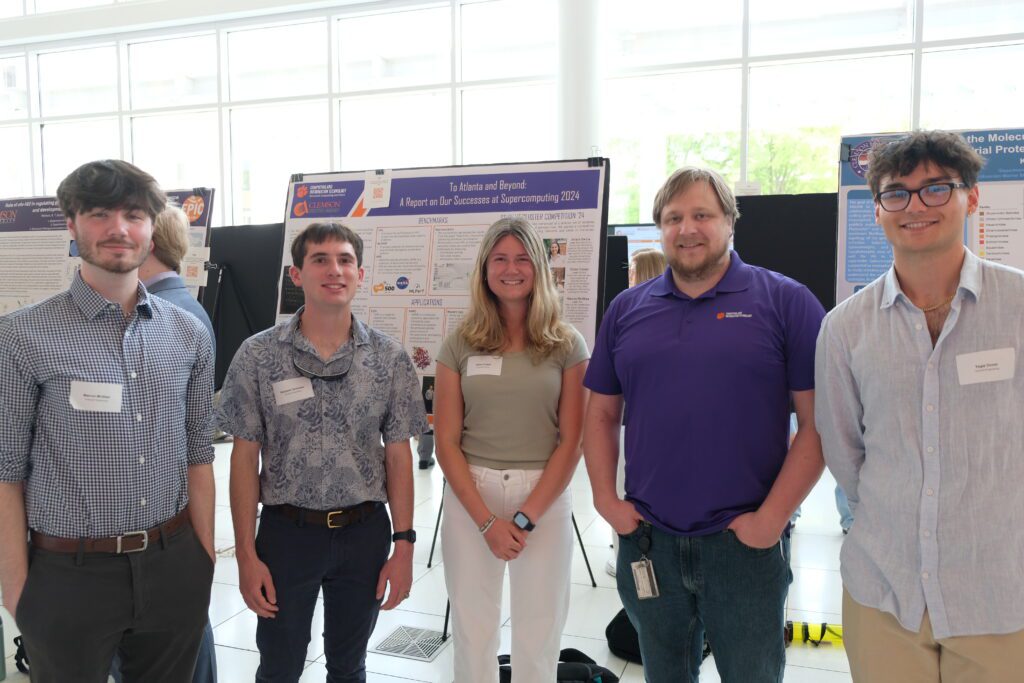
Clemson’s Research Computing and Data (RCD) group is pleased to announce an inaugural High Performance Computing (HPC) Day event to showcase HPC research and education on Friday, September 26, 2025 from 8 a.m. to 4 p.m. in the Watt Family Innovation Center. This event is a fantastic opportunity to network with other HPC researchers, learn new skills and information and to elevate cutting-edge research. Registration for the event is now open for Clemson staff, employees and students (graduate and undergraduate) and the event is free to attend.
Enrollment for the Clemson MBA Executive Board Learning Series is now open! The Clemson MBA Executive Board Learning Series is a professional development series designed to offer focused, accessible education on topics shaping the future of business. Each session will be offered in-person and virtually and will be held every Monday from 4 pm to 6 pm, beginning on October 6th and running through October 27th.