By Griffin Barfield
This April, Dr. Ashlyn Hardie, Institute fellow from the Department of Parks, Recreation and Tourism Management, co-led the first-ever Starting Block Accelerator in London, England with Dr. Per Svensson from Louisiana State University. This innovative initiative is the first of its kind, eliciting pioneering research in the Sport for Development and Peace (SDP) sector. Funded by RHBSSI through a seed grant awarded in 2024, this research has already led to notable, practical impacts, scholarly implications and industry partnerships.
The goal of the Starting Block Accelerator is to support nonprofit leaders, and subsequently their SDP organizations and beneficiaries, regarding various aspects of capacity building. The Starting Block Accelerator’s most distinct contribution to the SDP sector and the research within sport management is that the accelerator is entirely evidence-based and designed to bridge the gap between practice and research in SDP.
Five SDP organizations joined Hardie’s crew in London for a four-day intensive workshop where grassroots leaders from around the world were flown in to participate in a research-backed capacity building accelerator. The five organizations selected were invited because they all met the following criteria: their organizations (1) are operating in the late-start-up or early-growth life cycle stages and (2) have diverse geographic locations, cultural contents and/or sports for implementation.
According to Hardie, the goal of the Starting Block is to “bring in these organizations who have been around for a couple of years and are already doing really great things. But, despite how incredible their work is, they struggle to secure resources and make ends meet. Most SDP leaders are coaches and educators in their educational and training background, so we want to support them in developing the managerial and business-oriented skill sets needed to move further into the growth and maturation life cycle stages.”
Meet the team
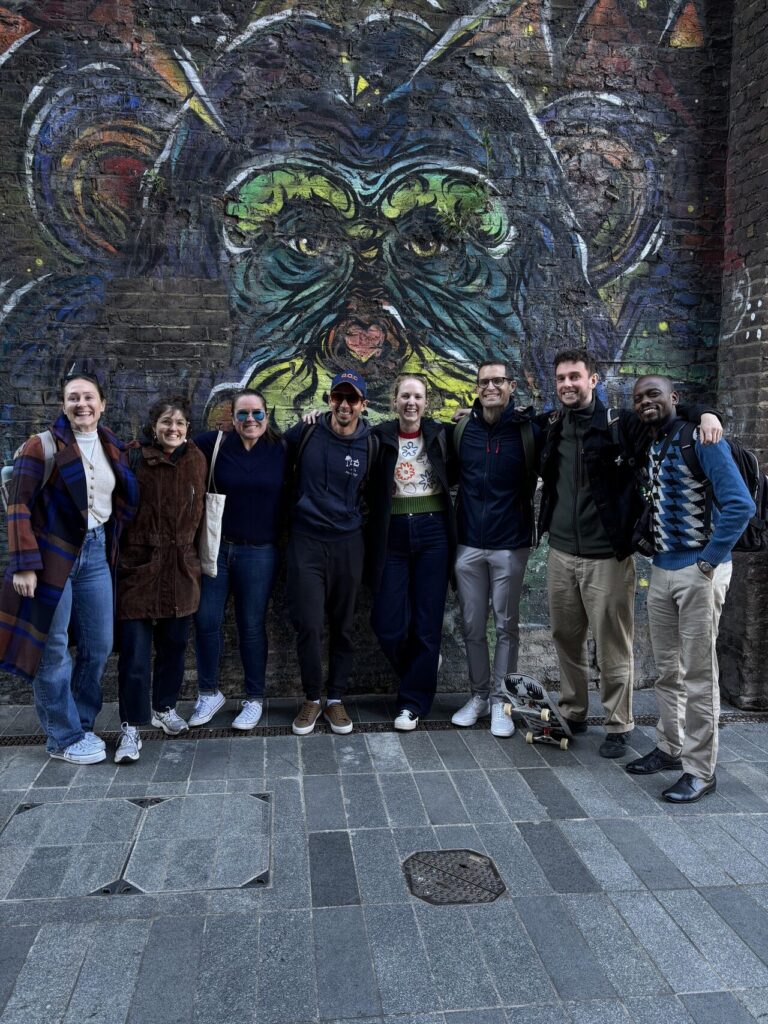
The SDP organizations, represented by their founders in London, included: X-SUBA, a multi-sport mechanism for youth development based in Uganda; Atoot!, a women and girls empowerment soccer organization based in Nepal; Lwandi Surf, a surf academy for local youth in Mozambique; EmpowerVan, a mobile martial arts and self defense initiative for refugees in Athens, Greece; and Free Movement Skateboarding, a skateboarding initiative for local youth participants, also based in Athens.
Accompanying Hardie, Svensson and these SDP leaders in London, was Dr. Kat Raw from Swinburne University of Technology in Australia. Though unable to attend in London, Dr. Gareth Jones from Temple University is also a research affiliate of the initiative – ultimately demonstrating the vast networking and collaborative efforts of the Starting Block Accelerator. These collaborations are not just with practitioners and industry leaders but have also led to multi-institutional academic partnerships.
The workshop
After the groups arrived in London, the first workshop day focused on foundational concepts of nonprofit management in SDP. Topics included mission statements, programmatic goals and alignment, and analyzing partnerships and surrounding operational environments for their success. Participants engaged in a series of activities to help challenge, support, refine and rewrite organizational aspects as needed. Having this strong foundation in place allowed for deeper work in the following days to ensure optimal outcomes.
“Day one was very foundational stuff, like ‘Let’s go through all these things, let’s break down the structure of your organization and really understand where you might have any gaps, whatever it is, so we can focus on where to build,’” Hardie said.
Day two focused on various aspects of monitoring and evaluation, analyzing how each organization collects its data and suggesting how to build strong arguments for potential stakeholders by using data to provide evidence of their outcomes to potential partners and funders. Each organizational leader was prompted through a series of activities to contemplate their own data, access to data and opportunities for data collection that could serve their need to demonstrate effectiveness of their outcomes. Consulting was provided regarding data collection, analysis and, ultimately, the storytelling necessary to turn that data into something accessible for potential partners, funders and others.
The next day involved higher-level managerial concepts, discussing various strategies for securing funding, and practical methods for accessing and digesting evidence-based research in SDP. Given the goal of this initiative is to bridge the gap between research and practice, Hardie stated, “Our aim was to help improve their capacities to conduct their own research through developing skills and knowledge on monitoring and evaluation techniques, but also to help them understand what academic research is open-access and available to them, as well as tactics for making this research digestible for practical use.”
Hardie and her team felt this was an essential part of the accelerator, to ensure their participants knew how to access notable findings on SDP organizations. According to Hardie, so many organizations are using trial and error methods on what works and what does not, because so much of scholarly research is buried behind paywalls or written in academic language that is tough to understand for non-native English speakers.

“There’s a massive gap, specifically in sport for development, because of the paywall and then the language barrier to such an international industry,” she said. “So, what we did on that third day was really focus on translating… how are we taking research and providing it to them in a way that has no cost and is easy to access and comprehend.”
The fourth and final day focused on developing capacities for innovation within the SDP sector. The content focused on practical techniques that each group could use to be innovative in its leadership, utilize modern resources like artificial intelligence, and strategically innovative in their brand, positioning and partnerships.
To wrap up the initiative, at the end of day four, Hardie and team hosted a networking event for the five participating founders to meet with a group of industry-leading representatives from various globally renowned funding bodies in SDP.
“We set it up like a speed dating event,” said Hardie. “At the start, each of our five participants were able to give a 5-10 minute ‘elevator pitch’ for their organization to the group of funders. Then, we created a rotation of 15-minute cycles where SDP leaders could get personalized feedback from the attending funders – likely individuals who have reviewed their applications in the past or will review applications of theirs in the future.”
A “massive success”
At the end of it all, the event was a “massive success” according to Hardie. Not only did the research team gain valuable feedback and insight from the co-design element of the pilot accelerator but, practically, there were noteworthy developments seen for each organizational leader and the capacities they developed over the week. Networking across the research team, practitioner participants and industry funders was a key takeaway from the event, as it has led to new collaborations, friendships and future funding, research and applied opportunities.
“It was really collaborative and the participants all became seemingly real friends over the course of a few days. It was really special to watch,” she said. “I think, from a positive culture and facilitation standpoint, it was a massive success. But, also from an outcome standpoint, we were so pleased with the engagement and some of the developments, ideas and next steps that came out of the week.”

The organizations have expressed immense gratitude for the support they received over the week in London. Historically, SDP groups desperately look for support, seeking resources, partnerships and/or funding – all of which lead to routine rejection and feelings of defeat. To this end, Hardie noted:
“I think just participating in something like this, on its own – regardless of outcomes – restores faith for people. It heals some of their burnout. It heals some of the trauma that these organizational leaders go through by constantly feeling like they’re just hitting dead end after dead end after dead end, or getting rejected consistently by the same funding groups. It kind of breathes life into people in a way. Just like it did for our research team. It heals some of our burnout, some of our frustrations. It restored heightened levels of inspiration and motivation for our research team and those industry leaders too.”
The future of Starting Block
As for the future, Hardie’s team is collecting follow-up data from the Starting Block in London and will continue collecting longitudinal data on the outcomes from the accelerator over the next year. The cohort format is something that the research team plans to keep, bringing in five new organizations in the next cycle, potentially with the mentorship and support from organizations who participated in the cohort before them. In terms of long-term goals, Hardie hopes to finalize an adaptable curriculum and network that allows the Starting Block to support SDP organizations on a pathway out of their start-up phases, into desired positions of growth and organizational stability.
This pilot for the Starting Block Accelerator is hopefully only the start of a multi-prong initiative with resource-providing platforms, with no barrier to entry for the global community of SDP leaders.
“This type of initiative is so wildly innovative, and something that’s so hard and unprecedented to get funding for, especially in sport for development,” Hardie said. “We are sincerely grateful for the RHBSSI seed funding, because it gives really impactful and powerful initiatives like this a chance! A chance to give proof of concept, to collect pilot data to go for bigger funding and, individually, a chance for those practitioners and our research team to engage in once-in-a-lifetime work. So, for that, I am sincerely thankful.”
