By Evelyn Lane

In June 2025, Robert H. Brooks Sports Science Institute Fellow and Assistant Professor in the Department of Parks, Recreation and Tourism Management, Ashlyn Hardie, Ph. D., recently embarked on a journey to Costa Rica. She was accompanied by Mike Clark, former assistant director for Clemson Student-Athlete Development, Nick Singleton, assistant director for Clemson Student-Athlete Development, and nine female student-athletes from Clemson Women’s Rowing, Track and Field, Softball and Gymnastics.
Clemson Student-Athlete Development (SADEV) is a branch within Clemson Athletics where staff work with student-athletes to help them grow in their leadership skills, prepare for post-graduation careers and work on holistic human development. The Director of Student-Athlete Development, Tori Niemann, and Dr. Hardie originally connected because of Hardie’s research expertise on women in sport and sport in the international context. Subsequently, Hardie began to assist the SADEV staff in their goal to ensure the service trip to Costa Rica was intentional, impactful, had measurable research outcomes, and would benefit the Costa Rican community.
Hardie’s research emphasizes the importance of understanding intention versus impact in international development and service work. Her mission is to help others understand that in order to make a positive change, there has to be more than just positive intention; service providers and volunteers also have to acknowledge and embrace the culture and norms of the country they are in to optimize positive outcomes for all parties. According to Hardie, she was really impressed with the SADEV staff’s intentionality in learning about ethical international service practice and prioritizing that in the trip preparations.
Embarking on the trip
On the trip, all of the student-athletes were women, and the two staff members leading the trip, Clark and Singleton, were men. So, in addition to Hardie’s professional contributions, she was excited to be an example to these young women of an experienced female traveler. Hardie shared, “While it wasn’t the intended purpose of my role on the trip, I cherish any opportunity to be an example for young women of how to break out of their comfort zone, embrace different cultures and different people, and seize opportunities to grow through travel. The idea of traveling internationally as a young woman can feel daunting or unsafe, but it makes all the difference to have an example and mentor who can share some helpful tips and support in the process.”

During their service trip, student-athletes learned about the local communities and cultures of Costa Rica, explored the city, zip-lined through the rainforest, gained deeper insight into the ecological elements of Costa Rica and the importance of eco-friendly practices in their culture. The main purpose of the trip, which took up four of the six days of the trip, was to work at a school in the rural mountains of Costa Rica called La Jolla. There, they helped build a community space with a kitchen and bathroom area, along with more creative tasks such as painting signs in English with the school’s core values so that the Costa Rican students could learn English and important values such as empathy and self-awareness. Clemson athletes also helped with general clean-up, participated in a Father’s Day fundraiser and dance classes, and supported with other tasks during the week.
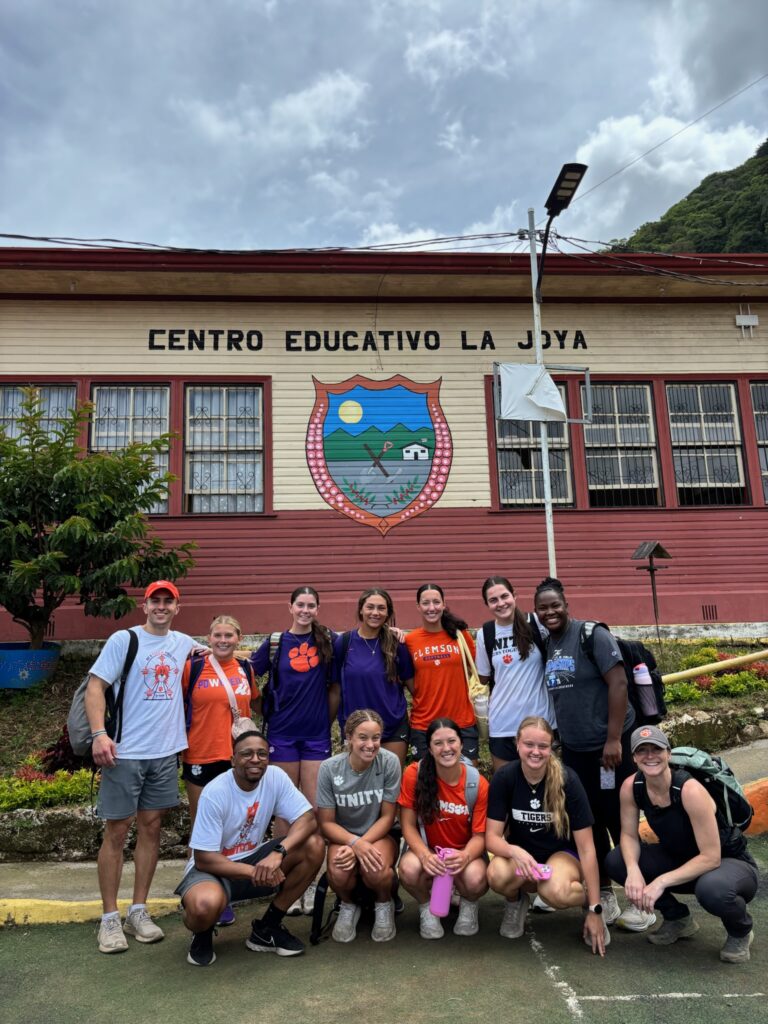
Service trips can benefit both the community that is being assisted and leave participating volunteers with lasting memories, a greater understanding of other cultures, and comfort traveling to a new environment. To this end, Hardie states that there were three main takeaways that were voiced from the Clemson group collectively at the end of their travels.
The first was that the student-athletes expanded their Clemson horizons while abroad and stepped out of their comfort zones. On day one of the trip, the athletes mostly hung out with their teammates and were more reserved; by day six, they formed a little sisterhood and had shared experiences and developed friendships across teams as a result.
The second takeaway was that the student-athletes were able to recognize differences in the way Americans live and what many people take for granted every day. When people picture a trip to Costa Rica, they visualize lying out on the beach during the day and using their resort WiFi to wind down at night, and trust that there will be water coming out of the showerhead so they can rinse off the sand after a long day at the beach. Instead, the women on this trip experienced inconsistency in cell service and WiFi, and the water being shut off for a night at their homestays as a result of a small earthquake (that was not felt by people, but as a safety precaution). Although this made individuals anxious and feel inconvenienced, their host families explained this was relatively normal, which ultimately broadened the scope of Clemson athletes’ understanding of how experiences can vary greatly in other parts of the world.

The last takeaway that the group expressed was that they had a greater desire to connect and contribute to the community surrounding them. The girls were nervous at first, but once they saw all that they could accomplish, they took pride in their work. They also dove more into the culture, they practiced the language and overcame their own discomfort to connect with their environment. These learnings applied to both the student-athletes and the staff leaders alongside Hardie, who acknowledged in real-time that they were in a new place and were able to embrace new things that they had not experienced before.
Hardie states that this trip allowed for self-reflecting and conquering challenges that the group does not normally encounter day-to-day in Clemson, South Carolina. Instead of preparing for a hard exam or training for a new personal record in their respective sport, the athletes had to navigate language barriers so they could communicate with their host families and learn new norms, try new foods, and navigate new cities/towns.
Six days is a short amount of time to fully appreciate being immersed in a new culture, but the student-athletes made the most out of their time. They connected with the locals and attempted to speak the native language, and even participated in a dance class. Cultural acclimation can take weeks for some, but Hardie was proud of them for going out and trying new things and maximizing the time they had.
Aftermath of the service trip
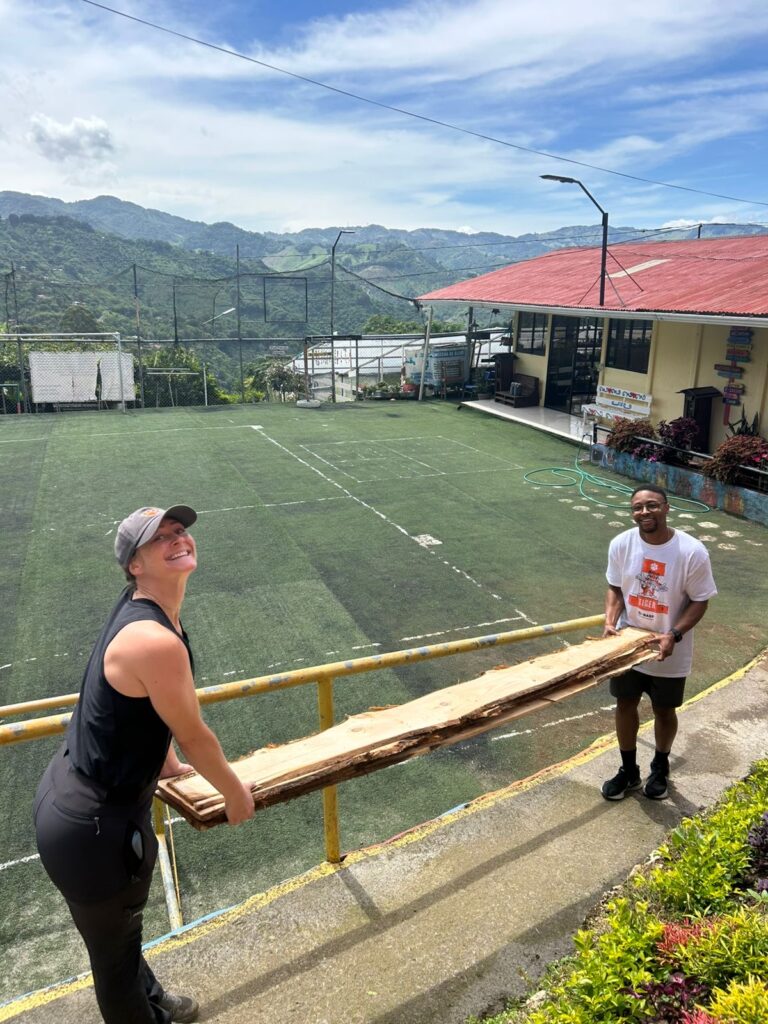
Hardie says that, for the staff and faculty who go on service trips such as these, it allows for moments of learning and reflection that can be utilized to inform future Clemson student-athletes’ community service projects. The impact this group made does not just stay in Costa Rica; it follows them back to Clemson and influences their future projects.
In addition to the service trip itself, Hardie and Niemann partnered together on a research initiative to assess the impact of these opportunities for Clemson student-athletes and donor support. Before, during, and after this trip, Hardie collected data. She challenged the girls to reflect on things like how their identities influence the spaces they are interacting in, cultural understanding and integration, and their own personal development from the trip. She took ethnographic notes throughout this time about her experiences working and interacting with the group, and her observations from the week.
Hardie will be analyzing the qualitative data and asking questions such as, “How did the relationship between the student-athlete development staff and the student-athletes change?” and “What were the most meaningful outcomes for those student-athletes?” and “What was the change in their global perspective?” The information can be used for future trips to prepare student-athletes on how to better interact with other countries, and to seek and interact with donors for projects such as these.
In the future, Hardie is excited to continue working on and supporting international service projects with SADEV as a point-of-contact, regardless of whether or not she travels alongside the team, to provide insight and advice as to how to prepare student-athletes before travelling abroad, as well as support in future research endeavors.
