Sept. 29 is World Heart Day!
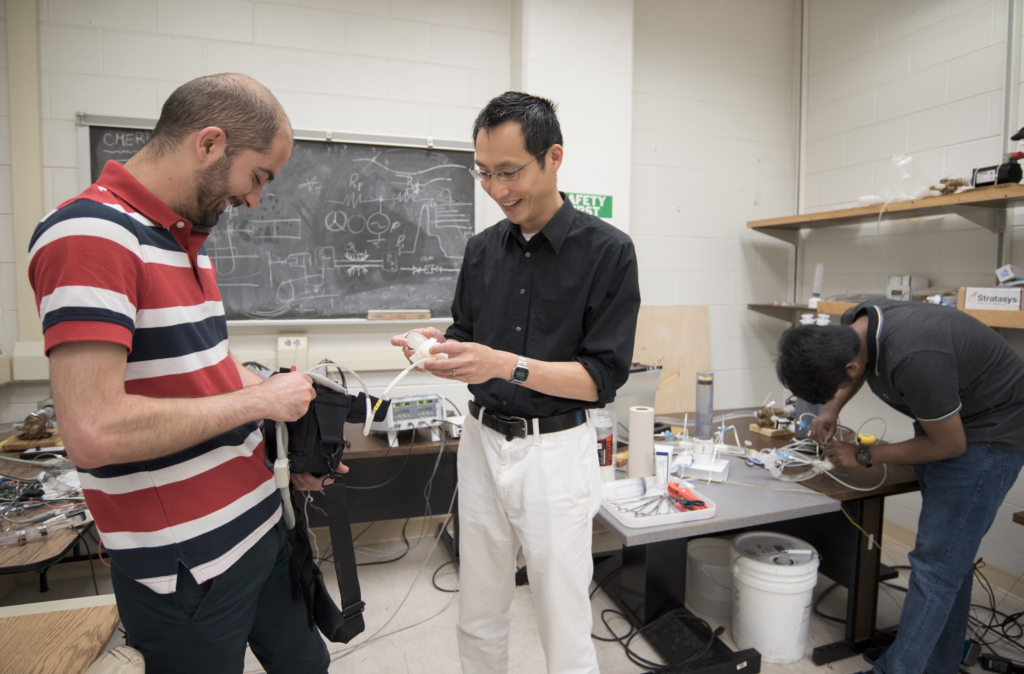
Faculty fellow and associate professor in mechanical engineering and bioengineering, Ethan Kung, Ph.D., founded the Cardiovascular Modeling and Experimentation Research Laboratory (CMERL) in 2014, and the research conducted there can save lives. Part of his most recent research focuses on how to calculate the possibility of having a stroke in a patient with stenosis in their carotid artery.
The carotid artery is a major artery that carries blood to the brain, and stenosis is the narrowing of the artery. For some patients, stenosis can cause a blood clot that travels to the brain, causing a stroke.
“When a patient comes in with that stenosis, right now, doctors don’t know what to do, whether they need to have surgery and remove it, or just to leave it,” Kung said. “A clinical goal is we need to figure out a way to determine, if a patient has a stenosis, what their risk of stroke is.”
Over the past couple of years, Kung has used computer simulations to study blood flow patterns across different patients. The goal is to test if clinicians can differentiate between stroke and non-stroke patients based on their blood flow patterns.
The computer simulations produced 3D maps of velocity and blood pressure within the arteries using a data analysis method called topological data analysis. This helps researchers, like Kung, turn large amounts of data into smaller shapes.
“Right now, the 3D map, the velocity, you could have millions of nodes, each one has three directions of velocity, that’s a lot of data,” Kung said. “So, the analysis turns this large amount of data into something that’s smaller, that has shapes that we could study, and we’re trying to see if we could distinguish this stroke to the non-stroke patients with this analysis. And if we do find a difference, then we will be able to trace back to interpret what this means in terms of blood flow.”
By simplifying the data, there’s hope to find the differences between the two patient groups.
“If we could identify some kind of big-picture blood flow differences, then we can learn something mechanistic about what causes the blood clot and potentially be able to help distinguish these patient groups better,” Kung said.
For this year’s World Heart Day, remember to eat healthy, exercise daily and check out the CMERL to learn more about Kung’s cardiovascular research.
