Sports Insight

Athletic Trainer Month: Behind the scenes of Clemson Athletics

This semester, RHBSSI is working with two track-and-field student-athlete interns through the UPIC Beyond the Game program. In recognition of National Athletic Trainer Month, we’re highlighting the people who support them behind the scenes. We spoke with their athletic trainers about what it’s like to keep athletes healthy and performing throughout the season.
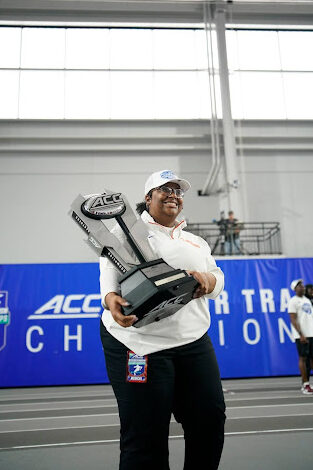

Assistant Athletic Trainer; Men’s and Women’s Cross Country/Track and Field

Dayshia Davenport

A great place to start is the recovery triangle, which includes proper hydration, adequate sleep, and good nutrition. That said, each event requires different forces on the body.

Some coaches may already have their plan made and want to see what I can help with in order to make sure they can get through the training week. For example, throwers who may have a heavy-lifting day and a throwing session may need more mobility and soft-tissue work to combat soreness.

In certain cases, I discuss with the event coach at the beginning of the season, as well as throughout the season, what they would like to accomplish and what each training week looks like, so we can plan recovery and anticipate aches and pains.

I try to listen to what the athlete says their body feels like and give recommendations based on what I know is to come in the training week.

I try to listen to what the athlete says their body feels like and give recommendations based on what I know is to come in the training week.


Collaborating with the coach and with support staff (strength and conditioning coaches, mental health/performance, chiropractors, massage therapists, nutritionists, etc.) is huge for this. My job is to bridge the middle between all entities of sports while also taking care of the physical needs in and out of season. 

If I notice someone may not be recovering or is having a hard time with general aches and pains, I will discuss this with all parties to help set them up for success before the next competition. That can look like changing training surfaces, adjusting weight-training sessions throughout the week, encouraging certain meals after speed vs. endurance training, or encouraging the athlete to focus on mental recovery by doing something non-sports-related.

These are just some examples, but every athlete is different and requires conversations to make sure their physical and mental needs are met for the longevity of the season. 


Each injury is different, so the return-to-play process can involve many variables. My biggest focus is to keep the athlete mentally locked in to getting back. I can manage the physical for the most part, but mental prep is huge.

I try to challenge my athletes each week to complete a movement they haven’t done before. This helps them feel encouraged that they are progressing despite not physically receiving imaging to monitor their progress.

If it’s a minor injury, I typically lay out a calendar and set goals for what I need to see from them to progress to the next step. I also sit with the event coach to discuss when I think they will be back and what parameters need to be met in order to return to group training. I tend to be more aggressive with in-season injuries given the timeline, so I may see that athlete multiple times a day, even on the weekend. If it’s a major injury that may affect the season, I do the same thing, but I may encourage the athlete to connect with mental health or sports performance so they don’t lose that sense of identity while away from sport.

My personality can be very sarcastic and joking, but I also try to give them the empathy they may not be giving themselves through private check-ins, if needed. Each athlete is different, which is why it’s important to build a relationship with them to know how to approach in-season injuries.


Donna Bullock

The emotional struggle that student-athletes go through while not participating in their sport. 


When they don’t hesitate, mentally, emotionally and physically when you incorporate in their rehabilitation, the movement they did when they got hurt. All 3 won’t happen at once so it’s patience and repetition and confidence building. Also, when they are smiling while participating.


That student-athletes can easily recover and it doesn’t affect the other parts of their lives – socially, academically, relationships, religious  – all parts of their lives


Associate Athletic Trainer

Learn about the science of golf and support your Clemson Tigers for Women’s Golf Month

Photos by Josh Wilson, August 2024, Women’s Golf, The Walker Course, Clemson University

Women’s Golf Month is celebrated throughout June each year. This June, we celebrate Clemson Women’s Golf which has a strong history of elite performance and camaraderie with the academics at Clemson University.

Over the years, various faculty at Clemson have studied the science behind the game and its players.

Faculty from Clemson University’s Department of Bioengineering, including Interim Director of the Robert H. Brooks Sports Science Institute, John DesJardins, Ph.D., have studied ‘balance improvements and golf swing kinematic consistency with eight-week balance interventions.’ The purpose of the study, conducted in 2020, was to determine if a training program targeted specifically at balance could enhance players’ overall performance by improving postural stability and swing consistency. After studying eight NCAA Division I players, it was determined that balance training would enhance posture but, while no negative effects were measured, swing consistency did not improve. Another benefit of the study showed the importance of conducting research to help coaches and players understand both the positive and negative effects of their training programs and to potentially make modifications based on that data. While the original study was conducted with male golfers, its conclusions can be applied across teams. Click here to read the full article in the Journal of Sports Research.

Another Clemson faculty member, Gregory Cranmer, Ph.D., from the Department of Communication and fellow of the Robert H. Brooks Sports Science Institute, has studied ‘female golfer’s uncertainty management during their transition into professional golf.’ The 2020 study offers potential strategies for collegiate organizations and professional associations to prepare student-athletes for the uncertain transition into professional golf.

On August 28-29, the Tiger Golf Gathering (TGG) Foundation will host the 2025 Tiger Golf Gathering in Clemson, an annual fundraising event that benefits the Clemson Golf program. The event features a Thursday Open at The Walker Course and Auction Party in the afternoon at the Madren Conference Center and Inn. Friday morning features the Tiger-Am at The Cliffs at Keowee Springs. Meet current and former Tigers and bid on some amazing items to support your Clemson golfers. Sponsorships and online donations are also available.

Click here to learn more about Clemson’s sports science faculty.

Reprinting history: The story of an almost-discontinued Clemson/Georgia rivalry book 

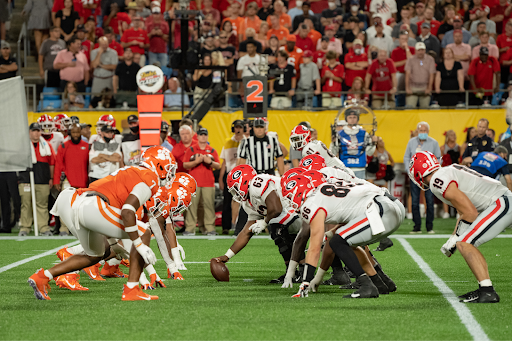
2024 Clemson v.s. Georgia kickoff game

By Grace O’Donnell and Griffin Barfield

Ahead of Clemson’s week one game against Georgia last August, there was the same nostalgic buzz in the air as there always is when the border rivals meet. After more than a century of football, the teams had built up quite the reputation. However, a special account chronicling the two teams’ history was nearly lost to time – if it weren’t for two Clemson students’ determination ahead of the 2024 matchup. 

The story begins back in 2013 when author T. Kyle King published Fighting Like Cats and Dogs. King grew up a Georgia fan, living in Atlanta and attending school in Athens. After school, he became a co-host of The Dawg Show and, eventually, of Dawg Sports, reporting on all things Georgia Athletics. 

In his writing, King highlights the biggest moments of the Clemson and Georgia football rivalry. He begins in 1977, a time in which he says, “there was no more closely contested or nationally significant rivalry in college football” than the one between the border neighbors, and extends all the way through the 2003 season. After that, the teams did not meet for a decade. 

Sounds interesting, right? There’s just one problem – its publishing came to a halt in 2021.

For a book that “always sold well” according to Allison Mero, director of Clemson University Press since 2017, King’s was gone at an inconvenient time: the beginning of the Clemson vs. Georgia series that occurred in 2021 and 2024. 

The Reprint

Mero put the book’s reprinting on University Press’ back burner until the spring of 2024. However, she later discovered the problem was more complex than it going out of print. 

First, there was no backlist on file for the book allowing for online production of the text. Second, although most books in modern publishing are created in Adobe InDesign, there were no previous InDesign files.

New print for the book
O’Keefe’s redesign included creating a cover which accurately reflected the contents, selecting a new font and sizing it to increase the overall thickness and readability of the book. 
Original print for the book

With these issues combined, a forced manual reprint was necessary. 

Two Clemson students helped with the book’s revival: Mars O’Keefe, a junior Art major, and Yana Gudakova, an editorial assistant studying both English and Spanish Language and Literature. O’Keefe updated the cover while Gudakova retyped the book, something she did with no prior typeset experience. The press staff then reviewed it after the typeset was complete. 

Typesetting was done through optic character recognition (OCR), a feature provided through Adobe Acrobat. The technology converts scanned images and text into editable files much quicker than arduously retyping an entire 248-page book.  

The entire operation was no easy task but, because of the team’s hard work, the book was reprinted and released before the Clemson versus Georgia game last August in Atlanta. For O’Keefe and Gudakova, it was a semester-long project requiring dedication and countless hours of work. For Mero, it was a chance to preserve the legacy of Clemson. 

“The press is small but mighty – our mission is to publish high quality scholarship and publish books that need to be published, regardless of how many sell,” she said. Her goal is “professionalizing CU Press and trying to make books more available and discoverable.”

The press is an institution within the Clemson Library but technically is its own entity. Therefore, Mero says she is not a librarian, rather a historian. 

As a historian, she considers herself “an interpreter of facts.” After reading King’s work, Mero decided the content was fairly unbiased and worthy of publishing. It was not heavily skewed towards either team and presents more like a recounting of games than an opinion. 

“It taps into the people who have been fans for decades,” she said. “That’s who this book is for. It’s for getting the legacy right.”

Kyle King
Author T. Kyle King

King spent time on both campuses while writing, making sure to emphasize successes from both sides of the rivalry. His research included a brief meeting with ex-head coach Danny Ford, which King appreciated.

“While I was introduced to the rivalry as a Georgia partisan, I spent a great deal of time at Clemson doing research for the book,” he said. 

“I have a great deal of respect for the Clemson community and I tried very hard to do justice to both sides. Particularly in light of the fact that there was a time when conference expansion threatened to end this rivalry, I am strongly encouraged to know that current students recognize the ongoing vitality of the rivalry and want to make certain others are aware of it, as well.”

King no longer writes for Dawg Sports. He stopped around the time of his book release, putting down the pen and paper to work as a senior partner for a law firm in Atlanta. Although no longer actively writing, the reprinting of King’s novel has him both “humble and grateful that this important aspect of history has been preserved.”

While the Bulldogs enjoy a modern level of success to compete with the 1980s, King has no regrets about leaving the press box.

“I thoroughly enjoyed my time working in that arena, but I left because I thought it was time to go, and I haven’t looked back,” he said. 

“Again, I’m grateful to everyone who stepped in to fill whatever void I may have left, and they’re doing a wonderful job in all of those areas, so I haven’t had any reason to wonder about what might have been.”

Clemson University Press was instrumental in maintaining such a beloved piece of Clemson’s history. “We’re just glad that it’s going to be available,” Mero said.  

Clemson University Press logo

The book can be purchased on Clemson University Press’ website, where it is currently the best-selling title, while the opportunity for an e-book is still forthcoming.

For King, he got his wish in the end: seeing a piece of Tiger versus Bulldog history become available once again.

“The great thing about college football is that so many people are so passionate about it that they leave behind a lasting record of their heritage and intensity, which especially comes to life in the local press and the student newspapers from the period,” he said. 

“There is an old saying that journalism is the first draft of history, and in this case, it really is true.”

Clemson Baseball pitcher and Physics lecturer join forces to find common variable in pitch velocity

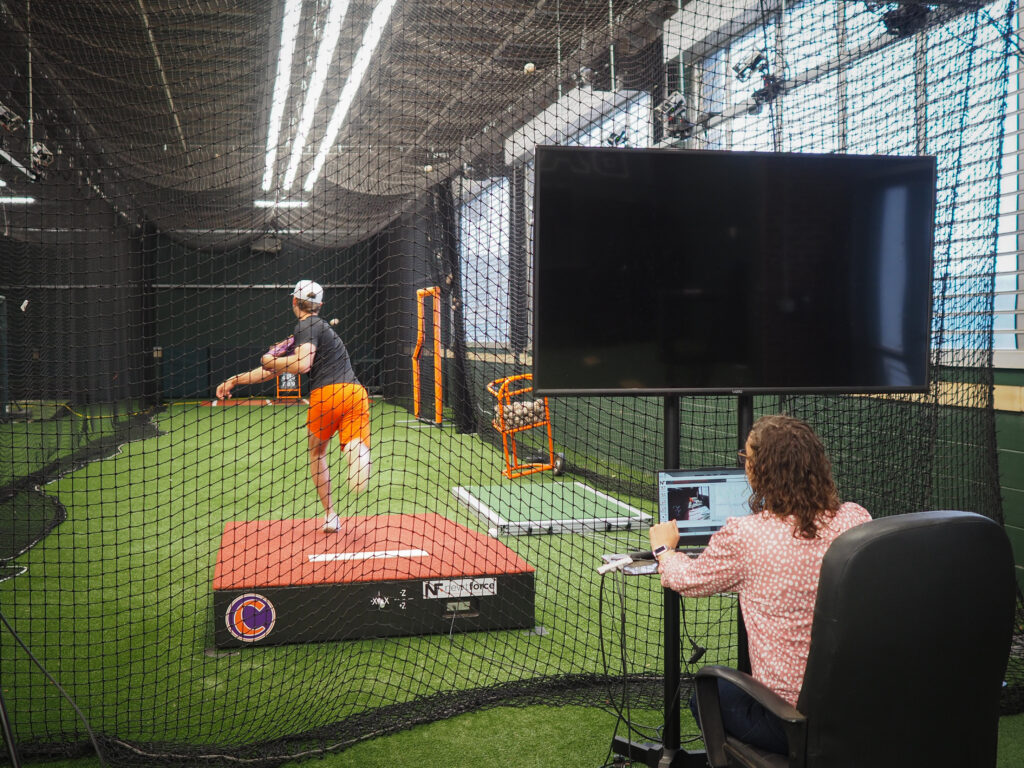
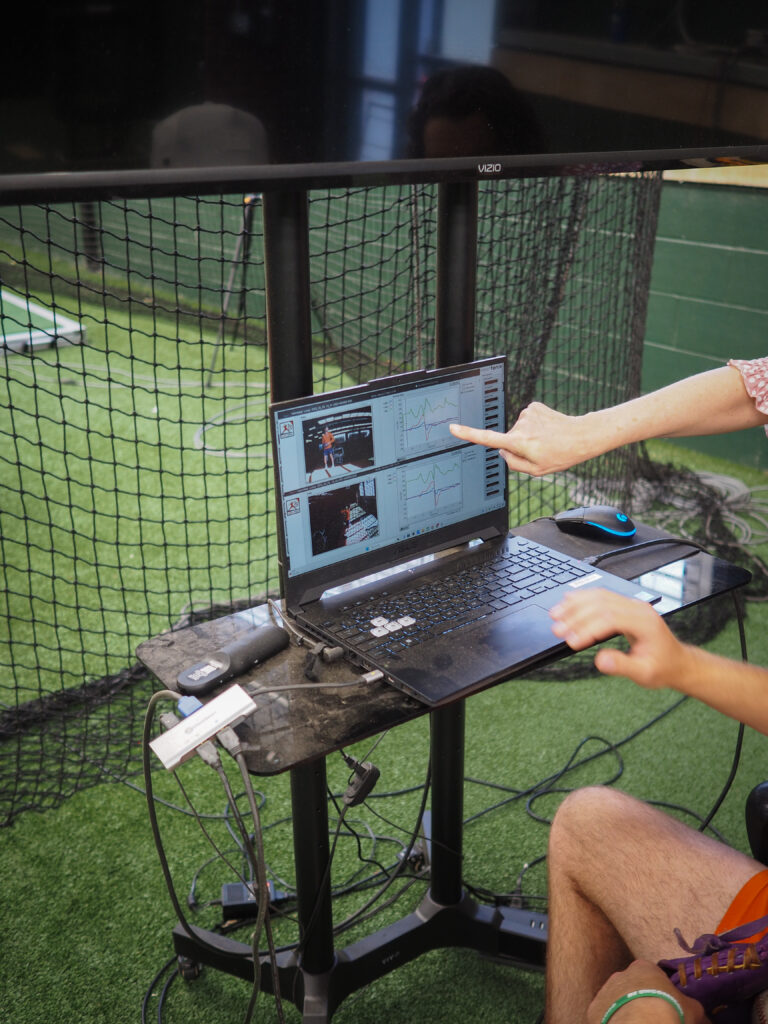
Amy Pope analyzing Lucas Mahlstedt's pitching data.
Amy Pope analyzing Lucas Mahlstedt’s pitching data (photo by Natalie Bell)

By Griffin Barfield

Lucas Mahlstedt, senior Physics major, has joined forces with Physics lecturer, Amy Pope, to analyze pitching data to examine how the mechanics of a baseball pitch relate to pitch velocity. . One of Clemson Baseball’s top relief pitchers, Mahlstedt is combining his love for the sport and physics to complete his senior thesis this semester. 

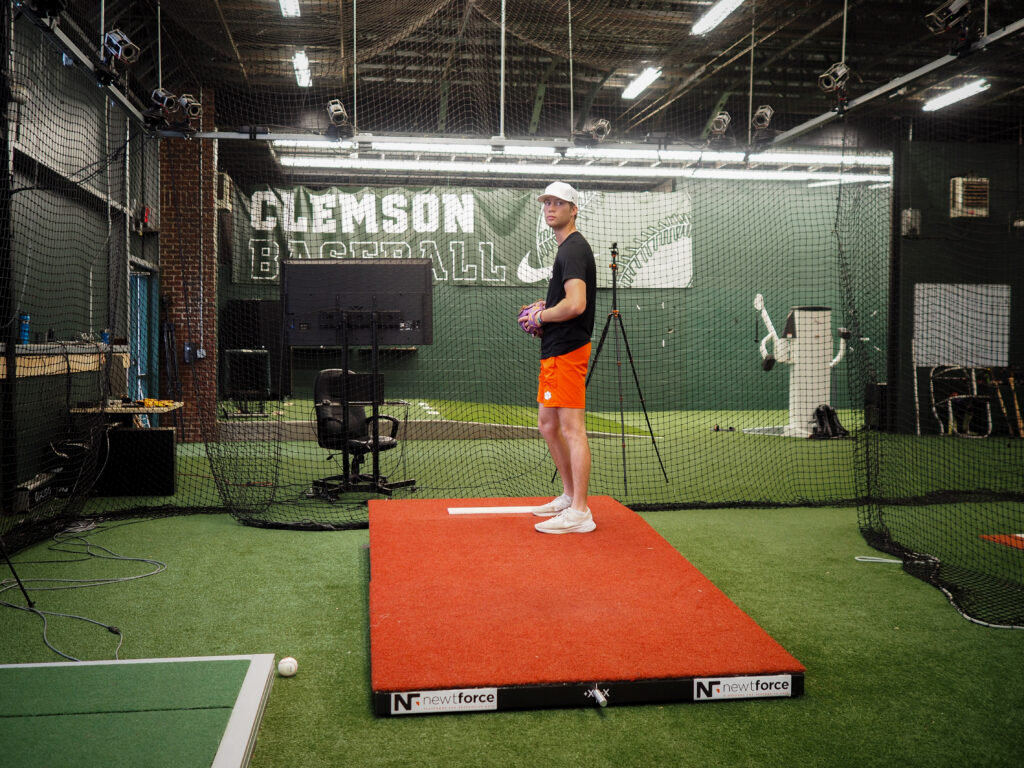
Mahlstedt demonstrating throwing motion (photo by Natalie Bell)

“Our main goal is to figure out what increases pitch velocity the most because there’s so many different ways,” said Mahlstedt. “So many different pitchers have different mechanics. You’ve got guys who throw from the side, up top, guys with different arm action.”

Mahlstedt’s throwing motion is a ‘submarine’ throw, which means his toss closely resembles an underhand throw by whipping his arm around his body, allowing the ball to come from different angles. The motion is untraditional compared to a pitcher that throws over their shoulder. Regardless of throwing motion, size and age, Mahlstedt is interested in establishing a consistent variable through physics that pitchers can use to improve their game.

“So, we’re trying to find something consistent that every pitcher could use at different levels,” he said.

The physics of sport

Pope teaches the physics of sport at Clemson. Her work intersects with different sports like football and, most recently, breakdancing which was introduced in the 2024 Paris Olympics. She has also worked closely with golf and ski jumping. This is her first time working with baseball student-athletes. 

From golf to baseball, Pope describes how ball material makes this study different from one she had conducted with Clemson Golf students.  

“I’ve worked with some of my students who have been in golf and we’ve looked at Trackman data for that,” Pope said. “Golf is difficult because the balls have dimples, which give a lot of additional air flow and make the ball stay in the air longer.”

Using a Newtforce Mound to collect data, Mahlstedt has narrowed down variables that could help detect a linear relationship for faster pitches. 

“The Newtforce Mound looks like a piece of plywood that’s at a little bit of an incline,” Pope explained, “and whenever you are stepping on the plate, it’s recording all of the forces that are acting on it in three dimensions at one time.”

A radar gun is also used to detect the speed of each pitch. 

Mahlstedt gearing up to pitch.

With the help of these tools, Mahlstedt believes that the acceleration impulse of the pitch, or the ground force measured from the pitcher’s leg lift, could be the variable he’s been looking for.

The two compared Mahlstedt’s data with other pitchers and managers on the team, who participated in the research, and they saw a linear correlation. 

“For multiple pitchers, we have observed that the larger the impulse put into the ground during the pitch, and conversely, the harder the ground pushes up on the player, the faster the exit velocity of the ball,” Pope said. 

While there are various details that could be factors, such as stride length in the pitcher, their arm strength and effective kinetic chain of their arm movement, the two are putting their attention to how the ground forces affect the exit velocity of the ball. 

“I think we narrowed it on mainly focusing on the lower half of the body,” Mahlstedt said. 

With a full-body sport like baseball, there is high injury incidence at all levels. Baseball pitchers face risk of serious injury throughout their careers; therefore, performance cannot be fostered without a serious look at injury prevention.

“We can talk about injury prevention because if you can get that lower half of your body into it, you’re going to be able to throw the ball faster without risking your throwing arm as much,” Pope said. 

“If you can generate more velocity from [your lower body], it should be less from [your upper body], at least,” Mahlstedt agreed.

The results are in

For the Clemson pitcher, the results have been working. As of April 2, the pitcher has a 1.09 earned run average(ERA), striking out 34 in 24.2 innings pitched this season, and an opposing batting average of .180. Mahlstedt has also noticed that he has “been throwing harder” over the course of this season.

Pope and Mahlstedt reviewing results

The senior has been using a larger acceleration impulse for his pitches, heightening the force that he puts in the ground from his leg lift. From this force, and according to Newton’s third law of motion, the opposite reaction that the ground gives him the force that he needs to throw faster.

If this variable is important, how, then, does an athlete train to increase their acceleration impulse?

“A lot of water bag drills,” said Mahlstedt. “It’s used for stability, but if you take a water bag and you move it and you kind of rock, you almost feel this impulse with the water sloshing back and forth. It just improves stability.”

Jumping exercises, such as one leg jumps, have helped Mahlstedt’s transfer of force, which would allow for a linear increase.

“That has led to that increase in acceleration impulse and then an increase in velocity,” he said. 

As for the future, Mahlstedt and Pope will be further researching how the upper and lower body interact during a pitcher’s career progression, hypothesizing that measuring the lower half of the body could lead to more findings that will help pitcher training. 

“The kinetics with the ground forces in the lower half is easier because we have to do the force itself,” Mahlstedt said.

“We’re looking at ways that we can quantitatively say that most players, if they do this, they should be throwing the ball faster,” Pope added. “Each athlete is very individualized with their body mechanics and in what they do, so we’re just trying to look at some overall metrics that a player might be able to look at to see if they can improve that metric and, thereby, improving their pitching speed.”

Injury prevention was another future topic mentioned, due to the amount of pitchers that suffer upper body injuries from body fatigue. Most of the research released about baseball pitchers is about injury prevention, and the two are interested in evaluating how their research on lower body forces can add to prevention.

“If you can focus on the lower half to increase the speed of the pitch,” Pope said, “that’s probably less damaging to the arm. Not a lot of pitchers go out because they injure the lower half.”

Whether the MLB Draft or a future in baseball is in the cards, Mahlstedt hopes that his research will be the continuation of something important, whether in pitcher development or injury prevention, on the baseball diamond. 

The code to success for a female athlete in computer science

By Nicole Souza

Paige Wasiela (right) participating in Rush Week 2025

March is Expanding Girls’ Horizons in Science and Engineering Month, a time to celebrate the achievements of women in STEM and highlight the importance of supportive communities in these fields. While science, technology, engineering and math (STEM) offer incredible opportunities, gender disparities remain, particularly in computer science. According to the National Center for Biotechnology Information, girls make up 61% of advanced placement (AP) biology students, 52% in AP statistics and 50% in AP chemistry. However, that number drops to just 23% in AP computer science.1 This gender gap persists beyond primary education, continuing into college and the workforce. Every day, women work to forge their own pathways to success.

Paige Wasiela, a senior computer science student at Clemson University, exemplifies a woman who has found academic and personal support in her field. Through extracurricular involvement and women’s intramural sports, she has thrived in a male-dominated field.

Paige was initially drawn to STEM by its limitless possibilities. “I was inspired to pursue STEM because I saw the opportunities post-grad to contribute to creating something that society, and myself, could benefit from,” she said. 

Her journey has not been without challenges. She found her courses rigorous and, like many women in STEM, initially struggled to build a support system in her male-dominated major.  “The rigor of courses in the STEM fields, computer science specifically, have proven to be very challenging, but by seeking help from TAs [teaching assistants] and professors, I have been able to pass my classes and learn.” 

However, academic support from professors and TAs can only go so far. Finding a community of like-minded individuals became a crucial part of her academic success.

Paige (middle, orange shirt) with other members of Theta Tau

When looking for such a community, Paige found Theta Tau, a co-ed professional engineering organization after receiving a recommendation from a friend. Joining Theta Tau would shape the next three years of her college experience. Through the organization, Paige built lasting friendships, received help in classes from people she would have never met otherwise, and even secured a full-time job that she is passionate about. Theta Tau offered mentorship and support, and as a group that is equally composed of men and women, it provided a close-knit network of like-minded women who shared her academic drive and social interests.

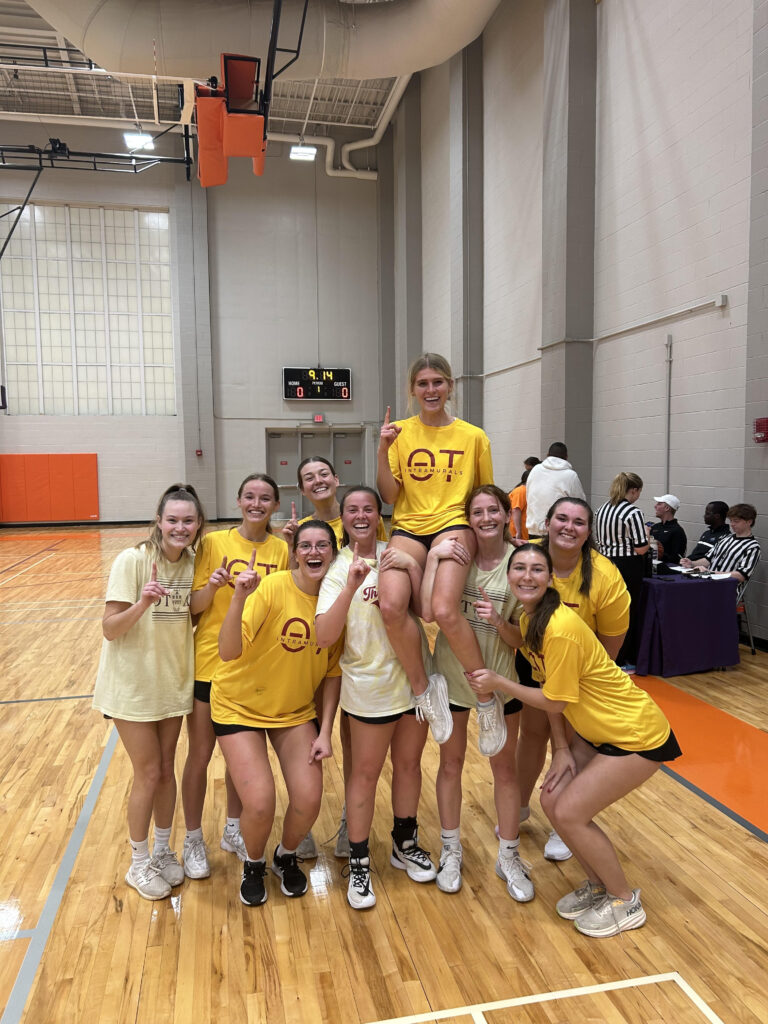
Paige (middle, black socks) holds her teammate up to celebrate their intramural victory

Outside the classroom, Paige excelled in athletics. Her love for basketball led her to join the Theta Tau women’s intramural basketball team. What started as a fun activity quickly became something more meaningful. “Playing together and having fun creates a bond between us that makes us want to get to know each other better outside of the sport and be better friends,” Paige explained. This camaraderie extended into academics. “Getting to know people on the basketball court opens the door to being more comfortable around each other, especially when asking for help on things like academics.”

Mentorship has played a significant role in Paige’s journey. Admiring her teammates on the court often translated to admiration in the classroom and beyond. “When you admire someone’s work on the court, you can easily admire their work in academia, or just in life,” she said. Seeing older members succeed in their coursework provided both inspiration and guidance. Now preparing to graduate, she hopes to pass on an important lesson to younger students: never be afraid to connect with older members of your organization or major. “We’re all students in STEM. We’re all in this together.”

For girls considering a career in STEM, Paige says to “go for it! You never know until you try, and it shouldn’t be something that scares anyone. There’s a community out there for girls in STEM.” 

While statistics show progress in closing the gender gap in many fields, there is still a significant disparity. Building relationships with other women in the field can help overcome challenges and foster success.

Paige’s story is a testament to the power of community, mentorship and support in helping women thrive in STEM. Whether through professional organizations like Theta Tau or the shared experience of sports, finding a network of supportive women can be life changing. As we celebrate Expanding Girls’ Horizons in Science and Engineering Month, let Paige’s journey inspire the next generation of women in STEM.

  1. National Initiative for Cybersecurity Careers and Studies. (2025, February 12). March is Expanding Girls’ Horizons in Science and Engineering Month! National Initiative for Cybersecurity Careers and Studies. https://niccs.cisa.gov/cybersecurity-career-resources/featured-stories/march-expanding-girls-horizons-science-and  ↩︎

How the Clemson rowing team inspired two alumnae to row the Pacific

With March marking Women’s History Month, the Clemson Athletics and sports science communities have plenty to celebrate, including several women’s varsity programs at the University, one of which is the rowing team.

Competing in its first-ever season in 1999, the Clemson women’s rowing team has an enriched history and has been a staple of Clemson Athletics for two-and-a-half decades.

After Clemson announced it was adding a varsity women’s program in 1997, two years later, the Tigers were on Lake Hartwell practicing and competing. Since then, the team has accomplished great feats and has even climbed all the way to the mountain top in NCAA competition. 

One decade after being established as a program, Clemson’s Varsity 4+ team captured Clemson’s first-ever national championship at the NCAA Rowing Championships in Cherry Hill, New Jersey, in 2009.

That championship helped pave the way for future rowing athletes to attend and compete at Clemson University, two of whom are set to speak at the Robert H. Brooks Sports Science Institute’s (RHBSSI) annual lecture series later this month.

An attempt at a world record

In honor of Women’s History Month, RHBSSI is proud to be hosting Jenny D’Anthony and Anna McLean on March 26 in Freeman Hall for its annual lecture series.

The duo will speak about their ongoing preparation for the estimated 60-day trip from Monterey Bay, Calif., to Kauai, Hawaii, as a part of the World’s Toughest Row competition. From taking two-hour sleeping shifts to burning 10,000 calories a day to desalinating ocean water, D’Anthony and McLean will begin their journey across the Pacific on June 8.

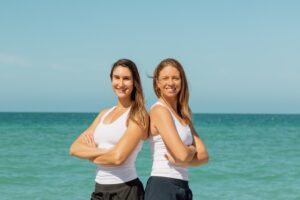
Jenny D’Anthony (left) and Anna McLean (right) are set to row the Pacific Ocean in June but will speak on Clemson University’s campus beforehand in March.

For months, the pair has been training to be the youngest and fastest female athletes to row across the Pacific Ocean. As a part of their mission, D’Anthony and McLean are raising money for the Hear Her Roar campaign, which brings awareness and financial support to Clemson’s female student-athletes.

McLean and D’Anthony were members of Clemson’s rowing team beginning in 2014 until they graduated from Clemson in 2017 and 2018, respectively. In 2022, McLean, from the United Kingdom, and D’Anthony, from the United States, formed United Row.

D’Anthony credits her time at Clemson for the person she is today and her motivation to complete the upcoming row across the Pacific. 

“My Clemson experience was nothing short of incredible,” D’Anthony told Iptay. “It transformed me in ways well beyond athletics. Opening my eyes and mind to things I never thought possible. I wear the paw with pride and am grateful for the opportunity to represent and give back to my alma-mater. I am incredibly excited to immerse myself in an all-consuming challenge, where I will test my limits both physically and mentally. There are few, if any, times in life you can entirely devote your attention to one goal. This is one incredible exception.”

As for McLean, her experience as a Tiger already inspired her to row the Atlantic Ocean with her brother in 43 days, 15 hours and 22 minutes in 2019. Now, she’s onto an even bigger challenge with her best friend. 

“As a student-athlete at Clemson I was able to meld my love for rowing alongside my passion for business,” McLean told Iptay. “Surrounded by such driven and highly successful students empowered me to ‘never settle’ (but) rather continue striving for more. From mornings on Lake Hartwell to months in the Atlantic Ocean, and now with dreams even bigger, conquering the Pacific, I am beyond grateful for the foundation Clemson laid and humbled to be giving back to my alma mater and supporting future generations to pursue their dreams too.”

Clemson students, faculty, alumni and community members are invited to hear D’Anthony and McLean discuss their upcoming 2,800 nautical-mile rowing competition. The talk with RHBSSI will begin at 6 p.m. EST on March 26 in the Freeman Hall auditorium, followed by a reception with food and refreshments in the Freeman Hall gallery from 7-8 p.m.

Those interested should RSVP for the event at clemsonsportslecture.rsvpify.com.