On February 21, Clemson University held an engaging event for Tigers of all backgrounds to join the launch of the University’s new capital campaign, Fiercely Forward, the driving force to achieve the bold initiatives of the University’s strategic plan, Clemson Elevate.
Partners of the Robert H. Brooks Sports Science Institute showcased their sports science technologies, research and creative endeavors in a fun-filled display of helmet-hitting, off-road vehicle exploring and exoskeleton viewing.
Bioengineers, packaging scientists, and automotive and industrial engineers from the Institute’s fellows cohort participated in the event, engaging with guests and explaining how their lines of inquiry and new innovations are making an impact in the greater Clemson community and across the globe.
For the Robert H. Brooks Sports Science Institute, this campaign is a launching ground for new initiatives in support of the University’s strategic plan, positioning RHBSSI to become a national leader in sports science and equipping students with the skills, experiences and connections to thrive in a dynamic industry of sports enthusiasts of all backgrounds.
John DesJardins, Ph.D., on Oct. 18 at the Launchpad
The Robert H. Brooks Sports Science Institute (RHBSSI) recently sponsored the Brook T. Smith Launchpad’s first annual Sports Entrepreneurship Symposium on October 18 in downtown Clemson. Interim Director, John Desjardins, participated by speaking on sports science and sports education at Clemson University.
Clemson offers more than 55 courses in sport, spanning colleges and disciplines – everything from the history of sports in the modern world in the Department of History and Geography, to kinesiology in the Department of Biological Sciences. Overall, more than 15 departments participate in sports education at Clemson, spanning 7 colleges.
“It was a pleasure to sponsor and participate in the Brook T. Smith Launchpad’s first-annual Sports Entrepreneurship Symposium. The Robert H. Brooks Sports Science Institute exists at Clemson to work as a platform for the multidisciplinary study of sport. It is great to see so many Clemson alumni going on to work in the sports field – and then return to share their knowledge and experience with Clemson students!”
John DesJardins, Ph.D., interim director of the Institute
The Sports Entrepreneurship Symposium consisted of multiple panel discussions with professional speakers from numerous sports disciplines. Topics ranged from AI’s impact on data analysis to new business opportunities through NIL. Attendees were encouraged to explore opportunities in the sports entrepreneurial ecosystem and learn skills to accelerate their careers.
Click here to learn more about the Brook T. Smith Launchpad, Clemson’s entrepreneurial hub. Click here for a list of courses at Clemson that delve into sport.
Placed among mini golf holes and poster presentations, live demonstrations and activities representing the sports sciences will be on display at the Institute’s RECESS Symposium on October 24. Located in the Madren Center’s Grand Ballroom, the demonstrations will include:
Headgear Impact Performance: Greg Batt, Ph.D.
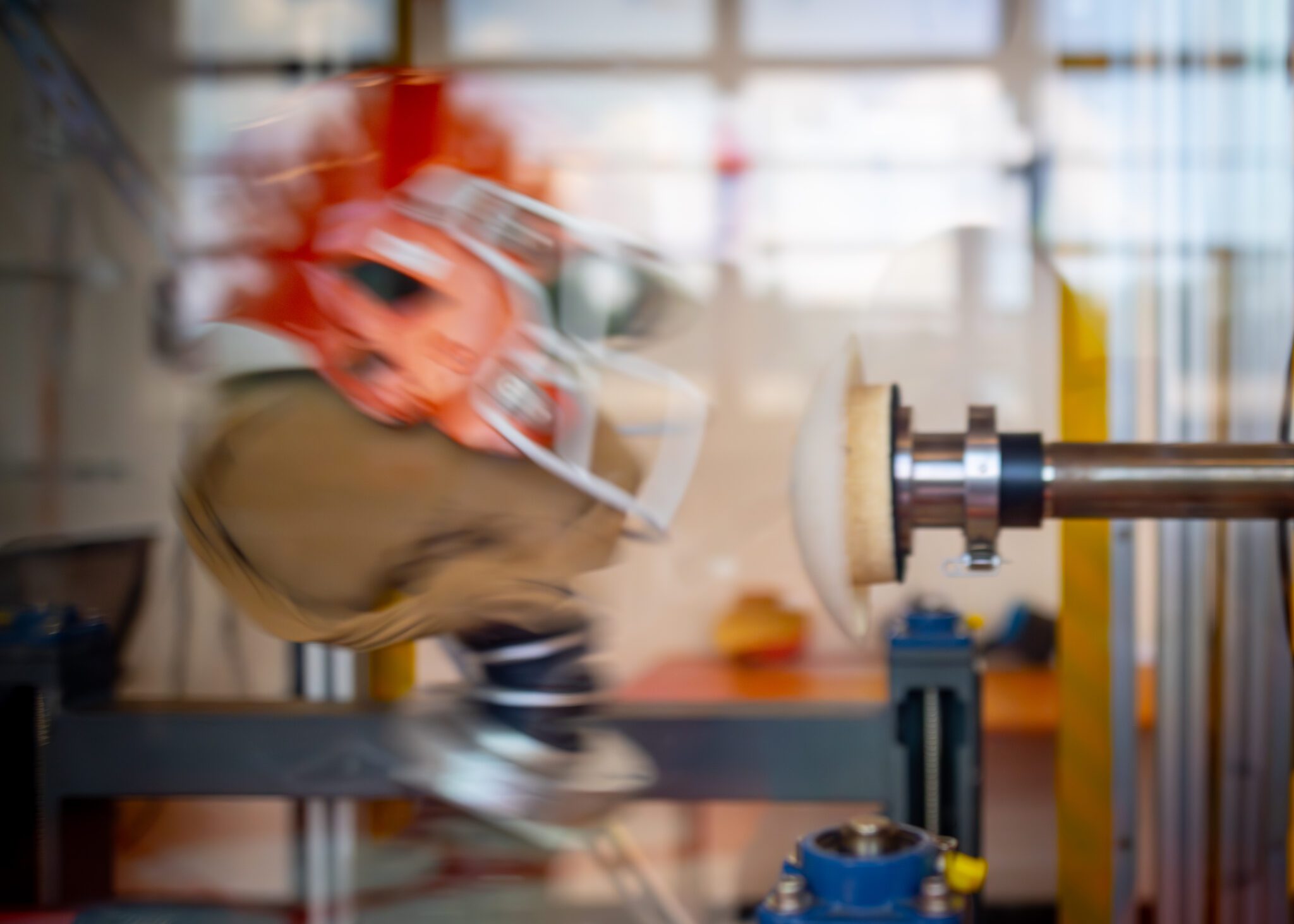
The Clemson Headgear Impact Performance (CHIP) Lab at Clemson tests the strength of sports helmet faceguards. According to Batt, these masks are made to protect players from many injuries but fail more often than one might think. Using a pneumatic canon, the impact on the helmet is recorded. Testing in the lab, done by students, hopes the data collected will one day make sports safer for everyone. The CHIP Lab will demo various equipment at RECESS like helmets, a head and neck form, a hammer and a computer that will be used to acquire acceleration response of the head. The team will be available to discuss more about the outcomes of their testing and answer questions.
Rowing Motion Capture: Anthony Marino and John DesJardins, Ph.D.
Collegiate rowing is the oldest intercollegiate sport in the United States, and has a prestigious historical tradition among American universities dating back to 1852 (Harvard Magazine). Unfortunately, the sport has long been considered a men’s-only sport it took over 100 years for women gain recognition. A collaboration between Clemson Bioengineering and the Clemson Women’s Rowing program has investigated questions specific to women’s rowing and enhanced the training, health and performance of our athletes. A 3D motion capture technology has been used at Clemson to test novel foot plates during rowing. At RECESS, participants will be able to interact with this system and learn more about the outcomes for rowers.
Virtual Reality Soccer: Felipe Tobar, Ph.D.
Tobar’s research initiative integrates virtual reality (VR) technology, electroencephalogram (EEG) monitoring, and artificial intelligence (AI) to understand the experiences of Olympic and Paralympic soccer athletes using VR simulators for training purposes. The long-term goals of this project are to develop more effective VR soccer training experiences that enable skill transfer to improve on-field player performance for competitive athletes, and develop more inclusive VR soccer experiences, both as training tools and for recreation, for persons with disabilities. Participants at RECESS will enter a simulation to experience real soccer gameplay by making quick decisions on the field and passing forward. Challenge yourself and enjoy a cutting-edge, sports-based VR technology that merges fun with athletic training.
Exoskeleton Demonstration: Jessica Avilés, Ph.D.
Exoskeletons are devices worn outside the body to assist with movement. They come in a wide variety for the upper and lower body, some powered by batteries and motors, some by hydraulics and some by springs. Avilés’ research aims to help people with spinal cord injuries find the best exoskeletons and training plans so they can participate in sports. Her goal is to turn exoskeleton racing into a Paralympic and collegiate adaptive sport.
Open Cap Makerless Motion Capture for Hamstrings: Reed Gurchiek, Ph.D.
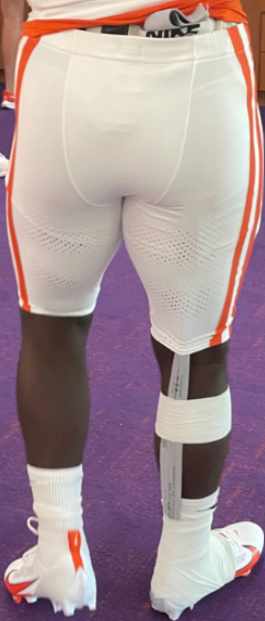
Gurchiek’s makerless motion capture technology, Open Cap, measures an athlete’s hamstring pain. He has developed a wearable device that uses a passive elastic band to assist the hamstring muscles during running. This device is designed to rehabilitate hamstring strain injuries more effectively than is currently possible, addressing a growing and widespread problem as hamstring strains are currently the most prevalent time-loss injury in field-based sports. Currently being tested, the device should reduce hamstring muscle activity without altering running motion. Get familiar with this technology when you attend RECESS.
The Physics of Breakdancing: Amy Pope, Ph.D.
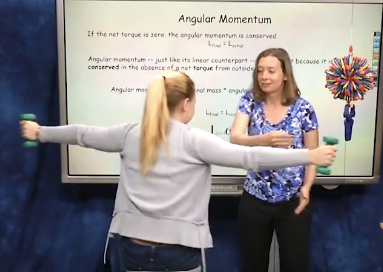
The conservation of angular momentum can be demonstrated using a rotating stool and weights. When a person sits on a frictionless rotating stool with arms extended while holding weights, they start spinning at a certain speed. As they pull the weights inward, their moment of inertia decreases and to conserve angular momentum, their rotational speed increases. This demonstrates how angular velocity adjusts to changes in the moment of inertia when no external torques act on the system, similar to how breakdancers, divers or skaters spin faster by pulling in their limbs. Give it a go at RECESS!
A Demonstration of Force Measurement using Force Plates and Accelerometer: Adam Schiferl, Clemson student
This demonstration presents an interactive approach to understanding introductory kinematics and mechanics by leveraging sports to make physics concepts more relatable. Participants will kick a soccer ball in a controlled way and get force readings. Analysis of this data will explain the force vs. time graph stage by stage illustrating how forces acting on an athlete vary during different phases of exercise.
“Tiger 24,” A Student-Designed Formula One Race Car: Clemson Formula SAE team
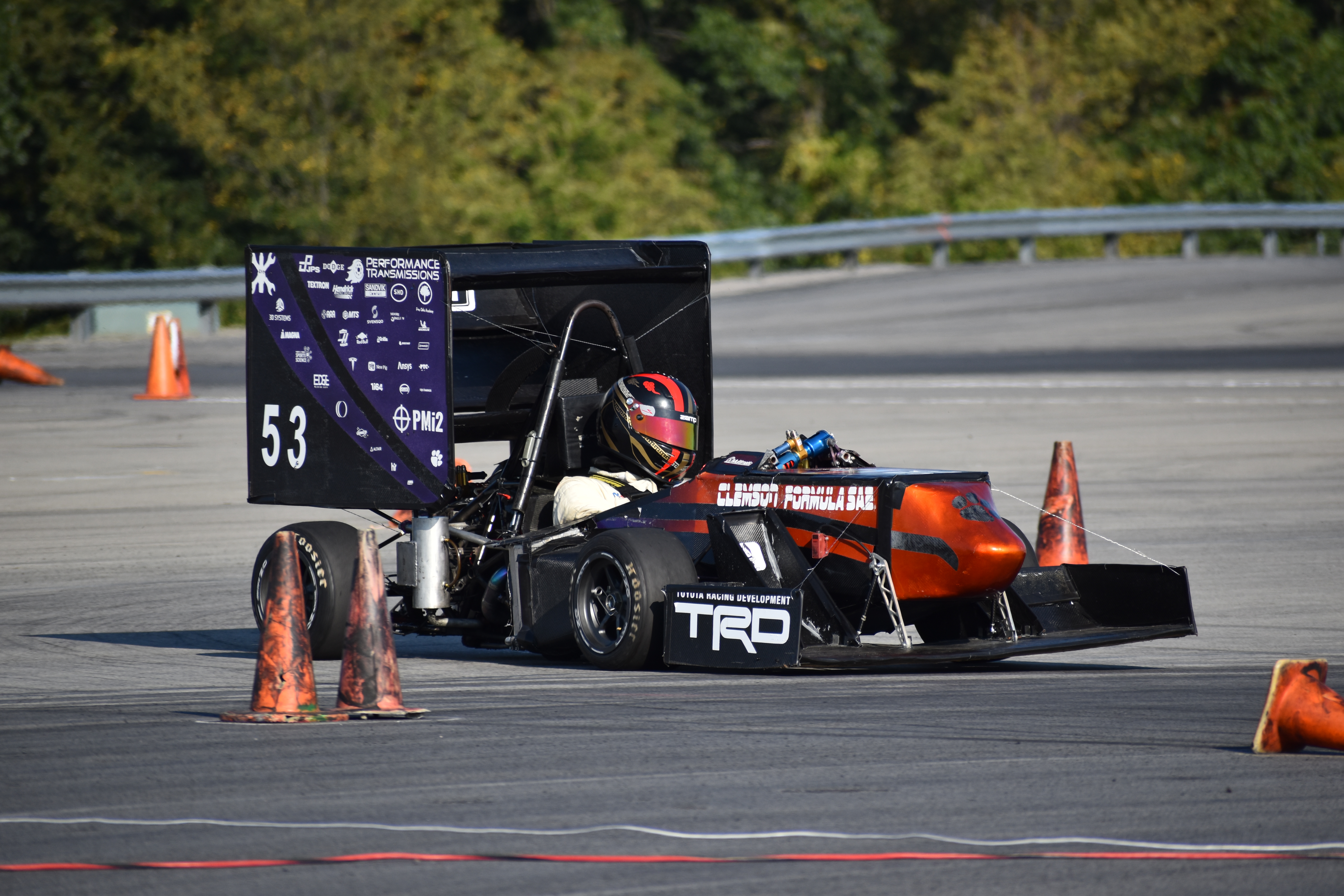
The Clemson University Formula SAE (CUFSAE) team is a student-run organization dedicated to designing, manufacturing and competing with a formula-style race car. They aim to provide students with the tools to learn relevant skills while exploring the possibilities of employment in the automotive industry. This year’s student-designed Formula One race car, the Tiger 24, which has been competing in student competitions across the nation, will be on display and the team will be available to answer questions.
To view all these amazing live demonstrations at RECESS, RSVP here.
This summer, one of the Robert H. Brooks Sports Science Institute’s newest faculty fellows, Felipe Tobar, Ph.D., traveled Europe to continue his long-term project of studying the transmission or suppression of difficult heritage in European soccer grounds. His findings at Real Madrid (Spain) and FC St. Pauli (Germany) will be included in an upcoming research documentary, “The Match That Not Every Club Wants to Play.” He also traveled to his home country, Brazil, to engage in other sport-related tourism and heritage activities.
Spain
To kick off his European research tour, Tobar traveled with the Clemson Women’s Soccer team to Spain for their study abroad trip. As part of their Parks, Recreation, and Tourism Management (PRTM) 3500 Global Challenges course about soccer, climate change and sustainability, the team visited four stadiums and three training centers for professional Spanish clubs, including Real Madrid, FC Barcelona, Valencia and Atletico Madrid. Tobar and the team watched official matches, toured backstage and even played official friendly matches with the clubs’ first and second teams. At each site, they analyzed and compared how the Spanish soccer clubs were engaged in the ‘green revolution.’
“The cultural and sporting experiences added to the opportunity to meet new people, including staff, students and the organizers. This is something that I will carry forward and soon share in my classroom with new students.”
Felipe Tobar, Ph.D. on his study abroad experience with the Clemson Women’s Soccer team
Germany
After leaving Spain, Tobar traveled to Germany and visited the cities of Frankfurt, Bremen and Hamburg. While there, Tobar engaged in activities related to his upcoming research documentary and a 2025 German study abroad program on football, culture of remembrance, and politics. Some of the incredible experiences Tobar had in Germany included touring Frankfurt and visiting Holocaust memorials and sites related to national socialism, touring the Weser Stadion using Google AI Translator, and checking the new museum exhibition of FC St Pauli on the discovery of a former Jewish player persecuted by the Nazi regime.
“The importance of coming back to Germany after three years since my dissertation data collection to record new footage for my documentary was essential. I confirmed my previous observations and reinforced networking links to bring undergraduate students to Germany next year on a study abroad program. The students will understand better how German society and its soccer clubs have been dealing with the Nazi past.”
Felipe Tobar, Ph.D. on his visit to Germany the summer of 2024
Turkey
The next stop on Tobar’s European excursion was Istanbul, Turkey for a few stadium tours and museum visits.
“Strolling through Istanbul streets and public buildings like the Grand Bazar, you can see a tradition that is part of the city’s cultural and sport heritage after every national championship.”
Felipe Tobar, Ph.D. on his experience in Istanbul, Turkey
He noticed that everywhere he looked, locals were displaying the flag of Galatasaray, the most successful Turkish club in European competitions and the current national champions. Tobar was able to speak with locals to better understand the reasons and history of such a tradition. He also had the opportunity to visit Galatasaray’s home and the clubs that wanted to dismantle Galatasaray’s hegemony.
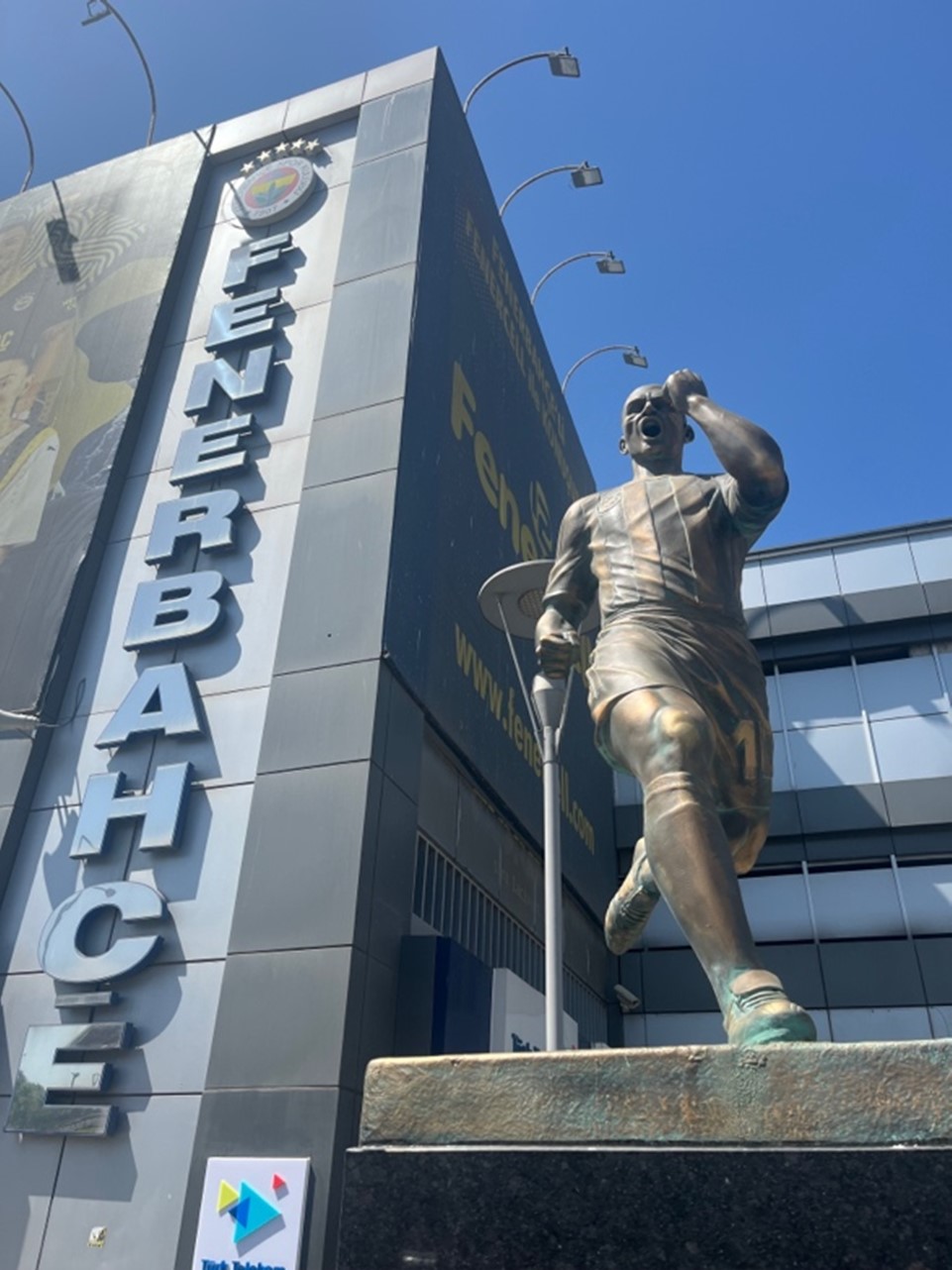
Tobar’s research agenda on Istanbul’s main soccer clubs started at Fenerbahçe Stadium, where he toured the club museum and researched local fans’ memories linked to former club captain Alex de Souza, who is the only living individual to have a statue in front of the stadium funded and erected entirely by fans.
Tobar later visited Besiktas stadium and its museum observing how this club, alongside the other capital clubs, paid fervent homage to Mustafa Kemal Atatürk, founding father of the Republic of Turkey. Tobar plans to author another paper seeking to understand the approaches each of these clubs employ when linking their images with what is still considered the most important personality in the history of modern Turkey.
The statue of former captain and club legend, Alex de Souza, in front of Fenerbahçe Stadium in Istanbul, Turkey.
In the façades of Besiktas stadium, the club features its Eagle mascot and a tribute to the 100 years of Turkey’s liberation from British control through images and phrases to honor Mustafa Kemal Atatürk.
UEFA EURO 2024
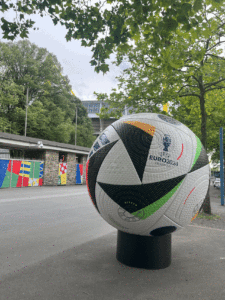
After Istanbul, Tobar traveled back to Germany for UEFA EURO 2024. Throughout the tournament, he traveled to several host cities to engage in two main lines of research: the ‘German Football Culture of Remembrance’, and how the UEFA (Union of European Football Associations) and its partners communicate sustainability efforts to football tourists and locals. Alongside his first line of research, the DFB Cultural Foundation (German Football Federation), in collaboration with the World Jewish Congress and What Matters, introduced the “Football and Remembrance” program aimed at addressing the history of national socialism. Various memorials, places of remembrance and museums across the nation, particularly near the ten host cities, participated in several special events.
Tobar was able to visit the following sites and talk to various experts:
Munich – Dachau Concentration Camp Memorial Site – Football in the Dachau concentration camp | Tour
Cologne – NS-Documentation Centre of the City of Cologne
Hamburg – Foundation of Hamburg Memorials and Learning Centres Commemorating the Victims of Nazi Crimes – Stories of Persecution during National Socialism and the HSV | Tour
Foundation of Hamburg Memorials and Learning Centres Commemorating the Victims of Nazi Crimes – Football in concentration camps | Tour
Bergen-Belsen Memorial – Who against whom? Football under National Socialism | Workshop
Büren-Wewelsburg – Memorial Museum Wewelsburg – More than just a game – football under National Socialism | Exhibition
Football Under the Nazis’ “Sports. Crowds. Power.” | Exhibition
In addition to visiting these sites, Tobar also had the
opportunity to visit the museums and representatives of Borussia Dortmund,
Bayer Leverkusen, and Bayern Munich, as well as the German Football Museum and
the German Olympic Museum. To learn more about his time in Dortmund, click here.
Tobar was also invited by the Red Against Racism initiative from Bayern Munich to visit the club’s headquarters and learn more about their project to tackle antisemitism and other discriminatory practices within German football stadiums and society. Still in Munich, Tobar visited a representative from the Kurt Landauer Foundation named after the former Jewish president, Bayern Munich, persecuted by the Nazis.
“Out of Germany, I intend to share these clubs’ experiences and ways of revisiting (or not) the past with different audiences and societies that often struggle to face their respective histories. Apart from making these stories more accessible as they will be written in English, the book can serve as a meaningful and powerful vehicle of reflection to other traumatic societies on how to come to terms with difficult pasts and potentially promote collective healing”.
Felipe Tobar, Ph.D., on the focus of his research in Germany
Strong messages were featured at Football Under the Nazis’ “Sports. Crowds. Power.” exhibition near Olympiastadion in Berlin reminding that ‘football is never neutral’ and that ‘people choose their actions’ during the Nazi regime.
Tour guides from Hamburg, Germany’s HSV Fan Projekt sharing the stories of persecution during national socialism.
UEFA EURO 2024’s sponsor, Chinese BYD’s electrical manufacturing company, stands at the UEFA EURO FAN FEST in Cologne.
Scotland
Tobar takes a picture of the plaque commemorating the home of Scottish (and, arguably, world) football. Credit: Glasgow Football Tour.
After Germany, Tobar traveled to Scotland for the Leisure Sciences Association Congress hosted by the University of West Scotland. At the conference, Tobar toured the Scottish National Football Museum and the national stadium, Hampden Park. He investigated the tour’s narrative and organization for future studies, and focused on understanding and cataloging how women’s football was depicted in the museum exhibitions. On the last day of his academic trip to Scotland, Tobar experienced the ‘Glasgow Football Tour’ which challenges the authorized heritage discourse from FIFA on who and when association football was invented, and who created the ‘passing game’ known today as ‘tik-taka,’ among other historical anecdotes.
Brazil
Before returning to Clemson, Tobar stopped in Brazil, his home country. Apart from following Grêmio Football Porto-Alegrense in two matches of the Brazilian Cup, in different cities and stadiums, as a sport tourist (just as he teaches in his ‘Sport Tourism and Events’ course in Clemson’s PRTM Department), Tobar visited the Brazilian National Football Museum located at the Pacaembu Stadium. This was once considered a historical landmark in the city of Sao Paulo. There, Tobar analyzed how the museum now remembers the image of the best soccer player of all time, Pelé, who was also responsible for popularizing the sport in the U.S. in the late 1970s. Tobar also dedicated special attention to the promotion and interpretation of women’s football within the museum displays, which will be incorporated in a future publication comparing how the three national football museums he visited during the summer – German, Scottish and Brazilian – promote women’s football.
Marta, the world’s most acclaimed women’s football player, is highly revered across the museum displays.
A match between Grêmio and Corinthians, Copa do Brasil, Aug. 7, 2024.
“Having the opportunity to spend a few weeks in Brazil and engage in sport-related tourism and heritage research activities at such a relevant museum has been extremely rewarding. Also, participating in football matches and living fans’ passion for the number one sport in the country was a much-needed nostalgic experience.”
Felipe Tobar, Ph.D., on his experiences in Brazil
Up Next
Tobar was recently awarded a seed grant by RHBSSI to study more effective and inclusive VR soccer experiences. His research is kicking off this fall semester and he is currently recruiting Clemson students to join a Creative Inquiry course. Students will develop real-world skills relevant to their major, likely from PRTM, Bioengineering, Math or Computer Science. Furthermore, they will be active in helping create the experimental protocols and survey tools, collecting data during research sessions and analyzing results for the project.
To enroll, select one of the following course options in iROAR:
PRTM 3980, 002 (CRN 92089),
PRTM 3981, 002 (CRN 92090)
BIOE 4510 (Sec 051): CI-Sports Science EEG & VR
To learn more about Felipe Tobar’s research and European adventures, follow him on LinkedIn or contact him at ftobar@clemson.edu.
As the Summer Olympics grow closer, organizers are putting a focus on mental health and adding new accommodations for athletes to rest more than just their bodies. Skye Arthur-Banning, Ph.D., professor of Parks, Recreation, and Tourism Management at Clemson, RHBSSI faculty fellow and co-founder of the U.S. Center for Mental Health & Sport, advocates for athletes’ mental well-being and emphasizes that it needs to become a higher priority while they are still competing in the Olympic games.
“We have seen athletes, either upon retirement or after the event, coming out and talking about their challenges,” offered Arthur-Banning when talking about how the end of the games is often the toughest on the athletes’ mental health. “We do have a lot of research that supports the post-Olympic blues, or post-Olympic depression, and for many athletes it is retirement.”
At the Paris Olympic Games starting July 26, there will be several mental health resources for the athletes, including access to quiet spaces next to workout areas where they can decompress. They will also have full-time mental health staff and a 24/7 help line available. In addition, Arthur-Banning recommends athletes improve their mental health by building a community of support with family members and teammates.
More About Skye Arthur-Banning, Ph.D.
In addition to being co-founder of the U.S. Center for Mental Health & Sport, Arthur-Banning is also the Director of Research and Development for the organization. The center is focused on making sport environments a place where all involved can experience support for their mental health. They provide resources, training and support to help make the sport environment one that is inclusive and provides a positive experience. Arthur-Banning has co-authored or edited five books, published 50+ peer-reviewed manuscripts, delivered 200+ international, national and state-level presentations, and has secured over $1.8 million in research dollars as a principal investigator.
The Robert H. Brooks Sports Science Institute is proud to have as part of its cohort of faculty members one College of Agriculture, Forestry, and Life Sciences representative from the Department of Food, Nutrition, and Packaging Sciences.
Greg Batt, Ph.D.
Having earned his master’s degree and Ph.D. from Clemson University, Batt is an associate professor in the Department of Food, Nutrition and Packaging Sciences.
Greg Batt has been at Clemson University for 23 years and has been a valued RHBSSI Faculty Fellow.
Batt began his work at Clemson in 2001 and has since been the Director of the Sonoco Package Testing Laboratory and Co-Director of the Clemson Headgear Impact Performance (CHIP) Lab at Clemson. Batt’s primary research interests are in the areas of experimental test development and dynamic modeling.
Batt and RHBSSI Interim Director, John DesJardins, recently won a patent at the Clemson University Research Foundation’s (CURF’s) Innovation Awards ceremony on April 17 for their mask/face shield work that is sponsored by RHBSSI. In 2023, the pair conducted a study comparing the head impact mechanics between cadaveric specimens and a synthetic hybrid III model.
Batt has been an engaged fellow for many years and is the co-director of the Clemson Headgear Impact Performance (CHIP) Lab with DesJardins. In the 2021-22 academic year, Batt received funding from RHBSSI for his work with the efficacy of bull-riders’ helmets to prevent face trauma. Preceding that, Batt received funding from RHBSSI for quantifying the impact performance of football helmet facemasks in the 2017-18 academic year.
His CHIP Lab student, Bianca Henline, was featured in RHBSSI’s 2023 Annual Report.
Rikishi Smith-Rey, faculty fellow of the Robert H. Brooks Sports Science Institute and assistant professor in Clemson University’s Department of Communication, recently founded Sport PhD, a service that seeks to make academic research centered around sports more accessible for athletes.
Smith-Rey is a former Division I athlete and youth soccer coach with extensive research experience in the sports communication and health communication fields. During her coaching years, she was able to apply her academic research to her youth athletes in a very tangible way.
“To me, translational research is so important,” Smith-Rey said. “If our research is just sitting in journals, it’s not helping those that we mean it for. I get a lot of worth out of seeing my research help.”
Rikishi Smith-Rey, a former Division I athlete, is seeking to connect athletes with research about sports to help them succeed in all walks of life.
Smith-Rey was inspired by a former athlete she coached to form Sport PhD, saying, “I still have not seen something that breaks down the knowledge that’s out there for athletes.”
Despite the extensive research on sports, Smith-Rey feels that this research is not accessible enough to athletes, especially those at the youth level. Areas of sport such as recruiting, sleep, nutrition, psychology and mental health are all topics that Smith-Rey seeks to promote to athletes in an accessible way.
Smith-Rey’s founding of Sport PhD was inspired in part by conversations with Brandon Boatwright, Ph.D., another assistant professor in the communication department at Clemson. Clemson women’s soccer student-athlete Ally Lynch has also worked as an intern with Rey this semester, and the pair have done extensive work on starting Sport PhD from the ground up.
Sport PhD has a primary mission to transform athletes into well-rounded individuals and athletes by equipping them with the knowledge and understanding they need to excel in every facet of their game.
Smith-Rey is excited to continue the work of Sport PhD as she works to widen the reach of the company.
“Sports gave me everything,” Smith-Rey added. “If I can give a little bit back to athletes so that they can understand their sport a little better, that would be super meaningful to me.”
Those interested in following the development of Sport PhD can find them on LinkedIn and Instagram.
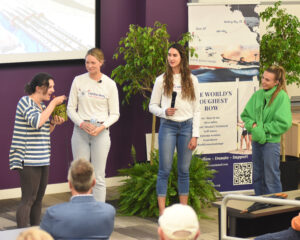
Anna McLean and Jenny D’Anthony speak to the crowd during the sports science lecture in Freeman Hall on March 26, 2024.
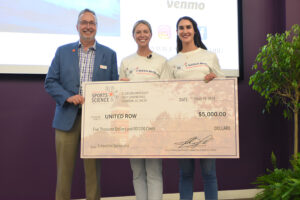
The Robert H. Brooks Sports Science Institute was thrilled to host United Row on March 26 for a sports science lecture in Freeman Hall, where two Clemson alumnae spoke to students, faculty and community members about their upcoming 2,800-mile journey across the Pacific Ocean.
At the lecture, Jenny D’Anthony and Anna McLean, former members of the Clemson rowing team, previewed their row across the Pacific. Attendees of the lecture were able to hear what exactly goes into the estimated 60-day trip and the challenges and thrills that come with it.
Competing in the World’s Toughest Row competition in June, D’Anthony and McLean discussed the equipment they use on their boat, their food and water systems and the mental fortitude it takes to complete the challenge.
“We felt so welcomed and taken care of during our stay and really appreciate everything the Institute did to make it a success,” D’Anthony said. “Everything was well organized and done professionally, really speaking to the nature of work the Institute does.”
Robert H. Brooks Sports Science Institute Interim Director John DesJardins (left) presents a $5,000 check to Anna McLean (middle) and Jenny D’Anthony (right) during the Institute’s sports science lecture on March 26.
At the end of the lecture, RHBSSI Interim Director John DesJardins presented United Row with a $5,000 check to sponsor the team. D’Anthony and McLean have already said that the money will go toward SAT phones and a BGAN device for the June expedition. In return, the Institute will have a sticker on United Row’s boat during the journey across the Pacific.
“The institute was excited to bring to campus two remarkable young alumni, to share their Clemson journey, and engage us in their remarkable challenge to row across the Pacific,” DesJardins said. “Anna and Jenny define the Clemson spirit in their pursuit of excellence, and we are proud to support their cause.”
“We hope to continue to promote and share the great work at the Robert H. Brooks Sports Science Institute,” D’Anthony added. “We are incredibly excited to see where it goes and thrilled to be a part of it.”
Jenny D’Anthony and Anna McLean give audience members the chance to try out the bagged meals they will be eating during the 60-day row across the Pacific Ocean.
Along with students and faculty in attendance, Clemson rowing head coach Stephen Frazier Wong and IPTAY Assistant Director of IPTAY Major Gifts Jordan Roper were also present. Partnered with IPTAY and the Hear Her Roar Campaign, United Row has worked closely with Roper to raise awareness and financial support for Clemson’s women student-athletes.
“As a fund raiser, who’s also a former student-athlete, being able to work with Anna and Jenny and United Row, and them deciding to choose Hear Her Hoar as the campaign that they want to fundraise for, is special,” Roper said at the lecture.
Anna McLean (left) and Jenny D’Anthony (right) join the Clemson Rowing team for practice on Lake Hartwell the morning of March 26.
The morning of the lecture, D’Anthony and McLean visited Clemson rowing practice as the sun rose earlier that day and later partnered with the Clemson Department of Bioengineering for a lunch and learn.
McLean and D’Anthony were members of Clemson’s rowing team beginning in 2014 until they graduated from Clemson in 2017 and 2018, respectively. In 2022, McLean, from the United Kingdom, and D’Anthony, from the United States, formed United Row.
Those interested in supporting United Row may visit the team’s website. Any sponsorship or donation will go directly to supplies for the boat or fundraising efforts for the Hear Her Roar Campaign. D’Anthony and McLean will begin their journey across the Pacific on June 8.
Two Robert H. Brooks Sports Science Institute faculty fellows were recently featured on Clemson University Research Foundation’s (CURF’s) social media accounts for their valuable research and work in the Clemson Headgear Impact Performance (CHIP) Laboratory.
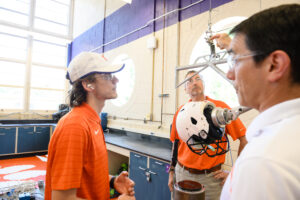
John DesJardins, a bioengineering professor, and Greg Batt, a food, nutrition, and packaging sciences associate professor, have worked in the CHIP lab for several years, aiming to assess the faceguards on headgear in sports and improve their effectiveness and safety.
John DesJardins, middle, and Greg Batt, right, work with a student on helmet research in the CHIP laboratory.
Under Batt and DesJardins’ leadership, the CHIP lab offers unique opportunities for students interested in researching the effects of impacts on the head and neck in sports. Last year, the institute spotlighted the work of Bianca Henline, a then-senior bioengineering student who researched the effectiveness of commonly worn bull riding helmets.
The institute is proud to financially support much of the work performed in the CHIP lab as DesJardins and Batt continue to lead a team of innovative students and groundbreaking research.
In the world of sports, there is a continuous drive to improve human performance. In this field, small improvements can lead to significant advancements. One student at Clemson University hopes that his research will do just that.
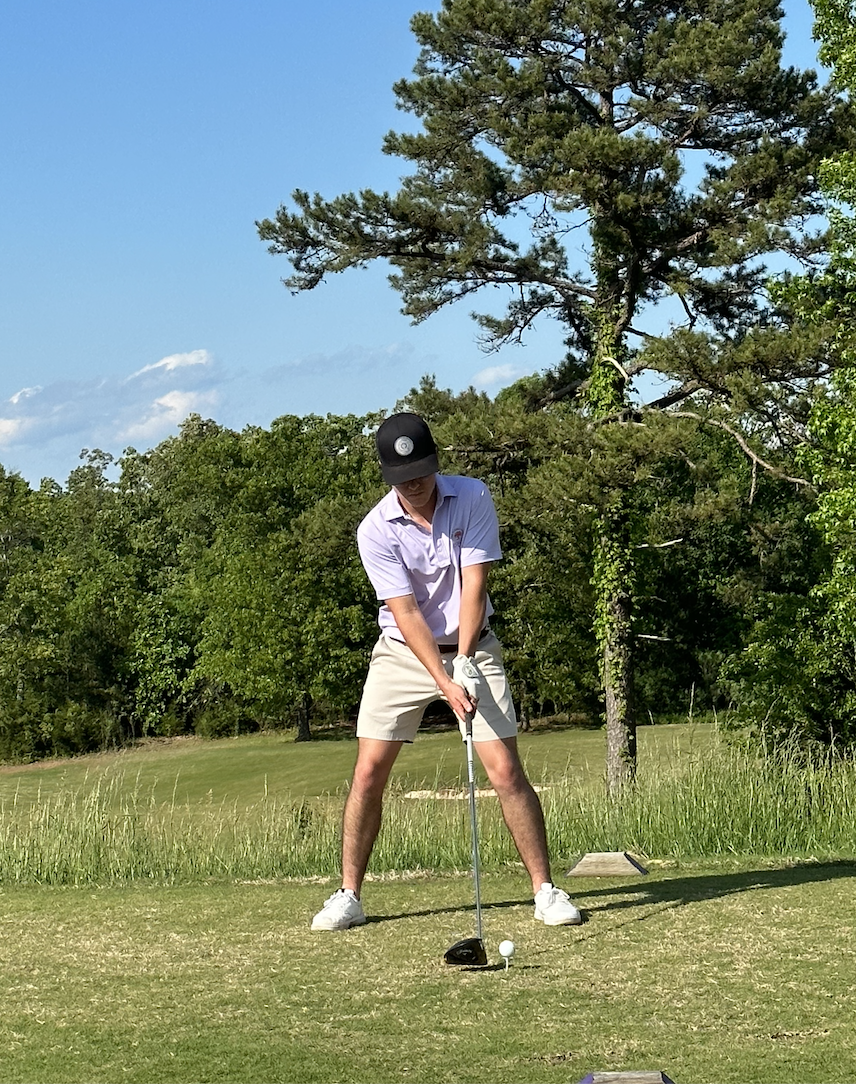
Will Mendez is a senior at Clemson who is combining his passion for golf with his degree in Mechanical Engineering to push the boundaries of golf performance. Will’s research is shedding light on the impact that different materials have on golf club performance and hopes to one day make a lasting impact on the sport.
Will Mendez getting ready to drive the ball while playing golf
Growing up, Will was always fascinated by cars and loved playing golf. After spending a summer working at a local golf shop, Will discovered how he could combine his love for golf with his love for engineering and design. The following summer, he got an internship with Callaway Golf where he was able to gain hands-on experience designing golf clubs that are now being sold on their website. One of his favorite parts about product engineering is getting to see a project go from the prototype and testing stages to the final product that consumers can buy.
“It’s rewarding to know that I contributed to a product and now it’s being sold around the world. In product design, I love how you get to take a product, commercialize it, and turn it into something that can have an impact on people”
Will Mendez
Working for Callaway Golf, Will discovered his true passion and woke up excited to go to work every day. Coming back to Clemson this fall, he knew he wanted to continue learning about the intersection of these two fields. After discovering an opportunity through the honors college, Will realized he could do just that, while also gaining credits toward his degree.
Will’s Research
Will was curious about the impact that different materials in golf club heads have on ball performance but could not find any research on the topic online. This sparked Will’s idea and desire to find the answer himself. With the help of Dr. Garrett Pataky, assistant professor in Mechanical Engineering, and undergraduate research grants, Will has begun his research into finding a high entropy alloy that has good energy return properties to determine what would work best in golf clubs. He is using multiple testing methods to evaluate the effectiveness of the materials, including drop testing, gas gun testing, and speed measurement devices. Although the research project is still in the early stages, Will has overcome a few challenges already.
Will, on the left, pictured with two other interns he worked with at Callaway Golf
The main challenge he has faced so far has been having to build this research project by himself, from scratch. Not having much prior research experience, Will has had to learn as he goes. Although it has seemed daunting at times, he knows that it will be even more rewarding in the end. For that, he says he is thankful that Dr. Pataky has given him the freedom to control the direction of his passion project and test something that no one has tested before.
In the process of building his research project, Will has had to get creative with the materials and testing methods. While trying to find a drop testing device, he struggled to find a consistent release mechanism that could drop a golf ball from 20 feet onto a small metal disc. After unsuccessfully trying many different devices, he came up with the creative idea to combine two systems made from a fishing drone company – the first being a release mechanism that typically drops fishing lures out into the ocean, and the second being a golf ball dropper attachment connected to the release mechanism. Together, these two devices are able to drop the golf balls in exactly the same way every time. Will is also using a gas gun to shoot projectiles at his metal disc. A bluetooth photogate laser speed measurement device is used to measure pre-impact speed, and a high-speed camera is used to measure the post-impact speed. Collectively, these tests will show which high entropy alloys will result in greater energy return.
Will firing off the gas gun for testing
Will’s Goals
This research is a year-long project that will be completed when Will graduates this upcoming spring. While he doesn’t know what the outcome of the research will be yet, he hopes that he will be able to take what he learns and use it in his future career. Whether he finds a material that is perfect or one that should absolutely not be used, he wants to bring that knowledge to help his future golf employer. Being an avid golfer himself, Will understands the significance of the impact of materials on golf equipment and wants to be apart of improving performance of the game in the future.
Will hopes to join a company in the golf industry following his graduation in May 2024 and continue his work in product engineering. Will credits Clemson for giving him the foundation and tools to succeed in new and challenging environments and he will take those skills with him in his career. A top engineering program and family-like culture drew Will to Clemson and now, after beginning his final year, he says he “can’t imagine going to school anywhere else.”
DIY golf simulator that Will and his roommates built in their house