The Parks, Recreation and Tourism Management (PRTM) Blog

Black Girls Golf Program Continues to Grow on Clemson Campus

Raquel Simpson started playing golf in Illinois when she was 9 years old.

She’d been playing for a few years when she caught the attention of Tiffany Fitzgerald, founder and CEO of Black Girls Golf LLC. Fitzgerald told Raquel’s father about an opportunity to improve her golf game and learn more about the industry through a summer scholars program she was developing with Clemson University.
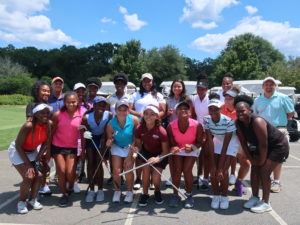
Teen athletes participating in the Black Girls Golf program on Clemson campus in July 2019.

Two years later, Raquel was practicing her swing on Clemson’s campus.

“When I found out about the Clemson opportunity, I was really excited about the chance to be around people who both look like me and play the same sport as I do,” says Raquel. “My Dad signed me up and now I’m here, and everything is going really well.”

Raquel is one of fifteen African American high school students who improved their golf game and learned about golf management through Clemson University’s PGA Golf Management Summer Scholars program, run in partnership with Fitzgerald’s organization. The program began in 2017 to foster increased diversity in the golf industry, and to help students see they’re not alone in their love of the sport.

“We’ve created a safe space and environment where these girls can show up knowing they are welcome and don’t feel like they need to prove that they belong,” says Fitzgerald. “It warms my heart to know they’re creating new friends and bonding with people who have a shared experience.”

Students also spend the week learning the many benefits the game can offer them outside of physical activity. Classes students take between training sessions cover career paths, industry trends and opportunities, business planning, golf instruction and player development programs.

“The program is more than just golf, because we want these students to consider turning their passion for the sport into a management career in the golf industry,” says Rick Lucas, director of the PGA golf management program and senior lecturer in Clemson’s parks, recreation and tourism management department. “Teaching them key business skills, such as business planning and customer relations, can help them get a feel for managing and running a golf facility and how to work in the golf environment.”

Before they’re accepted into the program, students are required to demonstrate high academic achievement, as well as golf ability. Many of the students in this year’s program have GPAs over 3.5.
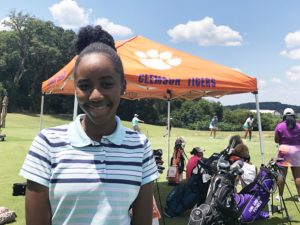
Raquel Simpson has been playing golf since she was 9 years old.
Golfer Raquel Simpson has been playing the sport since she was 9 years old.

As awareness of the program grows, Fitzgerald says more applications are being seen from students across the country.

“We received 50 applications this year from girls as far away as California, Florida, Michigan, Ohio and Texas, which demonstrates the need for this type of program throughout the United States,” says Fitzgerald. “The sweet spot for our camps is 10 participants at a time, which means that one of the vital pieces moving forward is going to be finding the resources and funding to continue to grow.”

Students receive scholarships from ONE Clemson to attend the program. After taking the program and seeing what Clemson has to offer, some of the students are expressing interest in pursuing their higher education at Clemson University. Additional scholarship support is now needed to help those students achieve that goal.

“These are exceptional students that have the potential to achieve great things in the golf industry if we can find them scholarship support,” says Lucas. “These students have already demonstrated they’re the best of the best, and we want them here at Clemson.”

If you would like to contribute to the Black Girls Golf program or fund a scholarship for one of these scholars to attend Clemson University’s PGA Golf Management program, please contact Rick Lucas at rlucas@clemson.edu.

Related: Clemson promotes diversity through golf camp for African-American girls (Clemson Newsstand, June 19, 2017)

Clemson Partners with America’s State Parks on Innovative New Webinar Series

More than 140 park leaders in 40 states and one Canadian province recently signed up for the first installment of an interactive new webinar series developed by Clemson’s Parks, Recreation and Tourism Management department and the National Association of State Park Directors.

The webinar series leads discussions about key issues affecting state park leaders. Every webinar starts with an overview of academic research about the topic and on-the-ground examples of how the issue is being addressed in different parts of the country. Participants use that information to frame a dialogue about what solutions are working in their state and challenges they are still facing.

Professor of Practice Phil Gaines and Associate Professor Matt Brownlee delivering the webinar on July 29, 2019.
Clemson PRTM Professor of Practice Phil Gaines and Associate Professor Matt Brownlee delivering the webinar on July 29, 2019.

“We’re excited to blend the academic knowledge of our Clemson University team with the expertise of leaders of America’s State Parks to develop and deliver an interactive, engaging and timely webinar series,” said Wayne Freimund, Chair of the Clemson’s Parks, Recreation and Tourism Management department. “We’re also switching up the traditional webinar model to create something that makes sure everyone is engaged, contributing to and benefiting from the discussion.”

The first webinar on July 29 focused on capacity issues, including a case study from Maryland State Parks. An overview of current research was provided by Clemson University Associate Professor Dr. Matt Brownlee. Phil Gaines, Professor of Practice and retired South Carolina State Park Director, then led a discussion about how different states can balance creating a positive experience for visitors, while also protecting state-managed resources. The webinar was recorded and uploaded to the Clemson PRTM YouTube channel.

Linda Lanterman, President of NASPD and current Director of Kansas State Parks, says the new approach helps the association’s members come together without having to leave their park sites.

“Opportunities to share information, and discuss ideas and innovations are the cornerstone of our organization,” says Lanterman. “Having the chance to use technology to examine current issues and challenges in an engaging format is appealing, particularly with limitations on travel and time.”

Now that the first webinar is complete, the partners are working together to find ways to keep the webinars interactive and engaging for 100 participants – and provide opportunities for everyone to contribute to the discussion in a meaningful way.

Freimund says this is a good problem to have.

“The first webinar demonstrated a clear need for this type of programming,” says Freimund. “Now we need to work on refining the system to ensure these webinars can be engaging, relevant, and informative for larger groups of people.”

Clemson Researchers Find Link Between Built Environment and Latinx Health

We all know that healthy eating and being active are important. According to Clemson Parks, Recreation and Tourism Management assistant professor Mariela Fernandez, however, where you live also has more of a role in our overall health than you might think. In fact, she says, research shows that some neighborhoods are more detrimental to your health than others.

“There’s a documented link between your health and whether or not you live in a built environment with access to core services such as health care, internet, transportation and recreational infrastructure,” says Fernandez. “If you live in this type of environment, you’re more likely to be physically active and make healthier choices, because the tools to do that are readily available to you.”

Drs. Mariela Fernandez and Garrett Stone
Drs. Mariela Fernandez and Garrett Stone led a systematic review about Latinx health and the rural built environment.

Many Latinx people, however, particularly those who have recently immigrated to the United States, are more likely to live in rural communities without access to those core services. Families are drawn to these communities for several reasons, such as affordability of housing, the possibility of increased job opportunities, and existing socio-cultural networks.

Although research has been conducted on the link between the built environment and health, Fernandez and former graduate student Garrett Stone wanted to find out how much of that existing research focused on Latinx communities. In 2016, they teamed up with undergraduate student Alondra DeSantiago to conduct a systematic review of academic literature that examines the influence of the rural built environment on Latinx health outcomes and behavior in the United States. The results of that review were recently published in Ethnicity and Health.

The group looked at nearly 2,500 articles before narrowing them down to approximately 146 full-text sources for their final review. Results suggested that the lack of a built environment in rural Latinx communities does contribute to negative physical, mental and behavioral outcomes.

“We found that Latinx families living in rural areas throughout the United States are facing a number of challenges, including access to health care and medical information,” says Stone, now an Assistant Professor at Vancouver Island University. “It doesn’t help that these families tend to be living in run-down, crowded places, and are disproportionally exposed to environmental hazards such as pesticides and agricultural run-off, which increases their need for ongoing medical services that are out of reach.”

The study found that health disparities are exacerbated by the fact that rural Latinx communities have become new destination sites for first generation immigrants who have unique challenges and concerns tied to their documentation status, English language proficiency and unfamiliarity with the medical system.

“This adds another barrier to those who, even if they had the means to search for health information, don’t know how, where or if they are able to access basic services,” said Fernandez.

Although the review identified several issues for Latinx communities in rural areas, Fernandez notes that they also found several limitations to existing research, necessitating further study.

“The articles we reviewed made clear connections between the rural built environment and Latinx health outcomes and behaviors, but few explored those connections in detail or if changes to the built environment could result in changes in health over time,” says Fernandez. “We see a clear and pressing need for more focused research in this area.”

Fernandez plans to use the findings of the systematic review to start building relationships with local rural communities in South Carolina to verify her study findings and work with families to create a plan of action to address them.

Initial findings can also provide useful information to those working in the field. For example, urban planners can use the study results to better understand the needs of Latinx communities and find ways to creatively design communities. Medical professionals can start to prepare for an increase in Latinx patients in their practices, as these groups continue to migrate into rural communities, or use the study to help advocate on behalf of their patients for better living and working conditions.

This study extends Fernandez’s research on how the lack of access to green spaces can affect the health outcomes of Latinx communities. Her dissertation on using the non-profit sector to advance social and environmental justice received the American Academy for Park and Recreation Administration’s 2016 Best Paper Award. Other research activities have included projects on the programmatic aspects limiting Latinx participation in a recreation center, the development of life skills in Latinx youth and the cultural competence youth leaders need in order to address challenges arising from an increasingly diverse society.

Related: Office of Hispanic Outreach at Clemson University

EDGE Field Trip Helps Students See Parks, Recreation and Tourism Agencies in Action

What do Disneyworld, the US Tennis Association’s National Campus and Camp Boggy Creek have in common?

They are all sites visited by Parks, Recreation and Tourism Management (PRTM) students as part of a multi-day field trip in June that gave students an opportunity to speak directly with professionals in the field about the challenges and successes involved with operating different types of industry organizations.

PRTM EDGE program faculty and students at Epcot Center in Florida last month.
PRTM EDGE program faculty and students at Epcot theme park in Florida last month.

The trip is part of the department’s Engaging in Diverse, Guided Experiences (EDGE) program, an innovative, immersive experience for sophomores that takes a collaborative approach to delivering core parks, recreation and tourism management content.

Unlike a traditional semester with several classes, the EDGE program incorporates the content of those classes into one learning experience. Learning is reinforced through lectures, small group work, individual assignments, readings, field trips, research and collaborations on real-world issues.

Field trips are designed to get students out of the classroom to see parks, recreation and tourism agencies in action, says Dr. Teresa Tucker, PRTM EDGE Program Coordinator and Senior Lecturer.

“Seeing concepts they’ve learned in the classroom being applied in the field, and in different settings, gives our students a better understanding of the qualifications and skills they’re going to need to succeed after they graduate,” she added.

PRTM EDGE program students before meeting with executives of the US National Tennis Association.
Students met with executives of the US National Tennis Association and were given a tour of the facility.

The trip was planned to focus on topics that affect all parks, recreation and tourism management agencies, such as facility operations, administration, finance, marketing, programming and risk management. Students traveled to Orlando and Eustis, Florida to learn about leadership strategies from the Disney business model, tour the US Tennis Association’s national campus, and talk to Camp Boggy Creek Director David Mann about managing a camp for children and families with serious illnesses.

Tucker says that students left with a well-rounded understanding of the different challenges these organizations face and how they address them, and that the trip also helped to create lasting relationships between students and program faculty.

“This trip helps reinforce core concepts in our field, which is important,” says Tucker. “But it’s also rewarding to see these trips help our students create lasting bonds with their fellow students and faculty – relationships that can help them succeed with their degree, and that they can continue to rely on as they build their careers after graduation.”

Read more about the EDGE program:

Clemson Master of Public Administration Program Ranked Among the Nation’s Best

Clemson’s Master of Public Administration Program (MPA) has a lot to celebrate! The program was recently ranked 10thof the 50 best online Master in Public Administration degree coursesby TheBestSchools.org.

Clemson’s MPA program ranking was based on its program quality, including the types of courses offered, faculty, rankings, awards and reputation, compared to all other accredited online MPA Programs in the United States.Best online master in public administration program badge

“We’re proud of this designation, which recognizes our program’s ability to provide the advanced training our students need to assume leadership roles in the public sector,” says Lori Dickes, Program Director of the MPA program and Associate Chair of Clemson’s Parks, Recreation and Tourism Management department. “Over the past several years, we’ve grown this program from a regional offering to a national program that draws students from across the country.”

MPA students can choose to specialize their training in emergency management, homeland defense and security, local and state government, nonprofit management or regional sustainability – ensuring the program meets the needs of a diverse range of public administration and non-profit professionals. Before they earn their credential, students take a comprehensive exam or complete a capstone research project to either demonstrate or expand on the knowledge they’ve gained.

The MPA program is also working to expand its specialized training options through a partnership with the Federal Emergency Management Agency (FEMA). Starting this fall, students can also further develop their professional and academic knowledge in two new certificate programs focused on Emergency Management and Homeland Defense and Security.

Although the program ranking confirms the quality of learning in the program, Dickes feels the real strength of Clemson’s MPA students rest in its people.

“This ranking confirms what we and our students already know – that our program, faculty and students are among the best of the best,” says Dickes. “What makes our program really special, however, are the relationships that come from this online program. Our students form close bonds with our faculty and one another and truly become part of the Clemson family, even though they only actually set foot on campus a few times.”

Learn more about Clemson’s online MPA program from its students and faculty:

Clemson Researchers Explore Tourism and Conservation in South Africa

Clemson PRTM faculty and graduate students on their trip to South Africa.

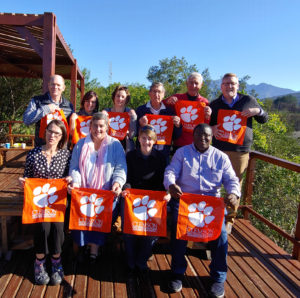
Clemson Parks, Recreation and Tourism Management (PRTM) faculty and graduate students were recently invited to South Africa to share their expertise, research human/wildlife experiences in Africa’s longest standing national park and explore new potential collaborations.

The group, led by Department Chair Wayne Freimund and consisting of Associate Chair Lori Dickes, faculty members Lauren Duffy and Aby Sene-Harper, and graduate students E’Lisha Fogle and Temitope Arogundade, took part in the Insaka international research symposium about how Africa can best meet the multiple societal and ecological challenges that come with transformative conservation, conducted a visitor research project for Kruger National Park and explored the possibility of a promising new collaborative project focused on Garden Route National Park.

The Insaka Symposium

The Insaka Symposium brought together experts in a wide variety of disciplines, such as social science, tourism, human rights, community development and environmental science to try to better understand and address rapid social and ecological changes in South Africa. According to Freimund, the multidisciplinary makeup of the group provides a richer and more thorough understanding of challenges throughout the country.

“South Africa’s conservation issues are complex, multidimensional and require all hands on deck, with everyone working together to find workable solutions,” says Freimund. “It’s rewarding to work as part of a collective of international leaders in their fields, collaborating on possible solutions we can share with the country’s decision makers.”

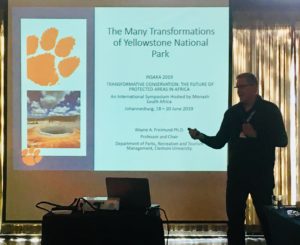
Clemson PRTM Chair Wayne Freimund speaking at the Insane Symposium in South Africa in June 2019.

Most of the team presented at the symposium, with Freimund and Dickes delivering keynote speeches. Their presentations shared findings from research conducted by the department in national parks throughout the United States and parts of Africa, and applied those learnings to a South African context. PRTM’s different areas of focus, including parks, community recreation, youth development, tourism and public administration, makes it well-suited to address the rapidly evolving social and ecological challenges the region is facing.

“We had a great scientific exchange and social capital building experience at the symposium, with the collective experiencing the breadth and depth of what Clemson had to offer and how a department like ours can fit into these large-scale problems in a constructive way,” continued Freimund.

The collective is now working together to apply for a National Science Foundation network collaboration grant involving the Insaka Consortia, Clemson and Montana universities, and potentially the University of Botswana, the Nelson Mandela University and other African partners. The grant proposal is focused on the Kafue River basin in Zambia, part of the Kavango-Zambezi (KAZA) Trans Frontier Park, which is the largest in the world.

Kruger National Park

After the symposium, the PRTM group traveled to Kruger National Park, one of the longest standing parks in Africa, to develop a study on challenges associated with human interaction with wildlife.

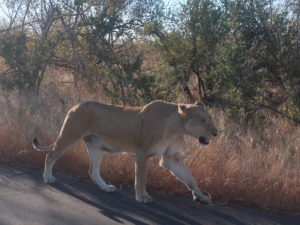
A female lion walking along the road in Kruger National Park.
Clemson PRTM faculty and graduate students researched visitor wildlife encounters, such as this one with a female lion, at Kruger National Park.

International and domestic tourism to the park is increasing, which brings a number of opportunities to the region, but also creates a tension between the park’s natural space and the humans wanting to experience it. Wildlife is migratory, making it difficult to create experiences for tourists. Human interaction can also pose challenges when animals feel at risk.

The group conducted research in the park to get a sense of wildlife interactions from a visitor’s perspective, and to better understand the complexities – and possible solutions for – human and wildlife experiences over time. The group is developing an app-based experience sampling method, where visitors send data throughout the day during their visit that describes where they are, what they are doing, how they feel about it, their perceived quality of their experience, among other questions. This will give researchers a better understanding of how to better manage incidents and create a better code of ethics for visitors, while also taking steps to enhance their visitor experience.

“Right now, the visitor experience at the park is based on the luck of the draw. For example, you could have an awesome experience of nature if your car drives beside a lion next to the road, or you could stumble into a long traffic jam if dozens of people get there before you,” says Freimund. “The first is a very positive experience. The second isn’t. Developing a visitor app for the park can help flag some of these issues and help help us better understand how the positive and negative episodes affect the overall experience and impression of the park.”

Garden Route National Park

The group’s final visit was to Garden Route National Park, near the town of George, where they explored the possibility of a new research collaboration with the Sustainability Research Unit at Nelson Mandela University, the Knsyna Basin Project and South Africa National Parks.

The group is exploring a number of key opportunities and challenges facing the park and region, such as municipal park development, tourism as an economic generator, youth development and conservation.

“The area’s national parks are open access, similar to national forests throughout the United States,” says Freimund. “There are opportunities to help visitors explore the health and cultural benefits of nature and expand the park’s recreational use and community engagement, while also managing its conservation. We have a great deal of experience in managing those issues, making a partnership a good fit.”

After a successful first meeting, the collective is working together to explore potential opportunities for collaboration, including research projects, student and faculty exchanges and a possible visit to Clemson. The group has struck a committee to look for ways to facilitate an exchange moving forward.

Watch the video below for more pictures of the group’s experiences!

Clemson Tigers in Tanzania

A group of Clemson University undergraduate students and lifelong learners recently traveled to Tanzania as part of a unique study abroad program organized by the department of Parks, Recreation and Tourism Management (PRTM) and Clemson’s Osher Lifelong Learning Institute (OLLI).

Clemson University offers several international travel options that expand the learning environment beyond the classroom into unique, and often challenging, cultural contexts. What sets this trip apart, however, is that the students were joined by a group of OLLI members midway through their experience.

Clemson Student Teaching Students in Chagga Village
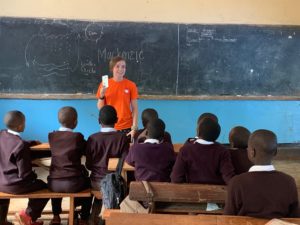
The study abroad trip was service-oriented, with students and OLLI members volunteering at a primary school in Chagga Village.

OLLI is a regional continuing education community and membership organization of more than 1,450 people that primarily serves adults age 50 and older, though adults of any age are welcome to participate. The institute offers lectures, courses, excursions and social events, as well as access to Clemson events and resources. Clemson’s OLLI is one of 123 similar organizations throughout the country, with a collective membership of more than 150,000 learners. The Tanzania study abroad trip was organized so that both groups could benefit from an intergenerationally-focused learning opportunity, and to establish stronger connections between our university students and the upstate community.

“We’re always looking for ways to enrich student learning, and partnering with OLLI accomplishes that by allowing both groups to experience Tanzania through another generation’s perspective,” says Arthur-Banning. “Students are able to learn from and network with key members of the upstate community, who also play lead roles in many upstate organizations.”

The study abroad experience is focused on service, with students volunteering with local children at schools and at a family-run orphanage in Tanzania’s capital city of Dar es Salaam before joining OLLI members for a few days to experience the country together. The combined group visited a Chagga village in Uru east at the base of Mt. Killimanjaro, where they learned about traditional food, coffee, and the process of making banana beer (called Mbege). They also taught students at the village’s primary school and went on a safari of Serengeti National Park and the Ngorongoro Crater.

The group’s volunteer work in the Chagga Village benefited both groups of learners in different ways. Students gave OLLI members insight into Clemson’s study abroad programs and their focus. OLLI members were able to apply their extensive skill sets to their volunteer roles, enriching the experience for students.

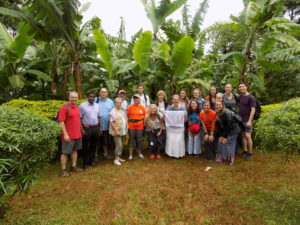
Group Picture of Clemson Students and OLLI Members in Tanzania.
The trip provided a unique opportunity for intergenerational learning between Clemson students and OLLI members.

“Our OLLI members are impressive, with a vast depth of knowledge and experience to share,” Vidotto says. “This program provides an excellent opportunity for our participating members and students to learn from each other and experience a different country and culture in a unique, authentic and culturally immersive way.”

Now that the trip is complete, Arthur-Banning and Vidotto are conducting an assessment to determine whether the study abroad trip met its learning objectives, and opportunities for improvement.

“We see great potential in continuing to find ways for Clemson students and the OLLI community to interact and learn from one another,” continued Vidotto. “This program is a great start, as we can now easily see how Clemson can create a model for the national OLLI network.”

Arthur-Banning also sees an ongoing opportunity for his students, now that the group is back in Clemson.

“We’ve encouraged our students to really think about how this experience has moved them to action in some way – whether it is spending more time with their family, bringing them closer to a higher being, moving them to have a more positive role in their own community or here on campus, or perhaps even to return to Africa to continue the amazing work that our institution continues to do,” says Arthur-Banning. “Whatever it is, I hope this trip does not simply become a neat experience, but that it stirs up an opportunity to continue to grow.”

Clemson Students Travel to Sweden to Explore Best Practices in Sustainability

A group of Clemson undergraduate students are spending five weeks in Kalmar, Sweden, this summer to learn about what makes the area one of the most sustainable regions in the world.

From July 10 to August 13, the students will live and study at the Linnaeus University Summer Academy in Kalmar, where they will explore topics such as sustainable shipping, farming, water treatment, water, energy, transportation, infrastructure, local foods, environmental impacts, business and economics, policy and ecology.

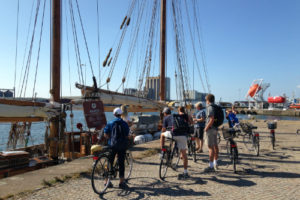
Clemson students riding bicycles in Sweden
Students bicycling by the Swedish coast during last year’s study abroad program.

The study abroad program is organized by Lori Dickes, Chair of Clemson University’s Master of Public Administration program and Jeffery Allen, director of the South Carolina Water Resources Center.

The program responds to a new global environment, with governments, businesses and other organizations across the globe considering how they can be more sustainable. Sustainability impacts a wide variety of management issues, such as overdevelopment, environmental issues, municipal services – such as water, trash, transportation and power – public health and high-quality nutrition, access to green space and concerns of over tourism.

“The concept of sustainability is increasingly vital for students to understand regardless of their study focus,” says Dickes. “Students participating in this study abroad program will have a unique opportunity to experience a city that is at the top of the sustainability game, and to consider how they can apply these lessons to their studies and their communities in the United States.”

Sweden consistently tops the RobecoSAM Country Sustainability Ranking, a semiannual survey that ranks 65 countries based on several environmental, social and governance indicators. The country’s green technology industry produces revenues of approximately  $3.5 billion annually and employs more than 40,000 people.

The study abroad program includes field work, class field trips, case study sites throughout the region, and research and group projects with students from other universities. The program uses an integrated systems and interdisciplinary approach to teach students how to learn about and consider research, behavior and social norms around sustainability.

Students are placed in teams to complete group projects, and will also expected to write blog posts and share presentations about what they’ve learned on a wide variety of sustainability topics. When they’re not in the classroom, they’ll also be given the option of experiencing Swedish culture in a different way, by participating in cultural and extracurricular activities, attending lectures by internationally-renowned speakers and experiencing other popular recreational activities in the area, such as biking, hiking, kayaking, canoeing and swimming.

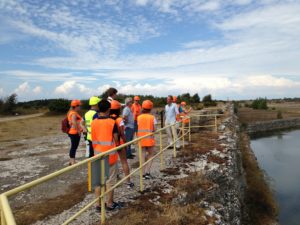
Students learning about water management.
Students learn about several different sustainability topics throughout their month in Sweden.

Students will also study and assess best practices from local, regional, national and international perspectives, with an emphasis on the transfer of knowledge across regions. Dickes says that this is particularly important, as it helps students understand how the scale of a sustainability initiative can impact its planning, implementation and ongoing management to reflect specific regional, social and cultural needs.

“Sustainability is often complex and culturally-influenced, so there is no single, one-size-fits-all approach to solutions,” says Dickes. “Being able to see what is working in Sweden and what challenges they’ve faced, while also being immersed in that culture, can help students understand why certain initiatives were framed or developed in a certain way for that specific population.”

The ability to consider the cultural context for a sustainability initiative, including an understanding of what motivates people to change patterns of behavior, can help students better adapt and apply best practices to challenges faced in the United States and throughout North America. The program also enrolls students from universities around the world, helping its participants see sustainability initiatives through the lens of other cultures, and to discuss sustainability experiences through a global perspective.

Dickes feels that having students from different areas of study – and different countries – take part in the program reflects the need for every sector with a stake in the issue to come together to find multi-faceted solutions.

“Because sustainability is a broad topic with many dimensions, it requires an interdisciplinary lens and understanding of the breadth of topics that fall under this broad umbrella,” she says. “We need many different types of academic and professional backgrounds to work together if we’re going to solve the complex environmental, social, organizational and policy problems of the world.”

Deconstructing Narratives and Making a Difference

Clemson Graduate Student Uses an Innovative Research Approach to Understand the Lives of Marginalized Persons in the Global South

Tourism is one of the world’s largest industries, responsible for the creation of one in five new jobs over the last five years, according to the World Travel and Tourism Council.

Most of those jobs are occupied by women, including in Africa. That said, job opportunities for men and women vary throughout the African continent, says E’Lisha Fogle, a doctoral student with the Parks, Recreation and Tourism Management program at Clemson University, with gender dynamics playing a role.

Picture of PRTM graduate student E'Lisha Fogle presenting at the ATLAS Africa conference in Uganda, which explores innovations in tourism.
PRTM graduate student E’Lisha Fogle presenting at the ATLAS Africa conference in Uganda, which explores innovations in tourism.

“A woman’s experience in the tourism industry throughout Africa is affected by underlying societal, cultural and political influences that affect how, where and when she could be involved in – and constrained by – tourism,” Fogle says.

Past research on gender and tourism in Africa has primarily focused on entrepreneurship, empowerment and other community-based initiatives involving women. Although those are important perspectives, Fogle is applying a different approach to understanding constraints to women’s participation in tourism and its related industries.

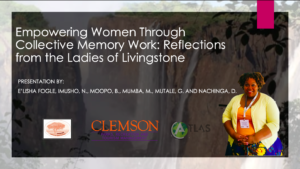
Fogle is analyzing these relationships through collective memory work, a research tool that addresses power structures, hegemony and inequality, with a goal of emancipation through discourse analysis. Members of the collective are able to deconstruct their own narratives, which, in Fogle’s research, also creates a safe space for personal growth and empowerment. Fogle believes this approach can play an integral role towards gender equality in the Global South, which includes most countries in Africa, Central and Latin America, Asia and some countries in Europe.

“Collective memory work is still emerging in Africa as a tourism research tool, as there are fewer women of color investigating these phenomena from an academic perspective,” says Fogle. “As a result, it has been relatively underutilized as a method to understanding issues affecting women in tourism spaces.”

Fogle spent a month in Livingstone, Zambia, between December 2018 to January 2019, with a group of six participants recognized by the collective memory work methodology as co-researchers. Fogle served as the group scholar with five female community members.  Together, they used collective memory work to explore how gender could constrain female participation in the tourism industry. Her goal is to apply a new layer to existing research that can be used to help encourage confidence in the workplace among women and lead to better opportunities, both in and beyond the industry.

Fogle’s faculty advisor, Dr. Lauren Duffy, says that E’Lisha’s work focuses on an important topic that needs our attention. “Ensuring women have access to the tourism industry as a source of employment and income is vital in terms of providing the means for economic and social independence,” Duffy says. “E’Lisha’s research is pushing new boundaries methodologically and having a direct impact on the people and organizations she’s working with.”

Fogle’s impact on the Livingstone community goes beyond her academic research. Before she left for Livingstone last December, she raised $1,300 that was divided equally among six local organizations to purchase equipment and supplies, education materials and uniforms, and health and hygiene products for women and children.

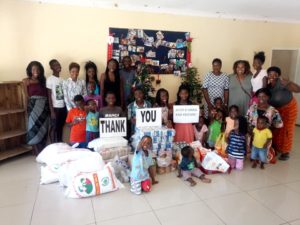
Photo of staff and children at Kwathu Children's Home in Livingstone, Zambia
Fogle’s fundraising initiative benefited several local organizations, including Kwathu Children’s Home, which was able to purchase food supplies for the first quarter of the year.

Dollars were also used to address critical facility needs – for example, financial support provided to the Baobuyu Learning Center, which provides free schooling to young children in the Mwandi area, covered their water, sewage and electricity costs for an entire year, while also helping them prepare their roof for upcoming maintenance work. Kwathu Children’s Home, which operates an orphanage and free community school, was able to purchase food supplies for the first quarter of the year.

Fogle’s philanthropic efforts were supported by the Conservation and Tourism Society in Livingstone, with Society member Jacob Kampindu facilitating the relationships between Fogle and the participating organizations.

“It’s important to me to ensure that my research in Africa does more than benefit me as a scholar,” says Fogle. “The dollars we were able to raise provided direct, and immediate, benefits to the communities sharing their knowledge and insight with me, while also raising awareness of their work here in Clemson.”

Fogle is now back in Africa sharing her collective memory work research approach at two major tourism conferences – at the ATLAS Africa conference in Uganda, which explores innovations in tourism, and the Insaka 2019 Symposium in South Africa, focusing on transformative conservation. She’s hoping her presentations will raise awareness and encourage the use of collective memory work in tourism research.

“Understanding gender constraints to female participation in the tourism industry is critical, given the number of women working in the field. The collective memory work approach provides invaluable new insight into what opportunities and challenges women working in tourism are facing,” says Fogle. “My hope is that the more we share information about this research technique, the more female African researchers will begin to see the value in using it.”

Graduate Student Spotlight: Carmen Nibigira, PhD

Carmen Nibigira knows the value of focus and persistence.

She pursued – and earned – a PhD, taking several twists and turns along the way. Carmen started her PhD journey in 2012 when she moved to Clemson from Burundi, a difficult decision that took her away from her children, who stayed with family back home while she studied.

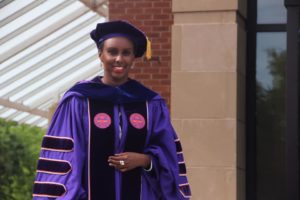
Picture of Carmen Nibigira at Clemson's doctoral hooding ceremony in May 2019.
Carmen Nibigira at Clemson’s doctoral hooding ceremony in May 2019.

Although she had quickly risen in her field, Carmen was conscious that dynamics in the tourism and hospitality field were changing, and that she had much to learn if she wanted to continue to advance her career. “My professional background was in hospitality, however, I began to see tourism industry discussions shift to a greater focus on conservation, preservation and community engagement,” Carmen says. “I had little knowledge at the time about how my journey in Clemson would unfold, but had faith that pursuing my education in tourism development, with a focus on policy, here was the best decision, regardless of the circumstances.”

In 2014, two years into her doctoral studies, she temporarily put them on hold to take a job as Director General of the Burundi National Tourism Office. This position gave her an opportunity to serve her country, apply her newfound knowledge and skills, and to make a difference. A year after that, Carmen was preparing for her comprehensive exams (also called comps, which are a key part of the process towards earning a PhD), when she accepted another position, this time serving as the regional tourism coordinator for the East Africa Tourism Platform. She was joined by her family in Nairobi, who had abruptly left their home country because of a political situation.

She continued to work towards her PhD part-time, and earned her doctorate this past May. Carmen’s faculty advisor, Travel and Tourism Professor Sheila Backman, says this kind of tenacity and focus is typical for Carmen. “Other graduate students find themselves needing to overcome challenges while they complete their credential, but not like Carmen,” said Sheila. “Instead of slowing her down, she always manages to navigate through anything that’s thrown her way. And she does it the right way. As a result, her academic and practitioner colleagues have tremendous respect for her and the knowledge, skills and commitment she brings to the table.”

Carmen started her academic career in the United Kingdom, earning her undergraduate degree in Brighton and her master’s in Birmingham, with experiences in Switzerland and East Africa. Earning a PhD in North America was appealing to Carmen, as she wanted to learn about tourism from a different cultural perspective. She chose Clemson because of its climate, tourism and parks management program and faculty’s international reputation.

Photo of Drs. Carmen Nibigira and Sheila Backman
Carmen with her faculty advisor, Professor Sheila Backman at All In Coffee Shop in Clemson this spring.

While she studied, Carmen also continued her long-standing work to empower women throughout East Africa by creating opportunities for education and mentorship. Carmen’s personally mentored dozens of women during her 20-year career in the travel and hospitality industry, and serves as a member of the Board of Directors for the Akilah Institute in Rwanda, a women’s college that prepares a new generation of African female leaders. The institute has been so successful that it’s looking to expand, with a goal of creating a network of campuses across sub-Saharan Africa within the next 15 years.

Carmen sees herself as being in a unique position to help, as an industry leader and one of a small percentage of people throughout the world who have a PhD. “Education is a great opportunity for young women. But it’s not just about education. It’s about the quality of education, equal pay, being able to get a good job and striving to have it all, just not all at once,” says Carmen. “It took me 15-20 years to work towards my PhD, when you factor in my university education and work experience. Once you understand that hard work pays, you become mentally prepared for the challenge.”

She’s now working as a Project Director for Horwath HTL, an international consulting firm that provides governments and other clients with tourism research, policy and strategy development and implementation support in East Africa. And she’s recently found a new challenge to pursue, after a conversation with one of her sons. “He asked me, why are you always focused on helping girls? Why not boys?” she said. His statement caught her off guard, and made her think.

“I’m a mother of boys, and began to wonder, are we creating the same opportunities for them? We perceive boys as having an advantage, but I’ve started to wonder if that’s really the case,” says Carmen. “I’m compelled to see how I can start engaging boys in the very near future. We have helped girls and women access education and equal opportunities, and boys are feeling left out.”

“After all, in Africa, we say that it takes a village to raise a child,” she continues. “I feel like it took several countries to raise me. If I can make a difference in any way, I will.”