Harriet Gilpin (also known as Hattie) always dreamed of running her own business.
After earning a degree in parks, recreation and tourism management at Clemson University in 2015, Hattie was working for a boutique hotel company in New York when she realized the time to pursue that dream was now.
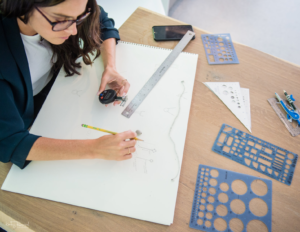
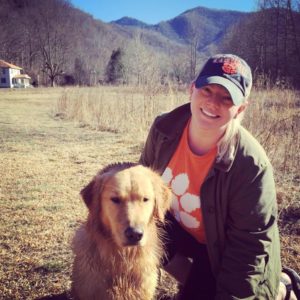
Clemson PRTM alum Harriet (Hattie) Gilpin (2015) says her experience as a Clemson PRTM student taught her the importance of being a team player.
“Although I liked my job, I realized that the best time for me to pursue my dream of going into business for myself was before I got too settled into a relationship or wanted to start a family,” she says. “Starting a business when I did freed me to focus entirely on my work without competing pressures and priorities.”
Flash forward a few months, and Hattie’s walking dogs by day and crafting high quality jewelry in her apartment by night.
“I look back on them now as some of the best days of my life so far, but I would wake up to walk my first dog at 7 am and get back to my shoebox apartment 12 hours later to start making jewelry,” she says. “Half the time I would fall asleep doing it and wake up with little pieces of jewelry and supplies stuck to my face.”
When Hattie reached the limits of what she could accomplish on her own, she reached out to a local jeweler for advice. In exchange for social media and website support, the jeweler became a mentor to Hattie, showing her the ins and outs of the jewelry industry.
“Working with her played a big role in my success,” she says. “She gave me the tools I needed to be successful, and I was able to help her with her business as well, so it was a win-win.”
Hattie’s small, home-based business is now an elevated jewelry line in New York City called Hattie Banks, which creates sophisticated pieces that quickly became favorites among celebrities and social media influencers. Her pieces are based on her childhood memories riding horses and on the beach, and are built to withstand daily wear.
Hattie’s jewelry line, called Hattie Banks, is a favorite of celebrities and social media influencers.
Hattie says that her experience as a Clemson PRTM student taught her the importance of being a team player, and that she now looks for that quality in her employees.
“The Clemson PRTM program let us make mistakes, and then they guided us through fixing them,” she says. “Now when I hire someone new, I need to be sure they’re comfortable working in an environment that gives them the freedom to make mistakes, because that’s the only way we’ll get bigger and better.”
She also now focuses on paying it forward, by providing similar mentorship to other women starting their own businesses.
“If someone didn’t help me, I wouldn’t be where I am today,” she says. “I find it really important to give back. You have to.”
Clemson youth development researcher and Associate Professor Dr. Ed Bowers has always had a natural curiosity about other people and cultures, particularly why people do what they do.
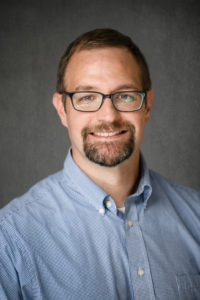
Clemson youth development researcher and Associate Professor Dr. Ed Bowers.
“I’ve always been interested in how people think and act in different environments and situations, and how the cultural context they live in can influence their beliefs and behaviors,” he says.
That curiosity is taking him all over the world. Over the course of his career so far, he’s visited more a dozen countries and taught in Dublin as part of an international service program, experiencing different cultures and perspectives wherever he goes.
When he visits a new place, he pays close attention to things most travelers are not likely to typically consider, such as what strengths young people need to develop in order to succeed, and how they may differ from what success may look like at home.
“It’s a habit at this point. People and our motivations are more complex than you might think,” he says. “For example, if you’re living in a remote area without ready access to core services such as education, health care or transportation, you’re going to see different measures of success than someone who is living in a major urban center.”
Dr. Bowers carries that curiosity to his research, which asks similar questions, but through a focus on positive youth development, and how youth-adult relationships can influence what goes right in the lives of children and adolescents. His work helps us figure out what every parent asks themselves at some point – why did my child do that? And do they have the characteristics and support they need to be successful in life?
His research also focuses on the strengths of youth, instead of negative behaviors. Bowers says this is because even though there is a widespread belief that the teen years are marked by ‘storm and stress,’ most teenagers are actually doing relatively well.
“Youth do make bad decisions, and there are reasons for that, but they also give to charities, care about people, and have sympathy and empathy for others,” he says. “Teenagers can contribute in positive ways to their communities. Building on these youth strengths rather than focusing on their deficits is a more effective way to promote thriving in young people.”
In 2015, Dr. Bowers and several of his academic colleagues explored measures that can help define positive skills and growth in a book they edited together about promoting positive youth development. The book shares a model that people working in positive youth development commonly use to measure a child’s strengths, called the Five Cs – competence, confidence, caring, compassion and character.
Dr. Bowers helped contribute to that model by examining youth responses from across the country to create a measure focused on what a thriving teenager looks like in a community, asking questions about skills or things that they do that demonstrate success.
Dr. Bowers is applying positive youth development models in other countries and environments to determine how measures of youth success may need to be adjusted, depending on where youth live.
Character, for example, can be measured by doing the right thing, having integrity and valuing diversity. Caring, on the other hand, is assessed by whether or not the teenager is bothered by seeing bad things happen to people, or if they want to step in and help.
Dr. Bowers is now working with colleagues in other universities and community organizations to apply that model to youth in other countries and environments, so they can determine how measures of success may need to be adjusted, depending on where and how youth live.
“For example, when measuring competence, a First Nations teenager living in a remote area in Canada’s Northwest Territories needs to have certain skills to succeed that would make no sense to a suburban kid in Boston,” he says. “We’re drilling deeper into the measures to find out exactly what skills are necessary in their specific contexts, to ensure the model can adapt to reflect their unique situations.”
How does one find out what measures work for certain groups of people? According to Dr. Bowers, the first step is asking them. Right now, he’s working with Maasai Mara University in Kenya, Oregon State University, and the University of South Carolina on a Templeton World Charity Foundation funded project to develop a new tool that youth workers will be able use to assess character strengths among Kenyan youth. The project is one of only 14 funded from over 150 applications spanning 55 countries around the globe, and involves interviews with 60 youth and 15 adults to get a sense of what measures are most important for youth living in different environments.
“Within Nairobi, there are teenagers living more traditional lives and street kids who are working towards very different ideas of success,” he says. “The challenge is to develop a model that can be tailored to specifically measure what skills and supports they need to be successful in their specific context of their shared community.”
The instrument they develop will be tested on a sample of 450 youths to establish its validity, relevance and ease of use. Dr. Bowers says the impact of this new tool will be far-reaching.
“This project is not just building a tool for one community,” he says. “It’s also building capacity for youth workers and scholars to conduct high quality research and become a hub for youth development in that area of the African continent.”
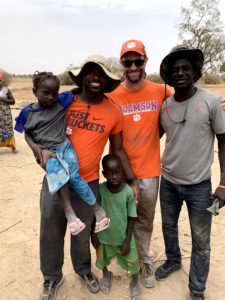
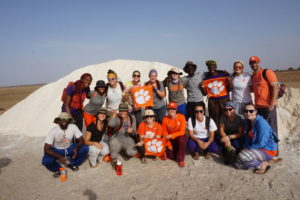
Ed Bowers (back row, right) in Senegal last June with student-athletes and staff that participated in a school build trek organized by buildOn.
Dr. Bowers is also using other opportunities to identify new avenues for applied research to benefit young people. In June he traveled to Senegal with a group of Clemson student-athletes and staff on a school construction project organized by buildOn, a non-profit organization that constructs a new school every two days in some of the economically poorest countries around the world. Now he’s working with YDL program graduate and buildOn Community Engagement Manager Aled Hollingworth to apply their experiences to the development of innovative service-learning opportunities. Next fall, Dr. Bowers also plans to co-teach an international virtual exchange course with a colleague in Vietnam. The course will bring together students from Clemson with students at Ho Chi Minh City Open University to explore the role of digital media in the lives of young people from different cultures.
He says that projects like the Kenyan initiative, service-learning study abroad experiences like the Senegal trip, and virtual exchanges are key to gathering the input needed to tailor youth development measurement tools for global communities. These experiences are equally important for students looking to enter the youth development field.
“Finding ways to get students out in these different cultures conducting field work is the best way to build their skills to see development from a systems perspective, extend our reach, and continue to build capacity in communities they visit,” he says. “Exchanges can also make a big difference, by connecting youth development students from other countries with our students to engage in discussions about best practices, and then identify ways to best promote thriving in diverse communities. Our goal is to encourage positive youth development in a global society.”
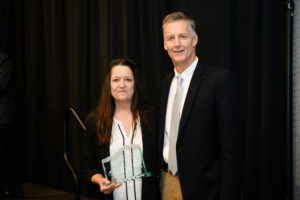
Dr. Carolyn Ward, Chief Executive Officer of the Blue Ridge Parkway Foundation, was recently honored with the William C. Everhart Award by the Clemson University Institute for Parks in recognition of sustained achievements that provide creative insights and that foster an appreciation of our natural and cultural heritage.
File name “Hartzog Luncheon and Lecture_Ward3.jpg” – Dr. Ward with Dr. Powell after receiving her William C. Everhart award.
The institute presents the annual awards program, which is named for George B. Hartzog Jr., the seventh director of the National Park Service, to showcase leading figures in the field of conservation. The awards are named for visionary leaders who make significant contributions to the management of parks and preservation of our natural, historical, and cultural heritage.
Dr. Ward received the William C. Everhart Award because of her longstanding commitment to connecting people to our country’s natural and cultural places and resources, and her contributions to the field of interpretation.
Bob Powell, director of the Institute for Parks, presented the award to Dr. Ward at a ceremony on October 22. According to Dr. Powell, Ward’s passionate leadership in the interpretation field has been instrumental in ensuring the field is evidence-based and moving forward.
“For many years, the philosophies and principles underlying the profession of interpretation have largely been followed based on faith and were largely untested,” he says. “She is a longstanding champion for the importance of research in informing the interpretation field as it evolves to meet the needs of the 21st century public.”
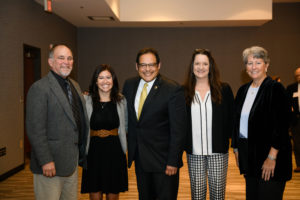
Dr. Ward (second from right) with fellow Hartzog award winners (l to r) Dr. Steven Trombulak, Dr. Jennifer Thomsen, David Vela and Chris Lehnertz.
Dr. Ward’s distinguished career has spanned three decades, from field interpreter at Hungry Mother State Park to CEO of the Blue Ridge Parkway Foundation, the primary philanthropic partner to the Blue Ridge Parkway. With more visitors than Yellowstone, Yosemite, and the Grand Canyon combined, the Blue Ridge Parkway is one of the most visited units of the National Park Service. Under Ward’s leadership, the foundation has provided over $14 million to support programs and projects that continue to help preserve and protect the parkway.
Dr. Ward was born in the Blue Ridge Mountains in Southwestern Virginia, graduated from Emory and Henry College, and received her master’s degree and PhD from Virginia Tech in Forestry. She is a decorated professor and award-winning researcher and author whose life’s work has been dedicated to building bridges and making connections. While working at Humboldt State University, Ward grew a modern and comprehensive interpretive program and conducted field research across the country. In 2009, she launched the ‘Kids in Parks’ program in partnership with the Blue Ridge Parkway and Blue Ridge Parkway Foundation, which unites National Park Service, state parks, community groups, the Eastern Band of Cherokee, and nonprofit organizations around the goal of getting more kids moving outdoors and connected to public lands. The Kids in Parks program now features 200 trails in 12 states and has facilitated over one million adventures for kids and families.
“Dr. Ward’s sustained leadership, grit and determination has left a lasting legacy across the US and the World and has positively influenced countless agencies, managers, interpreters, as well as the general public,” continues Dr. Powell. “Carolyn is an important and powerful role model that has blazed a trail of success in a field that has been traditionally male dominated. I cannot think of a more deserving recipient for this award.”
###
The Clemson University Institute for Parks (CUIP) provides research, education, training, and outreach that enhances the management of the world’s parks and protected areas. It accomplishes this by providing park and protected area managers with innovative research to support science-based decision-making; and by developing current and future leaders in the park movement by providing interdisciplinary and transformative education and training programs. The Institute currently consists of 35 Fellows and 8 Scholars working on park-related research.
Visit the CUIP website for more information about the George B. Hartzog, Jr. Environmental Awards program and its recipients.
Dr. Jenn Thomsen, assistant professor of parks, recreation and tourism management at the University of Montana, was recently honored with the Dwight A. Holder Award by the Clemson University Institute for Parks in recognition of her outstanding work as a conservation researcher and teacher in the environmental field.
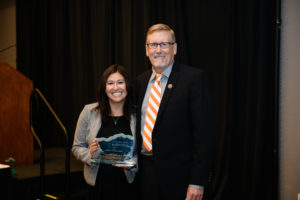
Dr. Thomsen and Clemson Parks, Recreation and Tourism Management Department Chair Dr. Wayne Freimund.
The institute presents the annual awards program, which is named for George B. Hartzog Jr., the seventh director of the National Park Service, to showcase leading figures in the field of conservation. Specific awards were named after visionary leaders that Hartzog respected and admired. Award recipients are following in Hartzog’s footsteps by making significant contributions to the management of parks and preservation of our natural, historical and cultural heritage.
The Dwight A. Holder Award recognizes academic professionals that exemplify Mr. Holder’s illustrious career as an entrepreneur and public servant, which included leading South Carolina’s parks to a new era of service. Dr. Thomsen received this award for outstanding work and sustained achievement that fosters understanding, wise use and conservation of natural and cultural resources.
Wayne Freimund, chair of the parks, recreation and tourism management department at Clemson University, presented the award to Dr. Thomsen at a ceremony on October 22. According to Dr. Freimund, Thomsen has made a significant impact on the conservation field at a relatively young age.
“Jenn already has an impressive publication and teaching record, with a research focus that requires her to pull groups together on almost intractable issues, such as livelihood versus wildlife population management,” he says. “She does it masterfully, with an unparalleled ability to find the glue that holds several different collaborators together.”
Dr. Thomsen graduated with her M.S. in Wildlife Biology from Clemson University, where she also earned her PhD in parks and conservation area management. Her research largely focuses on stakeholder collaboration associated with large landscape conservation, sustainable tourism and protected area management. Her work has involved partnerships with the Center for Large Landscape Conservation and the IUCN Connectivity and Transboundary Specialist groups to conduct surveys addressing the challenges, opportunities and outcomes associated with stakeholder collaboration and how these groups evolve over time in their transboundary ecosystem management. She also contributes to UNESCO’s biosphere reserve network and serves on the National MAB Committee.
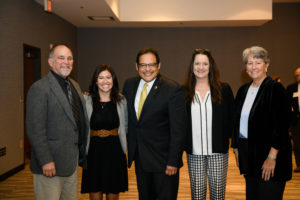
Dr. Thomsen (second from left) with fellow Hartzog award winners (l to r) Dr. Steve Trombulak, David Vela, Dr. Carolyn Ward and Chris Lehnertz.
Her work in sustainable tourism and protected area management focuses on the management of resources that balances the environmental, social/cultural and economic needs of diverse stakeholders. Her research explores unique types of tourism, such as voluntourism in Peru and Haiti, whitewater ecotourism in Bhutan and safari hunting tourism in Botswana. She’s conducted research for the US Forest Service and National Park Service and is part of the INSAKA collaborative group that brings together partners of African universities to address social-ecological issues. Dr. Thomsen is passionate about her teaching and field experiences for students, and about engaging the next generation of conservation and protected area leaders.
“Jenn’s students love her, and her faculty and collaborators love working with her,” continues Dr. Freimund. “And now as the recipient of this year’s Dwight A. Holder award, she can be rest assured that her alma mater feels the same way. I can’t wait to see where she takes her already-impressive career.”
###
The Clemson University Institute for Parks (CUIP) provides research, education, training, and outreach that enhances the management of the world’s parks and protected areas. It accomplishes this by providing park and protected area managers with innovative research to support science-based decision-making; and by developing current and future leaders in the park movement by providing interdisciplinary and transformative education and training programs. The Institute currently consists of 35 Fellows and 8 Scholars working on park-related research.
Visit the CUIP website for more information about the George B. Hartzog, Jr. Environmental Awards program and its recipients.
If you’re headed to the 5th annual Clemson Community Play Day at Nettles Park this Saturday, you’re likely to see several Clemson Parks, Recreation and Tourism Management (PRTM) students and Clemson Outdoor Lab staff on the job.
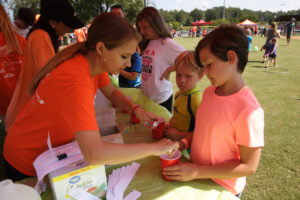
Clemson PRTM students volunteering at last year’s Community Play Day.
Clemson’s Community Play Day is a large community event that attracts several hundred people every year, and is organized through a partnership between the US Play Coalition and the City of Clemson. The event is free and encourages families to get up, get out and go play with several fun activities and games, including inflatables and crafts. This year’s event is on Saturday, September 14 between 11 am to 2 pm.
More than 40 PRTM students are volunteering at this year’s event, as part of their learning requirement for either the department’s EDGE undergraduate program or a course in Advanced Program Planning. Their roles include operating the registration area, helping to lead activity stations, and assisting with the event’s set up and take down.
According to Stephanie Garst, Executive Director of the US Play Coalition, having students fill on-site roles at the event is critical to the day’s success. Students also gain an on-the-job perspective of what goes into planning and implementing a large, family-friendly, outdoor event.
“Helping with Clemson’s Community Play Day gives our students more of an understanding of what needs to be considered when implementing an event of this size and scope,” she says. “There are so many factors that come into play, from accessibility and inclusion to risk management and safety. We hope that everyone who wants to attend our Play Day is able to explore different types of play while they are with us.”
After the event, students write a reflective paper about their volunteer experience, including what they learned and how it connected to what they have learned in the classroom.
“Volunteering for events such as Clemson Community Play Day offers students meaningful examples of the principles they are learning through lectures,” says Assistant Professor Dr. Harrison Pinckney, who teaches the Advanced Program Planning class. “The reflective papers students are asked to write after they volunteer brings their practical and academic experiences together into applied learning.”
PRTM EDGE Coordinator and Senior Lecturer Dr. Teresa Tucker adds that these types of volunteer experiences are also central to the innovative, immersive experience the EDGE program creates for sophomore students, taking a collaborative approach to delivering core parks, recreation and tourism management content.
“We supplement all of our classroom content with applied experiences that give students insight into a concept as both a learner and a future professional,” she says. “This type of experience gives us an opportunity to discuss as a group how they might manage working with volunteers in the future – knowledge that they are likely to draw on when they start working in the parks, recreation and tourism fields.”
Scuba divers never dive alone. A diving buddy is needed to make sure the diver is able to get out of the water quickly and safely, if the unexpected happens. Robbie Bogan, owner of Upstate Scuba in Clemson, says that same general rule also applies to running a successful business.
Robbie’s buddy? The Leisure Skills program managed by Clemson’s Parks, Recreation and Tourism Management department, which helped him build and grow Upstate Scuba, a local scuba diving business that trains divers in more than nine counties throughout South Carolina and parts of Georgia.
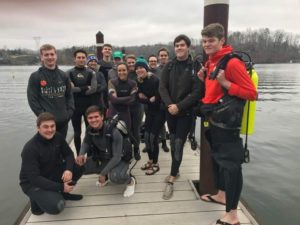
Clemson students preparing for their scuba certification.
Robbie, who’s been teaching a scuba diving course for the program since 2004, has always had a passion for diving and rescue.
“I started diving as a child, and worked as a firefighter for several years,” he says. “one of the areas I always wanted to explore was rescue diving – applying my scuba experience to underwater rescue and training others to do it too.”
On a trip to Clemson in 2004 and after discussions with people in the community, he realized the area had everything he needed to start a scuba diving business. There were no existing options to learn how to scuba dive in the region, giving him an untapped market.
Most importantly, says Clemson’s Leisure Skills program Director and Senior Lecturer Dan Anderson, a local scuba diving training option didn’t exist for Clemson University students who may need certification to build their careers, such as for some jobs in marine biology.
“When we spoke with Robbie, we saw an opportunity to help our students earn a certification that was otherwise locally unavailable,” he continued. “Scuba diving is a perfect fit for our Leisure Skills program, which helps Clemson students learn new skills, get more involved on campus and broaden their network opportunities.”
Students take leisure skills program for a number of reasons, including introducing themselves to new activities, and potential new hobbies or career options. More than 150 one-credit learning options were offered last spring in subjects such as dance, shotgun sports, yoga, fitness, outdoor recreation, sports and first aid. Class sections are taught by experts in the field, like Robbie.
The Leisure Skills scuba diving course teaches basic open water diving techniques and helps students gain the knowledge they need to meet requirements of an open water diving certification. Students take four classes to learn the basics of open water diving and practice what they’ve learned in three pool sessions.
At the end of the course, students are required to pass a swim test for certification by an internationally recognized and accepted certifying agency. The test requires them to complete three dives one day and two the next. When they pass the swim test, students earn one credit towards their undergraduate degree at Clemson University, while also gaining an international certification that they can use to dive anywhere in the world.
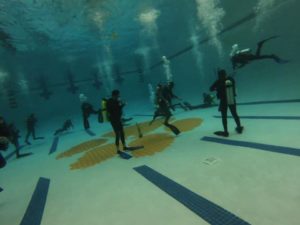
Some of the scuba diving training is completed in the pool at Clemson University’s Fike Recreation Center last March.
Students can maintain that certification for life, says Robbie.
“All they need to do to maintain their certification is to keep a log of their dives,” he says. “If they complete and record two dives per year, they keep their certification. If they don’t complete their dives, they have the option of taking a half-day update class to get them back up to speed and get re-certified.”
Robbie says that after starting to work with Leisure Skills to train Clemson students, he’s never looked back. His business continues to grow, having certified more than 3,000 students over the past 15 years, and is able to offer rescue diving training to first responders.
He credits his success to Clemson University.
“We’re now making a huge impact in the region by building underwater rescue capacity, but if it weren’t for the university’s leisure skills program, we wouldn’t be doing this,” he says. “The impact of the Leisure Skills program on my small business and so many others has impacted the Clemson community in ways that they may not even realize. We’re very fortunate and appreciative.”
He also says that the program helps people in more fields than you would originally expect.
“We’re seeing scuba diving being used in a number of different professions, such as for engineers doing underwater bridge inspectors, or even astronauts, as being underwater can mimic the experience of being in space,” he says. “Some of our former students have even become rescue divers themselves. Even if they don’t ever need to actually rescue anyone, the peace of mind knowing they’re ready to help is huge.”
***
Clemson’s Parks, Recreation and Tourism Management department employs experts in leisure studies and outdoor recreation. Learn more about its Leisure Skills program.
At first glance, Haley Plumley and Lauren Grubbs may not have a lot in common, other than their age (they’re both 12 years old). They also live in different states – Haley lives in Florida and Lauren in North Carolina – and have different connections to Clemson.
If you look a little deeper, however, you’ll see that they share a similar determination, and a strongly-held belief that despite their age, they have the power to change the world – a belief they’re proving by working to raise awareness of the plight of tigers in the wild.
Lauren Grubbs and Haley Plumley are working to save tigers in the wild (shown here in Clemson last spring).
Lauren and Haley got involved in different ways. Lauren writes letters that get attention. She was learning how to write persuasive letters as part of a 5th grade class project, when she decided to write Clemson University President Jim Clements about the need for the university to lead an effort to save tigers in the wild.
“About 70 kids in Lauren’s school sent persuasive letters to complete the project assignment, but she was the only student who received a personalized response back,” says her mother, Katie Grubbs. “She’s been writing letters ever since. It’s fascinating to see who replies and who doesn’t, and the confidence and influence she’s grown in the process.”
Clements asked Dr. Brett Wright, Director of the Tigers United University Consortium, to respond on his behalf to Lauren’s letter. The Consortium is devoted to tiger conservation and consists of four land-grant, tiger mascot universities working collaboratively on this issue – Clemson University, Auburn University, Louisiana State University and the University of Missouri. Katie says Dr. Wright’s response to Lauren’s letter was written in a way that she could understand and provided useful information about the Consortium, its goals and its work.
Haley, on the other hand, was working on a community service project for school and wanted to find a unique way for a kid to further a cause she could believe in, support and help. Last year, she learned about the Tigers United University Consortium at Clemson through her Dad, who played football for Clemson between 1990-94 and remains an active supporter. Haley overheard her Dad talking about a donation he had made to the consortium and their need for help, and realized she’d found her project.
“Over the last few years, Haley had been asking me how kids can get involved in an issue, and what they can do that would really help,” said Julie Plumley, Haley’s mother. “When she heard about the consortium and that it’s something many people don’t yet know about, she realized she could spread the word and really make a difference.”
Her idea was to create an educational program for elementary-aged children about the need for tiger conservation, including how they can help, so they could share that information with their friends and families and get involved.
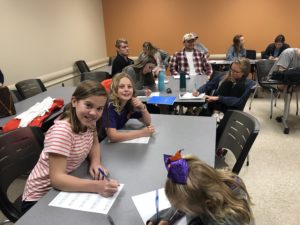
Lauren and Haley, shown with students in Clemson’s Youth Development in Camp class, vetted program and activity ideas in a ‘Shark Tank’ setting.
This idea started to become reality this past spring as a unique learning opportunity for Clemson University’s Parks, Recreation and Tourism Management students. Associate Professor Gwynn Powell, who teaches a Youth Development in Camp course, saw an opportunity for her students to combine public service with developmental pedagogy.
“Our class was developing activities for elementary school aged children participating in the City of Clemson’s annual spring break day camp,” says Dr. Powell. “The tiger conservation program was a great project, because it challenged them to develop a curriculum that combined academic content with recreational activities.”
Dr. Powell tasked her students with creating potential programs and activities for an elementary school education program to teach tiger conservation to students in grades first through fifth grade. Given their experience with the consortium and its work, Haley and Lauren were asked to vet the class’s ideas in a ‘Shark Tank’ evaluation setting.
Holly Carlisle, one of the students that presented to Haley and Lauren, said the process was a meaningful learning experience, and that the judges provided useful feedback.
“I was really motivated to work hard because our work was for more than a class assignment,” she says. “We tested our work with children, so we know we’re designing something meaningful for them. I hope the program can be used around the world to help children see the importance of tiger conservation.”
Fellow student Caroline Self agrees, and appreciated Haley and Lauren’s (often blunt) feedback.
“Those kids did not cut us any slack!” she says. “It was helpful to hear from them, because this assignment challenged us to target specific activities for specific grades, so we had to really understand the developmental difference in the ages to strike the right balance.”
The program is now being refined with input from elementary school teachers. Haley and Lauren’s schools agreed to pilot the program when it’s ready.
Consortium Director Brett Wright says Haley and Lauren are proving that anyone can have a significant impact on the world, regardless of your age.
“These girls are two of the savviest, most invested and dedicated people I’ve come across,” he says. “They know they can make a difference, and they’re putting in some serious work to spread the message about tiger conservation, and how dire the situation has become.
He says their involvement also gives him hope for the tiger’s future.
“We chant ‘Go Tigers’ on a daily basis, but not many know the truth about the animal we hold so dear – and how close they are to extinction,” he says. “Lauren and Haley are giving us an important tool we can use to raise awareness, and hopefully bring more people to the cause. Without that help, tigers as we know it may become extinct in their lifetime.”
***
Tigers United Week runs from September 3 to 7 in Clemson. The consortium’s universities are all raising awareness of tiger conservation through through several activities, including a Scarcity Scavenger Hunt with a grand cash prize and an information booth while Clemson tailgates for Saturday’s game, with an opportunity to meet Clemson’s First Lady Beth Clements and her daughter, Grace. The week culminates with a launch of a new, 30-second video about the consortium’s mission during the Clemson home football game on Saturday afternoon. More information about Tigers United Week and its activities can be found on the Tigers United blog.
You can also support Tigers United by texting CUtigers to 41444.
Louise Orr had finished her undergraduate degree and was working in state government, when she decided she needed a change.
“I had always loved wildlife and been interested in conservation, and had briefly considered studying zoology in college, but went a different route by studying communications instead,” she says. “I realized a few years after my graduation that not only could I still pursue that love for wildlife, but I could apply my communications background and experience to making a difference in the conservation field.”
Clemson PRTM graduate student Louise Orr is combining her communications experience and love of wildlife to help save Clemson’s tigers in the wild.
Louise is now pursuing her master’s degree in parks and conservation management in Clemson University’s Parks, Recreation and Tourism Management department. Her research focuses on how our political beliefs influence what types of conservation messages are most likely to reach us, or motivate us to take action.
“Most people have never seen an animal in the wild, making them largely disassociated from problems tigers face,” says Louise. “My research is exploring several variables, such as levels of knowledge about tiger conservation, their political ideologies and their moral foundations, to find out what kind of messages they would be most receptive to, so we can help organizations working to save tigers better encourage people to get involved and learn more about the need for tiger conservation and how they can help.”
One of the variables Louise is exploring is whether a person’s connection to a tiger mascot school would have any influence on their engagement in conservation behavior. If someone is passionate about their university’s mascot, does that translate to a passion for that animal in the wild and make them more likely to participate in conservation efforts?
Louise’s research for her master’s agree transfers well to her part-time job working as an Assistant Project Coordinator for the Tigers United University Consortium. The consortium is devoted to tiger conservation and consists of four land-grant, tiger mascot universities working collaboratively on this issue – Clemson University, Auburn University, Louisiana State University and the University of Missouri.
The consortium’s universities are all raising awareness of tiger conservation through Tigers United Week, which runs from September 3 to 7 in Clemson. Several activities are planned, including a documentary screening about a man’s quest to get a Siberian Tiger on camera, a Scarcity Scavenger Hunt with a grand cash prize, and an information booth with an opportunity to meet Clemson’s First Lady Beth Clements and her daughter, Grace. The week culminates with a launch of a new, 30 second video about the consortium’s mission during the Clemson football game on Saturday, September 7. More information about Tigers United Week and its activities can be found on the Tigers United blog.
Dr. Brett Wright, dean emeritus of Clemson’s College of Behavioral, Social and Health Sciences, is the consortium’s Director and Louise’s faculty advisor. He says Louise’s background in communications and her current research focus makes her a valuable part of the consortium team.
“A big part of the work we do at the consortium is getting the message out in a way that motivates people to make a difference, and Louise’s research and communications expertise will help us figure out how to best get our message across,” he says. “After all, students, faculty and alumni chant ‘Go Tigers’ on a daily basis, but not many know the truth about the animal we hold so dear – and how close they are to extinction. Fewer still may know how they can help.”
Louise is excited to help organizations like the consortium refine their conservation messaging.
“It’s a great feeling to combine what I’m passionate about with my knowledge and experience in the communications field, and to use it to make a difference in the world” she says. “Especially since this work is critically important. If we don’t continue to work hard and do what we can – our children and grandchildren aren’t going to have tigers in the wild. They’re going to be gone.”
Any graduate student will tell you that earning a master’s or doctorate is a very different experience than earning their undergraduate degree.
Graduate school often presents new challenges, such as how to successfully navigate juggling school and life, securing funding support, the academic job search, and imposter syndrome. These challenges don’t end after graduate school, as new faculty members find themselves working towards and beyond the tenure track.
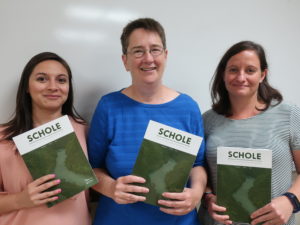
(L to R): Drs. Mariela Fernandez, Gwynn Powell and Lauren Duffy with their copies of the SCHOLE special issue (not pictured: fellow guest editor Lincoln Larson). SCHOLE is the Greek word for leisure.
With that in mind, several current and former faculty members in Clemson University’s Parks, Recreation and Tourism Management department guest edited and contributed to a two-part special issue of SCHOLE: A Journal of Leisure Studies and Recreation Education that focuses on the academic profession in parks, recreation, tourism and leisure.
The special issue was guest edited by Mariela Fernandez, Lauren Duffy, Gwynn Powell, and former faculty member Lincoln Larson. Contributors included Professor Emeriti Brett Wright and Fran McGuire, current department faculty member Iryna Sharaievska, and former faculty member Dart Schmalz.
“As professors, we have a unique perspective, having experienced the academic system through the lens of both graduate students and by working as faculty members at different stages of our careers,” says Fernandez. “The special issue is a valuable resource that can serve as a guide for students at every stage of their graduate studies, up to, including, and after their job search, as well as for our colleagues working in the academy.”
Part 1 of the issue provides advice about successfully navigating the different stages of an academic career, from graduate school to the post-tenure years. Part 2 explores contemporary challenges in higher education that influence academic programs and may impact faculty members throughout their careers, such as changing approaches to governance in academic institutions, the evolving experience economy, and the ongoing struggle to maintain a healthy work-life balance. The goal is to help graduate students and faculty colleagues recognize and address common challenges, ultimately enhancing success at both the professional and personal level.
Although the special issue is written to address challenges in the parks, recreation, tourism and leisure fields, contributing editor Lauren Duffy notes that the general principles could also apply to other fields.
“The challenges we all face in the leisure studies field are often not dissimilar from challenges others may encounter over the course of their academic training and career,” Duffy says. “Although information provided in this special issue is focused through the lens of our work, there are common threads that can be useful to any graduate student or academic professional.”
Contributing editor Gwynn Powell notes that the special issue can also start a dialogue about issues that are important topics of discussion, but are not often publicly discussed.
“For example, one of the articles in the special issue focuses on post-tenure pathways – the fact that extensive mentorship is provided pre-tenure, but disappears in the decades following that achievement,” says Powell. “Highlighting challenges like this can help colleagues working in the field realize they’re not alone, while also helping them address it.”
When many of us think about summertime for university students, we imagine vacations with family or afternoons spent on the lake.
For many Clemson University students, however, part of their summer is spent on-the-job, as they complete practicum requirements for their program of study. Michael Fanning, a Clemson Parks, Recreation and Tourism Management (PRTM) major, was one of those students.
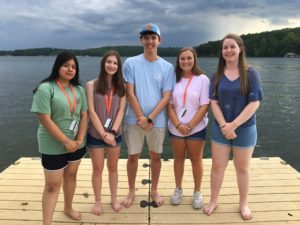
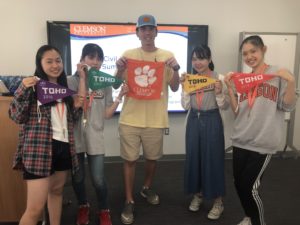
Clemson PRTM student Michael Fanning (center) worked with several other student counselors across campus to deliver Summer Scholars programming.
Michael completed his summer practicum on Clemson campus through the university’s Summer Scholars program, which helps middle and high school students explore the college experience through subjects they’re interested in.
Michael worked as a counselor, mentoring students and acting as a Clemson ambassador, by sharing his insight on what it is like to learn on campus in his chosen area of study.
“Our counselors come from a diverse set of majors so that there is always someone our scholars can connect with to learn more about being trained in a certain discipline,” says Camille Swanson, Director of the Summer Scholars program. “Michael was able to represent his major to the scholars, while also making them feel welcome and supported on campus.”
Michael says that the experience worked both ways, as the program hosted high school students from throughout the United States and other parts of the globe, such as South Korea and Japan, giving him insight into how other cultures perceive Clemson. He says he also benefited from an increased awareness of programs offered by other parts of the university.
“My favorite part of the Summer Scholars experience was experiencing different programs offered at Clemson, such as audio and civil engineering, various animal farms during vet camp, genetics and others,” he says. “I also enjoyed meeting and building relationships with counselors from other majors.”
Practicum experiences for students majoring in PRTM are designed to give students an opportunity to build their resume, while also gaining knowledge and work experience, according to Jamie Cathey, Parks, Recreation and Tourism Management Lecturer and Michael’s internship coordinator.
“For many of our students, their practicum is their first experience working in their field,” she adds. “Practicums serve an exploratory purpose, in that they give students a chance to try different jobs out and see what they enjoy doing most, while also giving them an opportunity to put what they’re learning in class into action.”
Michael (center) also had the opportunity to meet summer scholars from different parts of the world during his practicum experience.
Both Jamie and Camille agree that Michael was well-suited to his practicum position, as he has a natural affinity for helping others.
“If Michael saw one of our scholars sitting by themselves, he would immediately go and reach out to them, and find a way to get them involved,” says Camille. “He’s always calm, inviting and welcoming, and ready to connect with everyone he comes into contact with.”
Michael also knows that he’s picked the right major. “A PRTM major has a wide variety of rewarding career choices and is critical to the development of happy families,” he says. “I hope to take my experience and invest in the lives of young people and families to help create experiences for family time – the most valuable thing any family can share.”
Michael’s looking forward to graduating and exploring all of the options his Clemson degree can afford him. After his summer scholars experience, we’re confident his future looks bright.