By Katie Gerbasich
“It’s unethical to bring people into a lab and hit them real hard in the head,” Anthony Marino likes to joke.
Fortunately for researchers, crash test dummies can take the hit.
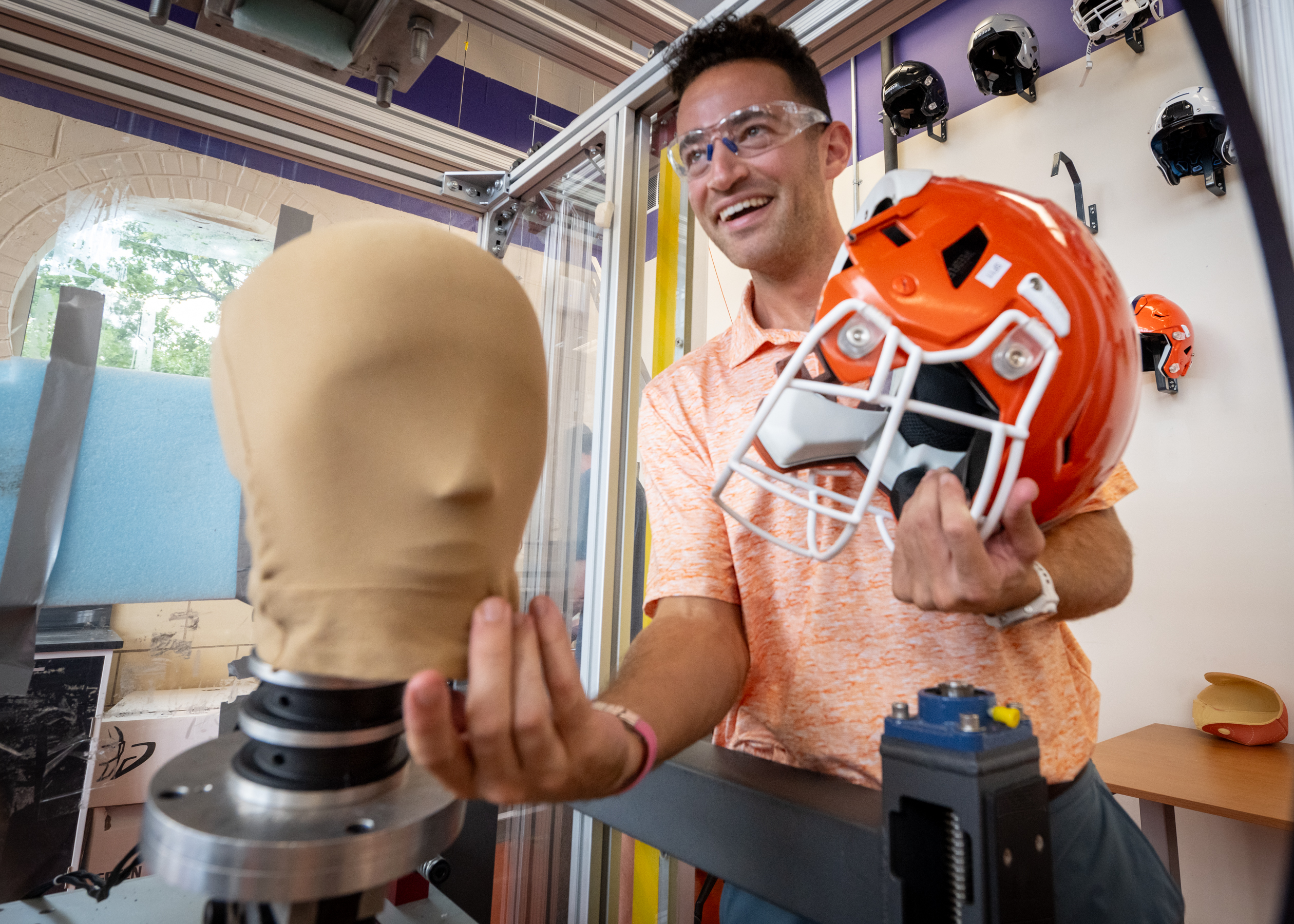
A recent Clemson Ph.D. graduate from the Department of Bioengineering, Marino focused his dissertation on examining the effectiveness of using the Hybrid III, a crash test dummy commonly used in football helmet testing, to replicate the hit a human would take on the field.
Marino conducted his research within the Clemson Headgear Impact Performance (CHIP) Laboratory.
The CHIP Lab has made major strides in helmet safety. Co-directed by Dr. John DesJardins, professor of bioengineering and director of the Robert H. Brooks Sports Science Institute (RHBSSI), and Dr. Greg Batt, a professor in the Department of Food, Nutrition and Packaging Sciences and a faculty fellow at RHBSSI, the lab focuses on improving how protective headgear is tested and developed, particularly for high-impact sports like football. The goal is to bring greater accuracy to helmet testing systems to better protect athletes from concussions and traumatic brain injuries.
How human-like is the Hybrid III neckform?

Marino became interested in studying the neck component of the Hybrid III because it was designed to simulate a human response to a frontal car crash, not the multi-directional impacts seen in sports.
“I saw the opportunity to look at the neck component because I thought that this crash test dummy neck that’s supposed to represent a human response to a frontal crash in a car was going to be a little different than a human response to a football impact.”
To fill the gap left by the lack of active human data, Marino used a computational model in OpenSim to replicate the lab testing.
Though the Hybrid III is commonly used in the field for helmet impact testing, Marino’s research found that, to match the dummy’s performance in controlled low-speed movements, such as neck-bending tests, a comparable human would have to be about 300% stronger.
During higher-speed impact testing, Marino found even larger differences. In one scenario, the computational model required a 1,000% increase in strength to replicate the Hybrid III’s response. Even with those increases, Marino said the computational human model could not fully replicate some of the Hybrid III’s injury metrics.
“You kind of had to create a superhuman to match our crash test dummy,” Marino said.
The findings suggest the Hybrid III may overestimate some injury metrics because its neck responds differently than a human neck, but the dummy’s durability and repeatability are why it remains the industry standard in helmet testing.
The why behind the work

Marino’s work provides insight into the limitations of the Hybrid III, laying the groundwork for more realistic helmet safety testing in the future.
Discovering tangible impacts is what motivates Marino. During his undergraduate studies in mechanical engineering at Auburn University, a professor introduced him to biomechanics and the idea that engineering principles could be applied to the human body.
“It’s just fascinating because the body really is a perfect machine when it’s working well, and we’re trying so hard to replicate it in other machines,” Marino said. “Then being able to see that you can directly help people, whether it’s injury prevention or rehabilitation and give people a better quality of life through engineering, completely flipped my career path.”
While the Hybrid III remains the industry standard, Marino’s findings raise important questions about how closely current testing systems reflect real human movement.
“The dummy isn’t humanlike at all, but it’s giving us data that’s protecting the player so far,” Marino said. “The device is durable and repeatable, which is the real reason it’s adopted so widely in this industry.”
