Sports Insight

Clemson Baseball pitcher and Physics lecturer join forces to find common variable in pitch velocity

Amy Pope analyzing Lucas Mahlstedt's pitching data.
Amy Pope analyzing Lucas Mahlstedt’s pitching data (photo by Natalie Bell)

By Griffin Barfield

Lucas Mahlstedt, senior Physics major, has joined forces with Physics lecturer, Amy Pope, to analyze pitching data to examine how the mechanics of a baseball pitch relate to pitch velocity. . One of Clemson Baseball’s top relief pitchers, Mahlstedt is combining his love for the sport and physics to complete his senior thesis this semester. 

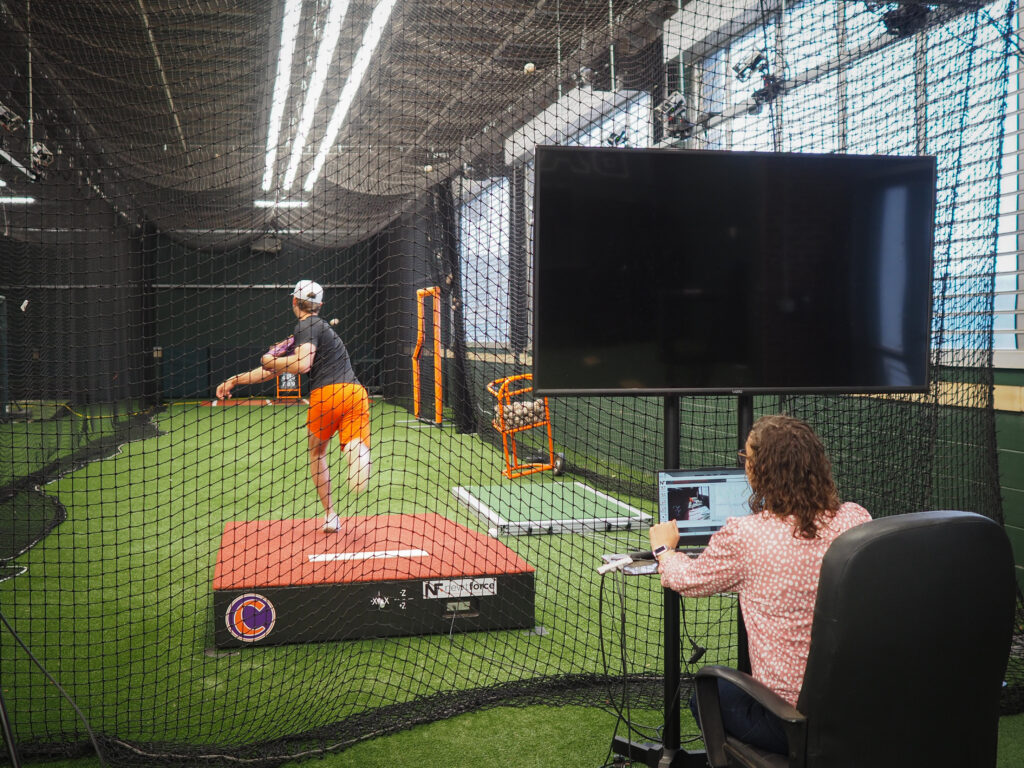
Mahlstedt demonstrating throwing motion (photo by Natalie Bell)

“Our main goal is to figure out what increases pitch velocity the most because there’s so many different ways,” said Mahlstedt. “So many different pitchers have different mechanics. You’ve got guys who throw from the side, up top, guys with different arm action.”

Mahlstedt’s throwing motion is a ‘submarine’ throw, which means his toss closely resembles an underhand throw by whipping his arm around his body, allowing the ball to come from different angles. The motion is untraditional compared to a pitcher that throws over their shoulder. Regardless of throwing motion, size and age, Mahlstedt is interested in establishing a consistent variable through physics that pitchers can use to improve their game.

“So, we’re trying to find something consistent that every pitcher could use at different levels,” he said.

The physics of sport

Pope teaches the physics of sport at Clemson. Her work intersects with different sports like football and, most recently, breakdancing which was introduced in the 2024 Paris Olympics. She has also worked closely with golf and ski jumping. This is her first time working with baseball student-athletes. 

From golf to baseball, Pope describes how ball material makes this study different from one she had conducted with Clemson Golf students.  

“I’ve worked with some of my students who have been in golf and we’ve looked at Trackman data for that,” Pope said. “Golf is difficult because the balls have dimples, which give a lot of additional air flow and make the ball stay in the air longer.”

Using a Newtforce Mound to collect data, Mahlstedt has narrowed down variables that could help detect a linear relationship for faster pitches. 

“The Newtforce Mound looks like a piece of plywood that’s at a little bit of an incline,” Pope explained, “and whenever you are stepping on the plate, it’s recording all of the forces that are acting on it in three dimensions at one time.”

A radar gun is also used to detect the speed of each pitch. 
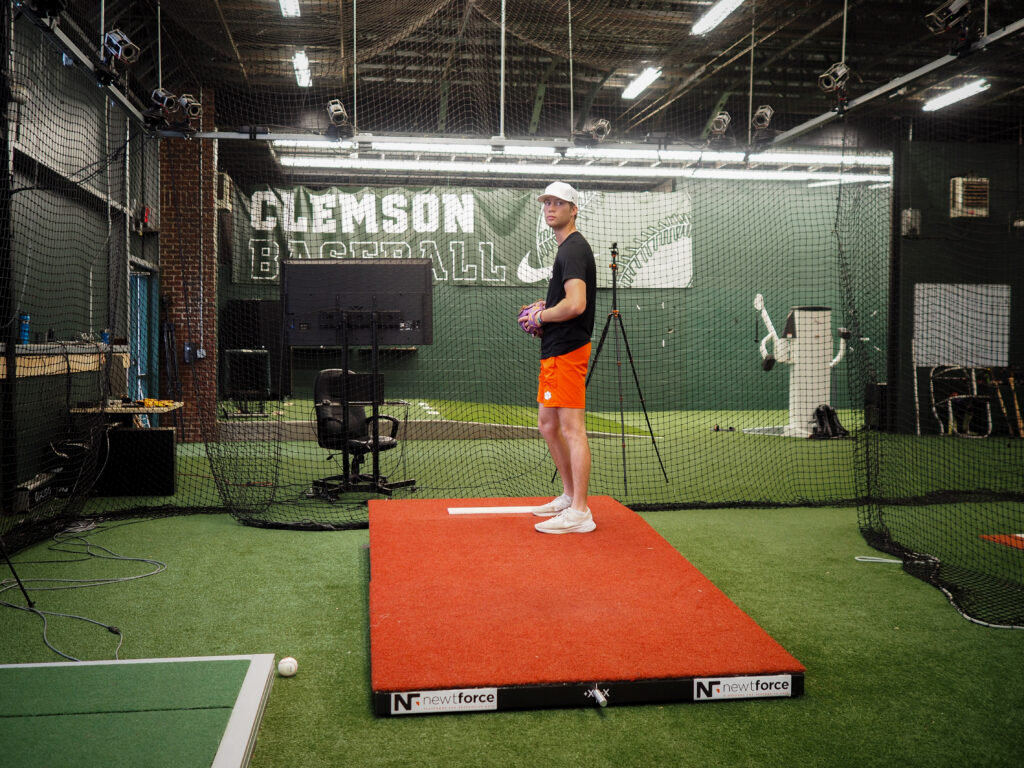
Mahlstedt gearing up to pitch.

With the help of these tools, Mahlstedt believes that the acceleration impulse of the pitch, or the ground force measured from the pitcher’s leg lift, could be the variable he’s been looking for.

The two compared Mahlstedt’s data with other pitchers and managers on the team, who participated in the research, and they saw a linear correlation. 

“For multiple pitchers, we have observed that the larger the impulse put into the ground during the pitch, and conversely, the harder the ground pushes up on the player, the faster the exit velocity of the ball,” Pope said. 

While there are various details that could be factors, such as stride length in the pitcher, their arm strength and effective kinetic chain of their arm movement, the two are putting their attention to how the ground forces affect the exit velocity of the ball. 

“I think we narrowed it on mainly focusing on the lower half of the body,” Mahlstedt said. 

With a full-body sport like baseball, there is high injury incidence at all levels. Baseball pitchers face risk of serious injury throughout their careers; therefore, performance cannot be fostered without a serious look at injury prevention.

“We can talk about injury prevention because if you can get that lower half of your body into it, you’re going to be able to throw the ball faster without risking your throwing arm as much,” Pope said. 

“If you can generate more velocity from [your lower body], it should be less from [your upper body], at least,” Mahlstedt agreed.

The results are in

For the Clemson pitcher, the results have been working. As of April 2, the pitcher has a 1.09 earned run average(ERA), striking out 34 in 24.2 innings pitched this season, and an opposing batting average of .180. Mahlstedt has also noticed that he has “been throwing harder” over the course of this season.
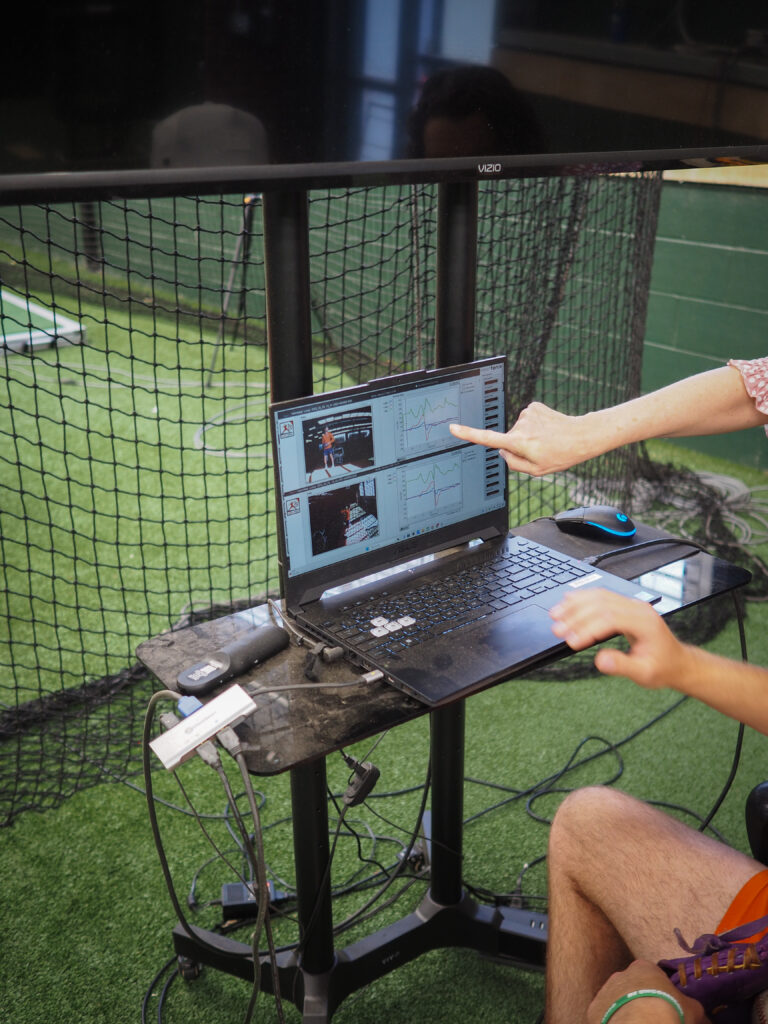
Pope and Mahlstedt reviewing results

The senior has been using a larger acceleration impulse for his pitches, heightening the force that he puts in the ground from his leg lift. From this force, and according to Newton’s third law of motion, the opposite reaction that the ground gives him the force that he needs to throw faster.

If this variable is important, how, then, does an athlete train to increase their acceleration impulse?

“A lot of water bag drills,” said Mahlstedt. “It’s used for stability, but if you take a water bag and you move it and you kind of rock, you almost feel this impulse with the water sloshing back and forth. It just improves stability.”

Jumping exercises, such as one leg jumps, have helped Mahlstedt’s transfer of force, which would allow for a linear increase.

“That has led to that increase in acceleration impulse and then an increase in velocity,” he said. 

As for the future, Mahlstedt and Pope will be further researching how the upper and lower body interact during a pitcher’s career progression, hypothesizing that measuring the lower half of the body could lead to more findings that will help pitcher training. 

“The kinetics with the ground forces in the lower half is easier because we have to do the force itself,” Mahlstedt said.

“We’re looking at ways that we can quantitatively say that most players, if they do this, they should be throwing the ball faster,” Pope added. “Each athlete is very individualized with their body mechanics and in what they do, so we’re just trying to look at some overall metrics that a player might be able to look at to see if they can improve that metric and, thereby, improving their pitching speed.”

Injury prevention was another future topic mentioned, due to the amount of pitchers that suffer upper body injuries from body fatigue. Most of the research released about baseball pitchers is about injury prevention, and the two are interested in evaluating how their research on lower body forces can add to prevention.

“If you can focus on the lower half to increase the speed of the pitch,” Pope said, “that’s probably less damaging to the arm. Not a lot of pitchers go out because they injure the lower half.”

Whether the MLB Draft or a future in baseball is in the cards, Mahlstedt hopes that his research will be the continuation of something important, whether in pitcher development or injury prevention, on the baseball diamond. 

The code to success for a female athlete in computer science

By Nicole Souza

Paige Wasiela (right) participating in Rush Week 2025

March is Expanding Girls’ Horizons in Science and Engineering Month, a time to celebrate the achievements of women in STEM and highlight the importance of supportive communities in these fields. While science, technology, engineering and math (STEM) offer incredible opportunities, gender disparities remain, particularly in computer science. According to the National Center for Biotechnology Information, girls make up 61% of advanced placement (AP) biology students, 52% in AP statistics and 50% in AP chemistry. However, that number drops to just 23% in AP computer science.1 This gender gap persists beyond primary education, continuing into college and the workforce. Every day, women work to forge their own pathways to success.

Paige Wasiela, a senior computer science student at Clemson University, exemplifies a woman who has found academic and personal support in her field. Through extracurricular involvement and women’s intramural sports, she has thrived in a male-dominated field.

Paige was initially drawn to STEM by its limitless possibilities. “I was inspired to pursue STEM because I saw the opportunities post-grad to contribute to creating something that society, and myself, could benefit from,” she said. 

Her journey has not been without challenges. She found her courses rigorous and, like many women in STEM, initially struggled to build a support system in her male-dominated major.  “The rigor of courses in the STEM fields, computer science specifically, have proven to be very challenging, but by seeking help from TAs [teaching assistants] and professors, I have been able to pass my classes and learn.” 

However, academic support from professors and TAs can only go so far. Finding a community of like-minded individuals became a crucial part of her academic success.

Paige (middle, orange shirt) with other members of Theta Tau

When looking for such a community, Paige found Theta Tau, a co-ed professional engineering organization after receiving a recommendation from a friend. Joining Theta Tau would shape the next three years of her college experience. Through the organization, Paige built lasting friendships, received help in classes from people she would have never met otherwise, and even secured a full-time job that she is passionate about. Theta Tau offered mentorship and support, and as a group that is equally composed of men and women, it provided a close-knit network of like-minded women who shared her academic drive and social interests.

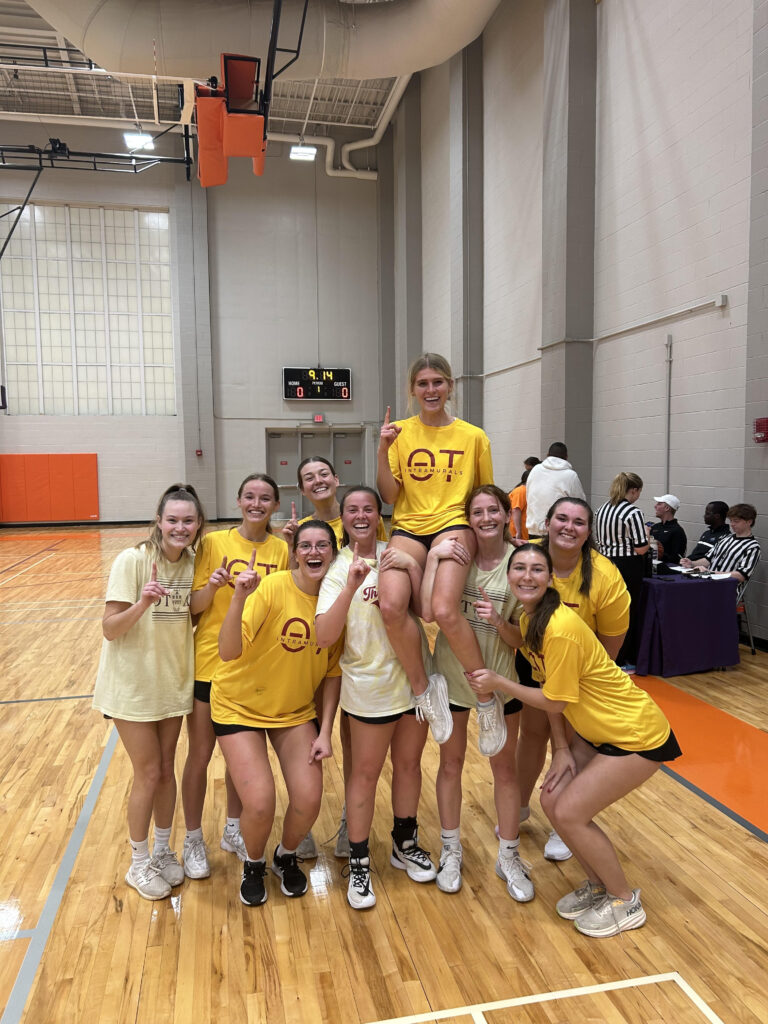
Paige (middle, black socks) holds her teammate up to celebrate their intramural victory

Outside the classroom, Paige excelled in athletics. Her love for basketball led her to join the Theta Tau women’s intramural basketball team. What started as a fun activity quickly became something more meaningful. “Playing together and having fun creates a bond between us that makes us want to get to know each other better outside of the sport and be better friends,” Paige explained. This camaraderie extended into academics. “Getting to know people on the basketball court opens the door to being more comfortable around each other, especially when asking for help on things like academics.”

Mentorship has played a significant role in Paige’s journey. Admiring her teammates on the court often translated to admiration in the classroom and beyond. “When you admire someone’s work on the court, you can easily admire their work in academia, or just in life,” she said. Seeing older members succeed in their coursework provided both inspiration and guidance. Now preparing to graduate, she hopes to pass on an important lesson to younger students: never be afraid to connect with older members of your organization or major. “We’re all students in STEM. We’re all in this together.”

For girls considering a career in STEM, Paige says to “go for it! You never know until you try, and it shouldn’t be something that scares anyone. There’s a community out there for girls in STEM.” 

While statistics show progress in closing the gender gap in many fields, there is still a significant disparity. Building relationships with other women in the field can help overcome challenges and foster success.

Paige’s story is a testament to the power of community, mentorship and support in helping women thrive in STEM. Whether through professional organizations like Theta Tau or the shared experience of sports, finding a network of supportive women can be life changing. As we celebrate Expanding Girls’ Horizons in Science and Engineering Month, let Paige’s journey inspire the next generation of women in STEM.

  1. National Initiative for Cybersecurity Careers and Studies. (2025, February 12). March is Expanding Girls’ Horizons in Science and Engineering Month! National Initiative for Cybersecurity Careers and Studies. https://niccs.cisa.gov/cybersecurity-career-resources/featured-stories/march-expanding-girls-horizons-science-and  ↩︎

Institute intern speaks about fulfilling her childhood dream for International Sports Car Racing Day

My Journey to Clemson Sports Car Club

By Natalie Bell

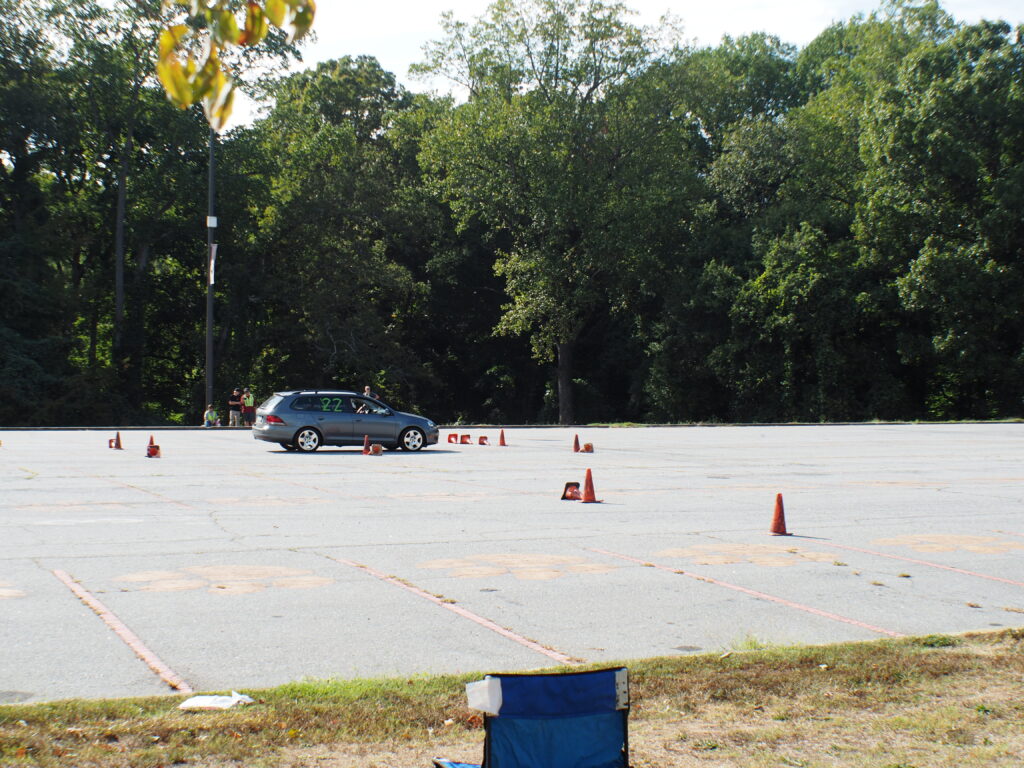
Natalie Bell racing in a Clemson Sports Car auto-crossing event.
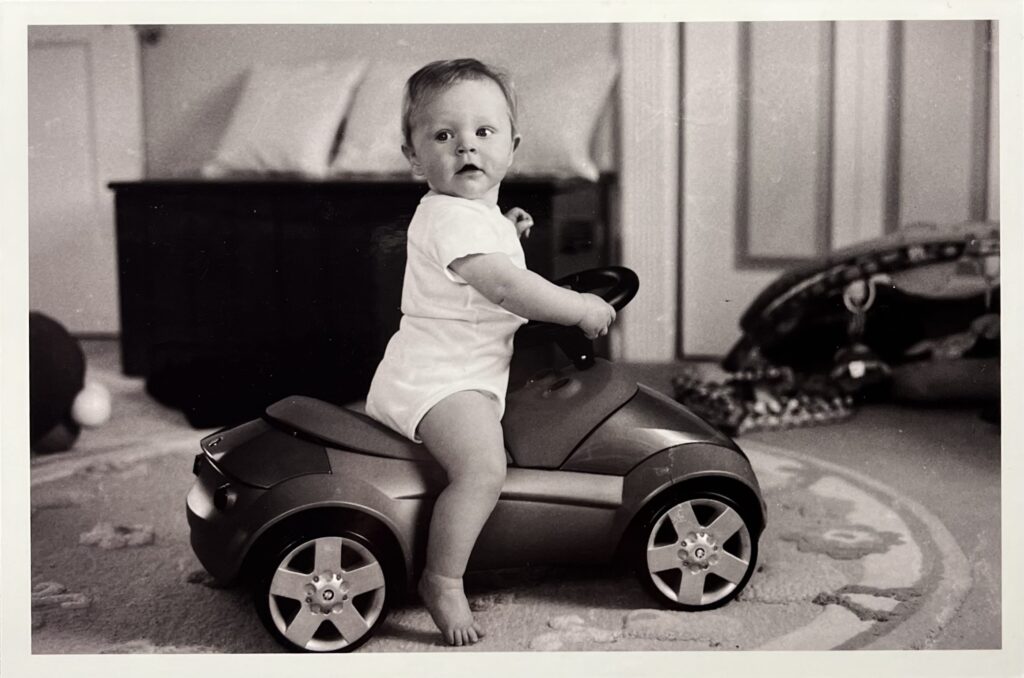
Bell as a young child playing with a toy car.
Bell as a young child.

 I grew up surrounded by my dad’s love of cars, specifically BMWs. He even bought me my own BMW to push around the house, and I spent Sundays with him watching F1 races in my lucky checkered flag socks, cheering on Kimi Raikkonen. I spent hours in the garage while he worked on his autocross car, so much so that when I was three, I begged him for my mechanic’s creeper to see what he was doing.

My dad was constantly fixing up his car for autocross- a racing event where drivers race one at a time through a cone-lined course. The objective is speed and agility, as hitting a cone results in a time penalty. The event organizers calculate all the times, and drivers can see where their times compare to their peers. As I watched him draw out autocross courses for our local Baltimore autocross group, I told him that I couldn’t wait to turn thirteen so that I could ride in the car with him as he raced. 

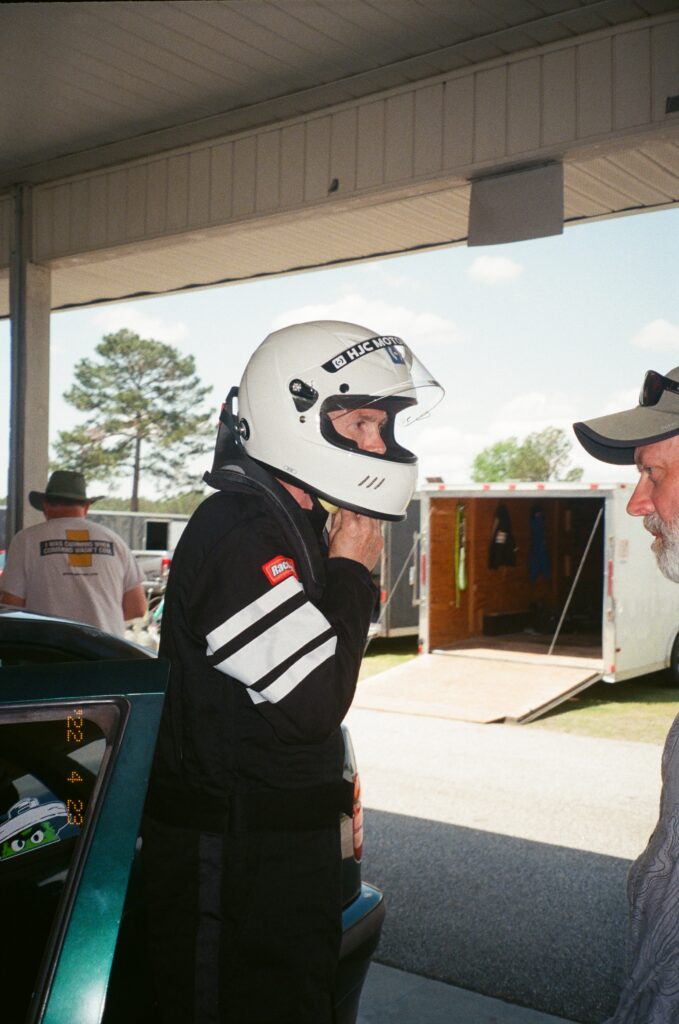
Bell’s dad ready to compete in 24 hours of Lemon.

That dream would end up on pause for a while. My dad sold his tan BMW to go back to school and didn’t race for a decade. Eventually, my dad stumbled upon 24 Hours of Lemons, which is probably the weirdest racing event you could ever partake in. 24 Hours of Lemons is a riff off of 24 Hours of Lemans, a prestigious professional racing event. However, Lemons is not prestigious and is not 24 hours long.

Lemons is a two-day endurance event with various locations across the country where drivers and mechanics give old “lemons” of cars new lives as race cars. Each team must buy a car for $500 and then outfit it with a roll cage and additional safety features. My dad gathered a team of his coworkers to form Team Race Team, fixed up a BMW 318ti that hadn’t run in 10 years, and turned it into Oscar the Grouch. Or Otto, because he’s German. 

Bell and Father preparing to race.

Watching my dad race again renewed my interest in racing. Eventually, I want to race alongside my dad in 24 Hours of Lemons, and autocrossing is one of the first steps. I have autocrossed as a part of Clemson Sports Car Club for the past two semesters, and I plan to continue to autocross post-grad. I love the sport of constantly trying to beat my own time while simultaneously trying to stay near my dad’s time (which is much faster than mine.) 

It’s so rewarding to participate in autocross with my dad and finally fulfill my childhood dream of racing with him. He has taught me not to give up on my passions- sometimes, they take time. 

Clemson Formula SAE gears up for race car formulation, events later this spring

By Griffin Barfield

A photo from clemsonfae.com featuring a former student-designed car

As the spring semester continues to pick up, so do the actions of the students of Clemson Formula SAE (CUFSAE), who are preparing for important events in April and May. 

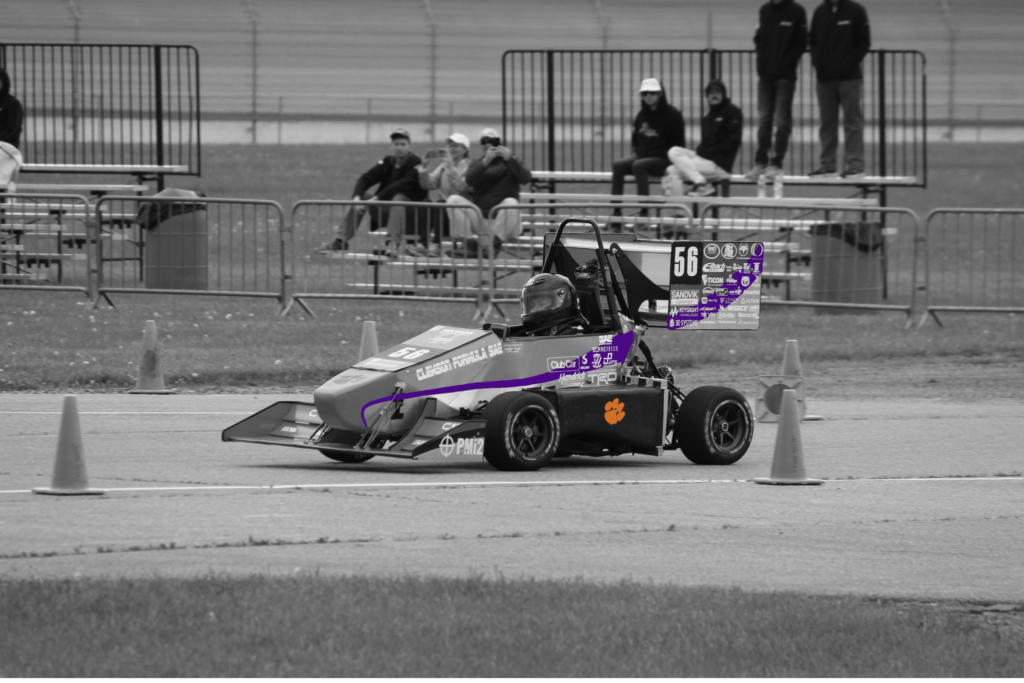
CUFSAE is a student race team that focuses on design, fabrication and competition of an open-wheeled, formula style race car. The team competes in the Society of Automotive Engineers student design competition.

In addition to the formulation of a race car, students have to work in all other facets of the racing business, including team management, public relations and sponsor procurement. The Robert H. Brooks Sports Science Institute is proud to sponsor CUFSAE for another year. 

For Clemson’s team, their sights are on the Michigan FSAE Competition in May for the planning and the creation of the racecar, called Tiger 25, where they will race at the Michigan International Speedway. 

Student members of CUFSAE can join five different divisions: aerodynamics, business, chassis, electrical, powertrain and suspension. 

Formula SAE Team
Clemson Formula SAE team, Fall 2024.

The team lead of the group is Grant Harley, who is studying Electrical and Computer Engineering in his first year of graduate school at Clemson. One of Harley’s main focuses is to keep the team focused on the design timeline for the car. In doing so, he sets weekly meetings with the leadership team and remains in contact with the Department of Mechanical Engineering faculty advisor. 

“The biggest thing I have to do before our car release is make sure the car is following the necessary production timeline and keeping the entire team on the same page about what needs to be done and when it needs to be done,” Harley said. 

A Charleston native, Harley is also a part of the electrical team, where he helps design the brake system plausibility device (BSPD) – a safety component that shuts the car off if the throttle position or brake pressure stop reading. 

“This helps protect the driver in the case of a malfunction in the car and protects the car from dangerous operating procedures,” Harley said. 

Cameron Boerst Headshot
Cameron Boerst, Vehicle Operations Manager.

Harley works closely with Vehicle Operations Manager, Cameron Boerst, a Mechanical Engineering junior with an Electrical Engineering minor. Boerst’s job focuses on test-day operations, planning when the car will run, whether on or off campus.

“This requires communication and planning between divisions to make sure the rear and front wings are ready, the electronics are working, the powertrain is running, and the suspension is tuned for a day of running,” Boerst said. 

Another Charleston native, Boerst is also designing the drivetrain of the car, which is what he looks forward to the most out of this project.

“The drivetrain is responsible for delivering power from the engine to the hubs of the rear wheels,” Boerst explained. “This includes a lot of CAD modeling in SolidWorks paired with Finite Element Analysis (FEA) on the forces experienced by the drivetrain.”

Peter Gaspich headshot
Peter Gaspich, Brooks Scholar

No matter how strong the engine may be, suspension is incredibly important to the car’s success. This is led by fellow junior mechanical engineer and recent Brooks Scholar, Peter Gaspich, an inaugural member of the new class of automotive engineers at Clemson. Gaspich and his team focus on manufacturing and testing of the car’s suspension system ahead of the May event.

“In other words, my goal is to ensure that the driver can get optimal performance from the tires and maximize grip throughout each lap, as maintaining grip to the road is the most essential part of a fast lap time,” Gaspich said. “No matter how powerful the engine is, it won’t be going anywhere very fast if it’s just spinning tires.”

The Greenville native also has one of the most important tasks on race day: constantly studying the car’s responses and making needed changes to the car to help the driver with the ride. 

At this point in the semester, the suspension team is working on manufacturing all of the suspension parts, something that Gaspich heavily takes part in.

“This includes outlining manufacturing plans, training new members on shop equipment, coordinating with sponsors to outsource the manufacturing of more complex components and spending late nights at the shop with my closest friends!” he said. 

The Tiger 24 racing in the Pittsburgh Shootout

With a project as big as designing and building a formula race car, it’s the little steps that count. For Harley, he is most looking forward to seeing the car run on its own for the first time. 

“I am most looking forward to the first time the car runs under its own power,” he said. “It’s an extremely fulfilling moment watching this project that you’ve spent almost a year designing and building culminate into this one moment.”

Every week means the team is one step closer to the first race. With March beginning, it’s crunch time for CUFSAE. The team hopes to see successes similar to, or greater than, last year’s Tiger 24 design.

Clemson Formula SAE team member working on the Tiger 25

From Gaspich’s perspective, as well as many others on the team, the opportunity to work on an ongoing project to present it in front of 119 other schools is something that the classroom doesn’t provide. 

“I cannot express enough how important being involved in Formula SAE is to anyone interested in a career in motorsports, or even engineering in-general, as engineering is so much more than what you learn in the classroom,” Gaspich said. 

Whether participating as a passion project or looking for experience for a future job in the motorsports industry, all eyes look to May where Tiger 25 will be racing on asphalt that has hosted NASCAR and IndyCar events. 

Clemson branded textile research for athletic apparel receives international recognition

By Griffin Barfield

Drs. Erica Walker and Amanda Bridges’ research discovers different strategies to ensure the University’s brand colors remain consistent on athletic apparel

Most sports fans own at least one t-shirt donning the brand of their favorite team or jersey representing their favorite athlete. When they are preparing to join the crowd at a field, rink or stadium, sports fans expect their regalia to look on-brand.

According to Drs. Erica Walker and Amanda Bridges, Clemson faculty in the Department of Graphic Communications, “Branded athletic apparel is a multi-billion dollar business expanding year over year. Sports teams and their fans expect brand accuracy and durability across all types of textile-based products from clothing to home decor. Color is a vital part of a brand’s identity and printing consistent, durable and accurate brand colors across different materials can be challenging for manufacturers.”

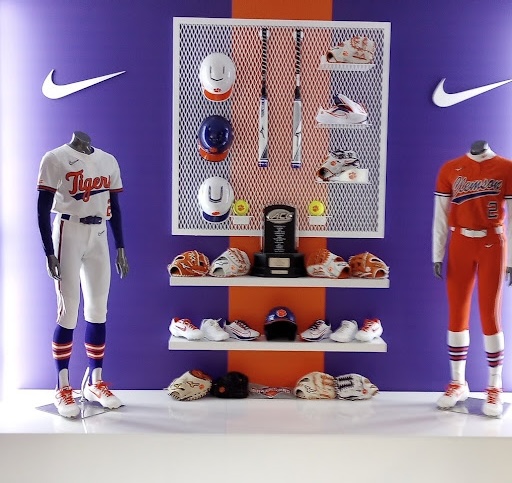
Clemson Orange is printed on different textiles and laundered to see how true-to-brand the color of the Clemson paw remains. 

The pair have examined the accuracy and durability of two Clemson brand colors, Clemson Orange and Regalia (purple), “specified by the brand as Pantone and CMYK values and measured as LAB values using a spectrophotometer, and printed on three textiles commonly used for clothing.”

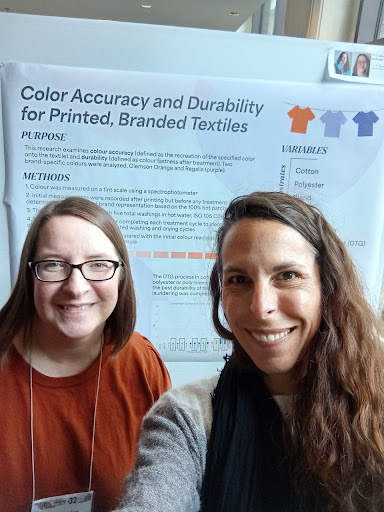
Late in 2024, Walker and Bridges received international recognition for their research presented at conferences in Montreal, Canada (Color and Imaging Conference, October 2024) and Seville, Spain (International Conference of Education, Research and Innovation, November 2024). Additionally, they will present in Boulder, Colorado this March at the Technical Association of Graphic Arts (TAGA) conference. 

Walker shared some of the challenges their research aimed to address.

“Orange is an especially difficult color to match in any medium,” she said. “Our eyes are pretty sensitive to variations in this color range so branded content creators have to be especially vigilant to ensure a consistent visual match. 

Another challenge is the variety of materials and places that the color appears. We see Clemson Orange on the TV screen, on printed t-shirts, painted on the grass on the athletic fields, on the plastic seat backs, on metal decorative art outside, and so many other surfaces. Each backing material and process must be carefully chosen and controlled to ensure accurate brand color.”

During their investigation, the two provided opportunities for freshmen-level experiential learning with a direct-to-garment (DTG) printer and worked closely with Clemson Athletics to assess how the University’s brand colors are affected by commercial washing processes, looking at color degradation. 

Walker shared advice for printers and manufacturers to achieve color accuracy and durability. 

Bridges (left) and Walker (right) attended the CIC Conference in Montreal, Canada last November. 

“You can never have too much quality control throughout the process. Everyone who touches the artwork or product from the beginning design to manufacturing to the sales floor has a role in ensuring brand accurate colors,” she said. “This even includes fans! How we launder brand-color products can help the colors stay accurate for longer. 

There are definitely some combinations of textiles and processes that will provide more accurate colors both initially and after multiple washes, so manufacturers take that into consideration when developing new products and deciding how to manufacture them.”

At the end of the day, one question remains above all in Walker’s and Bridges’ research: How can the University engage with textile manufacturers, printers and launderers to ensure the brand stays true on apparel and other products? 

“This project helped me connect my color work on screen to what the cameras actually record live—the uniforms of the players and the branded fan gear,” Walker said. “The current study attempts to back the solution up further than ColorNet, which fixed the brand colors after they were recorded on camera. Wouldn’t it be great to get the color more closely aligned both on and offscreen to provide a unified, cohesive brand experience?”

Walker has been a faculty fellow at the Robert H. Brooks Sports Science Institute for many years. The proposals she submitted for ‘director’s funding’ were reviewed and approved by RHBSSI leadership, and the Institute was pleased to fund the purchase of the DTG printer and offer financial assistance to participate in the conferences. 

“It was a very [special] international conference and the first time either of us had attended it,” Walker said about CIC. “[It] would definitely be a valuable event to visit again and we really appreciate the support which allowed us to go to both CIC and TAGA this academic year.”

From the classroom to the pool: Clemson Psychology major and club swimmer learns valuable skills for a career in sport 

By: Griffin Barfield

Photo by Natalie Bell, Graphic Communications ’25

It’s not only the varsity sports on Clemson’s campus that leave lasting impacts on students. Even before stepping foot on campus as a student, senior Psychology major, Sydney Lavin, wanted collegiate swimming to be a part of her Tiger tenure. 

While Clemson does not hold a varsity program for swimming, Lavin knew about Clemson Club Swim – a team that would come to have a lasting impact on her life.

As a freshman looking for things to do outside of class, swim club was the first thing on her mind. From a recreational standpoint, she would be able to continue a passion of hers while connecting with other students on campus.

“I always knew that I wanted to swim during college, but not varsity since it’s so

competitive, so Clemson Club Swim was perfect!” Lavin said. “I remember at Tiger Prowl freshman year, my only goal was to find the club swim table, and I’m so glad I did because it’s seriously been one of the best decisions I’ve made.”

Immediately, she was plugged in. Not even a year into swimming with the club, Lavin found the opportunity to do more: coaching a local club team in the area. 

Lavin is apart of the Foothills Area YMCA’s coaching staff, where she coaches the ages 6-18 of the club swim team.
Lavin, center, coaches a FAY club team at the Seneca YMCA

Now, she serves as the assistant coach for the Foothills Area YMCA’s (FAY) club team, coaching young swimmers in Seneca, South Carolina, where she has been for the last three years. 

“I’ve always thought that coaching would be fun, so it’s been the best job for me!” Lavin said.  “There’s definitely been a learning curve because I had never coached before, but it’s taught me so many lessons and life skills.”

When she first began with FAY, Lavin taught the youngest group, ranging from 6-10 years old. Now, she teaches the level above, ranging from ages 9-13. She describes the job as a “learning experience.”

Her work off campus has translated to the pool at Clemson’s Fike Recreation Center, where she has coached various practices over the years for the club team. In addition to coaching, Lavin has served as Clemson Club Swim’s treasurer for the past two years, managing the club’s budget and finances. 

Photo by Natalie Bell, GC ’25

However, her biggest takeaway from her four years with the team has been the interpersonal skills that she has developed with these positions. 

“I have the best group of friends from this club,” Lavin said, “but I’ve also had to learn how to communicate with University staff and others outside of the University on things like space reservations, banking, and equipment rentals for our home meet.”

These skills are important to Lavin, who is graduating this spring but plans to continue her education. She intends on pursuing a graduate degree in psychology with an Industrial-Organizational (I/O) Psychology concentration. She would like to go into I/O psychology consulting with collegiate athletic programs or institutions. 

Lavin also hopes to continue to coach if her post-graduate studies allow. Nevertheless, this recreational sport has provided her with a skillset that will translate into the real world, and for Lavin, the field of psychology.

“I love club sports because it’s that perfect middle ground of recreation and competition, another reason why Clemson Club Swim has been so good!” Lavin said. “This position has also been helpful in pursuing a career in consulting because of the communication and analytical skills required for the job.”

As part of undergraduate studies in psychology, Lavin works on a Creative Inquiry team with RHBSSI fellow, Marissa Shuffler, Ph.D., on her Institute-funded grant work developing teams in the context of NCAA sports.

Meet RHBSSI’s student interns for Spring 2025 semester

By Griffin Barfield

Coming into the new year of 2025, the Robert H. Brooks Sports Science Institute welcomes four new and one returning student intern for the spring 2025 semester. The five come with outstanding backgrounds, looking to bring new ideas and advances to the Institute. 

Griffin Barfield 

Griffin Barfield standing in front of Sikes Hall

Griffin Barfield is a junior Communication major and Spanish minor from Oceanport, NJ. He is the lead writer and editing intern for the Institute for the spring semester. This role involves providing the University with content about breakthroughs in the sports science community that are occurring at Clemson, interviewing students and faculty about the endeavors. 

“I’m excited to get going with the Robert H. Brooks Sports Science Institute,” Barfield said. “I’m looking forward to writing about unique advances that are occurring right here on campus and the people behind them.”

In addition to writing with RHBSSI this semester, Barfield is the current sports editor of The Tiger, Clemson student newspaper. While managing a newsroom of over 23 reporters, his experience in this role will help look deeper into the people behind the advances in the sport science world, hoping to tell a one-of-a-kind story. 

Evelyn Lane

Evelyn Lane standing in front of Sikes Hall

Evelyn Lane is from Piedmont, SC and is a junior Marketing major with a minor in Spanish. She is the Institute’s communications lead, creating content for the Robert H. Brooks Sports Science Institute’s social media handles. 

“I am so excited to work with RHBSSI to help promote the Institute and all of the amazing things they do for the faculty, students, and university as a whole,” Lane said. “I am looking forward to continuing to improve my skills in marketing communications and social media strategy, as well as work with my fellow interns and see all the things we will be able to accomplish together.”

Lane previously worked with Cadency, Clemson University’s student-led brand agency, for the last two years. While working with the agency’s social media account and brand strategy, she will look to bring that experience to the Institute in the spring semester. 

Natalie Bell

Natalie Bell standing in front of Sikes Hall

Natalie Bell is a senior Graphic Communications major with a minor in Brand Communications from Greenville, SC. Returning from the fall semester, she will continue her work as the lead graphic design intern in the spring with the Institute, creating visual media to benefit sports science efforts at Clemson. 

“I am excited to return as the Robert H. Brooks Sports Science Institute graphic design lead!” Bell said. “I loved my experience as a RHBSSI intern last fall. I look forward to seeing how I can further apply my graphic design skills to our events and promotional materials.”

Bell returns with the skills gained from the Institute a semester ago, where she will build off of her work from the fall. She is also currently the creative director in Cadency, looking to continue to use experience from her work there to enhance the Institute. 

Nicole Souza

Nicole Souza standing in front of trees.

Nicole Souza is a senior Bioengineering major from Duxbury, MA. She will serve as the technical communications specialist, acting as the technical knowledge base for concepts and technologies related to the events in sports science. She will also help with getting a firsthand look at the hard work that happens behind the scenes of these endeavors. 

“I’m really looking forward to working with the Robert H. Brooks Sports Science Institute,” Souza said. “It’s just a unique opportunity to collaborate with students from across campus and help share the Institute’s mission.”

Previously, Souza spent time in the industry through valuable internship experiences, working with medical devices and pharmaceutical companies. It has allowed her to receive a strong, technical foundation in science and engineering, which will help recognize the actions that are being done in the field of sports science. 

Keeleigh Bush

Keeleigh Bush standing by a balcony.

Keeleigh Bush is from Rutherfordton, NC and is a senior Parks, Recreation, and Tourism Management major with an emphasis in Tourism and Event Management. She is the events lead intern for the spring semester, arranging events over the course of the upcoming months. 

“I am extremely excited to get started this semester as the Events lead for the RHBSSI!” Bush said. “This is such an incredible opportunity to expand my network, and apply the skills and experience I have learned over the past three years. I’m looking forward to working with the team and being hands-on this semester.” 

Bush also serves as the public relations chair for the Clemson Event Planners Association. With this role, she will use her experience to help plan exciting events for RHBSSI to hold over the course of the spring semester.