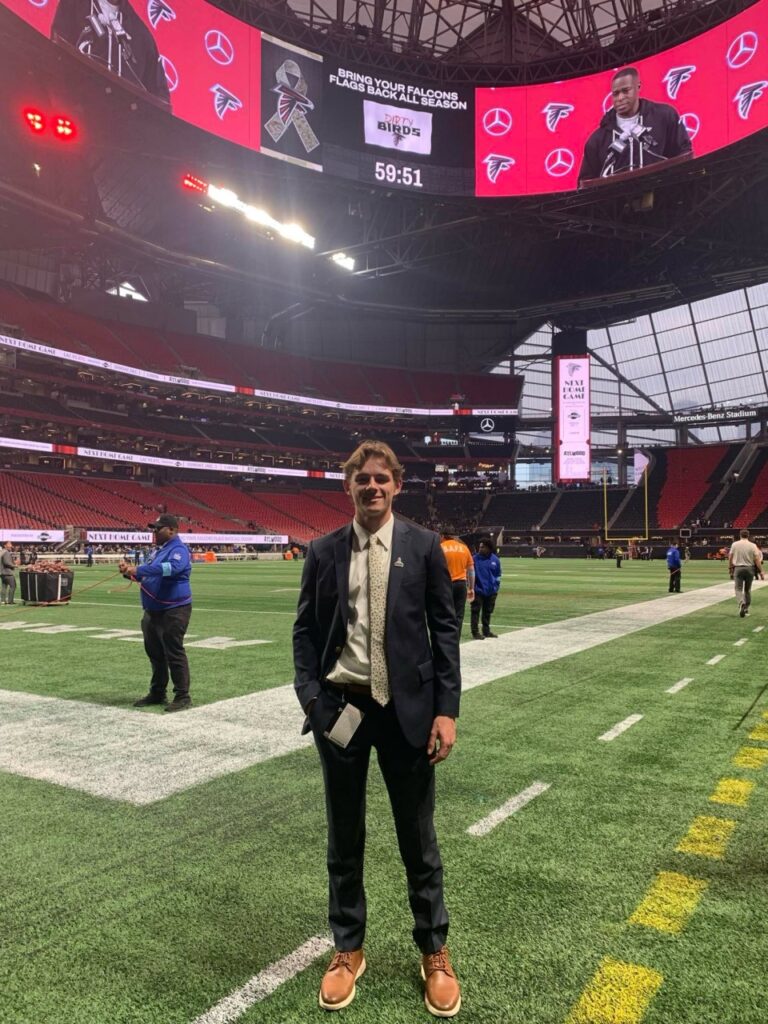
Patrick Neal graduated from Clemson in May 2025 as a double major in Business Management and Sport Communication. He received the Markvan Bellamy Brooks Endowed Scholarship in 2023. Throughout his time at Clemson he utilized his love for sports and major in Sport Communication to succeed in internships with Augusta National Golf Club and Clemson Athletics.
How have you utilized your major/concentration in sports to help your career?
I worked as a Coaches’ Recruiting Assistant with Clemson Football for 3.5 years while at school, and my concentration in sports helped me manage relationships and work successfully to bring in high school recruits to the program. I was also to have some experiences working with the Atlanta Falcons shadowing their community relations team, which was really special to see and only possible because of the communication and relationship skills I learned at school.
What is your current role and where are you located?
I work now as a Transportation Supervisor with DHL Supply Chain in Greer, SC. There I use my management and communication skills I learned to successfully manage 25 drivers and their route planning, along with the transportation operations of the site.
What has your journey been like since graduating from Clemson?
I’ve only been out of school for a month and a half or so, so really still trying to learn what it’s like to live as a college graduate. I got to travel around Europe with college friends right after graduation, which was awesome to see and experience some of Europe’s different cultures.
What advice would you give to future Brooks Scholars as they approach post-grad?
I’m still learning a lot, but I’d tell other scholars that as they approach post-grad, I think it’s just important to reflect on what you find most important in your life and to try to align your experiences with that. Find career opportunities and create goals that are going to help you fulfill what is most important and meaningful to you, and while career success is important, the people and relationships you have are going to be more important in the end.
Brian Smith graduated from Clemson in May 2023 with a major in Marketing and a minor in Entrepreneurship. He received the Markvan Bellamy Brooks Endowed Scholarship in 2022. Throughout his time at Clemson, he utilized his studies to succeed in his internships with major sports teams such as the New York Giants and the New York Yankees.
How have you utilized your major/concentration in sports to help your career?
My major played a huge role in shaping my overall business knowledge and expertise, but the experiences I had outside the classroom is really what allowed me to learn the business of sports firsthand. Being able to see different facets of the industry throughout my time in college helped determine the direction I wanted to go post-grad, and gave an understanding of how they all work and interact.
What is your current role and where are you located?
I am currently with Genesco Sports Enterprises, a sports marketing consulting agency specializing in brand partnership strategy. I’m fortunate enough to help manage some of the largest portfolios in sports sponsorship out of our New York City office.
What has your journey been like since graduating from Clemson?
After graduation I took a season-long internship in the New York Jets corporate partnerships department. After 8 months there I took the job with Genesco as an Assistant Manager and have since been promoted to Manager.
What advice would you give to future Brooks Scholars as they approach post-grad?
There’s never a job or task too small and take advantage of every opportunity that comes your way.
Nicole Entrup graduated from Clemson University in December 2021 with a major in Recreational Therapy and a minor in Nonprofit Leadership from the Department of Parks, Recreation and Tourism Management. Throughout her time at Clemson, she focused her coursework and field experiences on the power of adaptive sports as a therapeutic tool to support individuals with physical disabilities. Her studies allowed her to explore how sport fosters not just physical recovery, but also social connection, resilience and purpose.
How have you utilized your major/concentration in sports to help your career?
Nicole Entrup in front of the Wounded Warrior Project building
Since graduating, I’ve dedicated my career to leveraging the therapeutic and empowering nature of sport to improve the quality of life for individuals with physical disabilities, especially service members. I first served as an Adaptive Sports Coordinator for the Air Force Wounded Warrior Program, supporting athletes on their journey to the Warrior Games. I later transitioned to a clinical setting at the Center for the Intrepid, where I collaborated with nonprofit partners to design sport-based interventions aligned with patient goals. Many of these patients had experienced limb loss, burns or nerve damage. In this role, I created and led an adaptive sports program focused on improving functional movement, promoting camaraderie and helping individuals rediscover a sense of purpose. My foundation in recreational therapy was instrumental in understanding how to intentionally use sport as a tool for healing and growth.
What is your current role and where are you located?
I currently serve as an Adaptive Sports Specialist for Wounded Warrior Project, based out of San Antonio, Texas. My primary focus is programming within the Central U.S., though I travel nationwide to coordinate single-day and multi-day adaptive sports clinics. These events introduce or advance participants’ skills in a variety of sports from outdoor recreation like kayaking and fishing to competitive team sports like wheelchair basketball, sled hockey and sitting volleyball. I work closely with external partners to deliver meaningful experiences that promote physical wellness, build social connection, and strengthen each warrior’s sense of identity and purpose after injury.
What has your journey been like since graduating from Clemson?
My post-grad journey began almost immediately as I accepted a job with the Air Force Wounded Warrior Program just two days after graduation. I returned to San Antonio where I had interned at Morgan’s Sports during my undergrad. As I’ve moved through different roles from clinical and community-based, to now nonprofit, I’ve stayed rooted in the belief that sport is a powerful tool for transformation. I credit much of that perspective to mentors like Dr. Jasmine Townsend, who helped me see how sport can be used with intention to help individuals reclaim independence and reimagine their futures.
What advice would you give to future Brooks Scholars as they approach post-grad?
I challenge future scholars to stay grounded in the belief that sport has the power to change lives, and let that belief guide your next steps. Always be curious and committed to learning, not just in the classroom, but out in the field where sport meets real-world challenges. Seek out experiences that push you to grow, whether that’s through hands-on practice, conferences, collaborations or taking on new responsibilities.
Additionally, never underestimate the value of building genuine connections. The relationships you form, whether with peers, mentors or program participants, will open doors and shape your path in unexpected ways. Finally, when you lead with passion and keep the focus on creating impact through sport, you’ll be prepared to make a meaningful difference wherever you land.
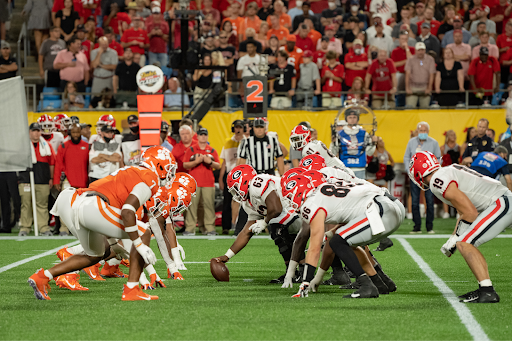
Ahead of Clemson’s week one game against Georgia last August, there was the same nostalgic buzz in the air as there always is when the border rivals meet. After more than a century of football, the teams had built up quite the reputation. However, a special account chronicling the two teams’ history was nearly lost to time – if it weren’t for two Clemson students’ determination ahead of the 2024 matchup.
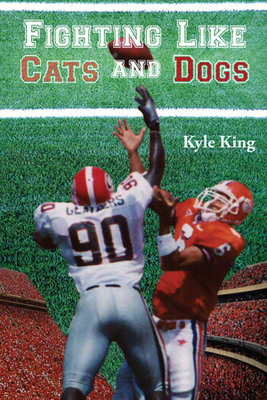
The story begins back in 2013 when author T. Kyle King published Fighting Like Cats and Dogs. King grew up a Georgia fan, living in Atlanta and attending school in Athens. After school, he became a co-host of The Dawg Show and, eventually, of Dawg Sports, reporting on all things Georgia Athletics.
In his writing, King highlights the biggest moments of the Clemson and Georgia football rivalry. He begins in 1977, a time in which he says, “there was no more closely contested or nationally significant rivalry in college football” than the one between the border neighbors, and extends all the way through the 2003 season. After that, the teams did not meet for a decade.
Sounds interesting, right? There’s just one problem – its publishing came to a halt in 2021.
For a book that “always sold well” according to Allison Mero, director of Clemson University Press since 2017, King’s was gone at an inconvenient time: the beginning of the Clemson vs. Georgia series that occurred in 2021 and 2024.
The Reprint
Mero put the book’s reprinting on University Press’ back burner until the spring of 2024. However, she later discovered the problem was more complex than it going out of print.
First, there was no backlist on file for the book allowing for online production of the text. Second, although most books in modern publishing are created in Adobe InDesign, there were no previous InDesign files.
O’Keefe’s redesign included creating a cover which accurately reflected the contents, selecting a new font and sizing it to increase the overall thickness and readability of the book.
With these issues combined, a forced manual reprint was necessary.
Two Clemson students helped with the book’s revival: Mars O’Keefe, a junior Art major, and Yana Gudakova, an editorial assistant studying both English and Spanish Language and Literature. O’Keefe updated the cover while Gudakova retyped the book, something she did with no prior typeset experience. The press staff then reviewed it after the typeset was complete.
Typesetting was done through optic character recognition (OCR), a feature provided through Adobe Acrobat. The technology converts scanned images and text into editable files much quicker than arduously retyping an entire 248-page book.
The entire operation was no easy task but, because of the team’s hard work, the book was reprinted and released before the Clemson versus Georgia game last August in Atlanta. For O’Keefe and Gudakova, it was a semester-long project requiring dedication and countless hours of work. For Mero, it was a chance to preserve the legacy of Clemson.
“The press is small but mighty – our mission is to publish high quality scholarship and publish books that need to be published, regardless of how many sell,” she said. Her goal is “professionalizing CU Press and trying to make books more available and discoverable.”
The press is an institution within the Clemson Library but technically is its own entity. Therefore, Mero says she is not a librarian, rather a historian.
As a historian, she considers herself “an interpreter of facts.” After reading King’s work, Mero decided the content was fairly unbiased and worthy of publishing. It was not heavily skewed towards either team and presents more like a recounting of games than an opinion.
“It taps into the people who have been fans for decades,” she said. “That’s who this book is for. It’s for getting the legacy right.”
Author T. Kyle King
King spent time on both campuses while writing, making sure to emphasize successes from both sides of the rivalry. His research included a brief meeting with ex-head coach Danny Ford, which King appreciated.
“While I was introduced to the rivalry as a Georgia partisan, I spent a great deal of time at Clemson doing research for the book,” he said.
“I have a great deal of respect for the Clemson community and I tried very hard to do justice to both sides. Particularly in light of the fact that there was a time when conference expansion threatened to end this rivalry, I am strongly encouraged to know that current students recognize the ongoing vitality of the rivalry and want to make certain others are aware of it, as well.”
King no longer writes for Dawg Sports. He stopped around the time of his book release, putting down the pen and paper to work as a senior partner for a law firm in Atlanta. Although no longer actively writing, the reprinting of King’s novel has him both “humble and grateful that this important aspect of history has been preserved.”
While the Bulldogs enjoy a modern level of success to compete with the 1980s, King has no regrets about leaving the press box.
“I thoroughly enjoyed my time working in that arena, but I left because I thought it was time to go, and I haven’t looked back,” he said.
“Again, I’m grateful to everyone who stepped in to fill whatever void I may have left, and they’re doing a wonderful job in all of those areas, so I haven’t had any reason to wonder about what might have been.”
Clemson University Press was instrumental in maintaining such a beloved piece of Clemson’s history. “We’re just glad that it’s going to be available,” Mero said.
The book can be purchased on Clemson University Press’ website, where it is currently the best-selling title, while the opportunity for an e-book is still forthcoming.
For King, he got his wish in the end: seeing a piece of Tiger versus Bulldog history become available once again.
“The great thing about college football is that so many people are so passionate about it that they leave behind a lasting record of their heritage and intensity, which especially comes to life in the local press and the student newspapers from the period,” he said.
“There is an old saying that journalism is the first draft of history, and in this case, it really is true.”
As summer begins, the Robert H. Brooks Sport Science Institute is excited to introduce the two interns who will be assisting the Institute throughout the summer. Meet Evelyn Lane and Maria Pocorobba, who bring a mix of returning knowledge and new ideas to the summer team.
Evelyn Lane
Evelyn Lane, senior marketing major and Spanish minor from Piedmont, South Carolina, is the Institute’s communications lead this summer. She will format and enhance sports science content, promoting the RHBSSI mission through social channels. She will also help develop and write content for the Institute’s Sports Insight blog.
“I am so happy to be returning to the Institute to continue to promote the sports research and newest developments of Clemson faculty, staff and students,” Lane said. “I am also so excited to improve my writing and communication skills through creating articles for the Sports Insight blog.”
Evelyn has previously worked as an account manager and brand strategist with Cadency, Clemson’s student-led agency, and is a returning intern with the RHBSSI from the Spring 2025 semester. She is excited to take her experience from the past semester and continue to help grow the Institute’s social media presence, and is eager to work with her fellow intern and see what they can accomplish.
Maria Pocorobba
Maria Pocorobba, senior communications major and minor in business and brand communication from Albany, New York, is the Institute’s content creator this summer. She will be assisting with strategizing, writing and designing content for the Robert H. Brooks Sports Science Institute to help communicate effectively with their audiences and promote upcoming events and initiatives.
“I am excited to continue combining my passion for design with sports, and gain more hands-on experience creating engaging visuals that bring RHBSSI’s mission to life and connect with the campus community,” Pocorobba said.”I am excited to bring my creative background and skills to RHBSSI this summer!”
She interned with the Brooke T Smith Launchpad as an Analyst in Residence, was a Creative Designer for Cadency, and is a Graphic Design intern for Clemson Athletics. In these roles, she creates social media content, branding elements, and promotional materials.
The end of the Spring semester means saying goodbye to five RHBSSI interns. These interns helped uphold and spread the RHBSSI mission in various ways, such as through our social media and student-oriented events. They have left a lasting impression on the Institute and shared their insight about their time here.
Griffin Barfield, Writer/Editor
Griffin Barfield is a junior Communication major and Spanish minor. Alongside interning for the Institute, he is the sports editor of The Tiger, Clemson’s student newspaper. He utilized his skills from this position to highlight Clemson University faculty, staff, students and events that align with the Institute. He skillfully translated the work and stories of the Clemson community into captivating sports science pieces for all audiences to enjoy.
“I’m so happy with how my time with the Institute ended up this semester,” Barfield said. “From forming great connections to connecting with Clemson’s campus more, I’m proud of the work I accomplished here this spring.”
Barfield will be graduating from Clemson in December of 2025. This summer, he plans to go back home and continue improving his writing and editorial skills in New Jersey.
“I hope to come back to the Institute next fall as a writing intern again, and as for this summer, I’ll be looking at freelance writing for my local publications in New Jersey.”
Evelyn Lane, Communications Lead
Evelyn Lane is a junior Marketing major and Spanish minor. Before interning at RHBSSI, she was a brand strategist and account manager for Cadency, Clemson’s student-led brand agency. She used her knowledge of social media strategies and analytics to aid the Institute in growing its social media presence and maintaining a cohesive brand image.
“My time with RHBSSI has helped me grow in many different aspects of my life,” Lane said. “I was able to collaborate with people from all different majors and backgrounds; I learned how to be confident in my ideas, and incorporate the ideas of others into the social media plan, and allow everyone to feel heard.”
Lane will stay in Clemson and continue her internship with the Institute this summer.
“I am so excited to continue working with RHBSSI, watching our media presence grow, and figuring out how to utilize each platform to the best of our abilities.”
Natalie Bell, Graphic Designer
Natalie Bell is a graduating senior Graphic Communications major with a minor in Brand Communications. While interning with RHBSSI, she was also Cadency’s creative director. This semester marks the end of her two semesters with the Institute, where she has been able to showcase her creative talent.
“I have loved my past two semesters with the Robert H. Brooks Sports Science Institute. Since I am a Graphic Communications major and Brand Communications minor, I am not in the sports realm. This internship allowed me to participate in the athletics and research side of Clemson University,” Bell said. “I have gotten to be a part of some fantastic opportunities, such as photographing Clemson’s first Paralympic soccer match and designing mini golf scorecards for our Research Symposium. RHBSSI has made me a more well-rounded graphic designer!”
Bell is graduating this May, and her future endeavors are bright.
“Upon graduation on May 8, I will be starting my full-time position as a Graphic Designer for FerebeeLane in Greenville, SC.”
Nicole Souza, Technical Communications Specialist
Nicole Souza is a graduating senior Bioengineering major. During her time with RHBSSI, she conducted research surrounding Real Madrid NEXT technology partners and utilized her scientific skillset to write blog posts about Clemson’s STEM impacts and CHIP (Clemson Headgear Impact Performance) Lab outcomes.
“It’s been amazing getting to see all the behind-the-scenes work that goes into not just sports science, but also supporting the University and its students,” Souza said. “My time at RHBSSI taught me a lot about the side of science I had not seen in my classes, like marketing, communication and outreach, and I’m really grateful for that.”
Although Souza is graduating this May, she plans to continue her path as a Tiger through Clemson’s Master’s program.
“After graduation this May, I’ll be interning at Arthrex as a product management intern, working with orthopedic medical devices and instruments. Even better, I’ll be coming back to Clemson in the fall to start my Master’s of Engineering in Biomedical Engineering. Go Tigers!”
Keeleigh Bush, Events Lead
Keeleigh Bush is a graduating senior Parks, Recreation and Tourism Management major with an emphasis in Tourism and Event Management. She is also the public relations chair for the Clemson Events Planners Association. With this background, she has excelled in planning, coordinating and executing speaker events and campus activations.
“I had such a great time serving as the Events Intern this semester,” Bush said. “It was incredibly fun and inspiring to work alongside such a talented group of fellow interns.”
Bush is graduating alongside Souza and Bell this May, and it ecstatic about future opportunities.
“I’m graduating this spring and currently exploring opportunities—excited for what’s ahead and staying open to new possibilities!”
Whether they are staying in Tiger Town or taking their talents elsewhere, we know our interns will thrive in the face of any challenge and we thank them for their hard work this semester!
Former RHBSSI intern Katie Gerbasich has been working closely with Clemson Athletics as a member of the Baseball Analytics team and a writer.
by Griffin Barfield
Katie Gerbasichat RECESS 2024.
A former intern at the Robert H. Brooks Sports Science Institute, Katie Gerbasich, a junior Sports Communication major from Houston, TX, has been working closely with various teams and departments through sport, building off of what she learned from the Institute.
Following her stint in the fall of 2024 with the Institute, Gerbasich is now working with the Baseball Analytics team through Clemson Olympic Sports Science. She works specifically with the hitting team, focusing on scouting and player development from the hitter’s perspective.
“We have access to a database that stores tons of information from every single play in the game,” Gerbasich said. “It’s our responsibility to take that information, filter out what’s important, and communicate it to our coaching staff.”
Gerbasich and her team also focus on opponents for Clemson Baseball, picking out key information to highlight its opponents’ strengths and weaknesses. From there, she helps communicate this data to the coaching staff for game planning.
“It’s been super cool to experience the behind-the-scenes of our team and see how our work makes an impact,” she said.
Gerbasich has been an intern with Tiger View Media this spring, covering various sporting events, including Clemson’s spring game.
In addition, Gerbasich joined Tiger View Media as a sports writer, covering various Clemson Baseball, Softball and Women’s Lacrosse events over the course of the spring seasons. She also received an opportunity through the media group to cover the Clemson Football spring game, calling it a “highlight moment.”
From her previous experience as an event and writing assistant with the Institute, she feels that her writing skills have been elevated to another level, being able to write a lot more with Tiger View Media.
“It feels like I’m seemingly able to pump out article after article,” Gerbasich said. “I’m so much more confident now in my abilities now, thanks to the support of the Institute.”
As for the future, Gerbasich will plan to stay with both programs, staying with baseball analytics until baseball season ends this summer. Furthermore, she will continue to work in sports media with Tiger View Media, covering football for the publication in the fall.
She hopes to graduate early and begin pursuing her Master’s degree in Sports Analytics at Clemson, aspiring to work for a professional team in analytics or communication.
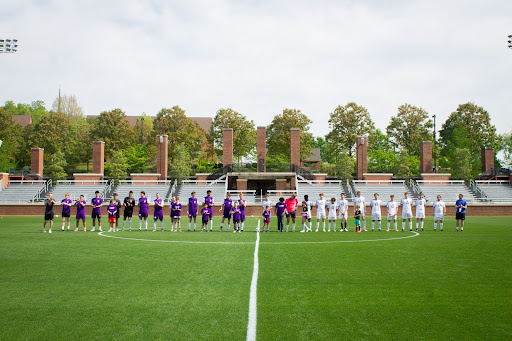
The team played and defeated the CP Soccer All Stars 6-1 at Historic Riggs Field at their first real match in program history.
Goalkeeper Max Alberici celebrates a goal with midfielder Chile Chitulangoma, who scored.
While the players lifted a trophy for the win, they weren’t just thrilled with the hardware: they were ecstatic that they even had the opportunity to play.
Shea Hammond is a graduate student in communication who has been with the team for several years, the first undergraduate player in the program’s history. Seeing the event come together was enough to inspire a win.
“It’s the name of the field. It’s historic,” Hammond said after the game. “To finally play on this field, it’s historic. It’s indescribable.”
Head coach and assistant professor in the Department of Parks, Recreation and Tourism Management, Felipe Tobar, watched his players’ dreams come true that afternoon. Many of them had dreamed of playing collegiate sports after high school, a period where many athletes with cerebral palsy (CP) stop playing.
“We’d like to say thank you to the community and the fanbase who supported us,” Tobar said. “They had a dream to play in a college stadium and they accomplished it.”
Graduate student Shea Hammond scored a hat-trick on Saturday morning.
Four different Clemson players scored, while Hammond scored a hat-trick with all three of his goals coming in the second half. One player, Tyler Bennett, is a team alumnus and one of the first two players to join the program in 2017. Bennett brought practices featuring movements, passing and other workouts from the U.S. CP National Team.
It was a new Clemson experience for Bennett, coming back to campus and playing in a full game of soccer with CP rules.
“I think it went well for the program,” Bennett said. “They showed that if you’re training here full-time, you’re going to do pretty well.”
Many faces from the Clemson Men’s and Women’s Soccer teams were present. Flags flew and celebrations commenced in the stands whenever a player scored. The entire women’s lacrosse team attended, surprising goalkeeper Max Alberici, the team’s manager.
That wasn’t the best moment of the game in Alberici’s opinion, however. His favorite experience came from watching substitute goalkeeper, Ethan Donahue, play. He joined the team several weeks before the match after Hammond recruited him on campus. Donahue and his disability were welcomed by the team in open arms.
“I was more happy to get him in the game,” Alberici said.
“There’s no relationship like an adaptive sport relationship,” Hammond said, “and like a CP soccer family.”
The match was the last that this team will play all together, as they say goodbye to Hammond following five seasons with the program. As he graduates from Clemson, Hammond looks forward to working with cerebral palsy and Paralympic athletes in the future.
The Robert H. Brooks Sports Science Institute sponsored the match’s trophy, which the Clemson CP team raised following its win.
“That’s a lifetime of work that I’m going to commit to and making sure that we can grow this program in this sport as much as possible,” Hammond said.
For Tobar, the practices and cultivation of this match proved to be a great success. Earlier in the week, the team played Daniel High School in a scrimmage to prepare for the game. Now, Tobar and his team are “blessed and honored” to have the opportunity to represent Clemson.
“That’s the only official game that we will play as a team,” Tobar said. “I could not be more proud.”
Click here to check out more photos from the match.
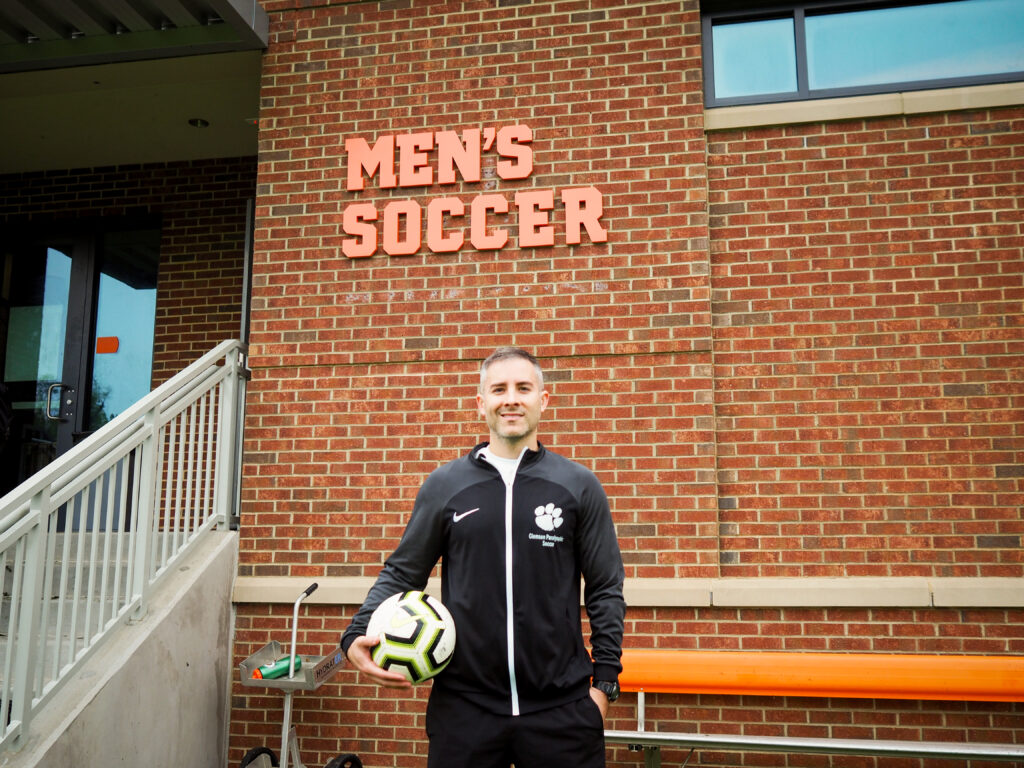
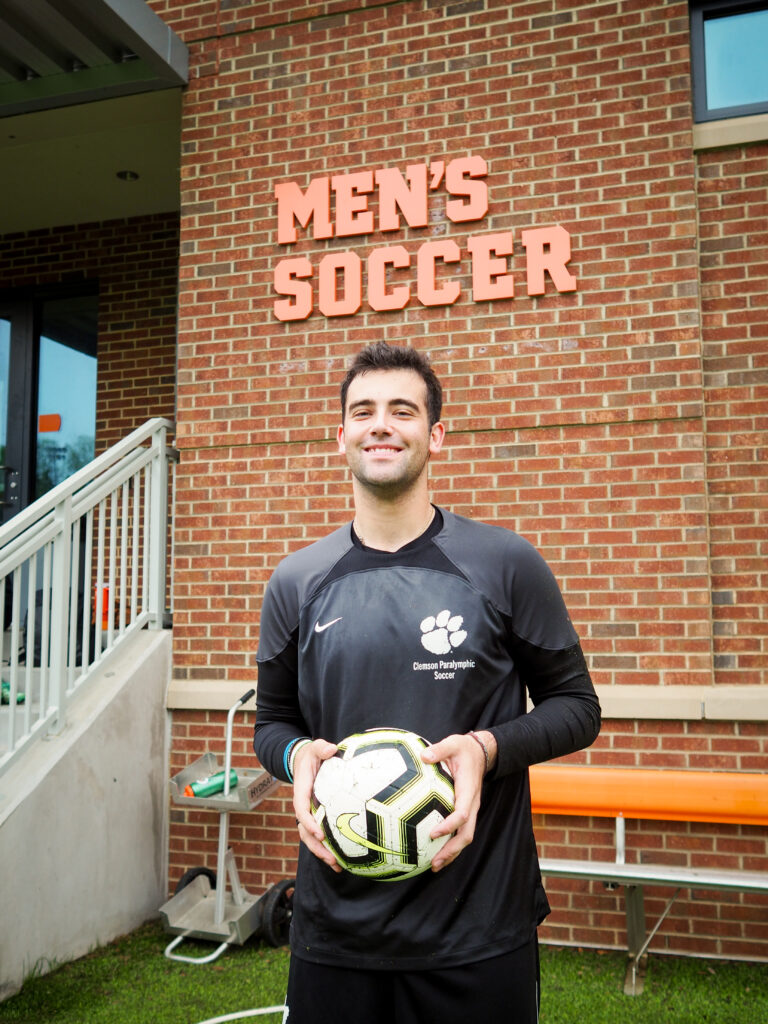
The Clemson Paralympic Soccer team gathers outside the Clemson Soccer practice facility in their new uniforms to prepare for the historic match on April 19. (Photo by Natalie Bell)
Clemson professor of sport and recreation management in the Department of Parks, Recreation and Tourism Management (PRTM), Skye Arthur-Banning, was at the London Paralympic Games in 2012 with a group of students when an idea came to him.
Five years later, that idea would form Clemson Paralympic Soccer, the only collegiate program of its kind in the nation. Now, on April 19 at 11 a.m., the team will be playing their first-ever match in front of a crowd at Historic Riggs Field.
Several Clemson Paralympic Soccer players receive national team call-ups by the U.S. Men’s CP National Team, where they play around the country and even across the globe.
History of Clemson Paralympic Soccer
Arthur-Banning was a soccer referee in 2012 working various professional leagues and U.S. Open cup games. Following the 2012 Paralympic Games, he decided to devote his time to Para soccer, seeing the high performance of blind and cerebral palsy (CP) soccer players during that time.
“Instantly, I knew that was my next step,” he said. “There’s my next opportunity to continue refereeing, but also begin to support those with disabilities in sport environments.
Clemson Paralympic Soccer Head Coach, Felipe Tobar (Photo by Natalie Bell)
Felipe Tobar, assistant professor in the PRTM department, is head coach of the team. Arthur-Banning took notice of Tobar in 2021 while he was assistant coach for Daniel High School’s varsity soccer team.
“They needed a coach, so they needed structured training sessions,” Tobar recalled. “Since I was doing that at Daniel, he invited me to join the program as a head coach. I immediately said yes.”
Strength through adversity
The team is gearing up for its first-ever match on April 19 at Historic Riggs Field at 11 a.m. They practice three times a week to prepare.(Photo by Natalie Bell)
Strength through adversity is the team’s motto. Tobar encourages the team to play and live by this every day.
Currently, the team is made up of six players who have cerebral palsy, a neurological condition that can affect movement and posture. They also welcome players who have suffered a stroke or any severe brain injury.
Tobar has a connection with brain injury through his mother who had a stroke in 2011. He took care of her for eight years in Brazil before moving to the U.S. to earn his Ph.D. in parks, recreation and tourism management at Clemson.
“I saw what a stroke can do to a person, and I empathize with the players,” he said. “I had this background with my mom in which you can’t treat them as victims, you have to really see them as equals.”
Tobar pushes his players with drills and feedback three mornings a week.
“We keep the sessions intense and I don’t treat them differently,” he said.
Goalkeeper Max Alberici is the team’s starter, who saw an opportunity to play sports at the collegiate level and joined Clemson Paralympic Soccer.(Photo by Natalie Bell)
The players expend three times the amount of energy on the field as able-bodied soccer players due to quicker muscle fatigue – therefore, their recovery process takes longer.
For goalkeeper Max Alberici, who has spastic diplegia which affects more than one limb, he burns almost four times more energy than the average player. Alberici is a senior sports communication major who grew up playing lacrosse but saw this as an opportunity to continue playing sports in college, which was his dream.
“I hadn’t played organized soccer since eighth grade and I just go ‘okay, I’m doing this,’” Alberici said when he first heard about the program.
Now as the team’s starting goalkeeper, he embraces the training sessions and their intensity.
“There is definitely an intensity that I do enjoy and I had to learn to enjoy,” Alberici said. “But I think overall, I think having a game to work towards is going to make this a lot easier, mentally, for me.”
Because this program at Clemson is unique, four of the team’s six players are also part of the player pool for the U.S. Men’s Cerebral Palsy National Team, where they are regularly picked to play.
Chile Chitulangoma is a defensive midfielder that has been with the team for three years, becoming a regularly called-up player on the U.S. Men’s CP National Team. (Photo by Natalie Bell)
Midfielder Chile Chitulangoma, a junior mechanical engineering major, is one of those players who joined in the fall of 2022. He is hemiplegic on the left side of his body affecting his strength and coordination, but takes advantage of playing quickly to overcome these obstacles. He describes the practices as tactical.
“A lot has to do with technical ability being refined with your technique on the ball,” Chitulangoma said. “So, a lot of the work we do has to do with a lot of different passing patterns and precise movements.”
In the beginning years of the program, the team would practice at local recreational fields like Nettles Park and the Snow Family Outdoor Fitness and Wellness Complex. Since 2024, the team practices at Clemson Soccer’s men’s and women’s practice facilities with help from Clemson Athletics.
“Athletics has given a lot of support to us,” Tobar said. “That elevated the level of our training sessions.”
As the only U.S. school with this type of program, Clemson allots eight scholarships that allow out-of-state players to pay in-state tuition — the only university in the world that does so for CP soccer.
The match
Tobar describes the upcoming match as a debut for everyone — the first time Clemson Paralympic Soccer will play against other Paralympic soccer players from across the country for a trophy.
“We hope this game will bring attention to our program and the University this week,” Tobar said.
Players who have recently been admitted to play for the Tigers next season will also be on this all-star team of contenders. The captain of the U.S. Men’s Cerebral Palsy National Team, Josh Burnais, will be coaching the opposing team.
CP soccer rules are slightly different from traditional soccer rules. The game will be played in two halves, each 30 minutes long. Compared to soccer’s standard 11-on-11 format, CP soccer is played 7-on-7 with field dimensions and goal sizes a little smaller.
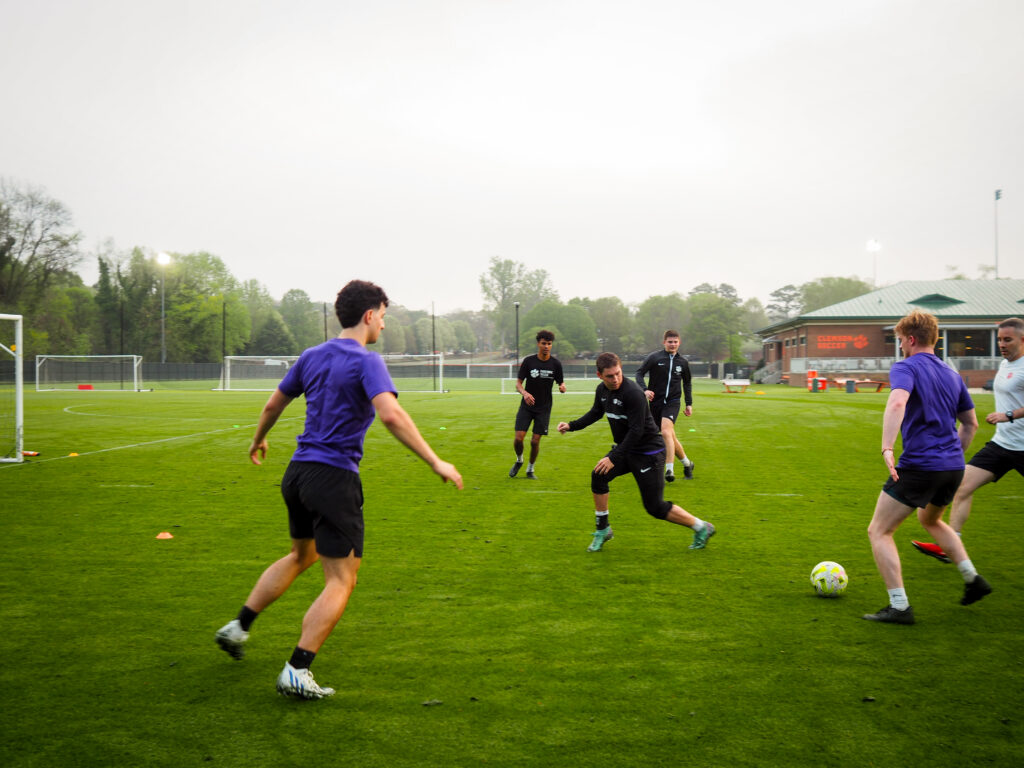
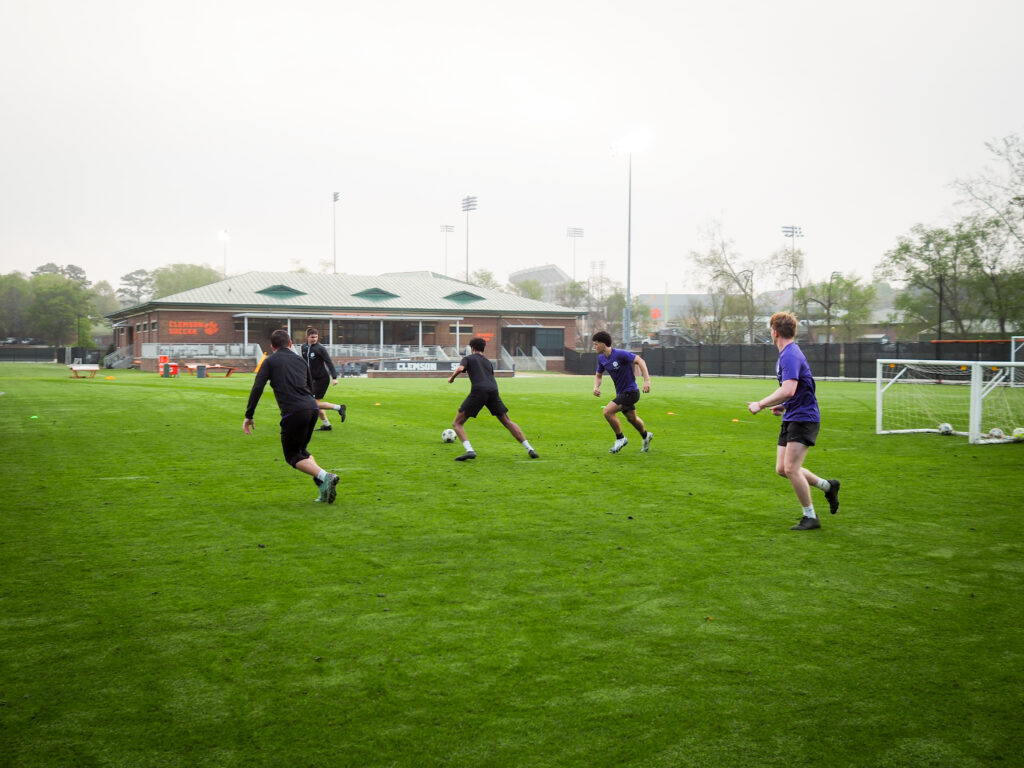
Clemson Paralympic Soccer Team practicing for the upcoming match (Photo by Natalie Bell)
Throw-ins can change to simply rolling the ball in underhand. If the ball unintentionally hits the CP-impacted hand in a natural position, there is no handball offense. These changes were made based on how the body functions for a CP player.
The event on April 19 will also be open to children with disabilities in the Upstate to have a one-hour clinic with the team from 9 to 10 a.m. to meet and play together. During the starting lineups, they will enter the field with the players.
“We want them to see their future on the pitch, so they can reflect and see that although there are barriers that they are going to face, it’s still possible to strive and succeed,” Tobar said.
For many of the players, it is a dream come true. Alberici grew up wanting to play in a stadium, and now his dream is becoming a reality.
“My main goal was always to be a college athlete,” Alberici said. “The soccer piece was much later than almost every single one of my teammates, but I’d never thought I’d play college sports in a college stadium.”
Meanwhile, for players like Chitulangoma, educating the public about overcoming adversity is what is most exciting.
“I think it’s a very unique opportunity to [educate about my disability] with a game of soccer,” Chitulangoma said. “I don’t think there’s a better way we could show our game and our disability to the community.”
Clemson Athletics is supporting the event. The day will see several Clemson Men’s and Women’s Soccer players making an appearance, with some taking part in halftime promotions.
Tobar also plans to auction signed soccer balls and other items to fundraise for the team.
That same weekend, Clemson Adaptive Sports and Recreation will be hosting the Palmetto Games, a regional adaptive sport event featuring track and field, swimming and air rifle competitions.
“We want to have as many people as possible,” Tobar said. “There are no other sports that are going to be playing that morning, so it’s a full day of Para sports.”
With kickoff set for 11 a.m. on April 19, Arthur-Banning, Tobar and the team are ready for their first organized CP game in program history, hoping to spread more awareness about Para sports and the work that the players have put in.
“I think this game provides that opportunity for them to showcase all the hard work that they’ve put in, all the skill and talent that they have and, hopefully, be able to do that in front of not only their Clemson peers, but their community at large,” Arthur-Banning said.
“This gives them that opportunity to show that off a little bit and feel like this is their payback, if you will. This is their moment.”
Arthur-Banning and Tobar are faculty fellows of the Robert H. Brooks Sports Science Institute at Clemson, sponsor of the trophy for the historic Paralympic soccer match.
The New Way Sport Fund (NWSF), directed by Ashlyn Hardie, Ph.D., faculty fellow of the Robert H. Brooks Sports Science Institute and assistant professor in the Department of Parks, Recreation and Tourism Management, and funded by the Center of Sport Management Research and Education at Texas A&M and the GYS4D Initiative, continues to create waves in the sports development sector. After securing funding and supporting five innovative grassroots organizations worldwide this spring, the fund is already seeing tangible results in the communities it serves. These groups, from Brazil to Uganda, represent a diverse range of initiatives that use sport as a tool for positive social change, and NWSF’s support is helping them take their missions to the next level.
Proyecto Social Skate – Brazil: a safe space for cultural integration
Proyecto Social Skate Ramp
Based in Brazil, Proyecto Social Skate uses skateboarding to create a safe space for diverse groups, particularly refugee families, child immigrants and indigenous populations. With the seed funding, they expanded their skate ramp to accommodate a 20% increase in participants and purchased essential equipment including skateboards, knee pads and helmets. This expansion allows Proyecto Social Skate to continue bringing together young people from different ethnic and cultural backgrounds, offering them a place for sport and an opportunity for cultural assimilation and integration
Comisión Mujer Joven – Nicaragua: empowering young women through sport
In Nicaragua, Comisión Mujer Joven is using the funding to invest in equipment, field space and curriculum development for young women. One of the most exciting outcomes so far is their new mental health support initiative. The group has provided a counselor for all 92 participants, helping athletes navigate concerns outside of performance—such as personal or mental health struggles. Additionally, Comisión Mujer Joven is hosting a tournament to raise funds and sustain their initiatives, demonstrating their forward-thinking approach to financial sustainability.
Girls in Football – Lebanon: overcoming barriers in sports for women
The Lebanese organization Girls in Football, is focused on breaking barriers for women in sports. With NWSF’s help, they have been able to pay for coaches and rent field space. This investment is key to their mission of providing girls with the opportunity to play football in an environment that supports and encourages their participation.
Rural Disabled Women Association (RUDIWA) – Uganda: education and inclusion for disabled women and girls
RUDIWA, based in Uganda, is using its funding to support disabled women and girls by offering access to education and sporting programs. The organization has provided books, menstrual hygiene products and other supplies to 25 participants who could not afford them. Beyond that, RUDIWA has created inclusive sports programs where women with disabilities can engage with their community, find fellowship and gain valuable life skills. By providing educational resources and sport opportunities, RUDIWA is fostering greater inclusion and empowerment.
Impact Academy – Egypt: a boxing academy for women and girls
Impact Academy Participants
In Egypt, Impact Academy, a boxing initiative for women and girls, is saving its funding to secure a permanent practice space. This thoughtful, strategic move will allow them to create a safe, self-sustaining space for their athletes, free from the disruption they often face in rental facilities. Impact Academy is planning to use their space for training and to generate income, making this an example of sustainability in action.
A focus on capacity building and future plans
One of the key elements of the NWSF is its commitment to supporting both immediate needs and long-term sustainability. Each of the five groups has been allocated 10 capacity-building hours to help them with essential areas such as grant applications, financial management, curriculum development and more. These tailored consultations aim to empower the organizations to become self-sufficient and expand their impact.
“We’ve heard from many groups that this funding is life-changing,” said Hardie. “This is often the first time they’ve received unrestricted funding, which allows them to make their own decisions on how to spend the money. That level of trust and flexibility is incredibly empowering.”
The fund has also received positive feedback for its accessibility.
“The application process was so easy, and we really appreciate the opportunity to learn how to do things on our own,” said one participant. Many organizations expressed gratitude for the opportunity to be guided in a way that respects their local expertise while also offering valuable resources for their growth.
Looking ahead: round two of funding and research initiatives
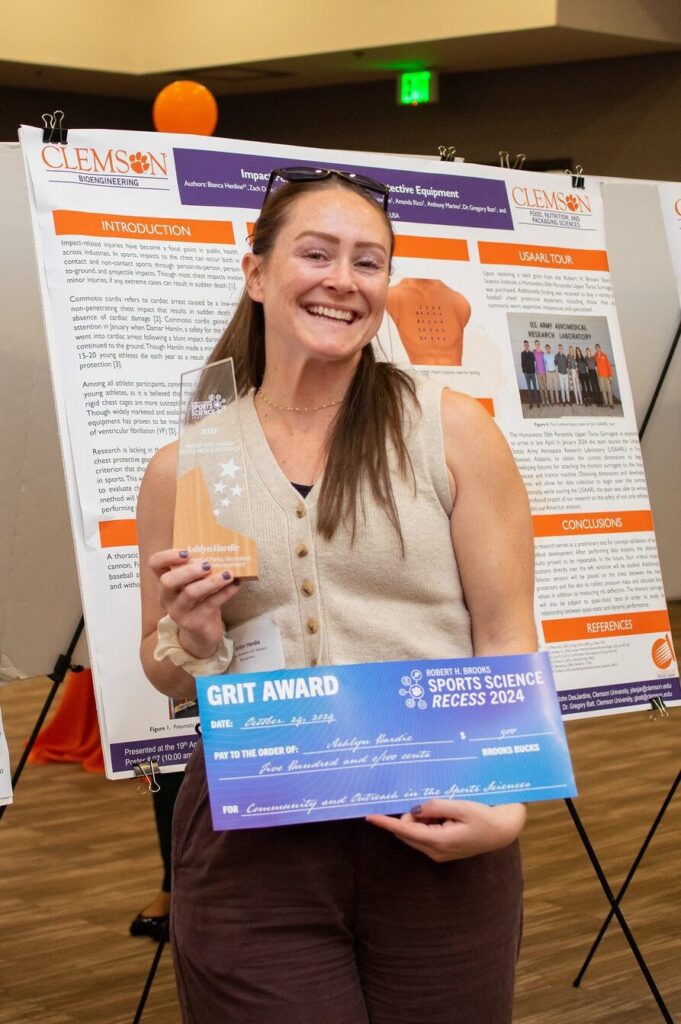
Ashlyn Hardie winning the GRIT award for her New Way Sport Fund
As the summer approaches, NWSF is gearing up for round two of funding. With funding support from the Center of Sport Management Research and Education at Texas A&M University already secured for the next funding cycle, the call for applications will open in July, allowing for new organizations to benefit from this funding mechanism and the embedded support resources. In the meantime, NWSF is conducting research on the outcomes of the funded groups, collaborating with Marlene A. Dixon (Texas A&M), Dr. Kat Raw (Swinburne Institute of Technology in Melbourne), and Dr. Per Svensson (Louisiana State University) to assess what strategies are most effective in creating sustainable change through sport.
As Hardie highlights, “I could not be leading this on my own. Essential collaborators and supporters include the funders — CSMRE at Texas A&M and the GYS4D Initiative — along with the Practitioner Advisory Committee, which consists of Nora Dooley, the director of Soccer Without Borders, Juliana Roman, member of La Nuestra Feminista, and Pappu Modak, secretary and head of Sports and Hope for Independence.”
With a focus on collaboration, trust and empowerment, the New Way Sport Fund is paving the way for a more inclusive, sustainable future for sports-based social change worldwide.