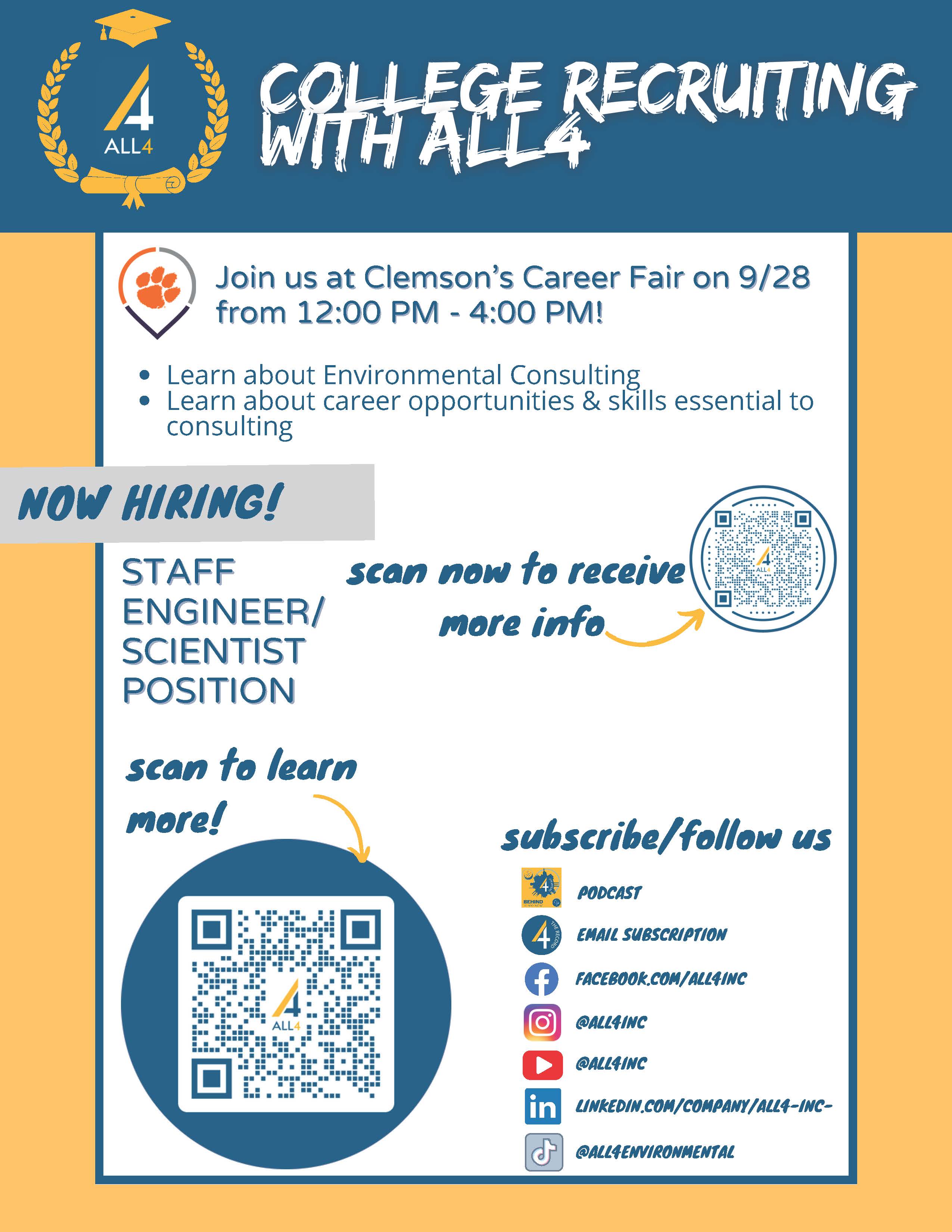
Opportunities with All4
September 19, 2023
September 19, 2023
September 11, 2023
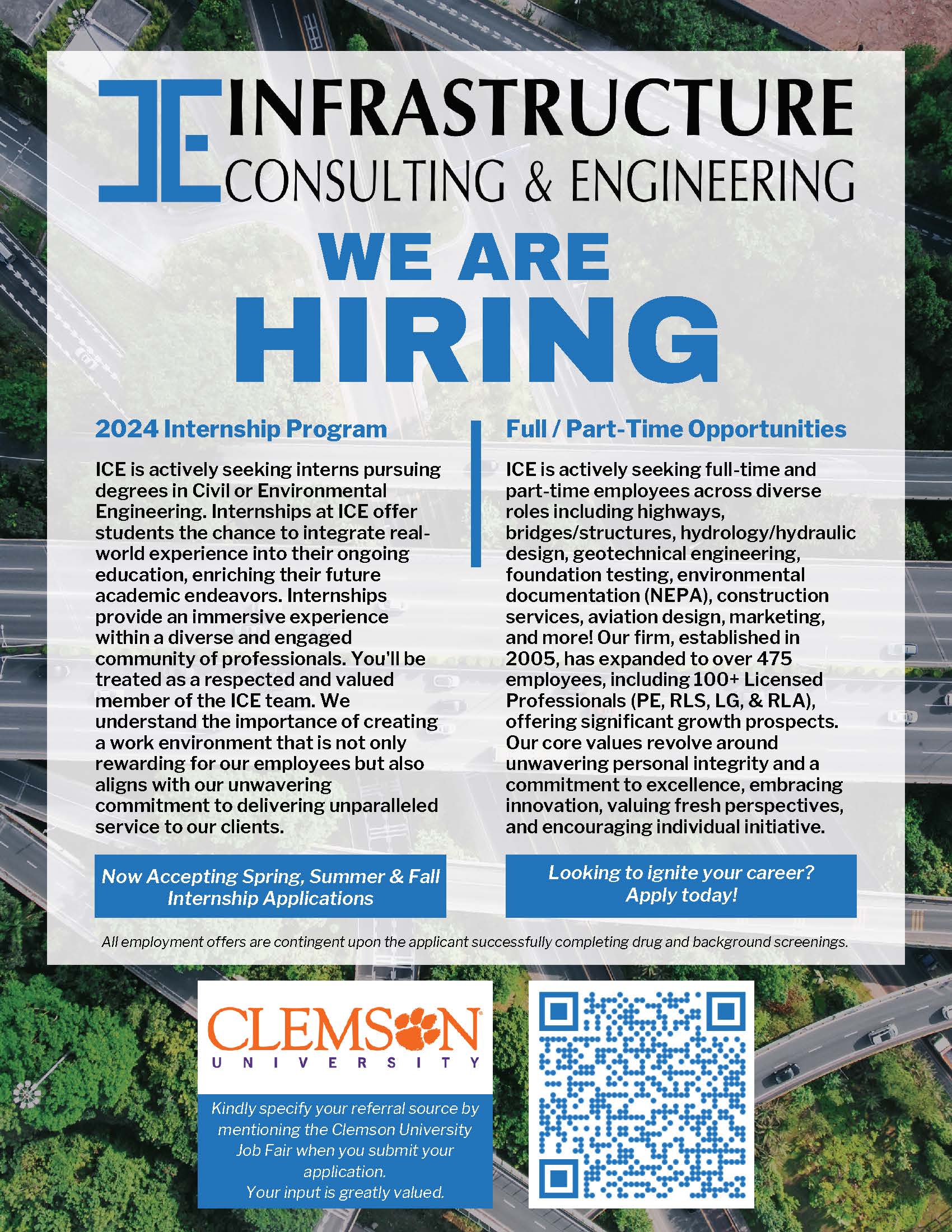
ICE Clemson job fair internship and job opportunities
March 31, 2023
7-11 weeks from May 2023 to September 2023
The NSF Spatiotemporal Innovation Center (STC) is looking for several undergraduate research assistants to serve as NSF REU Fellows from May 2023 to September 2023 depending on your time availability. They will potentially work at the George Mason University site (Fairfax, VA) or the Harvard University site (Cambridge, MA), pending on funding availability from NSF.
This opportunity is supported by the National Science Foundation (NSF) I/UCRC and Research Experiences for Undergraduates (REU) Programs, which enable undergraduate students to obtain research experience and consider a career path in spatiotemporal domains (e.g., CS, GIS, Geosciences, etc.). NSF REU fellows will work in a team with graduate students, postdocs, research staff and faculty at one of the center sites and will conduct research related to spatiotemporal issues. NSF REU fellows also have the opportunity to attend a professional conference to present their research results. Fellows may participate in a variety of research projects.
Requirements:
A complete application includes:
Selection process:
There will be three steps for selecting the students:
Interested students please email your application to STC email address (stc @ gmu.edu). The review of applications will start in early April of 2023, and end until the positions are filled. Please contact Dr. Chaowei Yang (cyang3 @ gmu.edu) or and Dr. Wendy Guan (wguan @ cga.harvard.edu) with questions about the NSF REU Summer Fellows in Geographic Information Science program at George Mason University or Harvard University respectively. We look forward to receiving your applications.
Note: The length of the REU term will depend on the pandemic situation and university policy this summer. We will follow each university’s guidelines for on-site or remote work arrangements when the time comes. If on-site is possible, the program will be a 7-week term, while if remote work is necessary, it could be up to 11-week term. Details will be discussed with the selected candidates during or after the interviews.
George Mason University and Harvard University are equal opportunity/affirmative action employers. All qualified applicants will receive consideration as NSF REU follows without regard to race, color, religion, sex, national origin, disability, age or protected veteran status.
March 10, 2023
Savannah River Ecology Laboratory is hiring two program managers – one for safety and one for research support (permits, archiving, IACUC, environmental compliance, reporting).
Program manager for research support: https://www.ugajobsearch.com/postings/306774
Program manager for safety: https://www.ugajobsearch.com/postings/306772
February 13, 2023
Green Infrastructure for Sustainable Urban Environments (GI4SUrE) Research Experience for Undergraduates (REU) is a 10-week summer program designed to expose and immerse 10 undergraduate students to unique green infrastructure (GI) research.
Green infrastructure is a way to build better infrastructure, as a part of the National Academy of Engineering’s Grand Challenge, to restore and improve urban infrastructure. This program lets students perform field, laboratory, or modeling studies to explore how GI can mitigate the effects of urban runoff on surface water quality and hydrology. This research will affect not only eastern Tennessee, but any area that deals with urban stormwater runoff. Students will also dive into a professional and social atmosphere that will develop their fundamental research methodologies and critical thinking skills.
May 27 through August 6, 2023. This includes move-in/move-out days.
We are accepting applications now, and the application deadline is March 1st. You are responsible for ensuring that your application is complete prior to the application deadline. We will use a rolling admissions process (exceptional applicants may be accepted before the deadline) so you should submit your application early.
Students must meet these conditions:
We especially encourage applications from students who are from groups underrepresented in STEM, are veterans, disabled, or early in their undergraduate coursework.
Dr. Jon Hathaway
hathaway@utk.edu
865-974-6058
851 Neyland Dr.
415 John D. Tickle Building
Knoxville, TN 37996
Dr. Jon Hathaway received his PhD from North Carolina State University in 2010, where he studied the fate, transport, and removal of indicator bacteria in urban stormwater runoff. After a brief research fellowship at Monash University in Melbourne, Australia, and nearly two and half years at one of the nation’s leading ecological design and consulting firms, he joined the faculty of the Department of Civil and Environmental Engineering at the University of Tennessee, Knoxville.
February 10, 2023
Are you an SC undergraduate student interested in working on a NASA related research project this summer? Please consider applying for our SC Space Grant Palmetto Academy program!
We are re-opening the application portal to apply for Palmetto Academy student researchers! We still have spaces to fill and want to encourage any student who are interested to apply. As a student researcher, you will work with a faculty at one of our SC Space Grant member institutions on a NASA-related project (see project/mentor list below).
New student applications are due by Midnight, February 27, 2027.
For more information and a detailed project summary blurb, please visit our Palmetto Academy page on our website:
https://scspacegrant.cofc.edu/palmettoacademyresearch
Summer 2023 Palmetto Academy Research Programs:
February 2, 2023
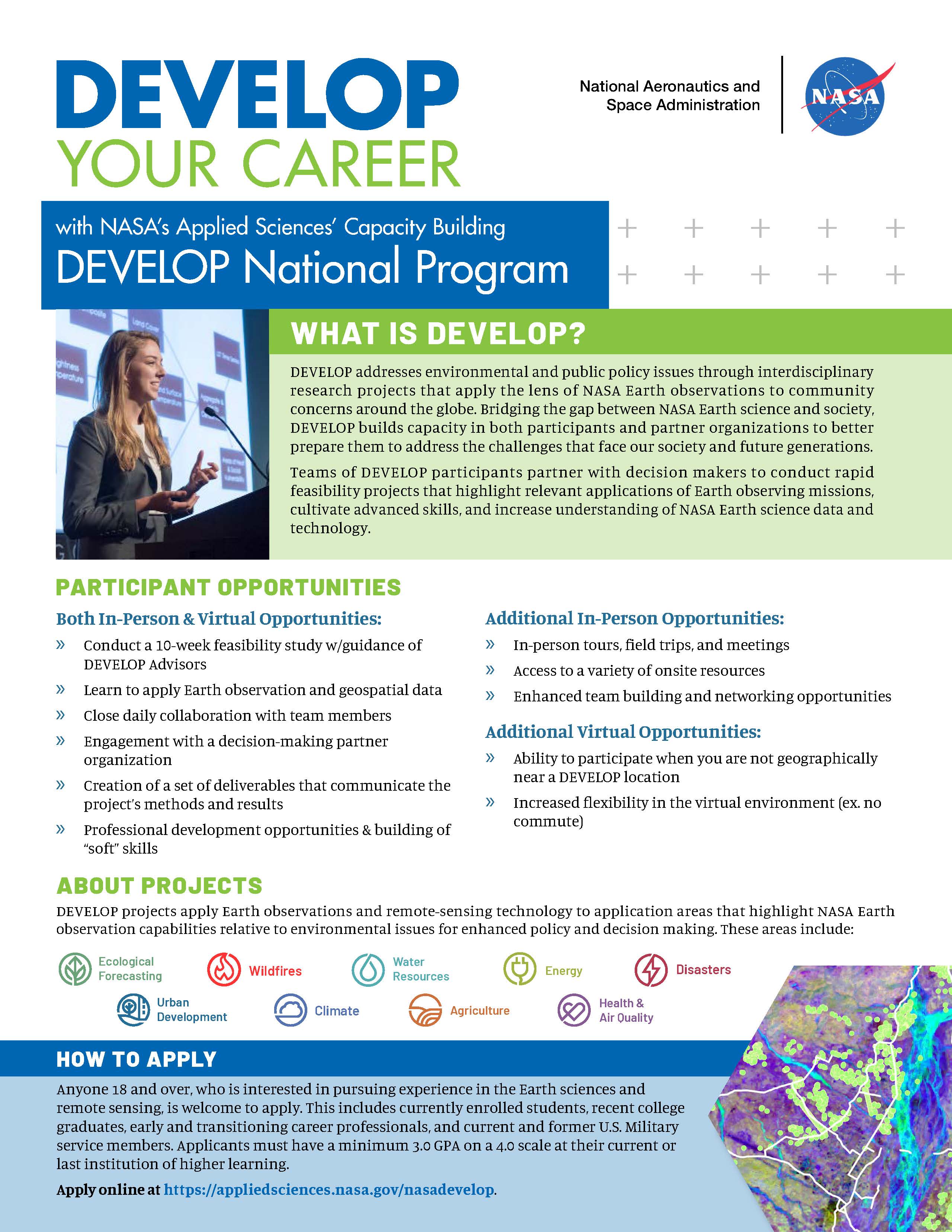
NASA DEVELOP projects focus on helping local, national, and international communities address their environmental concerns by utilizing data collected by NASA’s Earth observing fleet of satellites. NASA DEVELOP operates at eleven locations across the country at NASA Centers and other regional locations. This is a great opportunity for participants who are interested in practical applications of remote sensing and GIS, specifically in the field of Earth Science. Participants will work with NASA scientists, partner organizations, and science advisors to learn about the use of NASA Earth science data for use in water resources, disaster management, ecological conservation, and other applications to address environmental community concerns.
Responsibilities for participants include literature review, data processing and analysis, and producing deliverables such as a technical report, presentation, and video. Although previous GIS or remote sensing knowledge is beneficial, no previous experience in Earth science research is required to apply to NASA DEVELOP. This is a multi-disciplinary opportunity for all those interested in Earth science, and applicants from a diversity of backgrounds are encouraged to apply.
Applicants must have excellent verbal and written communication skills and be able to work in a fast-paced, highly collaborative environment. Days of the week are flexible, but applicants should be able to commit to 20 – 29 hours per week during the term. The position is paid on an hourly basis that is determined by education level and geographic location.
Details about this opportunity and how to apply can be found online at https://appliedsciences.nasa.gov/what-we-do/capacity-building/develop. Applications for the summer 2023 term (June 5th – August 11st) are due on February 24th, with recommendations due March 10th.
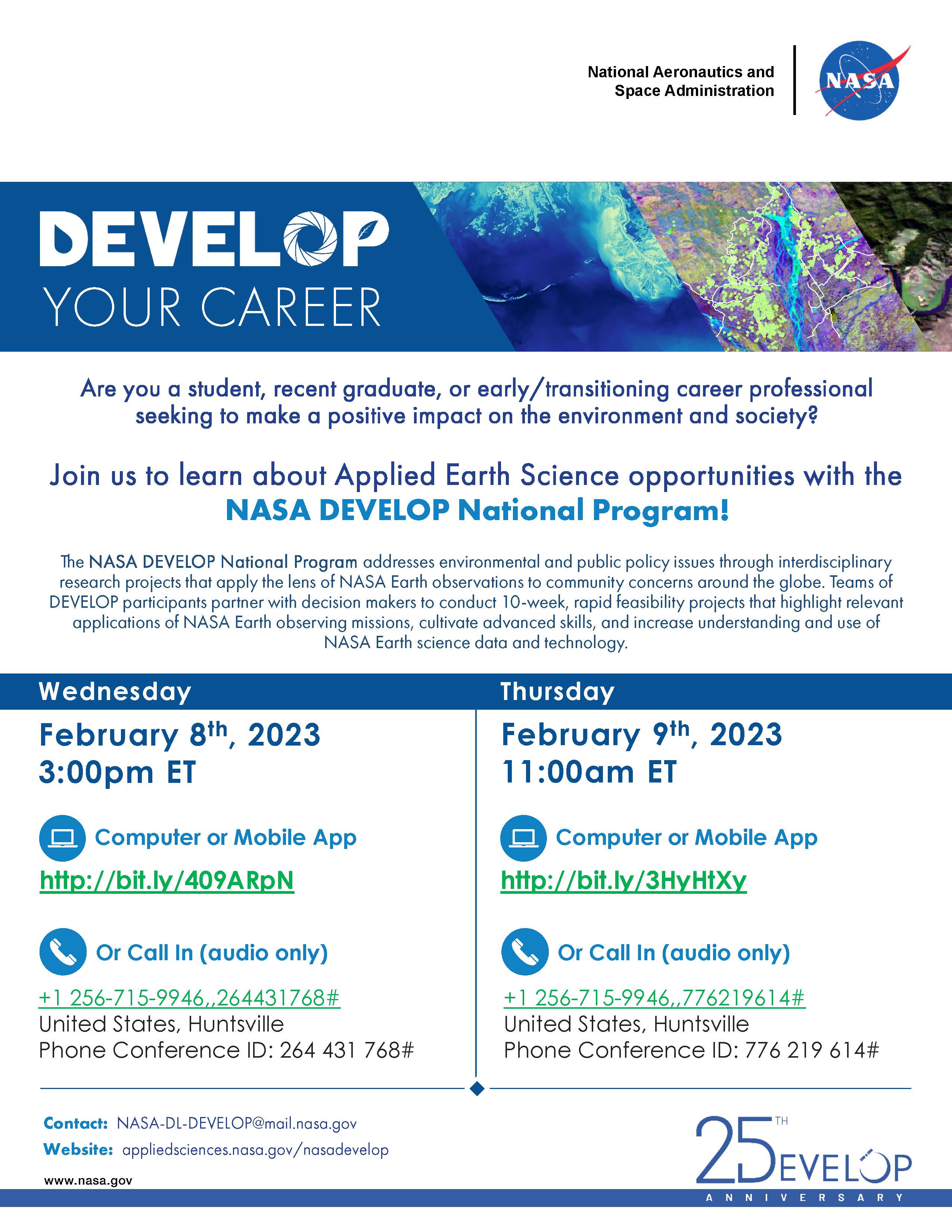
We are hosting virtual “About DEVELOP” webinars on February 8th at 3 pm ET and February 9th at 11 am ET with more information about DEVELOP and applying to the program. Please see the attached flyer for details on joining these events.
January 31, 2023
Job Type Graduate
Job Rank PhD Student
Job Institution University of South Alabama
Job Description:
The Chemical and Bio-molecular Engineering Program at the University of South Alabama, Mobile Al, is looking for two highly motivated Doctoral candidates starting in August 2023.
The first position involves modeling the performance and microbial communities of Anaerobic Membrane Bioreactors (AnMBR) treating domestic wastewater.
The second position involves developing protein-based adsorbents for contaminant removal.
The project is headed by Dr. Kaushik Venkiteshwaran, Assistant Professor in Civil, Coastal and Environment Engineering at South Alabama, and will serve as the academic and research advisor for the candidates.
Successful candidates will join the Chemical and Bio-molecular Engineering Program at South Alabama, and will receive a doctoral degree in Chemical and Bio-molecular Engineering upon completion.
Research duties include:
Project-1
1) Building and operating lab-scale AnMBRs
2) Perform typical water/wastewater analyses
3) Perform microbial community analysis and bioinformatics
4) Perform computational modeling
Project-2
1) Isolate target DNA, design primers, perform gene cloning and cultivate bacterial cultures
2) Performing adsorption experiments
Required qualifications:
1) Bachelors in Civil or Chemical Engineering or related fields from a verifiable Institution
2) Masters in Civil or Chemical Engineering or related fields from a verifiable Institution
3) GRE: >151 in Verbal and Quantitative
4) For international students, an official TOEFL,
IELTS, iTEP, or Pearson (PTE Academic) score is required. The minimum
required test scores are: TOEFL – 525 on the paper version, 197 on the computer
version, or 71 on the internet version; IELTS – 6.0; iTEP – 3.7; Pearson’s (PTE
Academic) – 48
Preferred qualification (Highlight any of the following in your CV or SOP)
1) Experience in operating biological reactors
2) Experience in performing typical water/wastewater analyses
3) Experience in performing microbial analyses (Plating, Genetic cloning,
DNA/RNA extraction, PCRs etc.)
4) Experience in using statistical softwares (such as R, Matlab, Python etc.)
5) Writing experience – Share journal publications or conference proceedings if
any.
Interested candidates should contact Dr. Venkiteshwaran (kvenkiteshwaran@southalabama.edu)
via email with your Statement of Purpose (SOP), CV and transcripts before
February 28th 2023. You can also direct any questions to Dr. Venkiteshwaran
January 25, 2023
Do you want to begin a career in academic or policy research? Are you interested in contributing to impactful, balanced research that is aimed at improving environmental, energy and natural resource decisions? A summer research internship with Resources for the Future (RFF) might be right for you. The RFF summer internship program provides an opportunity for students to prepare for careers that engage in academic and policy-relevant research. Interns are essential members of the RFF Research and Policy Engagement team. They are responsible for providing technical support that, under the direction of RFF Fellows, allows for the production of compelling and impactful research that aligns with RFF’s mission of improving environmental, energy and natural resource decisions through impartial economic research and policy engagement.
Internships will run from June 12, 2023 to August 18, 2023. Start or end dates can be changed with an approved exception. All internships will be conducted in RFF’s offices in Washington, DC. Applications for the summer 2023 hiring season will close on March 17th, with interviews conducted by April 21st. Hiring decisions will be made by May 5th.
Summer 2023 Projects that will be supported by a summer intern include:
January 11, 2023
Marine and environmental sciences are crucial for the future of human health, food, water and energy. The nine-week internship connects you to a hands-on research project. Interns will receive an orientation to working in a lab, seminars on molecular techniques relevant to fisheries, aquaculture, energy production, and environmental research. Group activities will promote science communication, professional and life skill development.
IMET and UMCES are committed to creating opportunities for a diverse body of undergraduates to enable and encourage students from underserved communities to continue on to higher degrees and careers in marine and environmental science.
Internship Benefits: This full time internship includes a stipend of $5,400 for the nine-week period. IMET intends to provide no-cost summer housing for students from outside the Baltimore metropolitan area.
Internship Eligibility: This internship is most applicable to undergraduate students studying biology, marine science, environmental science, and other related degrees. (Preference will be given to rising juniors and seniors.)
Students from educational backgrounds with limited access to research opportunities and students from underserved communities with an interest in marine science and environmental science are welcomed and encouraged to apply.
