Cotton insect pests caused an estimated $798 million in yield losses plus management costs in the US in 2024. Many insects can cause damage to cotton, including the bollworm, stink bugs, thrips, and tarnished plant bugs (Figure 1).
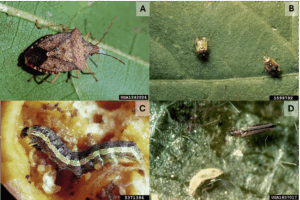
Figure 1. Cotton pests, the brown stink bug (A, Russ Ottens, University of Georgia, Bugwood.org), tarnish plant bug (B, John C. French Sr., Retired, Universities: Auburn, GA, Clemson and U of MO, Bugwood.org), cotton bollworm (C, Gyorgy Csoka, Hungary Forest Research Institute, Bugwood.org) and thrips (D, Jack T. Reed, Mississippi State University, Bugwood.org).
As cotton pest management changed over the years, so did the importance of these pests. For example, before the introduction of cotton plants expressing Bacillus thuringiensis (Bt), cotton bollworm caused severe yield losses, leading growers to spray insecticides several times over the season to control this pest. Nowadays, with the widespread use of cotton cultivars expressing Bt toxins, yield losses and insecticide sprays to control bollworm significantly decreased.
Entomologists at Clemson University, represented by Dr. Reay Jones, Dr. Greene and the student Igor Schardong, collaborating with cotton entomologists from North Carolina, Virigina, Georgia, Alabama, Florida, and Oklahoma are distributing a survey about cotton pest management targeting growers, consultants and extension agents. The goal of the survey is to document current insect pest status in cotton, its management strategies in the southeastern states and the implementation of IPM in the Southeast US.
If you are a grower, extension personnel and consultant who grow or monitor cotton fields, please help us responding to the survey scanning the following QR code. It is important to mention that the survey is anonymous, it only takes a couple of minutes.

Figure 2. QR code to access the cotton pest management survey.
Clemson University appreciate you taking your time to help on this important matter!
