Integrated Pest Management

Damping-Off on Direct-Seeded and Transplanted Vegetable Crops

By: Anthony Keinath, Vegetable Pathologist, Clemson Coastal REC

Originally posted on SC Grower: https://scgrower.com/

“Damping-off” refers to root and stem rot on young seedlings of direct-seeded crops. “Stem and root rot” is used to describe the same disease on transplanted crops. I use the term “seedling disease” when information below applies to both types of crops.


Stem and root rot on a watermelon transplant. Note the brown, water-soaked, discolored area on the stem just above the soil line.


Stem and root rot on a tomato transplant. Note the tan, collapsed area on the stem just above the soil line.

In South Carolina, the water mold Pythium is the most common cause of seedling diseases, especially on cucurbits, tomato, and pepper. The fungus Rhizoctonia also occurs on seedlings of certain crops, including beet, onion, radish, arugula, and head and stem brassicas (broccoli, cabbage, cauliflower) along with collard and kale. (Note that head and stem brassicas, collard, and kale are, botanically, Brassica oleracea, which is more susceptible to Rhizoctonia than mustard, Brassica juncea). Most vegetable crops can be infected by both pathogens. For example, 49% of diseased arugula seedlings were infected by Pythium and 54% by Rhizoctonia on an organic farm in the Lowcountry in an on-farm study in 2011.

At a recent vegetable grower meeting, summer squash was voted the crop most susceptible to damping-off out of a list of direct-seeded crops that included beets, onions, parsley, and cilantro. Squash and other cucurbits are susceptible to at least 9 species of Pythium, 3 warm-season species and 6 cool-season species. Thus, squash and other cucurbits are susceptible to seedling diseases year-round.


Recovery of Pythium species from transplants of cucumber, watermelon, Hubbard squash or bottle gourd, 2017 to 2019, Charleston and Lexington counties.

Fungicides and Biofungicides
The standard conventional fungicide Ridomil Gold applied via drip irrigation is recommended to reduce seedling diseases. Research in another state showed that Ridomil Gold is more effective applied as soon as possible after transplanting rather than several days or weeks later. Ridomil Gold will not completely prevent seedling disease, but, typically, it reduces the number of diseased plants. Biopesticides and NOP/OMRI organic-approved products generally have little effect on seedling disease in the field. They are useful in the greenhouse to prevent damping-off in seedling flats.

Cultural Practices
Plastic mulch is such a common production practice that I almost forgot how much it significantly reduces stem and root rot on transplants. I was reminded, in dramatic fashion, in an experiment in cooperation with the University of Georgia in spring 2015 that included mulched and not mulched plots of transplanted seedless watermelon. It’s very possible that some growers are seeing so much damping-off on summer squash because it is typically planted on bare ground.


Stem and root rot of seedless watermelon transplants in a field naturally infested with multiple species of Pythium at Coastal REC, Spring 2015

Resistance
No cultivars of any vegetable crop have genetic resistance to seedling diseases. As the graph below shows, however, there may be some differences among cultivars that could be called “field resistance,” a term used when certain cultivars have less disease under field conditions than is expected based on greenhouse testing.


Seedless watermelon cultivar Melody had significantly less Pythium stem and root rot than Citation and Fascination, Coastal REC, Spring 2015

Recommendations

  1. Transplants generally have less seedling disease issues than direct-seeded crops, because all vegetable crops become more resistant to stem and root rot as they age. This is not to say that stem and root rot doesn’t affect older plants, but it’s less likely.
  2. If you replace transplants that died from stem and root rot, do not set the new transplant in the same hole. Move the planting hole at least 6 inches away, because there might be fewer pathogen propagules in a different spot. The numbers of pathogens in soil is very variable.
  3. Overseeding at a higher rate of seed/foot or seeding a bit more shallowly than normal can improve stands of direct-seeded crops.

Clemson’s Vegetable Entomology Program

Dr. Tom Bilbo, Clemson’s vegetable and strawberry entomologist stationed at the Coastal Research and Education Center in Charleston, began his research and extension program late in 2021. Since starting here at Clemson, Dr. Bilbo has rapidly expanded his program and has started addressing a number of different economically important pest concerns for vegetable and strawberry growers. “The primary goal of my research program is to enhance sustainable food production through protection of yields from crop pests and enhancement of yields through conservation of beneficial insects” Dr. Biblo says. The primary areas of focus for his research are 1) developing new biological control strategies for key pests, 2) reducing pest potential through modification of farming practices and systems, and 3) improving insecticide use and managing insecticide resistance. When it comes to Extension and stakeholder interaction, focus areas include 1) identifying key entomological issues in vegetables and strawberries, 2) encouraging adoption of improved practices through demonstration of efficacy and profitability, and 3) improving stakeholder knowledge of advances in IPM and IRM.

Headshot of a man with brown hair.
Dr. Tom Bilbo, Clemson’s vegetable entomology specialist

“Overall, my research uses our understanding of insect ecology to reduce pest problems and enhance the role of beneficial species, especially predators and parasitoids” Dr. Bilbo says, “much of my research is conducted on commercial farms in coordination with local growers.” The reason for much of the research being conducted with collaborating growers in twofold. 1) Insect ecology entails insects moving around, and insects don’t care about the arbitrary plot borders researchers construct. So small plot experiment station trials make it difficult to tease apart treatment effects as well as not being a realistic representation of how insects behave on vegetable and fruit farms. 2) On-farm trials allow Dr. Bilbo to build relationships with growers to understand the pest problems better and create management strategies that are feasible, economical, and effective.

A man and a woman working in a field of leafy greens
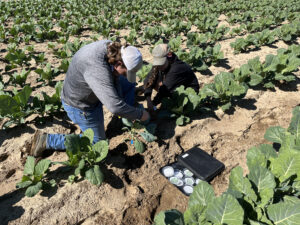
Research assistants Wyatt Witman and Caroline Dukes artificially infesting collard plants with diamondback moth larvae to determine parasitism rates at varying distance from flower strips.

Some of Dr. Bilbo’s on-going projects include pest management in brassicas, strawberry, tomato, watermelon, and cucurbits. In brassicas, the primary focus is effective integrated management of the diamondback moth, the major economic pest of most brassica crops worldwide. His work on diamondback moth includes determining how predator and parasitoid activity varies with the use of intercropped flowers (to optimize flower plantings), evaluating mating disruption as a potential management strategy, and determining which plants are best at attracting natural enemies of diamondback moths and other pests in both spring and fall crops. Much of this diamondback moth research is conducted in collaboration with specialists at NC State, Virginia Tech, and Tennessee State University. These types of regional efforts allow for a greater understanding of pest status and management options on a larger spatial scale.

A woman working in a field of leafy greens.
Research assistant Lindsey Newton setting up diamondback moth pheromone dispensers as part of a mating disruption experiment.

In strawberry, his primary research focus is on enhancing the role of beneficial predatory mites to manage spider mites. A survey of commercial farms for the presence of these beneficial mites will provide a baseline level of knowledge on their natural occurrence and role in suppressing pest mites. Other projects include evaluation of tomato and watermelon cultivars for spider mite preference, evaluating pheromone traps for pickleworm moth in cucurbit crops, continued Bt resistance monitoring in corn earworm, and conducting insecticide trials to evaluate new and existing products for important pests. All of this research and subsequent extension work to disseminate the results of these studies will directly benefit vegetable growers in South Carolina by maximizing their pest management and providing a full range of tools to effectively address those pests.

A man and a woman working on insect traps.
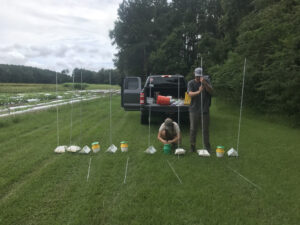
Research assistants Wyatt Witman and Caroline Dukes setting up a trapping experiment for pickleworm moth in zucchini

Management of Alternaria Black Spot on Conventional and Organic Kale Grown in the Fall

Contributing Author: Dr. Anthony Keinath

Black spot, also known as Alternaria leaf spot, is considered to be the most important fungal disease on organic kale in South Carolina. It tends to be more prevalent in the fall than in the spring. The primary cause is the fungus Alternaria brassicicola (AB), found worldwide on brassica crops. In South Carolina and Georgia, a second species, Alternaria japonica (AJ), also is present. AJ is more cold tolerant than AB, so it is more likely to be found on fall crops or overwintered kale than on spring crops.

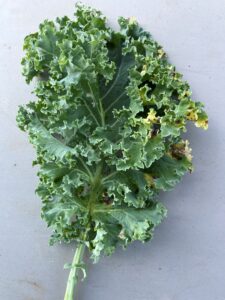
Kale leaf with yellow and brown patches
Kale infected with Alternaria black spot.

In October 2021, two fields at Coastal REC were each transplanted to 14 kale cultivars representing four types of kale: curly, Tuscan (lacinato), Siberian, and Portuguese. One field was organic certified, and one was conventional. The same rates of organic and conventional fertilizer were applied to each field. Transplants were spaced 1 ft apart in single rows on a 3-ft-wide bed with drip irrigation and white-on-black plastic mulch. Leaves were cropped in early to mid-December and again in late December to early January. Leaves were sorted into healthy and diseased categories, then counted and weighed by category. The diseased category included leaves with any leaf spots on them, even very small ones.

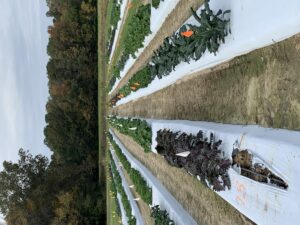
Rows of different kale crop types and cultivars
Various kale types and cultivars planted to test their yield potential and susceptibility to Alternaria black spot.

Average yields differed by the type of kale. Summed over both harvests, Siberian kale grew the fastest and yielded the most, followed by Portuguese kale, curly kale, and finally Tuscan kale. Cultivars did not differ much within kale type, except White Russian yielded more than Red Russian and Russian Royale when the yields from both harvests were added together.

Figure showing kale yield of various varieties
Kale yield by type.

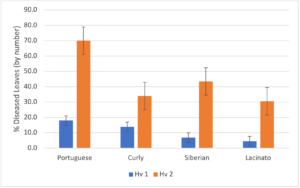
Kale type also differed in susceptibility to black spot when plants were sprayed with spores of Alternaria. Portuguese was the most susceptible and had more diseased leaves, 70%, than any other type or cultivar. Tuscan was the least susceptible, while curly and Siberian were intermediate. Curly kale cultivars didn’t differ in susceptibility at the first harvest, but when regrowth was harvested, Oldenbor had more disease (57% diseased leaves) than the other four curly kale cultivars. The red curly kale curly Roja had less disease than the four green curly kales, but it also had low yields. Among Siberian kales, Red Russian had less disease than White Russian. Toscano Tuscan kale had more disease than cultivar Lacinato.

Figure showing percentage of diseased plant with different kale types
Percentage of Alternaria black spot diseased leaves by kale type.

Another potential way to increase kale yields is to grow plants in double rows rather than single rows. At Coastal REC we did this in fall 2020 by transplanting two rows of kale on a 6-ft-wide bed with drip irrigation and white-on-black plastic mulch. The popular cultivars Darkibor and Winterbor were used. One plant at the end of each plot was inoculated with spores of AJ. Three plants in the middle non-inoculated portion of each plot were harvested, and the inoculated plant plus the plant next to it were also harvested. Leaves were sorted as described above.

Yield of healthy leaves was increased for both cultivars in double-row plots compared to single-row plots. This yield increase was observed on both inoculated and on non-inoculated plants. Black spot decreased yields of Winterbor in double rows but not single rows and not with cultivar Darkibor at either spacing. Double rows did not increase disease as much as might be expected because the hours kale leaves stayed wet was similar in both row spacings: 17.3 in single and 18.8 in double. This study demonstrates the importance of type and cultivar on disease prevalence. Selecting a type based on the balance of yield potential and disease resistance is an important part of an integrated management program for Alternaria black spot in kale.

This work was in part supported by the Organic Transitions Program, National Institute of Food and Agriculture, U.S. Department of Agriculture, under award number 2021-51106-35495.