Integrated Pest Management

Transgenic Bt Corn Research at Clemson University

Contributing Author: Dr. Francis Reay-Jones

More than 80% of field corn grown in the U.S. has been genetically engineered to express one or more insecticidal toxins from Bacillus thuringiensis, called Bt toxins. Bt corn was first commercialized in the U.S. in 1996, expressing a single Bt toxin targeting the European corn borer. Newer Bt corn hybrids express two or more Bt toxins, which has increased the number of target pests to include the corn earworm and the fall armyworm. Benefits of planting Bt corn can include protecting yield from insect damage, reducing the need to use insecticide, and improved grain quality. However, such benefits can be impacted by the development of resistance in target insects.
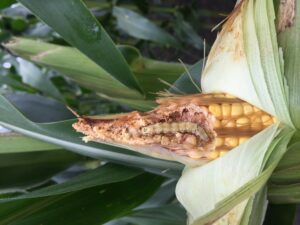
Corn earworm larvae feeding on corn ear.

Dr. Francis Reay-Jones is continuing this year to evaluate the efficacy of Bt traits and the impact Bt toxins have on the life cycle of the corn earworm, with implications on resistance evolution. “We have been conducting field efficacy trials with a range of Bt traits since 2009. Since then, we have seen some traits become less effective over time because corn earworm has developed resistance. We saw in particular a shift in 2015 when resistance to some of the Cry toxins expressed in Bt corn became more widespread not just in South Carolina, but across the southeastern U.S.” Although the corn earworm is generally not a significant economic pest of field corn, the same species is a serious pest in cotton, where it is known as bollworm. Because Bt cotton expresses the same or similar toxins as Bt corn, selection for resistance in Bt corn is likely driving resistance issues to Bt cotton. “Planting a non-Bt refuge is the only tool we have to manage resistance. Preventing resistance development in Bt corn is crucial so that the insect does not cause more damage to Bt cotton later in the season, where the corn earworm (or bollworm) is a major economic pest.”
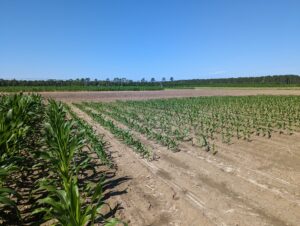
Corn trials at the Clemson University Pee Dee REC in 2023.

While resistance in corn earworm is widespread to most Cry toxins used in Bt corn and Bt cotton, one toxin, called Vip3A, remains highly effective. Trials in South Carolina continued this year to evaluate Bt corn hybrids expressing Vip3A. Examination of hundreds of corn ears in 2023 showed that these hybrids remain highly effective, with no ear injury found due to corn earworm feeding. In corn, this toxin is expressed in Trecepta, Optimum Leptra, and Agrisure Viptera products. While Vip3A remains effective, reports of unexpected injury in recent years in the mid-south underline the need for continued resistance monitoring. Vip3A toxins are also expressed in new Bt cotton varieties, and planting of non-Bt refuge in corn is crucial, since only a single Bt toxin is currently available with very good activity for this key pest.

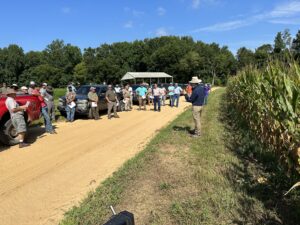
 

Edisto REC Hosts Field Corn Field Day

On Thursday, July 27, a corn production field day was held at Clemson University’s Edisto Research and Education Center in Blackville, SC. The field day was well attended by growers and other stakeholders to learn about the latest research and recommendations for corn agronomy, disease and nematode management, insect management, and soil fertility management.

Dr. Michael Plumblee, Clemson’s corn and soybean extension specialist, organized the field day in addition to providing updates on his on-going work with double cropping corn and soybean, corn variety trials, and corn fungicide efficacies. Double cropping corn and soybeans is a new strategy that Dr. Plumblee and his graduate student, Bennett Harrelson, are exploring as a potential mechanism for growers to increase profitability in the long South Carolina growing season. In this system, corn is harvested early and soybeans are immediately planted. Dr. Plumblee’s research seeks to identify best management practices for this system including planting date, harvest date, soybean variety, and nematode management.

Dr. John Mueller, a field crop pathologist and nematologist, provided updates on several nematacides that are commonly used by growers, Counter 20G and Velum. On-going trials conducted by Dr. Mueller will help determine which of these products provides effective control for growers. Dr. Mueller also spoke about corn fungicide trials that are on-going in collaboration with Dr. Plumblee. Dr. Mueller says the good news for growers this season is that it has been a relatively light disease year so far.

Dr. Mike Marshall, a field crop weed specialist, provided an update on a number of different pre and post emergent herbicide programs that could be used by growers in the field. There are many different herbicide programs that growers can utilize, and continued efforts to test the efficacy of these programs allows growers to be informed and not use herbicides which may not provide good levels of control.

Man speaking in front of corn field.
Dr. John Mueller discussing several different nematacides.

Dr. Francis Reay-Jones, a field crop entomologist, provided an update on the state of insect pest management in corn. Dr. Reay-Jones emphasized the importance of planting non-Bt refuge corn each year to delay the continued development of Bt resistance in corn earworm populations. While corn earworm is generally not an economic pest of corn, it is a major pest of cotton, where it is known as bollworm. Since cotton expresses many of the same Bt toxins that corn does, resistance management in corn continues to be a critical strategy to prevent further issues in managing the insect in cotton. Tim Bryant, provided an update of the state of stink bugs in field corn. Stink bugs are the most important economic insect pest of corn in the Southeast, but it is also a sporadic pest, so scouting is critical for growers to effectively manage it.

Man talking to crowd of people.
Dr. Francis Reay-Jones providing an update on the state of Bt resistance management in corn earworm populations.

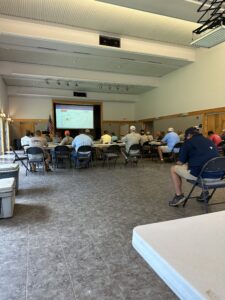
Finally, Dr. Bhupinder Farmaha provided an update on soil fertility practices for corn. Soil samples should be taken in the field and sent to the Clemson Agricultural Service Laboratory to provide a full break down of the nutrient contents of the soil in a field, allowing growers to amend the soil in a targeted and effective way. Dr. Farmaha also stressed the diminishing returns seen from soil amendments beyond a certain amount, emphasizing the importance of these soil tests.

Man speaking to a classroom of people
Dr. Bhupinder Farmaha discussing soil fertility in corn.

All of these biotic and abiotic factors play an important role in the success growers have with corn production. Integrating all these decisions with each other in a synergistic manner is the cornerstone of a truly integrated pest management program.