Hardie and the SADEV group having dinner in Costa Rica
In June 2025, Robert H. Brooks Sports Science Institute Fellow and Assistant Professor in the Department of Parks, Recreation and Tourism Management, Ashlyn Hardie, Ph. D., recently embarked on a journey to Costa Rica. She was accompanied by Mike Clark, former assistant director for Clemson Student-Athlete Development, Nick Singleton, assistant director for Clemson Student-Athlete Development, and nine female student-athletes from Clemson Women’s Rowing, Track and Field, Softball and Gymnastics.
Clemson Student-Athlete Development (SADEV) is a branch within Clemson Athletics where staff work with student-athletes to help them grow in their leadership skills, prepare for post-graduation careers and work on holistic human development. The Director of Student-Athlete Development, Tori Niemann, and Dr. Hardie originally connected because of Hardie’s research expertise on women in sport and sport in the international context. Subsequently, Hardie began to assist the SADEV staff in their goal to ensure the service trip to Costa Rica was intentional, impactful, had measurable research outcomes, and would benefit the Costa Rican community.
Hardie’s research emphasizes the importance of understanding intention versus impact in international development and service work. Her mission is to help others understand that in order to make a positive change, there has to be more than just positive intention; service providers and volunteers also have to acknowledge and embrace the culture and norms of the country they are in to optimize positive outcomes for all parties. According to Hardie, she was really impressed with the SADEV staff’s intentionality in learning about ethical international service practice and prioritizing that in the trip preparations.
Embarking on the trip
On the trip, all of the student-athletes were women, and the two staff members leading the trip, Clark and Singleton, were men. So, in addition to Hardie’s professional contributions, she was excited to be an example to these young women of an experienced female traveler. Hardie shared, “While it wasn’t the intended purpose of my role on the trip, I cherish any opportunity to be an example for young women of how to break out of their comfort zone, embrace different cultures and different people, and seize opportunities to grow through travel. The idea of traveling internationally as a young woman can feel daunting or unsafe, but it makes all the difference to have an example and mentor who can share some helpful tips and support in the process.”
The team on a zip-lining excursion through the rainforest
During their service trip, student-athletes learned about the local communities and cultures of Costa Rica, explored the city, zip-lined through the rainforest, gained deeper insight into the ecological elements of Costa Rica and the importance of eco-friendly practices in their culture. The main purpose of the trip, which took up four of the six days of the trip, was to work at a school in the rural mountains of Costa Rica called La Jolla. There, they helped build a community space with a kitchen and bathroom area, along with more creative tasks such as painting signs in English with the school’s core values so that the Costa Rican students could learn English and important values such as empathy and self-awareness. Clemson athletes also helped with general clean-up, participated in a Father’s Day fundraiser and dance classes, and supported with other tasks during the week.
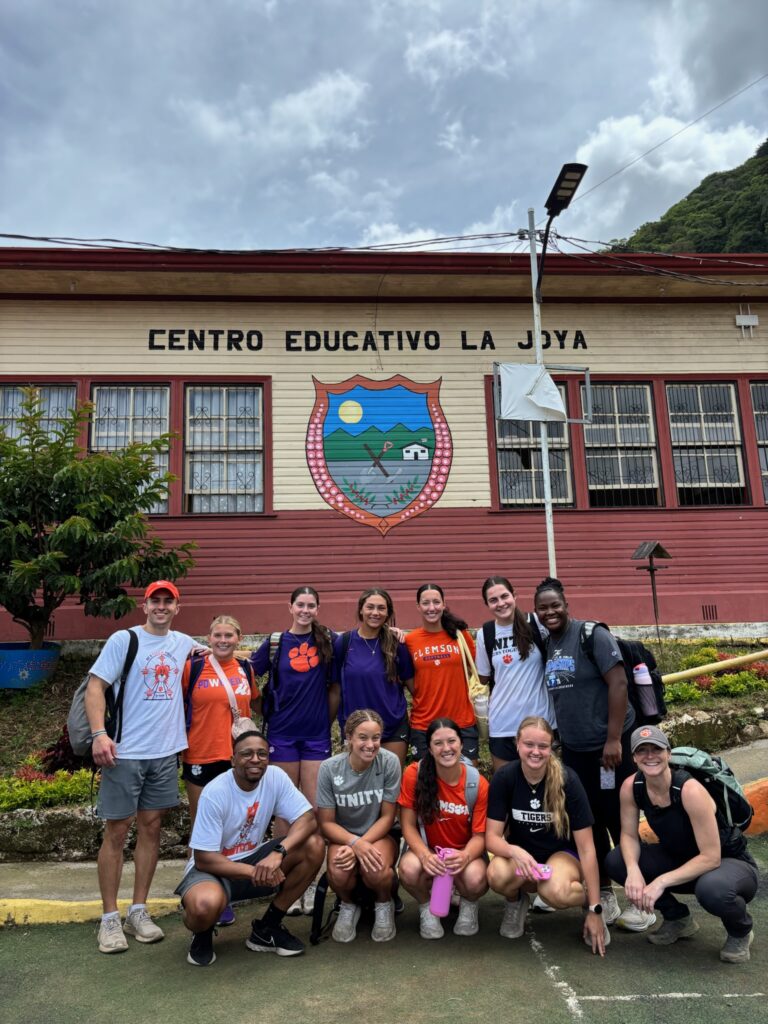
The team standing in front of the school they worked at throughout their trip
Service trips can benefit both the community that is being assisted and leave participating volunteers with lasting memories, a greater understanding of other cultures, and comfort traveling to a new environment. To this end, Hardie states that there were three main takeaways that were voiced from the Clemson group collectively at the end of their travels.
The first was that the student-athletes expanded their Clemson horizons while abroad and stepped out of their comfort zones. On day one of the trip, the athletes mostly hung out with their teammates and were more reserved; by day six, they formed a little sisterhood and had shared experiences and developed friendships across teams as a result.
The second takeaway was that the student-athletes were able to recognize differences in the way Americans live and what many people take for granted every day. When people picture a trip to Costa Rica, they visualize lying out on the beach during the day and using their resort WiFi to wind down at night, and trust that there will be water coming out of the showerhead so they can rinse off the sand after a long day at the beach. Instead, the women on this trip experienced inconsistency in cell service and WiFi, and the water being shut off for a night at their homestays as a result of a small earthquake (that was not felt by people, but as a safety precaution). Although this made individuals anxious and feel inconvenienced, their host families explained this was relatively normal, which ultimately broadened the scope of Clemson athletes’ understanding of how experiences can vary greatly in other parts of the world.
The team working on curating the garden
The last takeaway that the group expressed was that they had a greater desire to connect and contribute to the community surrounding them. The girls were nervous at first, but once they saw all that they could accomplish, they took pride in their work. They also dove more into the culture, they practiced the language and overcame their own discomfort to connect with their environment. These learnings applied to both the student-athletes and the staff leaders alongside Hardie, who acknowledged in real-time that they were in a new place and were able to embrace new things that they had not experienced before.
Hardie states that this trip allowed for self-reflecting and conquering challenges that the group does not normally encounter day-to-day in Clemson, South Carolina. Instead of preparing for a hard exam or training for a new personal record in their respective sport, the athletes had to navigate language barriers so they could communicate with their host families and learn new norms, try new foods, and navigate new cities/towns.
Six days is a short amount of time to fully appreciate being immersed in a new culture, but the student-athletes made the most out of their time. They connected with the locals and attempted to speak the native language, and even participated in a dance class. Cultural acclimation can take weeks for some, but Hardie was proud of them for going out and trying new things and maximizing the time they had.
Aftermath of the service trip
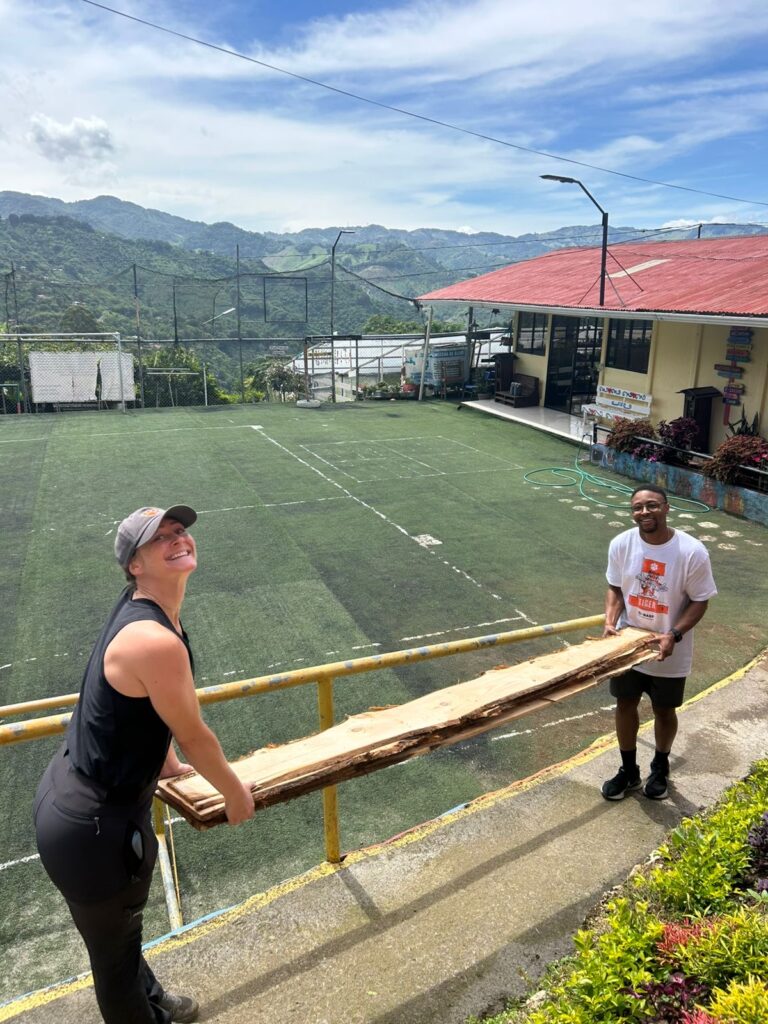
Ashlyn Hardie and Mike Clark participating in service work
Hardie says that, for the staff and faculty who go on service trips such as these, it allows for moments of learning and reflection that can be utilized to inform future Clemson student-athletes’ community service projects. The impact this group made does not just stay in Costa Rica; it follows them back to Clemson and influences their future projects.
In addition to the service trip itself, Hardie and Niemann partnered together on a research initiative to assess the impact of these opportunities for Clemson student-athletes and donor support. Before, during, and after this trip, Hardie collected data. She challenged the girls to reflect on things like how their identities influence the spaces they are interacting in, cultural understanding and integration, and their own personal development from the trip. She took ethnographic notes throughout this time about her experiences working and interacting with the group, and her observations from the week.
Hardie will be analyzing the qualitative data and asking questions such as, “How did the relationship between the student-athlete development staff and the student-athletes change?” and “What were the most meaningful outcomes for those student-athletes?” and “What was the change in their global perspective?”The information can be used for future trips to prepare student-athletes on how to better interact with other countries, and to seek and interact with donors for projects such as these.
In the future, Hardie is excited to continue working on and supporting international service projects with SADEV as a point-of-contact, regardless of whether or not she travels alongside the team, to provide insight and advice as to how to prepare student-athletes before travelling abroad, as well as support in future research endeavors.
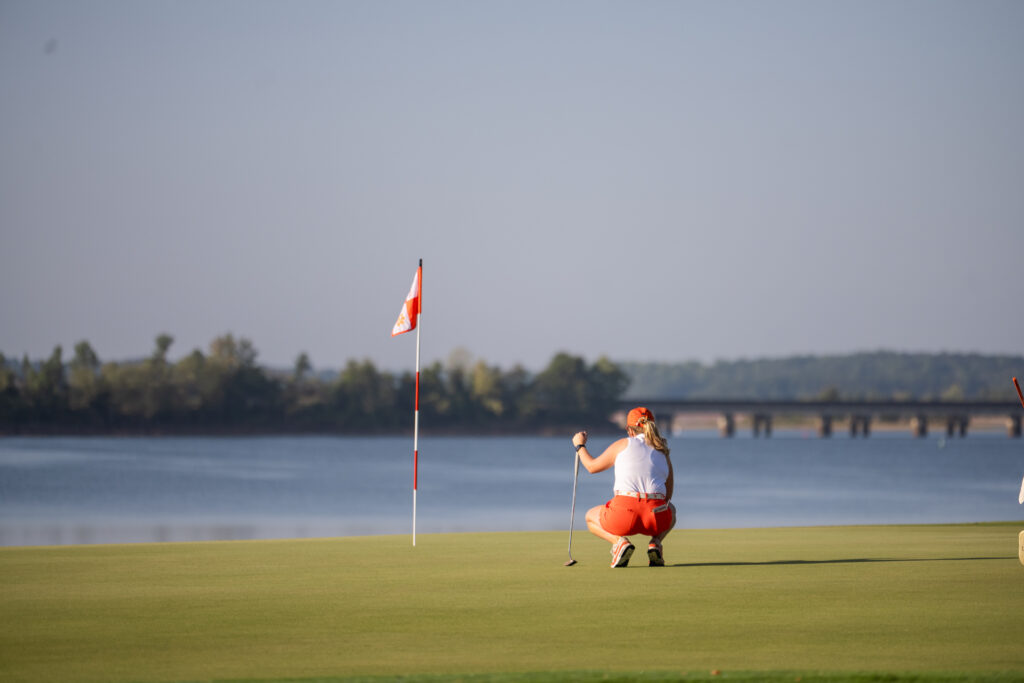
Photos by Josh Wilson, August 2024, Women’s Golf, The Walker Course, Clemson University
Women’s Golf Month is celebrated throughout June each year. This June, we celebrate Clemson Women’s Golf which has a strong history of elite performance and camaraderie with the academics at Clemson University.
Over the years, various faculty at Clemson have studied the science behind the game and its players.
Faculty from Clemson University’s Department of Bioengineering, including Interim Director of the Robert H. Brooks Sports Science Institute, John DesJardins, Ph.D., have studied ‘balance improvements and golf swing kinematic consistency with eight-week balance interventions.’ The purpose of the study, conducted in 2020, was to determine if a training program targeted specifically at balance could enhance players’ overall performance by improving postural stability and swing consistency. After studying eight NCAA Division I players, it was determined that balance training would enhance posture but, while no negative effects were measured, swing consistency did not improve. Another benefit of the study showed the importance of conducting research to help coaches and players understand both the positive and negative effects of their training programs and to potentially make modifications based on that data. While the original study was conducted with male golfers, its conclusions can be applied across teams. Click here to read the full article in the Journal of Sports Research.
Another Clemson faculty member, Gregory Cranmer, Ph.D., from the Department of Communication and fellow of the Robert H. Brooks Sports Science Institute, has studied ‘female golfer’s uncertainty management during their transition into professional golf.’ The 2020 study offers potential strategies for collegiate organizations and professional associations to prepare student-athletes for the uncertain transition into professional golf.
On August 28-29, the Tiger Golf Gathering (TGG) Foundation will host the 2025 Tiger Golf Gathering in Clemson, an annual fundraising event that benefits the Clemson Golf program. The event features a Thursday Open at The Walker Course and Auction Party in the afternoon at the Madren Conference Center and Inn. Friday morning features the Tiger-Am at The Cliffs at Keowee Springs. Meet current and former Tigers and bid on some amazing items to support your Clemson golfers. Sponsorships and online donations are also available.
Click here to learn more about Clemson’s sports science faculty.
An early morning photo of the pasture outside of Clemson’s Equine Center from the Center’s website
Leona Ransdell
RHBSSI staff fellow, Leona Ransdell, leads 4-H Equine programming for youth at Clemson University. The South Carolina 4-H Program is participating in and hosting a number of events this summer for equestrians, young and old, from the Special Olympics Equestrian State Show to STEM workshops and more.
Ransdell and the South Carolina 4-H Equine Program work in close partnership with the Clemson University Equine Center. The goal of the Clemson University Equine Center is to be a student-centered, self-sustaining enterprise that serves as a leader in the South Carolina horse industry. The Center caters to the needs of students through various means including:
Animal and Veterinary Science classes and labs
The Clemson Equine-Assisted Therapy (CLEAT) Program
Two IHSA equestrian teams
Student employment
Graduate research opportunities
Boarding
2024 South Carolina 4-H Horse Program Southern Regional Delegation
They also take seriously their responsibility to our community. Current outreach programs include:
Summer riding camps for high school students
Educational seminars and other continued learning opportunities
Applied research on industry-relevant topics
Private sales of young horses
The South Carolina 4-H Program and the Clemson University Equine Center will be hosting and working with the following events this summer:
Special Olympics State Equestrian Show (May 30-June 1)
Hosted at Clemson’s T. Ed Garrison Arena, the Special Olympics State Equestrian Show begins with an Opening Ceremony at 5 p.m. on Friday, May 30 and ends with the Equestrian Competition at 1 p.m. on Sunday, June 1. The weekend also includes a western hoedown, pole bending and barrel competition, trail competition, stall decorating contest and more.
Click here to learn more about the Special Olympics State Equestrian Show for South Carolina.
State 4-H Horse Show (June 10-14)
Hosted by the Clemson University College of Agriculture, Forestry and Life Sciences’ Cooperative Extension program, the State 4-H Horse Show incorporates indoor and outdoor activities for all levels, rookie to senior. The event features a Parade of Counties and Opening Ceremony on Wednesday, June 11 roughly 30 minutes after the morning events.
Click here to preview the tentative schedule for the State 4-H Horse Show.
State 4-H Congress (July 8-11)
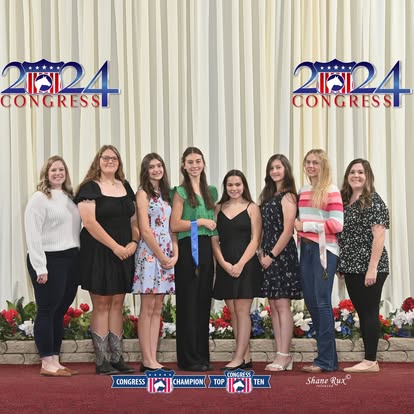
A photo from the 2024 State 4-H Congress
Hosted by the South Carolina 4-H Youth Development Program, qualified 4-H members (see website), aged 14-18 are invited to attend this year’s State 4-H Congress on Clemson University campus. The event is themed, “Beyond Our Time.” Join 4-H members from across the state as you represent your county at State 4-H Congress.
Youth will stay in the dorms, visit campus facilities and see the amazing work being done at Clemson. State 4-H Congress will celebrate the accomplishments and talents of our senior 4-H members, elect next year’s State 4-H Teen Council and provide a platform to engage in the head, heart, hands and health of 4-H through service, learning, connection and more.
Click here to learn more about the State 4-H Congress.
STEM Fest (July 19)
STEM Fest is a three-hour, community-based celebration of science, technology, engineering and math for up to 1,000 students and parents. Attendees participate in 50 hands-on stations, perform experiments, watch demonstrations and meet professionals from all different career backgrounds. Each station is manned by collegiate and professional volunteers. The upcoming event on July 19 will take place in Greenville, SC.
According to Leona, people interested in 4-H and Equine activities locally to them can reach out to their local county offices and most, if not all, offer multiple summer camps.
“For example, Newberry County has engineering camp in June, Crafty clover camp in July, Farm tour camp in July, general 4-H camp in July!” she said. “Pickens County has a Butterfly Habitat Workshop May 31 Horseless Horse Camp June 16!”
Ransdell ’12, is a Clemson Animal Science graduate passionate about horses, her community and education. She returned to Clemson in 2024 to take on her current role, which combines all of her passions into one.
“Everything we do at South Carolina 4-H and the Clemson University Equine Center is near and dear to my heart and I hope you will find one or more event this season that interests you!” said Ransdell.
For more information on youth programming at the Equine Center, contact Leona Ransdell at leona@clemson.edu. Click here to follow the Center on Facebook and click here to follow the South Carolina 4-H Livestock and Equine Program!
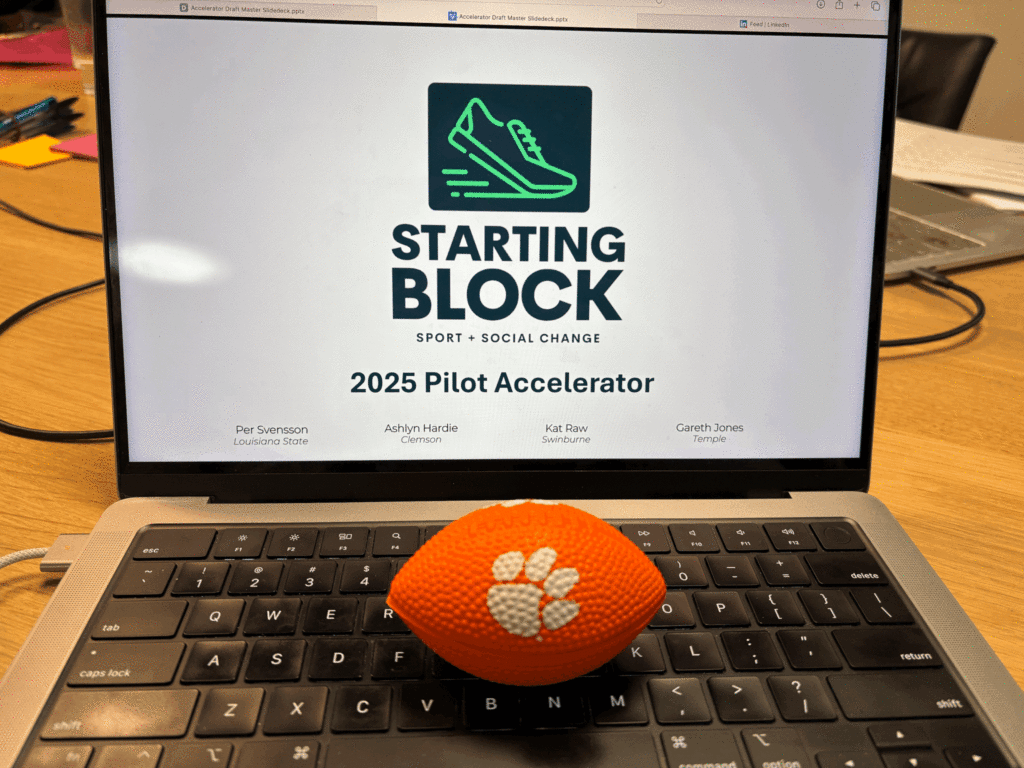
This April, Dr. Ashlyn Hardie, Institute fellow from the Department of Parks, Recreation and Tourism Management, co-led the first-ever Starting Block Accelerator in London, England with Dr. Per Svensson from Louisiana State University. This innovative initiative is the first of its kind, eliciting pioneering research in the Sport for Development and Peace (SDP) sector. Funded by RHBSSI through a seed grant awarded in 2024, this research has already led to notable, practical impacts, scholarly implications and industry partnerships.
The goal of the Starting Block Accelerator is to support nonprofit leaders, and subsequently their SDP organizations and beneficiaries, regarding various aspects of capacity building. The Starting Block Accelerator’s most distinct contribution to the SDP sector and the research within sport management is that the accelerator is entirely evidence-based and designed to bridge the gap between practice and research in SDP.
Five SDP organizations joined Hardie’s crew in London for a four-day intensive workshop where grassroots leaders from around the world were flown in to participate in a research-backed capacity building accelerator. The five organizations selected were invited because they all met the following criteria: their organizations (1) are operating in the late-start-up or early-growth life cycle stages and (2) have diverse geographic locations, cultural contents and/or sports for implementation.
According to Hardie, the goal of the Starting Block is to “bring in these organizations who have been around for a couple of years and are already doing really great things. But, despite how incredible their work is, they struggle to secure resources and make ends meet. Most SDP leaders are coaches and educators in their educational and training background, so we want to support them in developing the managerial and business-oriented skill sets needed to move further into the growth and maturation life cycle stages.”
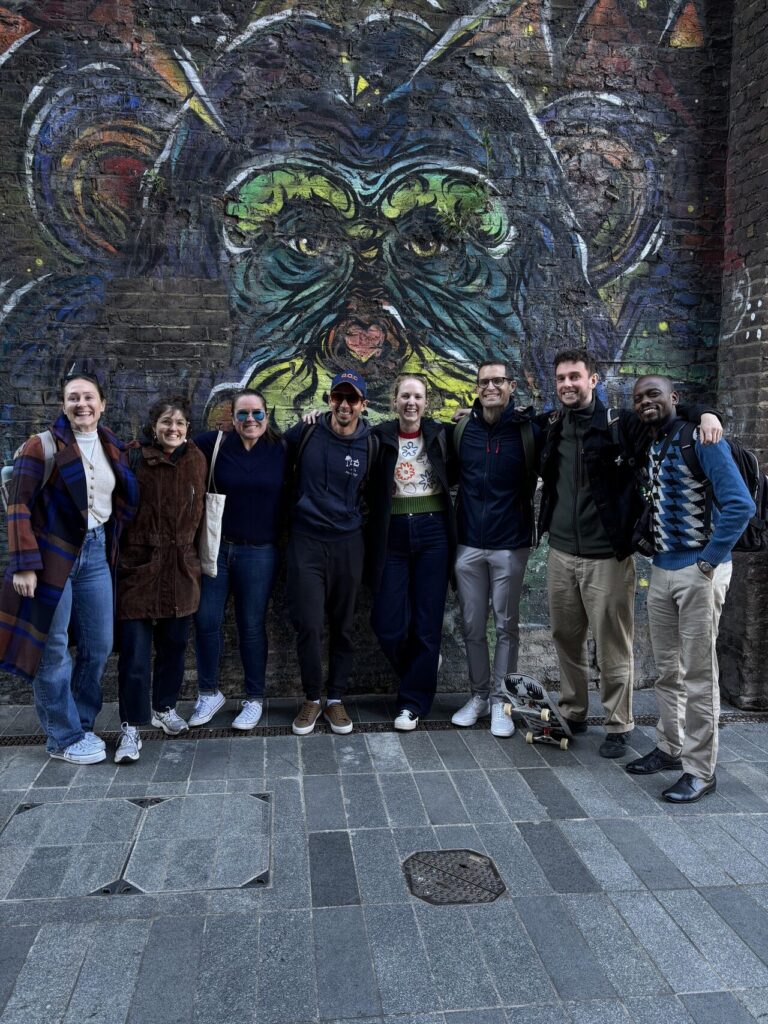
Meet the team
The SDP organizations, represented by their founders in London, included: X-SUBA, a multi-sport mechanism for youth development based in Uganda; Atoot!, a women and girls empowerment soccer organization based in Nepal; Lwandi Surf, a surf academy for local youth in Mozambique; EmpowerVan, a mobile martial arts and self defense initiative for refugees in Athens, Greece; and Free Movement Skateboarding, a skateboarding initiative for local youth participants, also based in Athens.
Accompanying Hardie, Svensson and these SDP leaders in London, was Dr. Kat Raw from Swinburne University of Technology in Australia. Though unable to attend in London, Dr. Gareth Jones from Temple University is also a research affiliate of the initiative – ultimately demonstrating the vast networking and collaborative efforts of the Starting Block Accelerator. These collaborations are not just with practitioners and industry leaders but have also led to multi-institutional academic partnerships.
The workshop
After the groups arrived in London, the first workshop day focused on foundational concepts of nonprofit management in SDP. Topics included mission statements, programmatic goals and alignment, and analyzing partnerships and surrounding operational environments for their success. Participants engaged in a series of activities to help challenge, support, refine and rewrite organizational aspects as needed. Having this strong foundation in place allowed for deeper work in the following days to ensure optimal outcomes.
“Day one was very foundational stuff, like ‘Let’s go through all these things, let’s break down the structure of your organization and really understand where you might have any gaps, whatever it is, so we can focus on where to build,’” Hardie said.
Hardie (far left) with her research team and SDP founders on day two of the workshop
Day two focused on various aspects of monitoring and evaluation, analyzing how each organization collects its data and suggesting how to build strong arguments for potential stakeholders by using data to provide evidence of their outcomes to potential partners and funders. Each organizational leader was prompted through a series of activities to contemplate their own data, access to data and opportunities for data collection that could serve their need to demonstrate effectiveness of their outcomes. Consulting was provided regarding data collection, analysis and, ultimately, the storytelling necessary to turn that data into something accessible for potential partners, funders and others.
The next day involved higher-level managerial concepts, discussing various strategies for securing funding, and practical methods for accessing and digesting evidence-based research in SDP. Given the goal of this initiative is to bridge the gap between research and practice, Hardie stated, “Our aim was to help improve their capacities to conduct their own research through developing skills and knowledge on monitoring and evaluation techniques, but also to help them understand what academic research is open-access and available to them, as well as tactics for making this research digestible for practical use.”
Hardie and her team felt this was an essential part of the accelerator, to ensure their participants knew how to access notable findings on SDP organizations. According to Hardie, so many organizations are using trial and error methods on what works and what does not, because so much of scholarly research is buried behind paywalls or written in academic language that is tough to understand for non-native English speakers.
The group working on strategies for organizational improvement in London
“There’s a massive gap, specifically in sport for development, because of the paywall and then the language barrier to such an international industry,” she said. “So, what we did on that third day was really focus on translating… how are we taking research and providing it to them in a way that has no cost and is easy to access and comprehend.”
The fourth and final day focused on developing capacities for innovation within the SDP sector. The content focused on practical techniques that each group could use to be innovative in its leadership, utilize modern resources like artificial intelligence, and strategically innovative in their brand, positioning and partnerships.
To wrap up the initiative, at the end of day four, Hardie and team hosted a networking event for the five participating founders to meet with a group of industry-leading representatives from various globally renowned funding bodies in SDP.
“We set it up like a speed dating event,” said Hardie. “At the start, each of our five participants were able to give a 5-10 minute ‘elevator pitch’ for their organization to the group of funders. Then, we created a rotation of 15-minute cycles where SDP leaders could get personalized feedback from the attending funders – likely individuals who have reviewed their applications in the past or will review applications of theirs in the future.”
A “massive success”
At the end of it all, the event was a “massive success” according to Hardie. Not only did the research team gain valuable feedback and insight from the co-design element of the pilot accelerator but, practically, there were noteworthy developments seen for each organizational leader and the capacities they developed over the week. Networking across the research team, practitioner participants and industry funders was a key takeaway from the event, as it has led to new collaborations, friendships and future funding, research and applied opportunities.
“It was really collaborative and the participants all became seemingly real friends over the course of a few days. It was really special to watch,” she said. “I think, from a positive culture and facilitation standpoint, it was a massive success. But, also from an outcome standpoint, we were so pleased with the engagement and some of the developments, ideas and next steps that came out of the week.”
Starting Block practitioners, SDP organization founders and potential funders meeting on the final day of the workshop
The organizations have expressed immense gratitude for the support they received over the week in London. Historically, SDP groups desperately look for support, seeking resources, partnerships and/or funding – all of which lead to routine rejection and feelings of defeat. To this end, Hardie noted:
“I think just participating in something like this, on its own – regardless of outcomes – restores faith for people. It heals some of their burnout. It heals some of the trauma that these organizational leaders go through by constantly feeling like they’re just hitting dead end after dead end after dead end, or getting rejected consistently by the same funding groups. It kind of breathes life into people in a way. Just like it did for our research team. It heals some of our burnout, some of our frustrations. It restored heightened levels of inspiration and motivation for our research team and those industry leaders too.”
The future of Starting Block
As for the future, Hardie’s team is collecting follow-up data from the Starting Block in London and will continue collecting longitudinal data on the outcomes from the accelerator over the next year. The cohort format is something that the research team plans to keep, bringing in five new organizations in the next cycle, potentially with the mentorship and support from organizations who participated in the cohort before them. In terms of long-term goals, Hardie hopes to finalize an adaptable curriculum and network that allows the Starting Block to support SDP organizations on a pathway out of their start-up phases, into desired positions of growth and organizational stability.
This pilot for the Starting Block Accelerator is hopefully only the start of a multi-prong initiative with resource-providing platforms, with no barrier to entry for the global community of SDP leaders.
“This type of initiative is so wildly innovative, and something that’s so hard and unprecedented to get funding for, especially in sport for development,” Hardie said. “We are sincerely grateful for the RHBSSI seed funding, because it gives really impactful and powerful initiatives like this a chance! A chance to give proof of concept, to collect pilot data to go for bigger funding and, individually, a chance for those practitioners and our research team to engage in once-in-a-lifetime work. So, for that, I am sincerely thankful.”
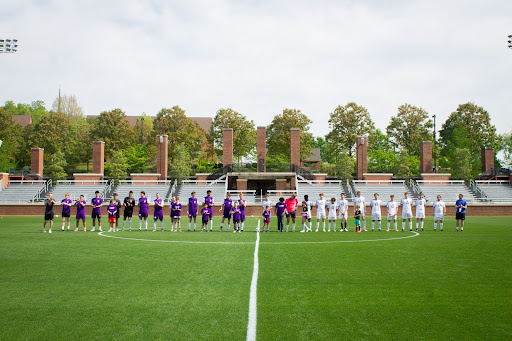
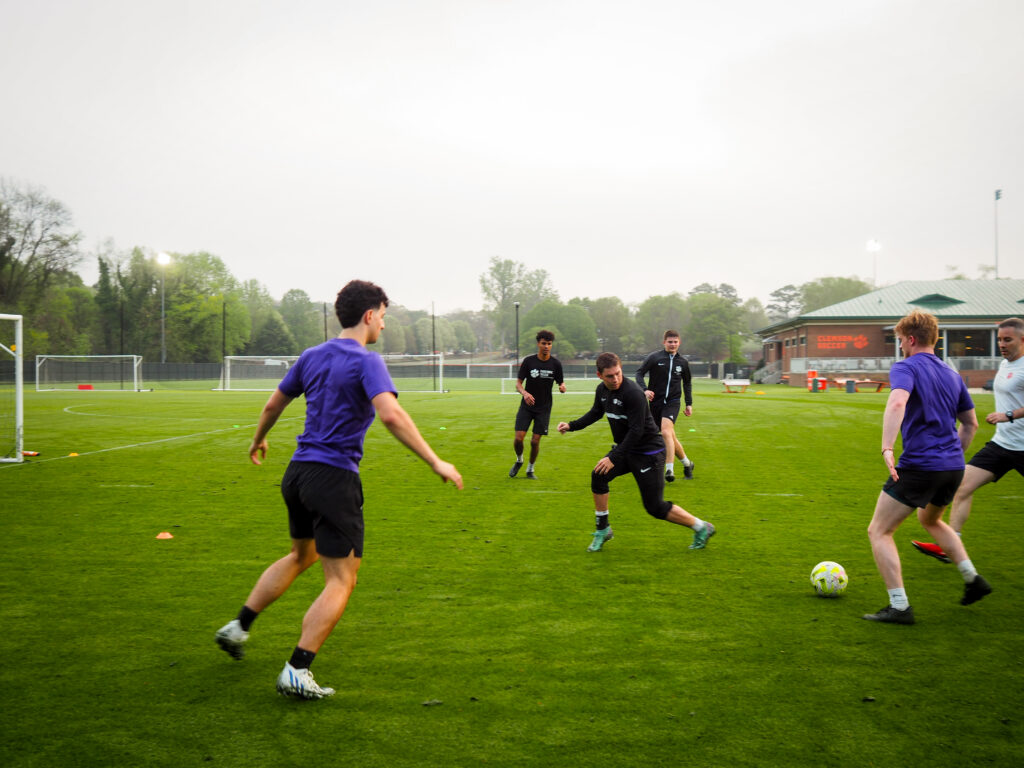
The team played and defeated the CP Soccer All Stars 6-1 at Historic Riggs Field at their first real match in program history.
Goalkeeper Max Alberici celebrates a goal with midfielder Chile Chitulangoma, who scored.
While the players lifted a trophy for the win, they weren’t just thrilled with the hardware: they were ecstatic that they even had the opportunity to play.
Shea Hammond is a graduate student in communication who has been with the team for several years, the first undergraduate player in the program’s history. Seeing the event come together was enough to inspire a win.
“It’s the name of the field. It’s historic,” Hammond said after the game. “To finally play on this field, it’s historic. It’s indescribable.”
Head coach and assistant professor in the Department of Parks, Recreation and Tourism Management, Felipe Tobar, watched his players’ dreams come true that afternoon. Many of them had dreamed of playing collegiate sports after high school, a period where many athletes with cerebral palsy (CP) stop playing.
“We’d like to say thank you to the community and the fanbase who supported us,” Tobar said. “They had a dream to play in a college stadium and they accomplished it.”
Graduate student Shea Hammond scored a hat-trick on Saturday morning.
Four different Clemson players scored, while Hammond scored a hat-trick with all three of his goals coming in the second half. One player, Tyler Bennett, is a team alumnus and one of the first two players to join the program in 2017. Bennett brought practices featuring movements, passing and other workouts from the U.S. CP National Team.
It was a new Clemson experience for Bennett, coming back to campus and playing in a full game of soccer with CP rules.
“I think it went well for the program,” Bennett said. “They showed that if you’re training here full-time, you’re going to do pretty well.”
Many faces from the Clemson Men’s and Women’s Soccer teams were present. Flags flew and celebrations commenced in the stands whenever a player scored. The entire women’s lacrosse team attended, surprising goalkeeper Max Alberici, the team’s manager.
That wasn’t the best moment of the game in Alberici’s opinion, however. His favorite experience came from watching substitute goalkeeper, Ethan Donahue, play. He joined the team several weeks before the match after Hammond recruited him on campus. Donahue and his disability were welcomed by the team in open arms.
“I was more happy to get him in the game,” Alberici said.
“There’s no relationship like an adaptive sport relationship,” Hammond said, “and like a CP soccer family.”
The match was the last that this team will play all together, as they say goodbye to Hammond following five seasons with the program. As he graduates from Clemson, Hammond looks forward to working with cerebral palsy and Paralympic athletes in the future.
The Robert H. Brooks Sports Science Institute sponsored the match’s trophy, which the Clemson CP team raised following its win.
“That’s a lifetime of work that I’m going to commit to and making sure that we can grow this program in this sport as much as possible,” Hammond said.
For Tobar, the practices and cultivation of this match proved to be a great success. Earlier in the week, the team played Daniel High School in a scrimmage to prepare for the game. Now, Tobar and his team are “blessed and honored” to have the opportunity to represent Clemson.
“That’s the only official game that we will play as a team,” Tobar said. “I could not be more proud.”
Click here to check out more photos from the match.
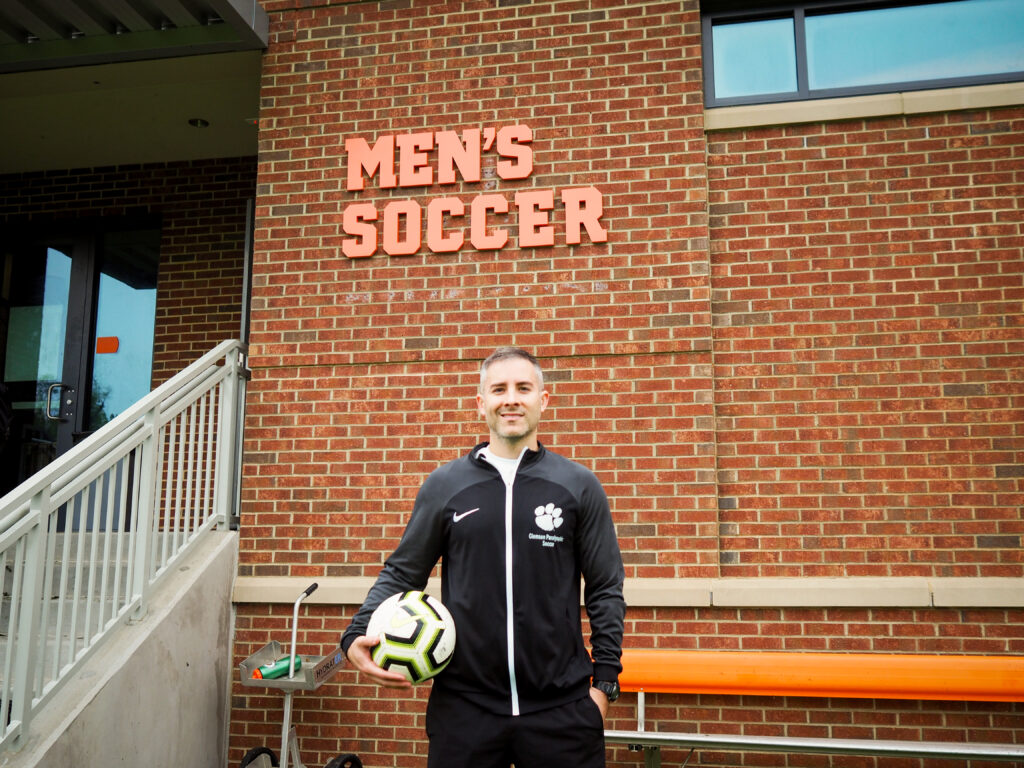
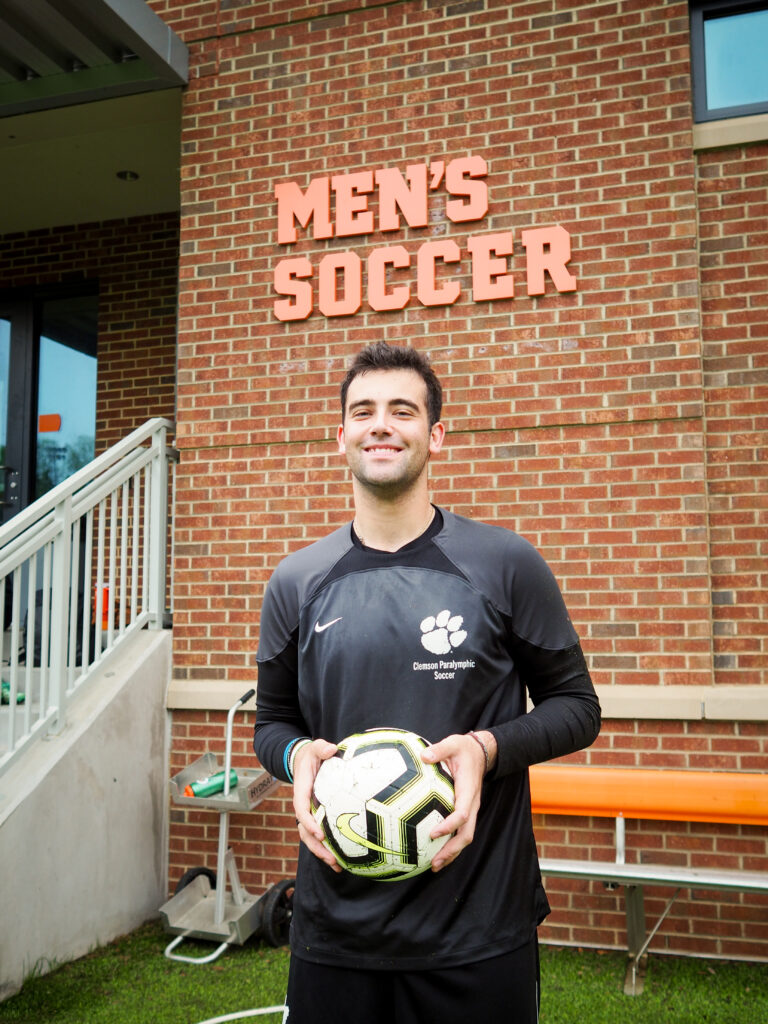
The Clemson Paralympic Soccer team gathers outside the Clemson Soccer practice facility in their new uniforms to prepare for the historic match on April 19. (Photo by Natalie Bell)
Clemson professor of sport and recreation management in the Department of Parks, Recreation and Tourism Management (PRTM), Skye Arthur-Banning, was at the London Paralympic Games in 2012 with a group of students when an idea came to him.
Five years later, that idea would form Clemson Paralympic Soccer, the only collegiate program of its kind in the nation. Now, on April 19 at 11 a.m., the team will be playing their first-ever match in front of a crowd at Historic Riggs Field.
Several Clemson Paralympic Soccer players receive national team call-ups by the U.S. Men’s CP National Team, where they play around the country and even across the globe.
History of Clemson Paralympic Soccer
Arthur-Banning was a soccer referee in 2012 working various professional leagues and U.S. Open cup games. Following the 2012 Paralympic Games, he decided to devote his time to Para soccer, seeing the high performance of blind and cerebral palsy (CP) soccer players during that time.
“Instantly, I knew that was my next step,” he said. “There’s my next opportunity to continue refereeing, but also begin to support those with disabilities in sport environments.
Clemson Paralympic Soccer Head Coach, Felipe Tobar (Photo by Natalie Bell)
Felipe Tobar, assistant professor in the PRTM department, is head coach of the team. Arthur-Banning took notice of Tobar in 2021 while he was assistant coach for Daniel High School’s varsity soccer team.
“They needed a coach, so they needed structured training sessions,” Tobar recalled. “Since I was doing that at Daniel, he invited me to join the program as a head coach. I immediately said yes.”
Strength through adversity
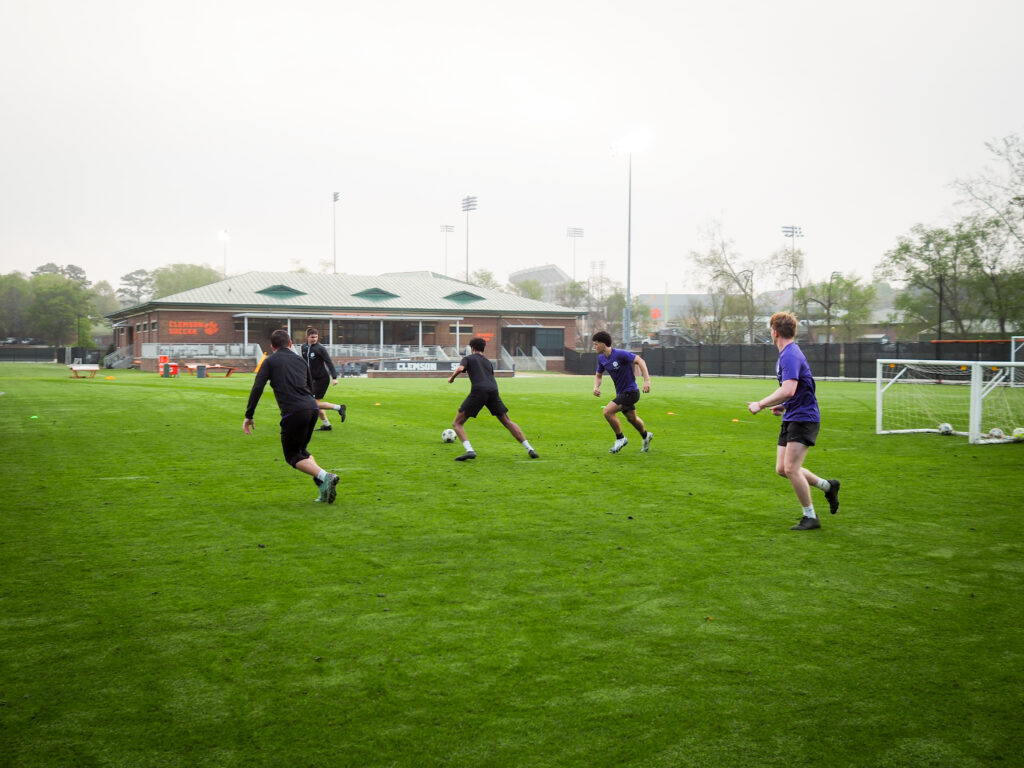
The team is gearing up for its first-ever match on April 19 at Historic Riggs Field at 11 a.m. They practice three times a week to prepare.(Photo by Natalie Bell)
Strength through adversity is the team’s motto. Tobar encourages the team to play and live by this every day.
Currently, the team is made up of six players who have cerebral palsy, a neurological condition that can affect movement and posture. They also welcome players who have suffered a stroke or any severe brain injury.
Tobar has a connection with brain injury through his mother who had a stroke in 2011. He took care of her for eight years in Brazil before moving to the U.S. to earn his Ph.D. in parks, recreation and tourism management at Clemson.
“I saw what a stroke can do to a person, and I empathize with the players,” he said. “I had this background with my mom in which you can’t treat them as victims, you have to really see them as equals.”
Tobar pushes his players with drills and feedback three mornings a week.
“We keep the sessions intense and I don’t treat them differently,” he said.
Goalkeeper Max Alberici is the team’s starter, who saw an opportunity to play sports at the collegiate level and joined Clemson Paralympic Soccer.(Photo by Natalie Bell)
The players expend three times the amount of energy on the field as able-bodied soccer players due to quicker muscle fatigue – therefore, their recovery process takes longer.
For goalkeeper Max Alberici, who has spastic diplegia which affects more than one limb, he burns almost four times more energy than the average player. Alberici is a senior sports communication major who grew up playing lacrosse but saw this as an opportunity to continue playing sports in college, which was his dream.
“I hadn’t played organized soccer since eighth grade and I just go ‘okay, I’m doing this,’” Alberici said when he first heard about the program.
Now as the team’s starting goalkeeper, he embraces the training sessions and their intensity.
“There is definitely an intensity that I do enjoy and I had to learn to enjoy,” Alberici said. “But I think overall, I think having a game to work towards is going to make this a lot easier, mentally, for me.”
Because this program at Clemson is unique, four of the team’s six players are also part of the player pool for the U.S. Men’s Cerebral Palsy National Team, where they are regularly picked to play.
Chile Chitulangoma is a defensive midfielder that has been with the team for three years, becoming a regularly called-up player on the U.S. Men’s CP National Team. (Photo by Natalie Bell)
Midfielder Chile Chitulangoma, a junior mechanical engineering major, is one of those players who joined in the fall of 2022. He is hemiplegic on the left side of his body affecting his strength and coordination, but takes advantage of playing quickly to overcome these obstacles. He describes the practices as tactical.
“A lot has to do with technical ability being refined with your technique on the ball,” Chitulangoma said. “So, a lot of the work we do has to do with a lot of different passing patterns and precise movements.”
In the beginning years of the program, the team would practice at local recreational fields like Nettles Park and the Snow Family Outdoor Fitness and Wellness Complex. Since 2024, the team practices at Clemson Soccer’s men’s and women’s practice facilities with help from Clemson Athletics.
“Athletics has given a lot of support to us,” Tobar said. “That elevated the level of our training sessions.”
As the only U.S. school with this type of program, Clemson allots eight scholarships that allow out-of-state players to pay in-state tuition — the only university in the world that does so for CP soccer.
The match
Tobar describes the upcoming match as a debut for everyone — the first time Clemson Paralympic Soccer will play against other Paralympic soccer players from across the country for a trophy.
“We hope this game will bring attention to our program and the University this week,” Tobar said.
Players who have recently been admitted to play for the Tigers next season will also be on this all-star team of contenders. The captain of the U.S. Men’s Cerebral Palsy National Team, Josh Burnais, will be coaching the opposing team.
CP soccer rules are slightly different from traditional soccer rules. The game will be played in two halves, each 30 minutes long. Compared to soccer’s standard 11-on-11 format, CP soccer is played 7-on-7 with field dimensions and goal sizes a little smaller.
Clemson Paralympic Soccer Team practicing for the upcoming match (Photo by Natalie Bell)
Throw-ins can change to simply rolling the ball in underhand. If the ball unintentionally hits the CP-impacted hand in a natural position, there is no handball offense. These changes were made based on how the body functions for a CP player.
The event on April 19 will also be open to children with disabilities in the Upstate to have a one-hour clinic with the team from 9 to 10 a.m. to meet and play together. During the starting lineups, they will enter the field with the players.
“We want them to see their future on the pitch, so they can reflect and see that although there are barriers that they are going to face, it’s still possible to strive and succeed,” Tobar said.
For many of the players, it is a dream come true. Alberici grew up wanting to play in a stadium, and now his dream is becoming a reality.
“My main goal was always to be a college athlete,” Alberici said. “The soccer piece was much later than almost every single one of my teammates, but I’d never thought I’d play college sports in a college stadium.”
Meanwhile, for players like Chitulangoma, educating the public about overcoming adversity is what is most exciting.
“I think it’s a very unique opportunity to [educate about my disability] with a game of soccer,” Chitulangoma said. “I don’t think there’s a better way we could show our game and our disability to the community.”
Clemson Athletics is supporting the event. The day will see several Clemson Men’s and Women’s Soccer players making an appearance, with some taking part in halftime promotions.
Tobar also plans to auction signed soccer balls and other items to fundraise for the team.
That same weekend, Clemson Adaptive Sports and Recreation will be hosting the Palmetto Games, a regional adaptive sport event featuring track and field, swimming and air rifle competitions.
“We want to have as many people as possible,” Tobar said. “There are no other sports that are going to be playing that morning, so it’s a full day of Para sports.”
With kickoff set for 11 a.m. on April 19, Arthur-Banning, Tobar and the team are ready for their first organized CP game in program history, hoping to spread more awareness about Para sports and the work that the players have put in.
“I think this game provides that opportunity for them to showcase all the hard work that they’ve put in, all the skill and talent that they have and, hopefully, be able to do that in front of not only their Clemson peers, but their community at large,” Arthur-Banning said.
“This gives them that opportunity to show that off a little bit and feel like this is their payback, if you will. This is their moment.”
Arthur-Banning and Tobar are faculty fellows of the Robert H. Brooks Sports Science Institute at Clemson, sponsor of the trophy for the historic Paralympic soccer match.
The New Way Sport Fund (NWSF), directed by Ashlyn Hardie, Ph.D., faculty fellow of the Robert H. Brooks Sports Science Institute and assistant professor in the Department of Parks, Recreation and Tourism Management, and funded by the Center of Sport Management Research and Education at Texas A&M and the GYS4D Initiative, continues to create waves in the sports development sector. After securing funding and supporting five innovative grassroots organizations worldwide this spring, the fund is already seeing tangible results in the communities it serves. These groups, from Brazil to Uganda, represent a diverse range of initiatives that use sport as a tool for positive social change, and NWSF’s support is helping them take their missions to the next level.
Proyecto Social Skate – Brazil: a safe space for cultural integration
Proyecto Social Skate Ramp
Based in Brazil, Proyecto Social Skate uses skateboarding to create a safe space for diverse groups, particularly refugee families, child immigrants and indigenous populations. With the seed funding, they expanded their skate ramp to accommodate a 20% increase in participants and purchased essential equipment including skateboards, knee pads and helmets. This expansion allows Proyecto Social Skate to continue bringing together young people from different ethnic and cultural backgrounds, offering them a place for sport and an opportunity for cultural assimilation and integration
Comisión Mujer Joven – Nicaragua: empowering young women through sport
In Nicaragua, Comisión Mujer Joven is using the funding to invest in equipment, field space and curriculum development for young women. One of the most exciting outcomes so far is their new mental health support initiative. The group has provided a counselor for all 92 participants, helping athletes navigate concerns outside of performance—such as personal or mental health struggles. Additionally, Comisión Mujer Joven is hosting a tournament to raise funds and sustain their initiatives, demonstrating their forward-thinking approach to financial sustainability.
Girls in Football – Lebanon: overcoming barriers in sports for women
The Lebanese organization Girls in Football, is focused on breaking barriers for women in sports. With NWSF’s help, they have been able to pay for coaches and rent field space. This investment is key to their mission of providing girls with the opportunity to play football in an environment that supports and encourages their participation.
Rural Disabled Women Association (RUDIWA) – Uganda: education and inclusion for disabled women and girls
RUDIWA, based in Uganda, is using its funding to support disabled women and girls by offering access to education and sporting programs. The organization has provided books, menstrual hygiene products and other supplies to 25 participants who could not afford them. Beyond that, RUDIWA has created inclusive sports programs where women with disabilities can engage with their community, find fellowship and gain valuable life skills. By providing educational resources and sport opportunities, RUDIWA is fostering greater inclusion and empowerment.
Impact Academy – Egypt: a boxing academy for women and girls
Impact Academy Participants
In Egypt, Impact Academy, a boxing initiative for women and girls, is saving its funding to secure a permanent practice space. This thoughtful, strategic move will allow them to create a safe, self-sustaining space for their athletes, free from the disruption they often face in rental facilities. Impact Academy is planning to use their space for training and to generate income, making this an example of sustainability in action.
A focus on capacity building and future plans
One of the key elements of the NWSF is its commitment to supporting both immediate needs and long-term sustainability. Each of the five groups has been allocated 10 capacity-building hours to help them with essential areas such as grant applications, financial management, curriculum development and more. These tailored consultations aim to empower the organizations to become self-sufficient and expand their impact.
“We’ve heard from many groups that this funding is life-changing,” said Hardie. “This is often the first time they’ve received unrestricted funding, which allows them to make their own decisions on how to spend the money. That level of trust and flexibility is incredibly empowering.”
The fund has also received positive feedback for its accessibility.
“The application process was so easy, and we really appreciate the opportunity to learn how to do things on our own,” said one participant. Many organizations expressed gratitude for the opportunity to be guided in a way that respects their local expertise while also offering valuable resources for their growth.
Looking ahead: round two of funding and research initiatives
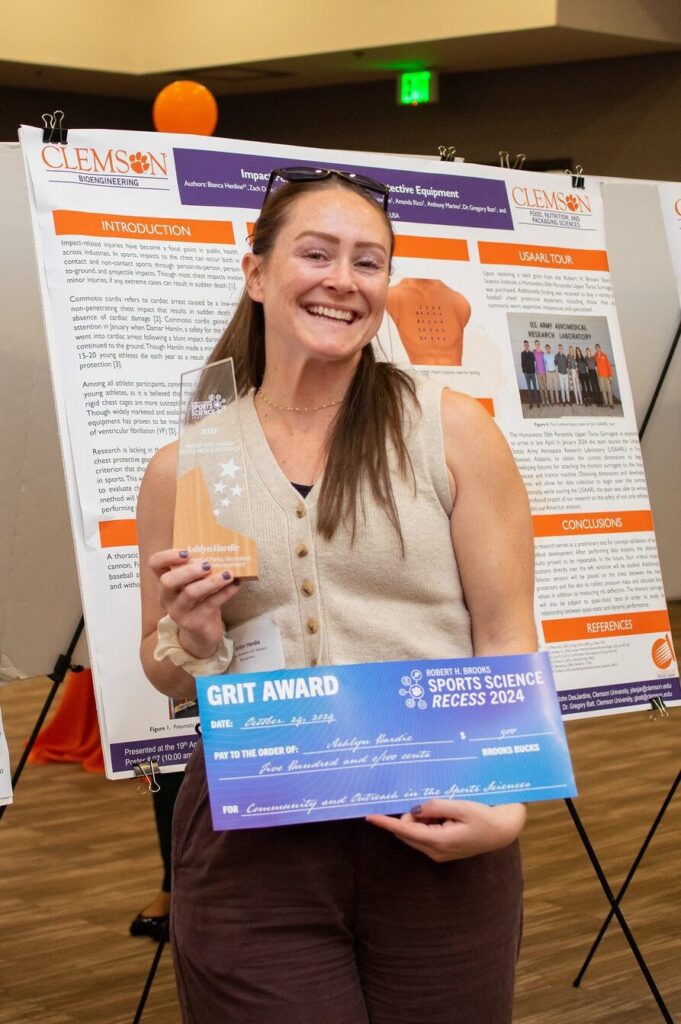
Ashlyn Hardie winning the GRIT award for her New Way Sport Fund
As the summer approaches, NWSF is gearing up for round two of funding. With funding support from the Center of Sport Management Research and Education at Texas A&M University already secured for the next funding cycle, the call for applications will open in July, allowing for new organizations to benefit from this funding mechanism and the embedded support resources. In the meantime, NWSF is conducting research on the outcomes of the funded groups, collaborating with Marlene A. Dixon (Texas A&M), Dr. Kat Raw (Swinburne Institute of Technology in Melbourne), and Dr. Per Svensson (Louisiana State University) to assess what strategies are most effective in creating sustainable change through sport.
As Hardie highlights, “I could not be leading this on my own. Essential collaborators and supporters include the funders — CSMRE at Texas A&M and the GYS4D Initiative — along with the Practitioner Advisory Committee, which consists of Nora Dooley, the director of Soccer Without Borders, Juliana Roman, member of La Nuestra Feminista, and Pappu Modak, secretary and head of Sports and Hope for Independence.”
With a focus on collaboration, trust and empowerment, the New Way Sport Fund is paving the way for a more inclusive, sustainable future for sports-based social change worldwide.
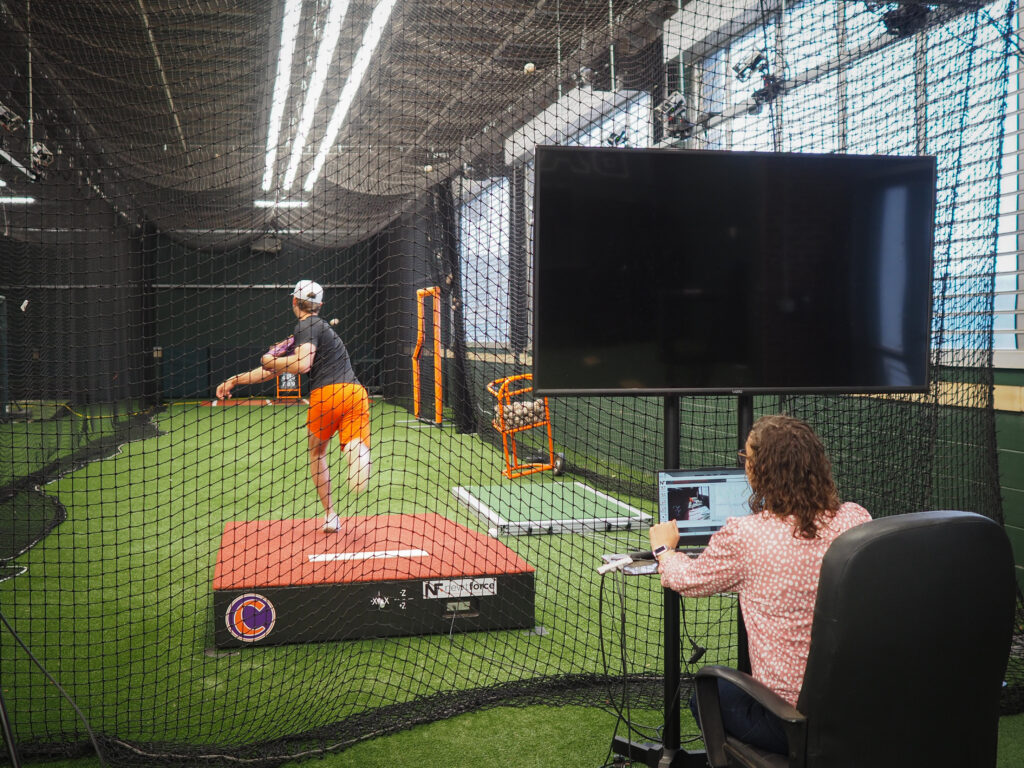
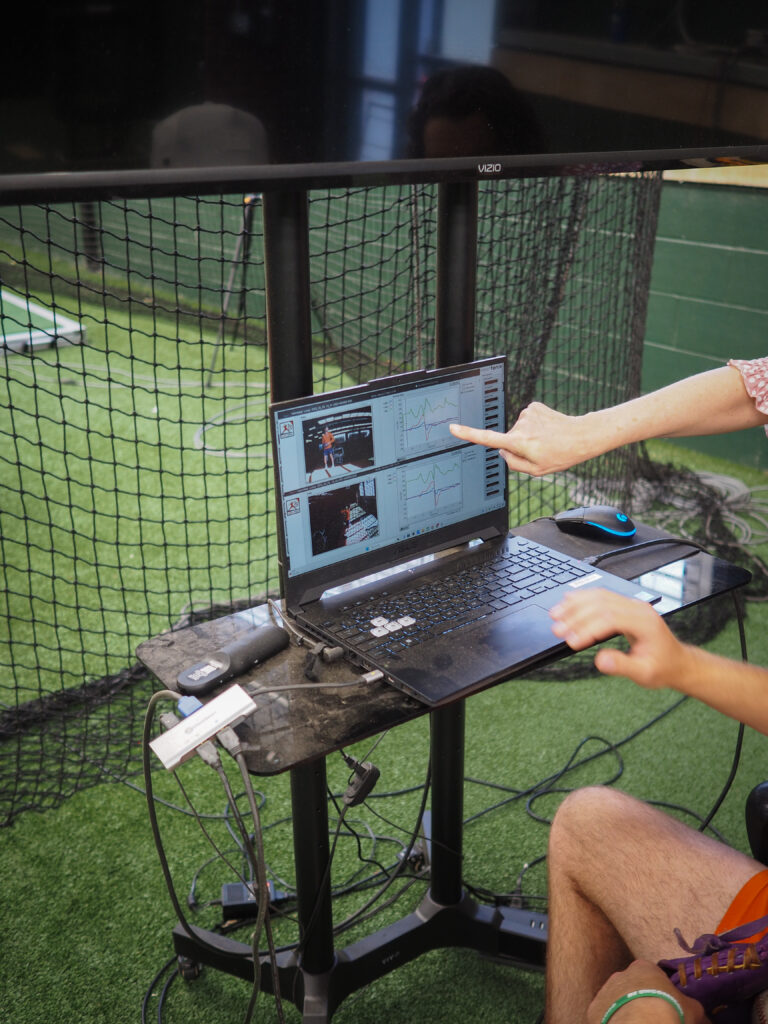
Amy Pope analyzing Lucas Mahlstedt’s pitching data (photo by Natalie Bell)
By Griffin Barfield
Lucas Mahlstedt, senior Physics major, has joined forces with Physics lecturer, Amy Pope, to analyze pitching data to examine how the mechanics of a baseball pitch relate to pitch velocity. . One of Clemson Baseball’s top relief pitchers, Mahlstedt is combining his love for the sport and physics to complete his senior thesis this semester.
Mahlstedtdemonstrating throwing motion (photo by Natalie Bell)
“Our main goal is to figure out what increases pitch velocity the most because there’s so many different ways,” said Mahlstedt. “So many different pitchers have different mechanics. You’ve got guys who throw from the side, up top, guys with different arm action.”
Mahlstedt’s throwing motion is a ‘submarine’ throw, which means his toss closely resembles an underhand throw by whipping his arm around his body, allowing the ball to come from different angles. The motion is untraditional compared to a pitcher that throws over their shoulder. Regardless of throwing motion, size and age, Mahlstedt is interested in establishing a consistent variable through physics that pitchers can use to improve their game.
“So, we’re trying to find something consistent that every pitcher could use at different levels,” he said.
The physics of sport
Pope teaches the physics of sport at Clemson. Her work intersects with different sports like football and, most recently, breakdancing which was introduced in the 2024 Paris Olympics. She has also worked closely with golf and ski jumping. This is her first time working with baseball student-athletes.
From golf to baseball, Pope describes how ball material makes this study different from one she had conducted with Clemson Golf students.
“I’ve worked with some of my students who have been in golf and we’ve looked at Trackman data for that,” Pope said. “Golf is difficult because the balls have dimples, which give a lot of additional air flow and make the ball stay in the air longer.”
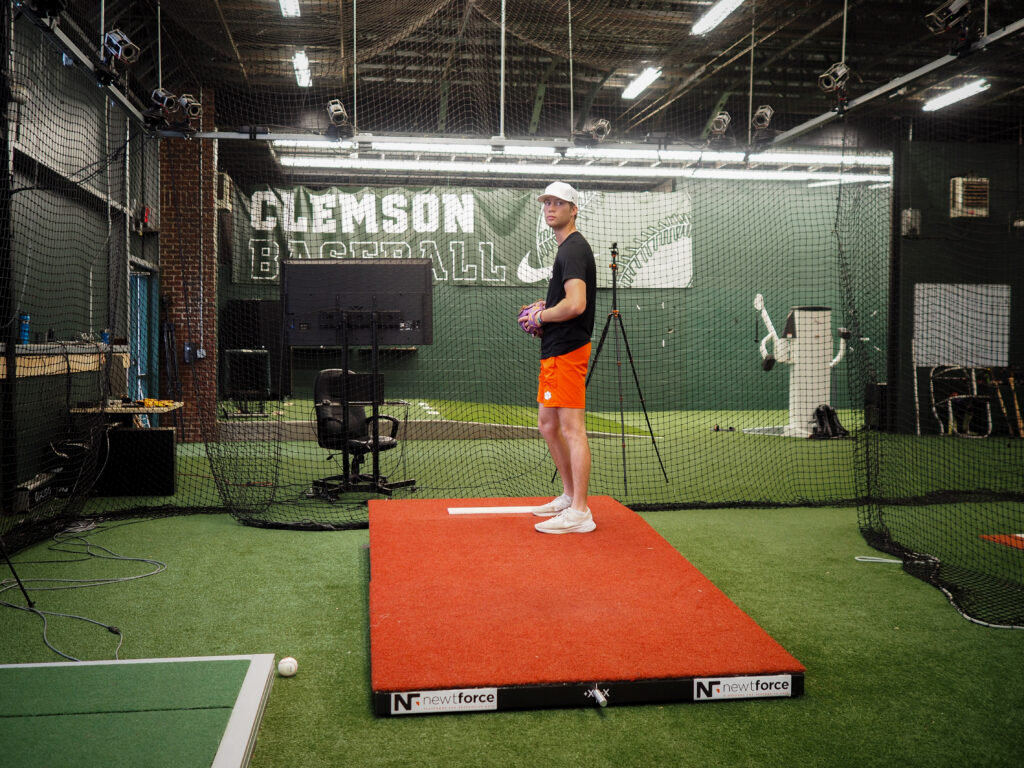
Using a Newtforce Mound to collect data, Mahlstedt has narrowed down variables that could help detect a linear relationship for faster pitches.
“The Newtforce Mound looks like a piece of plywood that’s at a little bit of an incline,” Pope explained, “and whenever you are stepping on the plate, it’s recording all of the forces that are acting on it in three dimensions at one time.”
A radar gun is also used to detect the speed of each pitch.
Mahlstedtgearing up to pitch.
With the help of these tools, Mahlstedt believes that the acceleration impulse of the pitch, or the ground force measured from the pitcher’s leg lift, could be the variable he’s been looking for.
The two compared Mahlstedt’s data with other pitchers and managers on the team, who participated in the research, and they saw a linear correlation.
“For multiple pitchers, we have observed that the larger the impulse put into the ground during the pitch, and conversely, the harder the ground pushes up on the player, the faster the exit velocity of the ball,” Pope said.
While there are various details that could be factors, such as stride length in the pitcher, their arm strength and effective kinetic chain of their arm movement, the two are putting their attention to how the ground forces affect the exit velocity of the ball.
“I think we narrowed it on mainly focusing on the lower half of the body,” Mahlstedt said.
With a full-body sport like baseball, there is high injury incidence at all levels. Baseball pitchers face risk of serious injury throughout their careers; therefore, performance cannot be fostered without a serious look at injury prevention.
“We can talk about injury prevention because if you can get that lower half of your body into it, you’re going to be able to throw the ball faster without risking your throwing arm as much,” Pope said.
“If you can generate more velocity from [your lower body], it should be less from [your upper body], at least,” Mahlstedt agreed.
The results are in
For the Clemson pitcher, the results have been working. As of April 2, the pitcher has a 1.09 earned run average(ERA), striking out 34 in 24.2 innings pitched this season, and an opposing batting average of .180. Mahlstedt has also noticed that he has “been throwing harder” over the course of this season.
Pope and Mahlstedtreviewing results
The senior has been using a larger acceleration impulse for his pitches, heightening the force that he puts in the ground from his leg lift. From this force, and according to Newton’s third law of motion, the opposite reaction that the ground gives him the force that he needs to throw faster.
If this variable is important, how, then, does an athlete train to increase their acceleration impulse?
“A lot of water bag drills,” said Mahlstedt. “It’s used for stability, but if you take a water bag and you move it and you kind of rock, you almost feel this impulse with the water sloshing back and forth. It just improves stability.”
Jumping exercises, such as one leg jumps, have helped Mahlstedt’s transfer of force, which would allow for a linear increase.
“That has led to that increase in acceleration impulse and then an increase in velocity,” he said.
As for the future, Mahlstedt and Pope will be further researching how the upper and lower body interact during a pitcher’s career progression, hypothesizing that measuring the lower half of the body could lead to more findings that will help pitcher training.
“The kinetics with the ground forces in the lower half is easier because we have to do the force itself,” Mahlstedt said.
“We’re looking at ways that we can quantitatively say that most players, if they do this, they should be throwing the ball faster,” Pope added. “Each athlete is very individualized with their body mechanics and in what they do, so we’re just trying to look at some overall metrics that a player might be able to look at to see if they can improve that metric and, thereby, improving their pitching speed.”
Injury prevention was another future topic mentioned, due to the amount of pitchers that suffer upper body injuries from body fatigue. Most of the research released about baseball pitchers is about injury prevention, and the two are interested in evaluating how their research on lower body forces can add to prevention.
“If you can focus on the lower half to increase the speed of the pitch,” Pope said, “that’s probably less damaging to the arm. Not a lot of pitchers go out because they injure the lower half.”
Whether the MLB Draft or a future in baseball is in the cards, Mahlstedt hopes that his research will be the continuation of something important, whether in pitcher development or injury prevention, on the baseball diamond.
March is Brain Injury Awareness Month, a national holiday led by the Brain Injury Association of America each year. Gregory Cranmer, Ph.D., associate professor in the Clemson University Department of Communication, is a scholar passionate about finding ways to provide meaningful and safe experiences for athletes through coaching, health interventions and socialization.
Sport-related concussions, or SRCs, are a significant health risk for athletes – and are generally underreported, increasing the risk for more severe outcomes. Cranmer and colleague Daniel Hartman, graduate teaching assistant in the Department of Communication at the University of Illinois, sought to understand the barriers that high school athletes across 20 sports face to reporting their concussion symptoms and how coaches play a part.
“Coaches play a pivotal role in promoting safety and health,” said Cranmer, “but concussion symptom reporting has been insufficient across the board.”
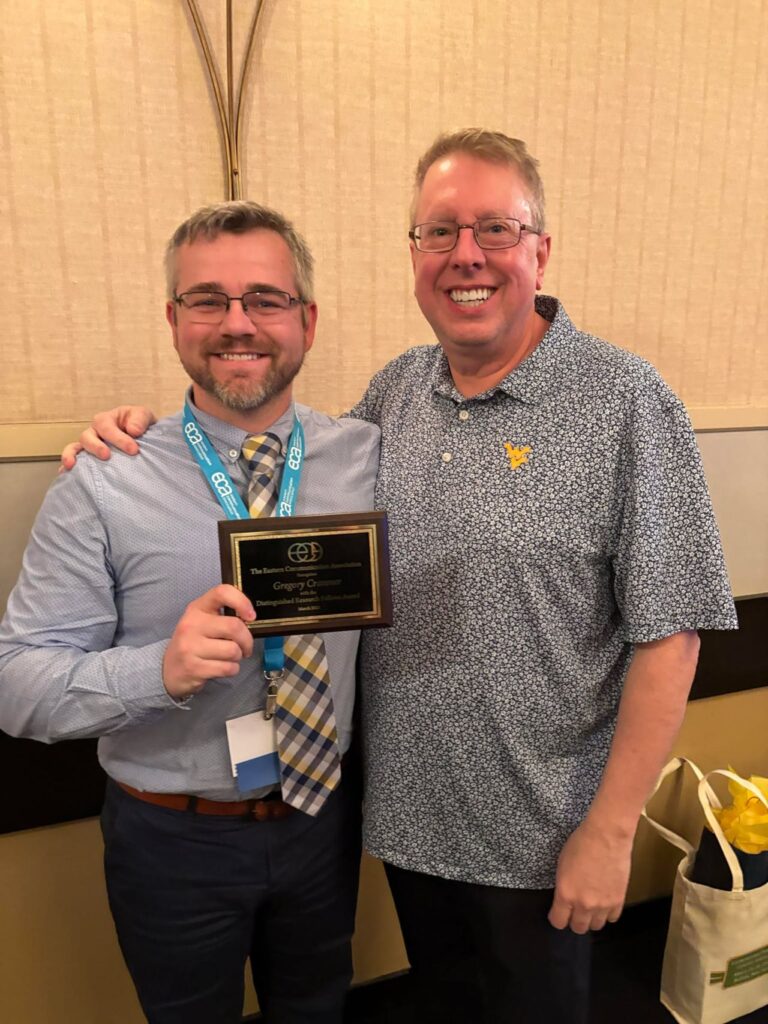
On March 29, Cranmer was honored as a Distinguished Reseach Fellow for the Eastern Communication Association. This means he is now part of the top 1% of researchers for the oldest communication association in the country.
Cranmer has been a faculty fellow of the Robert H. Brooks Sports Science Institute since 2017. Click here to connect with him on LinkedIn.
SunWoo Park, Clemson Ph.D. candidate, presents her research on the college football sport experience at a CSRI poster session
Clemson University’s Robert H. Brooks Sports Science Institute (RHBSSI) recently showcased at the College Sport Research Institute’s (CSRI) annual conference on college sport held March 19-21 in Columbia, South Carolina.
CSRI’s mission is to encourage and support interdisciplinary and inter-university college sport research, serve as the research consortium for college sport researchers from across the United States, and disseminate college sport research results to academics, college practitioners, and the general public.
As a premiere sponsor of the event, RHBSSI contributed to the success of the conference and engaged in meaningful discussions with scholars, practitioners and industry leaders studying college sport. Several RHBSSI faculty fellows and Clemson students attended, gaining valuable insights and sharing their cutting-edge research and innovation in sport. This gathering highlighted the Institute’s commitment to advancing research, education and collaboration on issues in intercollegiate athletics.
Clemson expertise on college sport
Faculty and Ph.D. students from the following Clemson departments attended the conference on behalf of RHBSSI and presented their research on college sport.
Chris Corr, Clemson University / Robert Hoffman, The Pennsylvania State University Abington / Richard M. Southall, University of South Carolina / Christopher Atwater, Troy University
Sarah Stokowski, Clemson University / Alex E. Chisholm, Clemson University / Andrew Rudd, Franklin Pierce University / Michael Godfrey, Clemson University
“‘Thank you to the Institute for supporting me to attend CSRI,” said Sarah Stokowski, associate professor of athletic leadership in the Clemson University Department of Education and Organizational Leadership Development. “I had the best time! It was also nice to see so many of my Clemson colleagues in attendance.”
Sponsorship impact
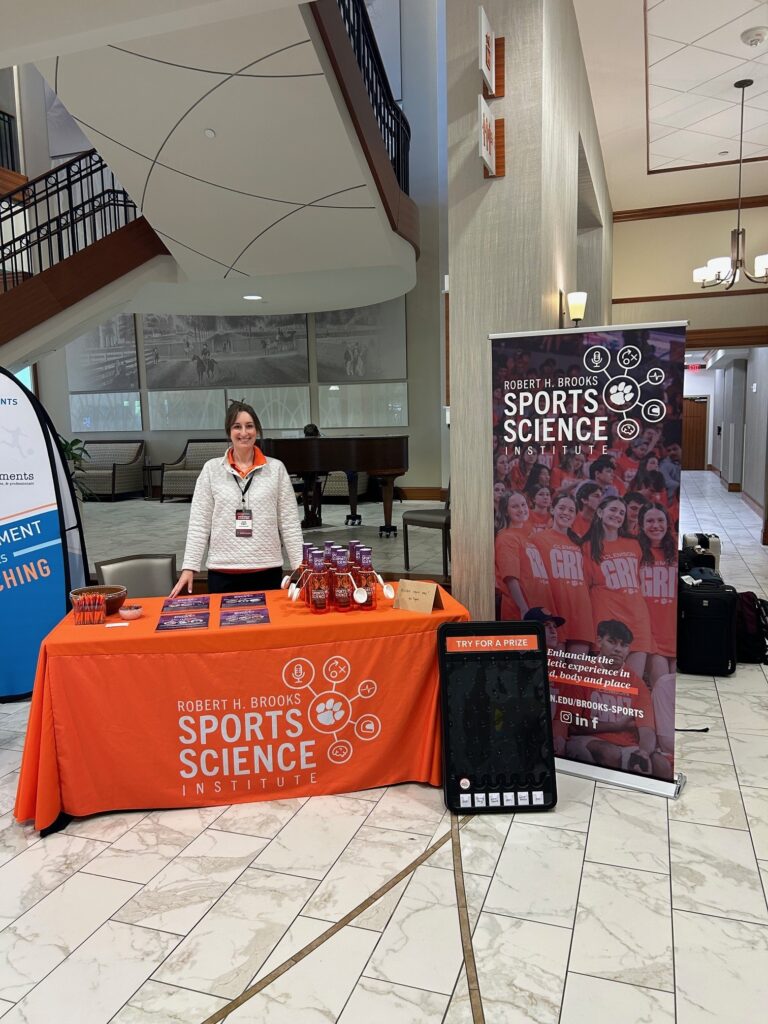
RHBSSI Assistant Director, Kayla Rogers, at the sponsorship table
“The CSRI conference provided an engaging venue to meet experts from across the country leading the academic study of college sport,” said John DesJardins, interim director of RHBSSI. “Our faculty fellows from Clemson’s College of Education have a rich history of attending, presenting at, and leading the conference, and we were honored to be involved this year and support several faculty and students to attend and present.”
RHBSSI set up a table at the event, providing an established space to meet attendees and talk about potential cross-over.
“Partnering with CSRI was the perfect opportunity to support Clemson faculty in the field and facilitate more cross-collaboration – between our faculty and those at other universities studying intercollegiate athletics,” said Kayla Rogers, assistant director of RHBSSI.
“Brooks helped make the conference be the best that it could be and I’m beyond appreciative and grateful,” said Chris Corr, executive director of CSRI and senior lecturer at Clemson University.