University Facilities

Construction of a New Water Tank to Strengthen Campus Supply

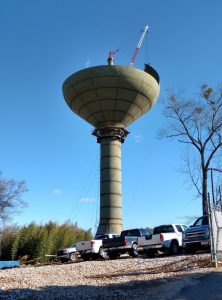
A photo of the new water tank currently under construction, dated January 2017.

University Facilities helps ensure that the university has a reliable supply of safe drinking water. The Anderson Regional Joint Water System (ARJWS), a regional water utility provider, serves as our primary source.  The University owns the distribution system that provides 23,000 students with water for domestic and sanitary purposes as well as fire protection.  State regulations require mid-size community systems such as Clemson’s to maintain a storage reserve of two hours of combined peak hour usage and fire protection; or one half maximum day usage, whichever is greater.  As our campus continues to grow, our need to keep pace with these regulations is driving the construction of a new water tank near Kite Hill.

History

Clemson University had its own conventional water treatment plant until February of 1989.  At that time, it began purchasing water from Duke Power Company.  Duke Power owned and operated a water treatment plant on Lake Hartwell near Anderson, SC, and provided water service to the university and other public utility systems within the region. During this time, the campus received its water through a 24-inch transmission main along US 76 from Anderson to Clemson.  In May of 2002, Duke Power sold their water supply facilities and operation to the Anderson Regional Joint Water System (ARJWS).

Today
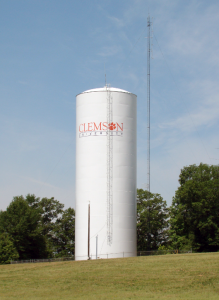
Photo of the Kite Hill standpipe water tank.
The current Kite Hill tank is an example of a standpipe water tank.

The current Kite Hill water tank was erected in 1958. While its existing standpipe storage can contain up to 1 million gallons of water, only about 150,000 gallons is usable due to limitations intrinsic to its design.  The university has an estimated critical water need of 450,000 gallons per day with a typical daily water consumption of 1,000,000 gallons per day.  As the campus population increases, facility growth on this system will require our water storage capacity to be significantly improved by 2018.  Building a new water tank near Kite Hill encompasses planning for the replacement of both the Clemson House and Kite Hill water tanks with a single tank installation. Doing so will consolidate and increase the overall usable water storage to satisfy the main campus’ long term water storage requirements. 

Benefits to the University

Replacing the current Kite Hill water tank with a new elevated storage tank will benefit the campus in a number of ways:

  1. In the event of a major water disruption such as pipe burst, the reserve water supply in the new campus elevated tank will increase from less than 8 hours to over 2 days in tandem with campus emergency conservation response planning (e.g. no outside water use).
  2. The new tank will allow us to use the full 1-million gallon capacity; the old tank was limited to 150,000 gallons.
  3. It would serve as the university’s long term solution to satisfy requirements for back-up pressurization and capacity for a licensed distribution system.
  4.  A larger working volume tank will be an improved pressure buffer to the water transmission and pumping system operated by ARJWS
  5. A single large capacity tank will allow ARJWS to pump water at lower cost off-peak times which may help control future water rates and lower peak time transmission line velocities, thereby delaying the need for future water transmission line capital improvements assessed as part of our future rate increases by ARJSW.

In addition, the water tank would serve as significant landmark for the University.

While our aim is to increase overall capacity, our intent dovetails with campus efforts to conserve water. Growth, not waste, is the impetus to this project.  With this upgrade to our supply, Clemson University will be able to support campus drinking water needs beyond 2035. 
North and South Chimneys at Central Energy Facility Undergo Repairs

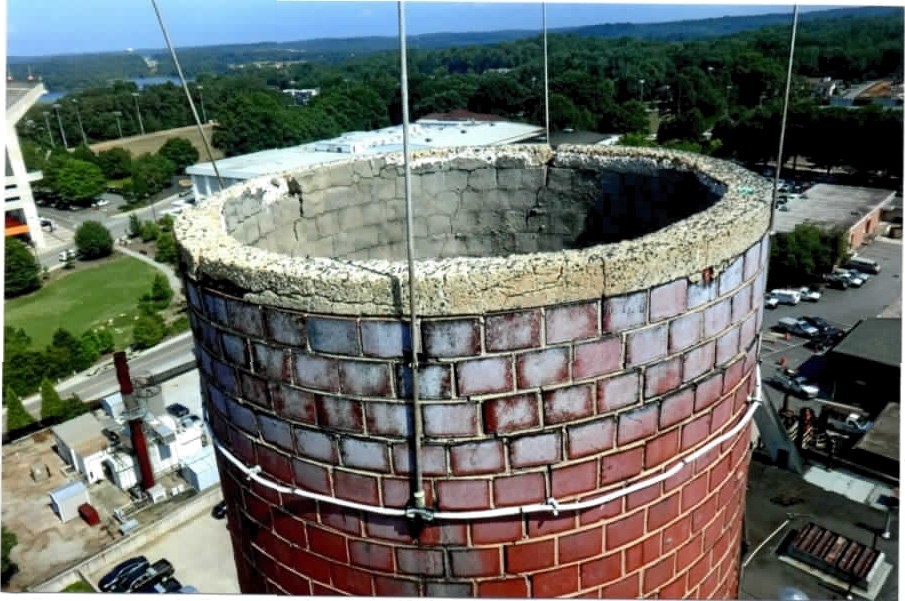
A photo of the condition of the South chimney's concrete cap and upper elevations.
A photo of the condition of the South chimney’s concrete cap and upper elevations.
As one approaches campus, Clemson University’s Central Energy Facility looms large alongside Tillman Hall and Death Valley Stadium. Its twin “smoke stacks” serve as an unmistakable landmark for visitors and their presence adjacent to increasingly contemporary structures amounts to a vintage interruption to fast-moving modernization at Clemson. Despite their bygone appearance, the chimneys of the CEF continue to play an important role in keeping students, employees and visitors comfortable within campus buildings.

The CEF’s History in Brief

The Central Energy Facility was constructed in 1948. Its original purpose was to provide steam-based heat to most of campus.

“The north stack was constructed as part of the original 1948 plant,” according to Tony Putnam, Director of Utility Services. In 1964, the Central Energy Facility (known in those days as ‘the Physical Plant’) underwent an upgrade to keep pace with campus growth. “The south stack was added as part of the 1964 plant expansion.”

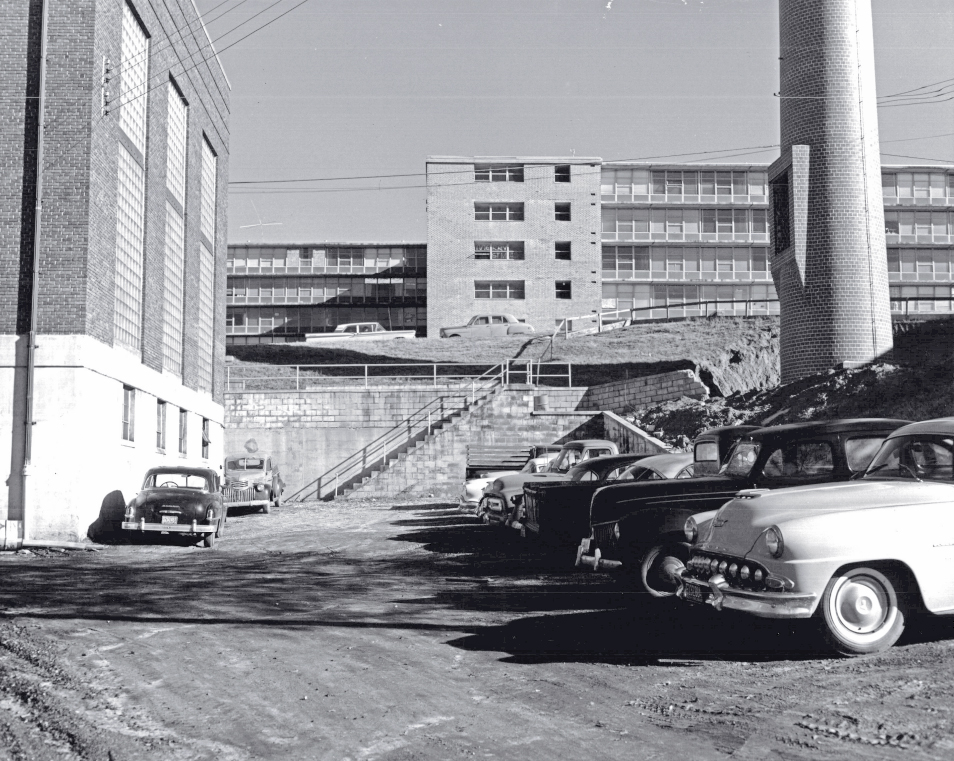
Near the base of the South chimney, taken in the 1960’s.
Today, the CEF serves as the key contributor to campus heating and air conditioning, serving much of the campus including various dorms, classrooms and research facilities, as well as Harcombe dining hall. Although it originally burned coal, on May 3rd of 2012 the CEF switched to natural gas in an effort to reduce operational costs. Coincidentally, natural gas has amounted to a major reduction in the university’s carbon footprint. Also, while the CEF’s primary purpose is to provide heating and cooling to the campus, it can produce electricity as needed. As it plays a critical role in the daily operation of Clemson University, it’s important to ensure that the CEF remains a safe and efficient facility.

Repair of the South Chimney

Prompted by concerns that recent construction adjacent to the Central Energy Facility could have affected their structural integrity, University Facilities commissioned Bednash Consulting, Inc. to inspect both the North and South chimneys on June 15th of this year. Their inspection report concluded that while the overall condition of the North chimney was good and required few repairs, several issues were found with the condition of the South chimney. The topmost 18′ of the chimney was recommended to be demolished and completely rebuilt. The chimney’s lightning protection system also needs replacing in order to bring it up to Underwriters’ Laboratories standards.

[vid origin=”clemsontv” vid_id=”JAEqSN8v5E6sBZwshyxiCA” size=”medium” align=”right”]

In order to perform the repairs, a wooden ladder is built from the base of the chimney to its summit. The ladder supports itself from the ground and the lightning arresting cable connected to the chimney stabilizes it. With the ladder in place, a platform encircling the chimney is constructed near the top to give workers a stable workspace to perform brick and mortar work. The material used to repair the chimney is hoisted from the ground using a pulley. However, the workers themselves must traverse the ladder each time they wish to reach or leave the platform. We’ve included a video that provides the worker’s perspective of what it’s like to climb the chimney, fair warning to those afraid of heights.

The “Smoke Stacks” continue to serve Clemson University as a part of providing a reliable source of heating and air to campus housing and academic areas. One day they may come down, but until that time the chimneys of the Central Energy Facility will continue to benefit from the maintenance necessary to ensure they are safe and sound.

Special thanks to Project Manager Tom Minor who provided inspection information along with footage of the repairs.

New West Energy Plant Will Help Keep Growing Campus Cool

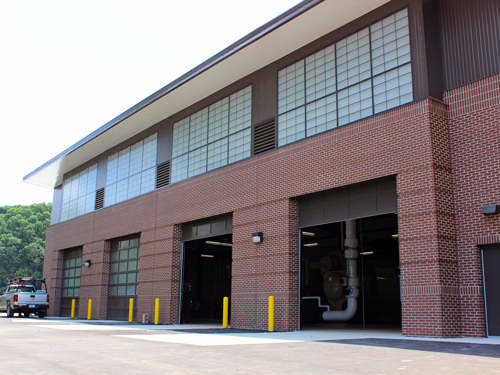
The new West Energy Plant

Clemson University’s main campus consists of roughly 165 buildings spread across 1,400 acres. Since 2008, the majority of these buildings’ air conditioning needs have been served from three on-campus chilled water facilities, known as the Central Energy Facility (CEF), the East Energy Plant, and the South (Hinson) Energy Plant. Chilled water, which helps cool a building’s overall temperature to a human comfort level, is pumped from these facilities to over 70 campus buildings through underground piping system often referred to as a chilled water loop.

With growing load demand, University Facilities’ Utility Services has constructed a fourth energy plant on the north side of the stadium, the West Energy Plant. Commissioned on June 2016, this facility increased Clemson’s chilled water (CHW) capacity by 3,000 cooling tons. There is space for an additional 3,000 tons of CHW capacity as well.  For reference an average size 3 bedroom home in South Carolina will have a 3 ton air conditioning unit.

Existing Infrastructure

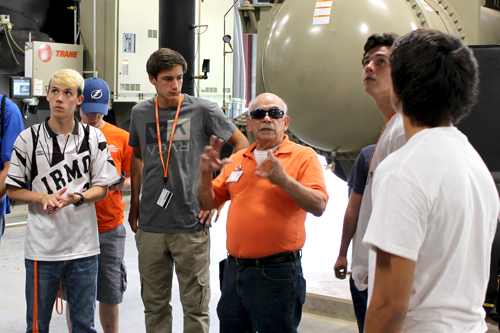
Sam Zanca provides a tour of the plant to a class.
Capital Projects Manager Sam Zanca provides a tour of the plant to a class.

The Central chilled water loop combines the operations of the three interconnected chiller plants–the CEF, East and South–to efficiently serve the Central loop distribution system. The three Central chiller plants are designed for 11,400 tons of available capacity at a 12°F delta-T (40-52 ° F). In plain speak, the chilled water facilities connected to the Central loop send water to connected buildings at 40-degrees Fahrenheit and collectively receive the same water back at 52-degrees Fahrenheit, some 12-degrees warmer.  More on this in a bit.

In terms of equipment, CEF has three 1,800 nominal-ton Trane duplex chillers which were installed in 1999, two of which rely on Lake Hartwell for lake water condenser cooling. The South (Hinson) Energy Plant has three 1,200 nominal-ton Trane chillers which were commissioned in 2008. The East Energy Plant originally built in 1986 was upgraded with two new 1,450 ton, variable speed drive Trane chillers in 2013.  By moving to variable frequency drive chillers, the University is able to reduce its energy-consumption by optimizing control of the chiller plant’s operation to meet fluctuations in demand for air conditioning.

The New West Energy Plant

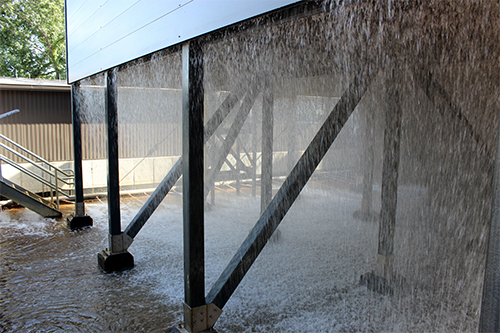
One of the cooling tower "sumps."
One of the cooling tower sumps, famously known as “The Monsoon Room.”

The new West Energy Plant has two 1,500 nominal-ton variable speed drive Trane chillers which together provide 3,000 tons of chill-water at 15°F delta-T (42-57 ° F).  Chilled water system efficiency is tied to its delta-T, where in the higher the delta-T number, the more efficient the overall system can perform. This results in a decrease in the amount of electricity required to generate air conditioning for connected buildings while also amounting to cost savings for university operations.  An efficient university central chilled water can provide cooling as much as 30 percent more efficient than a home air conditioning system.

Sufficient for Now, Prepared for the Future

With the new West Energy Plant, the total capacity of Clemson’s chilled water distribution system provides a peak system capacity of 13,100 cooling tons, with a current peak demand from connected buildings at about 11,300 cooling tons.  That said, one only has to look in almost any direction to see that our cooling needs will be challenged with new campus construction.  With the addition of the West Energy Plant, Clemson University is capable of meeting such demands for the foreseeable future.