Integrated Pest Management

Managing Spotted Lanternfly in SC Landscapes—Why August Matters!

August offers an early opportunity to help reduce next spring’s Spotted Lanternfly hatch in South Carolina. Adult populations are active now and, based on current predictions, are beginning to lay egg masses earlier than in northern states. These eggs can overwinter and hatch next spring, and they’re notoriously tricky to spot and remove once laid. Reducing the number of adults now can make a meaningful difference.

In landscapes, watch for lanternflies feeding on Tree of Heaven, grapevines, maples, and ornamental plants such as roses, lilacs, willows, birch, and blueberries. Both red-bodied nymphs and adults are present this time of year, so scout broadly: trunks, outdoor furniture, vehicles, fence posts—anywhere they might gather or lay eggs.

If you find them, remove them. Where feasible, eliminate host plants like Tree of Heaven, and consider targeted insecticide use if populations are high and egg-laying has begun. We’ve included a life stage calendar and size guide to help with identification in the field.

Don’t hesitate to contact Dr. Zee Ahmed’s team or the Department of Plant Industry at Clemson if you need assistance with identifying stages or weighing treatment options. The goal is to reduce overwintering eggs before they become next year’s problem. Refer to the included flyer for details on lifecycle timing and the activity calendar.


Pee Dee Rec Field Day – August 28th

The Pee Dee Research and Education Center invites you to learn the most recently findings of research in plant pathology, entomology, soil and crop science in South Carolina.

Come join us in the field day organized at the Pee Dee Rec Field day on August 28th, from 9:00 am to 12:00 pm, and hear from the experts of Clemson university!

Spotted Lanternfly Confirmed in South Carolina

It was only a matter of time, given its previous detections in North Carolina and Georgia—and now South Carolina has officially joined the list of states where the invasive Spotted Lanternfly (Lycorma delicatula) has been detected. This phloem-feeding planthopper poses a serious threat to vineyards, ornamental plantings, and tree health throughout the region.

Dr. Muhammad “Zee” Ahmed, Assistant Professor at Clemson University’s Turf and Ornamental Entomology Lab, is actively collaborating with entomologists nationwide through the Multistate Working Group for SLF. His ongoing efforts include:

  • A field guide focused on early detection, host identification, life stages, and sustainable management strategies (Link).
  • A detailed educational talk covering SLF biology, identification tips, damage symptoms, and integrated control approaches (Link).
  • An updated Land Grant article on SLF, expected to go live soon to support regional IPM efforts.

With a host range exceeding 100 plant species and proven economic damage in the millions—particularly in vineyards—the need for early detection and rapid response cannot be overstated. Dr. Ahmed’s outreach emphasizes careful scouting for SLF egg masses, which can be confused with mud dauber nests, lichens, or other natural debris. Recognizing black sooty mold, branch dieback, and the insect’s distinct nymph and adult appearances are also key.

Management Tactics at a Glance

  • Cultural & Mechanical: Removal of preferred hosts like Tree of Heaven; scraping egg masses.
  • Chemical: Targeted use of insecticidal soaps, horticultural oils, and neonicotinoids.
  • Biological: Including Beauveria bassiana and egg parasitoids like Ooencyrtus kuvanae already present in the US.

Dr. Ahmed’s field guide is a critical resource for growers, landscapers, and IPM professionals looking to protect turfgrass, ornamental landscapes, and agricultural sectors from this hitchhiking pest.

To learn more or get involved, contact Dr. Ahmed at mahmed2@clemson.edu.


Battling Mealybugs in the Greenhouse: A Practical Guide from the Turf and Ornamental Entomology Lab

Mealybugs may be small, but their impact in greenhouse production can be massive. These sap-sucking pests often sneak in as nearly invisible crawlers and quickly establish persistent infestations—nestling behind leaves, burrowing into root zones, and hiding in plant debris. Once entrenched, they can be notoriously difficult to manage.

At the Turf and Ornamental Entomology Laboratory, we’ve seen firsthand how challenging mealybug outbreaks can be for growers. That’s why PhD students Powlomee Mondal and Peilin Tan, under the guidance of Dr. Zee Ahmed, compiled a comprehensive guide to help greenhouse professionals tackle these pests head-on.

What’s Inside the Strategy


In the article, Managing Mealybugs in the Greenhouse, we outline a science-based, step-by-step approach that includes:

  • Accurate species identification to tailor control strategies
  • Timed applications based on pest life cycles
  • Rotation of systemic and contact insecticides to prevent resistance
  • Sanitation protocols, including bench-washing and debris removal
  • Efficacy data to guide product selection and application timing

This guide is designed to empower growers with practical, research-backed tactics that reduce pest pressure while preserving plant health and minimizing chemical overuse.

Read the Full Article

Mondal, P., Tan, P. and Ahmed, Z., 2025. How to manage mealybugs in the greenhouse. Greenhouse Management, [online] 24 June. Available at: https://www.greenhousemag.com/article/managing-mealybugs-pest-control-greenhouse/ [Accessed 4 Jul. 2025].


Grower Input Needed:

In addition to the article, Peilin Tan is conducting a brief survey to better understand the current challenges and research needs related to mealybug management in greenhouse systems. The survey consists of nine multiple-choice questions and does not collect any personal information.

We would greatly appreciate your participation:
Take the Survey

Figure 1: Scale insects.

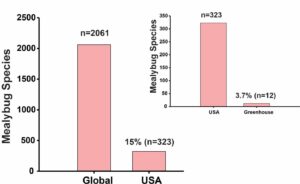
Figure 2: Mealy bug species globally, in the USA, and in greenhouses.

Figure 3: Mealybug species considered greenhouse pests.