Integrated Pest Management

Battling Mealybugs in the Greenhouse: A Practical Guide from the Turf and Ornamental Entomology Lab

Mealybugs may be small, but their impact in greenhouse production can be massive. These sap-sucking pests often sneak in as nearly invisible crawlers and quickly establish persistent infestations—nestling behind leaves, burrowing into root zones, and hiding in plant debris. Once entrenched, they can be notoriously difficult to manage.

At the Turf and Ornamental Entomology Laboratory, we’ve seen firsthand how challenging mealybug outbreaks can be for growers. That’s why PhD students Powlomee Mondal and Peilin Tan, under the guidance of Dr. Zee Ahmed, compiled a comprehensive guide to help greenhouse professionals tackle these pests head-on.

What’s Inside the Strategy


In the article, Managing Mealybugs in the Greenhouse, we outline a science-based, step-by-step approach that includes:

  • Accurate species identification to tailor control strategies
  • Timed applications based on pest life cycles
  • Rotation of systemic and contact insecticides to prevent resistance
  • Sanitation protocols, including bench-washing and debris removal
  • Efficacy data to guide product selection and application timing

This guide is designed to empower growers with practical, research-backed tactics that reduce pest pressure while preserving plant health and minimizing chemical overuse.

Read the Full Article

Mondal, P., Tan, P. and Ahmed, Z., 2025. How to manage mealybugs in the greenhouse. Greenhouse Management, [online] 24 June. Available at: https://www.greenhousemag.com/article/managing-mealybugs-pest-control-greenhouse/ [Accessed 4 Jul. 2025].


Grower Input Needed:

In addition to the article, Peilin Tan is conducting a brief survey to better understand the current challenges and research needs related to mealybug management in greenhouse systems. The survey consists of nine multiple-choice questions and does not collect any personal information.

We would greatly appreciate your participation:
Take the Survey

Figure 1: Scale insects.

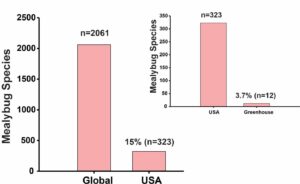
Figure 2: Mealy bug species globally, in the USA, and in greenhouses.

Figure 3: Mealybug species considered greenhouse pests.

Stem rot/white mold application timing and fungicide consideration

The combination of warmer temperatures and stress from dry conditions for rainfed fields is a reminder that if our fields have some history of stem rot/white mold disease (Figure 1), we can proactively protect them during our earlier fungicide applications. This can be as simple as adding tebuconazole in with the 45-day spray or coming in earlier 30/35 DAP with Elatus/Excalia/Lucento, or we may also consider swapping fungicides during latter applications for increased control. Not all fields need the extra attention, but it is a helpful tool at our disposal where we are looking for additional management. Likewise, earlier applications are less subject to canopy interference of spray penetration/ground deposition. Rain is our friend for many things including fungicide wash in, but its contribution rapidly drops off with increasing time after application. Two days after an application, rain will help some but is at that point more modest than monumental. Rain-in the day of application or a day after improves wash in, but this often comes at the expense of foliar leaf spot coverage/control. A persnickety predicament, or rather, a reminder of fine tuning one way or another. If we are coming due for an application where soil disease control is a priority and we can wait a day to two/three days to take advantage of a coming rain we can consider doing so, keeping in mind the suggestive rather than absolute nature of forecasts. This is more helpful later in the season when canopy size is larger. However, an application without rain is better than no application at all. We cannot wait indefinitely to take advantage of a possible rainfall, and we do well to keep in mind the importance of effective leaf spot management at the same time, as both our soil and foliar diseases are best managed in a preventative rather than reactive manner.


From work across eleven experiments conducted from 2015 to 2023 evaluating the efficacy of several different fungicides for stem rot/white mold control, maximum label rates of benzovindiflupyr plus azoxystrobin (Elatus) and inpyrfluxam (Excalis) were estimated as conferring the greatest returns over the chlorothalonil-only control (Bravo-only).


Control efficacy of maximum labeled rates of flutolanil (Convoy) and prothioconazole plus tebuconazole (Provost Silver) were also effective in managing this disease. While an application of tebuconazole alone for soil disease control was among the most efficient in terms of % stem rot control per fungicide product application cost, that active ingredient also conferred the least total amount of control at its maximum label rate. This makes tebuconazole an important and efficient fungicide to keep in our overall disease management programs, but other fungicides or tank mix combinations are capable of providing greater control where we could benefit from it due to specific fields having a history of increased white mold disease pressure, weather conditions during the year favoring its development, or application windows preceding a timely rain or irrigation allowing us to capitalize on increased efficacy.


Check out the paper about white mold management published in MDPI by Daniel Anco, the extension peanut specialist at Clemson University.
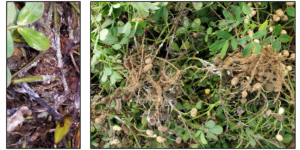
Figure 1: Peanut plants showing symptoms of white mold disease.

Leafminer Activity in South Carolina Iris Production

The U.S. cut flower market was valued at approximately 9.2 billion USD in 2021 and is projected to grow to nearly 12.8 billion USD by 2028, with a steady compound annual growth rate of 4.8%. While irises make up a smaller share of this market, their visual appeal and versatility give them lasting economic and cultural value. Some varieties even pull double duty—producing rhizomes used in perfumes and traditional medicine. For South Carolina, ornamental horticulture is more than just aesthetics—it’s a key part of the state’s thriving green industry. Irises—particularly a wide range of native and cultivated varieties/cultivars—play a notable role in this sector, contributing to landscape diversity, wetland restoration, and the ornamental plant trade.

However, iris growers across the region may be facing an unseen threat. We recently discovered a dipteran leafminer, tentatively identified as Cerodontha sp., causing significant damage in iris production areas. A quick survey of major plant outlets in Florence, SC revealed that most Louisiana iris plants were infested, with damage easily mistaken for abiotic stress like overwatering or nutrient issues (Figure 1).

What to Look For:

  • Yellowing and wilting of iris leaf blades (Figure 2)
  • Short, whitish serpentine tunnels near the base of leaves (Figure 2)
  • Iris plants failing to bloom

Detecting and monitoring the leafminer life cycle in your area is the first step in effective management. Many growers have had difficulty managing leafminers, and a key early task is confirming whether the symptoms observed are actually caused by leafminers. This involves locating mines and inspecting them for visible life stages such as larvae, pupae, or empty trails. Misdiagnosing the symptoms or mistiming treatments can significantly reduce control efficacy, especially when insecticides are applied during periods when the pest is in the egg, pupal, or inactive larval stage—times when it’s least vulnerable and least exposed to control measures.

If you find damage on your irises:

Please contact Dr. Zee Ahmed at mahmed2@clemson.edu or (352) 283-0173 for support with identification and management.

Cotton and soybean insect newsletter

The Clemson University Cotton/Soybean Insect Newsletter is in its 20th year of distribution/circulation to stakeholders needing regular and timely information about important arthropod pests of cotton and soybeans in South Carolina and the southeastern USA.  The newsletter includes information from contributors (Extension agents, consultants, industry reps, etc.) about the situation in their areas of the state, weekly observations in cotton and soybeans, frequent data from current or past research trials, current numbers of important insects caught in pheromone traps, insect identification aids, and much more.

Anyone can request to receive the newsletter by emailing Jeremy Greene at greene4@clemson.edu to request inclusion.  Please include your role (producer, consultant, industry rep, etc.) in South Carolina or elsewhere to ensure you are added in the correct email category.

CORN AND SOYBEAN FIELD DAYS SUMMER 2025!

Clemson Cooperative Extension is hosting two Corn and Soybean field days in July!  The events will start at 8:30am and end around 12:00pm.

After presentations, free lunch will be served! The events are free, and topics will include key information on corn and soybean production and management practices. See the flier below.