Integrated Pest Management

Two-spot cotton leafhopper in South Carolina

Amrasca bigutulla, commonly know as the two-spot cotton leafhopper, has been detected in several states in the southeastern US, including Alabama, Georgia, Florida, and South Carolina. This species is native to southeast Asia, where it is an important pest of cotton and okra. The arrival of the insect in the continental U.S. is a concern for cotton and vegetable production, although its impact on yield remains unclear. 

Adults are characterized by two black dots on the distal part of the forewings. Females oviposit on leaf tissues, and upon hatching, nymphs grow through four developmental stages in about 8 or 9 days. Adults live an additional 11 or 12 days. The short life cycle enables two  -spot cotton leafhoppers to produce multiple generations throughout the season.
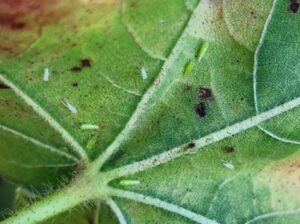
 

Figure 1. Adults and nymphs of  two-spot cotton leafhopper feeding under cotton leaves. 

Both nymphs and adults feed on the underside of cotton leaves by injecting its mouth part in the tissue and consuming plants sap (Figure 2). Feeding can cause the cotton leaves to turn yellow. The detection of two-spot cotton leafhoppers is a concern for cotton production in the southeastern US. In addition to quantifying potential impacts on yield, future research will focus on monitoring two-spot cotton leafhopper populations throughout the season, developing economic thresholds and treatment recommendations to provide management solutions for cotton growers.


Figure 2. Mild (left) and severe (right) injury of two-spot cotton leafhopper in cotton.  
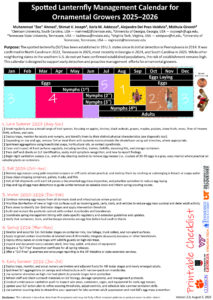
Spotted Lanternfly Management Calendar for Ornamental Growers in the Southeastern U.S.

The spotted lanternfly (SLF) has been established in 19 U.S. states since its first detection in Pennsylvania in 2014. It was confirmed in North Carolina in 2022, Tennessee in 2023, Georgia in 2024 and South Carolina in 2025. While other neighboring states in the southeastern U.S. don’t yet have confirmed established populations, the risk of establishment remains high.

Dr. Zee Ahmed (Clemson University) and his colleagues—Dr.   Shimat Joseph (University of Georgia), Dr. Midhula Gireesh (University of Tennessee), Karla Addesso (Tennessee State University) and Alejandro Del Pozo-Valdivia (Virginia Tech) developed a management calendar to support early detection and proactive control efforts for ornamental growers in the Southeastern U.S. This seasonal framework offers practical guidance to help growers address SLF concerns proactively from late summer 2025 through summer 2026.

Here is the link  Spotted Lanternfly Management Calendar for Ornamental Growers in the Southeastern U.S.

Managing Spotted Lanternfly in SC Landscapes—Why August Matters!

August offers an early opportunity to help reduce next spring’s Spotted Lanternfly hatch in South Carolina. Adult populations are active now and, based on current predictions, are beginning to lay egg masses earlier than in northern states. These eggs can overwinter and hatch next spring, and they’re notoriously tricky to spot and remove once laid. Reducing the number of adults now can make a meaningful difference.

In landscapes, watch for lanternflies feeding on Tree of Heaven, grapevines, maples, and ornamental plants such as roses, lilacs, willows, birch, and blueberries. Both red-bodied nymphs and adults are present this time of year, so scout broadly: trunks, outdoor furniture, vehicles, fence posts—anywhere they might gather or lay eggs.

If you find them, remove them. Where feasible, eliminate host plants like Tree of Heaven, and consider targeted insecticide use if populations are high and egg-laying has begun. We’ve included a life stage calendar and size guide to help with identification in the field.

Don’t hesitate to contact Dr. Zee Ahmed’s team or the Department of Plant Industry at Clemson if you need assistance with identifying stages or weighing treatment options. The goal is to reduce overwintering eggs before they become next year’s problem. Refer to the included flyer for details on lifecycle timing and the activity calendar.


Spotted Lanternfly Confirmed in South Carolina

It was only a matter of time, given its previous detections in North Carolina and Georgia—and now South Carolina has officially joined the list of states where the invasive Spotted Lanternfly (Lycorma delicatula) has been detected. This phloem-feeding planthopper poses a serious threat to vineyards, ornamental plantings, and tree health throughout the region.

Dr. Muhammad “Zee” Ahmed, Assistant Professor at Clemson University’s Turf and Ornamental Entomology Lab, is actively collaborating with entomologists nationwide through the Multistate Working Group for SLF. His ongoing efforts include:

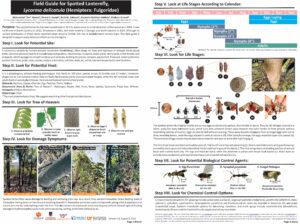
  • A field guide focused on early detection, host identification, life stages, and sustainable management strategies (Link).
  • A detailed educational talk covering SLF biology, identification tips, damage symptoms, and integrated control approaches (Link).
  • An updated Land Grant article on SLF, expected to go live soon to support regional IPM efforts.

With a host range exceeding 100 plant species and proven economic damage in the millions—particularly in vineyards—the need for early detection and rapid response cannot be overstated. Dr. Ahmed’s outreach emphasizes careful scouting for SLF egg masses, which can be confused with mud dauber nests, lichens, or other natural debris. Recognizing black sooty mold, branch dieback, and the insect’s distinct nymph and adult appearances are also key.

Management Tactics at a Glance

  • Cultural & Mechanical: Removal of preferred hosts like Tree of Heaven; scraping egg masses.
  • Chemical: Targeted use of insecticidal soaps, horticultural oils, and neonicotinoids.
  • Biological: Including Beauveria bassiana and egg parasitoids like Ooencyrtus kuvanae already present in the US.

Dr. Ahmed’s field guide is a critical resource for growers, landscapers, and IPM professionals looking to protect turfgrass, ornamental landscapes, and agricultural sectors from this hitchhiking pest.

To learn more or get involved, contact Dr. Ahmed at mahmed2@clemson.edu.