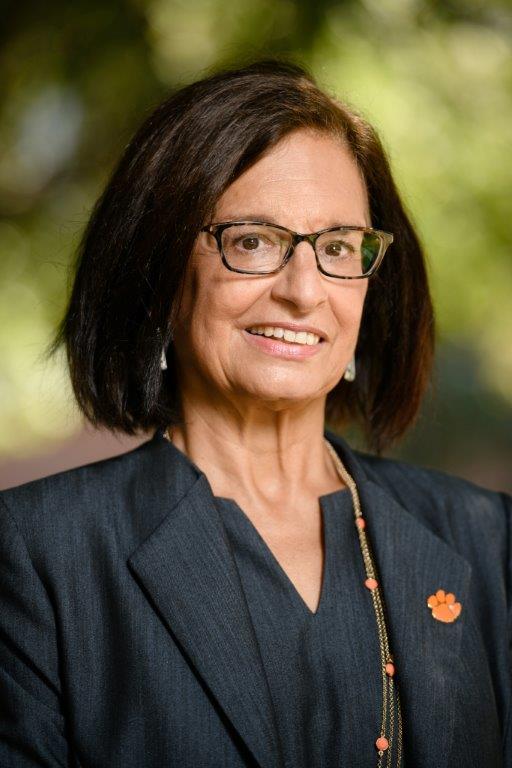
CTR team members with Clemson alumnus Dr. Shannon Kennedy
By Nathan Inman
February 28 was a day that was nearly three years in the making for Clemson Tiger Racing. After being established in 2023, CTR finally ran its first-ever endurance race late last month.
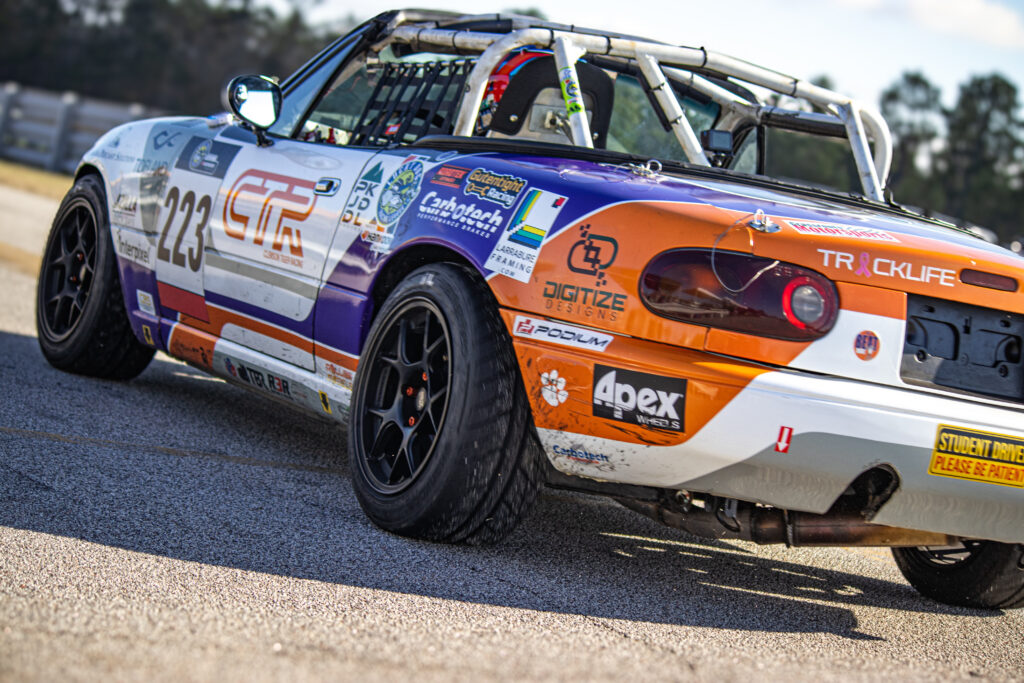
It could have been easy for the team to take it easy and just log laps to gain experience, leaving car number 223 to be an afterthought to its competitors. Instead, though, everyone knew they were there. The team finished fourth in the Saturday race after a solid showing throughout the day, leaving CTR with a shot at a podium finish. Unfortunately, the team was unable to cross the finish line, as the car ran out of gas and slowed to a stop out of the final corner.
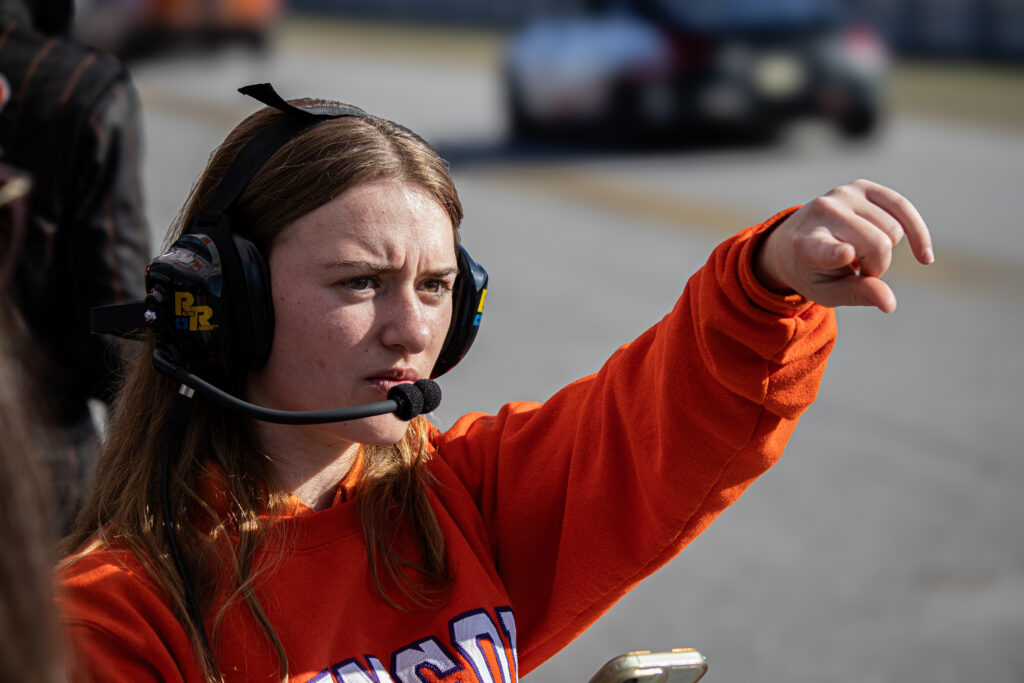
Hadley Smith on the team radio as race engineer.
While the race finished in heartbreaking fashion, the result was still one the team could be proud of. “I think we were all flabbergasted that we made it through,” said Hadley Smith, a sophomore engineering major and race engineer for CTR. “We were so incredibly excited and proud of ourselves that we made it through the first day.” The pride Smith mentioned was echoed by several of her fellow team members.
“It’s hard for me to put this feeling into words,” said Macy Jersek, graduate student and operations lead for CTR. “I’m just so happy and really proud of this team. I think we all were just thrilled to see the car finish, and to be so successful and to be competitive with our little Miata with 80 horsepower.”
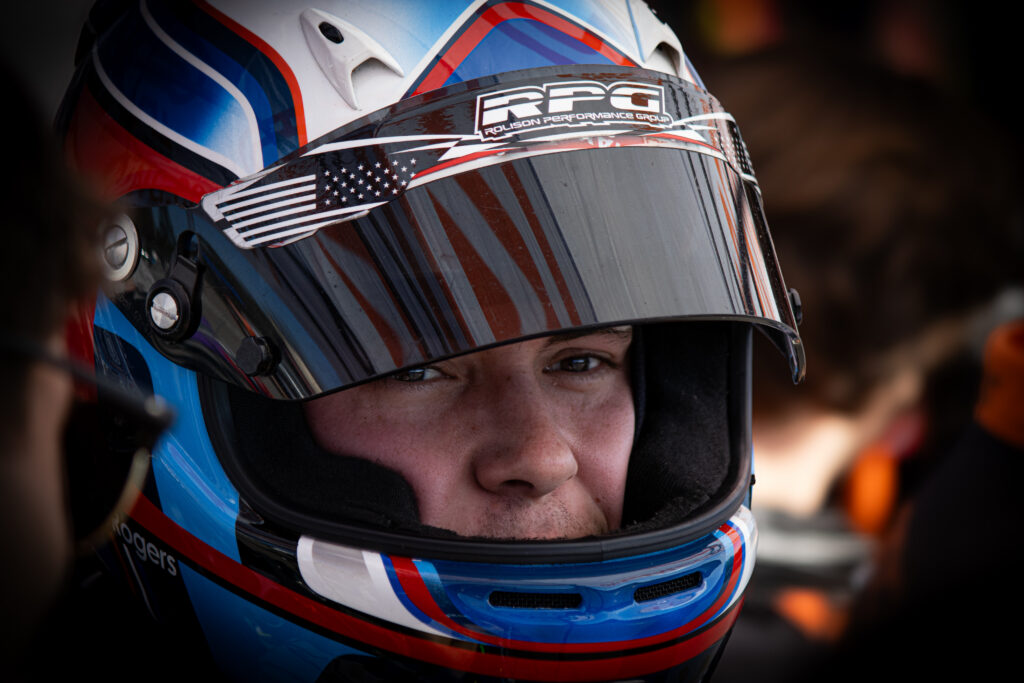
Kieran Rogers prepares to enter the car for the final stint of Saturday’s race.
“I’m also very proud of everyone,” added Kieran Rogers, junior automotive engineering student who is the race engineer lead and a driver for CTR. “There’s a lot of work that went into it, so it’s very rewarding when you see we’re able to go on for as long as possible.”
As Saturday drew to a close, the focus shifted to Sunday, when the team would hit the track once more for the second race of the weekend. After the learning experience of their first race, the team was hopeful they could compete for a podium position once again.
Not only did CTR compete for a podium in Sunday’s race, and the team also led at the break after the first hour and held the lead for several hours afterwards. It appeared that CTR was going to have a shot at winning a race in its first-ever race weekend. Unfortunately, with roughly 90 minutes remaining, the car suffered a failure in the rear differential. With so little time remaining and the car extremely hot, CTR was unable to make repairs and was forced to retire from the race.
CTR leaves the pit lane following the final pit stop on Saturday.
While the end result was not what the team had hoped for, the team members had every reason to hold their heads high and mark the weekend as a success. A car fully engineered, maintained and driven by college students lasted an impressive 341 laps and nearly 13 hours throughout the two races, leaving the expectations heading into the weekend in the dust. Even more impressive was that the parts built and installed by the team stayed in shape, and the only thing that prevented the team from completing all 14 hours and potentially earning a race win or podium was one that was never touched by the students besides fluid changes, serving as a testament to the work of the mechanics.
“I think it just really shows how hard every single one of the mechanics has been working,” said Matthew Flaim, an automotive engineering graduate student, as well as driver and lead mechanic for CTR. “Just the effort that has been going in to make sure that we’re making, not only a consistent and competitive race car, but also a safe race car.”
With CTR’s first race finally in the books, the team is now looking ahead to more races and hopes to be back on track in May at Atlanta Motorsports Park. With the experience of the first race weekend and the knowledge gained from it, the sky is now the limit for the team’s future success.
At a university that prides itself on athletics and academics, there’s a group within that helps student-athletes find success on the field and in the classroom.
The Clemson Athletic Council acts as the liaison between the University’s faculty, administration and athletic departments, meeting bi-monthly to discuss important topics that student-athletes face.
Meetings are joined by Athletic Director, Graham Neff, Senior Associate Athletic Director, Matt Lombardi, and other senior members of the Athletic Department staff while allowing open discussions with members of the council throughout their meetings.
Each college elects a representative and an alternative, and the Clemson president appoints a representative from the University. Both Undergraduate and Graduate Student Government as well as Faculty, Staff and Student Senate are represented. Two student-athletes from the executive board of the Student Athlete Advisory Council (SAAC) represent all student-athletes on campus.
Jake Serra runs at a Clemson Track meet
Senior Health Sciences major and President of SAAC, Jake Serra, went from specifically focusing on his track and field career to making a bigger difference in his position as a student-athlete.
“I was thinking, how can I make an impact in another way?” Serra said. “So, that’s where the Student Athlete Advisory Committee comes in. We have one here at Clemson that, unbiased, is the best one in the nation.”
Assistant Professor of sports communication and faculty fellow of the Robert H. Brooks Sports Science Institute, Rikishi Smith-Rey, Ph.D., served on her university’s SAAC when she was a student-athlete as an undergraduate, going full circle when she was voted on last spring to represent the College of Behavioral, Social and Health Sciences as a faculty liaison.
Having a wide variety of faculty from colleges across the University and staff from the athletic department help improve communication between the academic institution and the athletic department.
Rikishi Smith-Rey, Department of Communication
“We get to bridge the two of them,” Smith-Rey said. “We get to bridge the academic institutional side to the athletic side, and SAAC is in there as well, and they’re telling us how they are getting the teams more intertwined. It’s great seeing all the different groups coming together.”
Another faculty fellow of the Robert H. Brooks Sports Science Institute and a professor of Food, Nutrition and Packaging Sciences within the College of Agriculture, Forestry and Life Sciences, Greg Batt, Ph.D., has served on the Clemson Athletic Council since the fall of 2019. He has seen important topics covered from the COVID-19 pandemic to NIL.
Committee Structure
The Clemson Athletic Council reports directly to the President with an Executive Committee that is comprised of the Chair, Vice-Chair, the chairs of three subcommittees, and the Faculty Athletic Representative (FAR), Antonis Katsiyannis, who was appointed by the President.
The Chair of Athletic Council, Mary Anne Raymond, a Professor of Marketing and Thomas F. Chapman Distinguished Professor of Leadership, creates the agendas for the meetings, communicates with both the President and Athletic Director regarding the focus of the subcommittees, and communicates any special initiatives that are directed by the President.
Meetings are led by Raymond, with updates and reports by Neff, Lombardi, SAAC, and the FAR at every meeting. New coaches, the Director of NIL, and leaders like Natalie Honnen, Executive Senior Associate AD for Student – Athlete Services and Performance, are invited to speak at Athletic Council meetings to enhance members’ understanding of the many areas the athletic department encompasses and to provide insights into areas where athletic council members can collaborate and contribute, such as the Student Athlete Wellness initiative.
The council was typically organized into three sub-committees: Academic Policies and Integrity, Student Athlete Welfare and Experience, and Administration and Communication. While all three committees serve important roles, there’s been more of an emphasis by all AC members on Student Athlete Welfare and Experience, which Batt chairs and says is the “main heartbeat” of the council.
Mary Anne Raymond, Thomas F. Chapman Distinguished Professor of Leadership, Department of Marketing
Professor of Marketing, Mary Anne Raymond, who is Chair for the Executive Committee as well, noted that the Council has shifted its focus to work on aiding the wellness of the student-athletes, who look to balance academics, athletics, and a positive social experience.
“We’re focusing on the well-being of the student-athletes,” she said. “I think that will stay for a while because there’s been so much going on with student well-being and the population’s well-being in general. Should we need to shift, or should the President have a special project, we would focus on that project as well.”
The AC brings in the likes of Serra and the Vice President of Internal Affairs with SAAC, Rose Imbesi, a senior Marketing major, as well. Both were appointed in the spring of 2024 and have served since. They provide the perspective of the student-athletes, expressing their needs and ways to improve the way they handle the academic side of their experience.
“They allow looking behind the curtain in athletics, but we are fully academics, so we understand that world,” Batt said, “so we can be liaisons for them.”
Drs. Batt and Smith-Rey are also faculty fellows with the Robert H. Brooks Sports Science Institute, and communicate these important athletic topics back to their research and educational peers at the university and nationally.
Serra and Imbesi also work towards bringing each athletic program together, allowing more communication and community between each group of student-athletes.
“My goal is really just to increase that feeling of community within athletics so you’re not just supporting your own team and seeing your own team every day,” Imbesi said, “to really bring that community together so that we are all one group of Clemson Athletics, not just separate teams.”
Issues and Outcomes
Collegiate athletics are in an interesting time with the rise of topics like NIL and the House case, meaning that the topics the Clemson Athletic Council is focusing on can vary at each meeting.
Neff and Lombardi emphasize numbers like graduation rates, retention rates and GPAs during the meetings, which have allowed Serra and Imbesi to create a solution to how student-athletes can be protected for their academics, providing support like tutoring to further their education.
Now, the protection plan has been implemented across multiple schools of the ACC, SEC and Big 10, becoming a product of the use of the Council’s meetings.
“That was something where we went to these professors in the Athletic Council,” Serra said. “I said, ‘Hey, here’s my idea. What can we take from this?’ They brought it to President Clements; they brought it to their colleges, and we were able to explode across the nation with that, but it really started here at Clemson.”
Another way that the members connect with the student-athletes is by attending lunches with various student-athletes throughout the semesters. The Clemson Athletic Council works with SACC to organize dates and times for faculty to have lunch with student-athletes, listening to their thoughts, concerns and recommendations for things that they would like to see from an academic standpoint.
Greg Batt, Department of Food, Nutrition and Packaging Sciences
“With my involvement on the Athletic Council, it gave me a real grassroots perspective of the challenges of being a student-athlete,” Batt said, “and so my involvement in the Athletic Council, I think that experience has been made richer by the fact that I get to see what it really looks like, day in and day out, for these guys trying to balance sports, academics and a college experience.”
The meetings also serve as an opportunity to correct any misinformation that may be framed throughout the University. Then, solutions about how to better communicate with faculty or student-athletes are created to bring truth into the respective spaces.
“It’s been really useful,” Imbesi said. “I think to have that communication between teachers and athletics administration, just so they know and are kind of in the loop of what’s actually happening and what’s actually going on, because there’s so much happening.”
When new head coaches are hired for a given program, they are also given a chance to speak to the Council, allowing council members to ask questions and get to know them at a personal level.
As for the future, ideas like NIL, paying athletes and well-being are topics that will not go away, but the Clemson Athletic Council will continue to overcome obstacles that are presented around the University or the country, depending on what they are.
For Serra and Imbesi, there are ideas of a ticketing plan that would incentivize undergraduate and graduate students to come to non-revenue-generating Olympic sports, looking to continue to create the community between every athletic program at Clemson.
Serra believes that the best is yet to come with SAAC and the Council as a whole.
“We’re just such a passionate group that is really willing to pioneer this new change,” he said. “A lot of this stuff that we have in mind is not out yet. It’s not, we’ll see how it goes. It’s a lot of checks and balances we have, but I think continually supporting student athletes is always going to be our number one priority.”
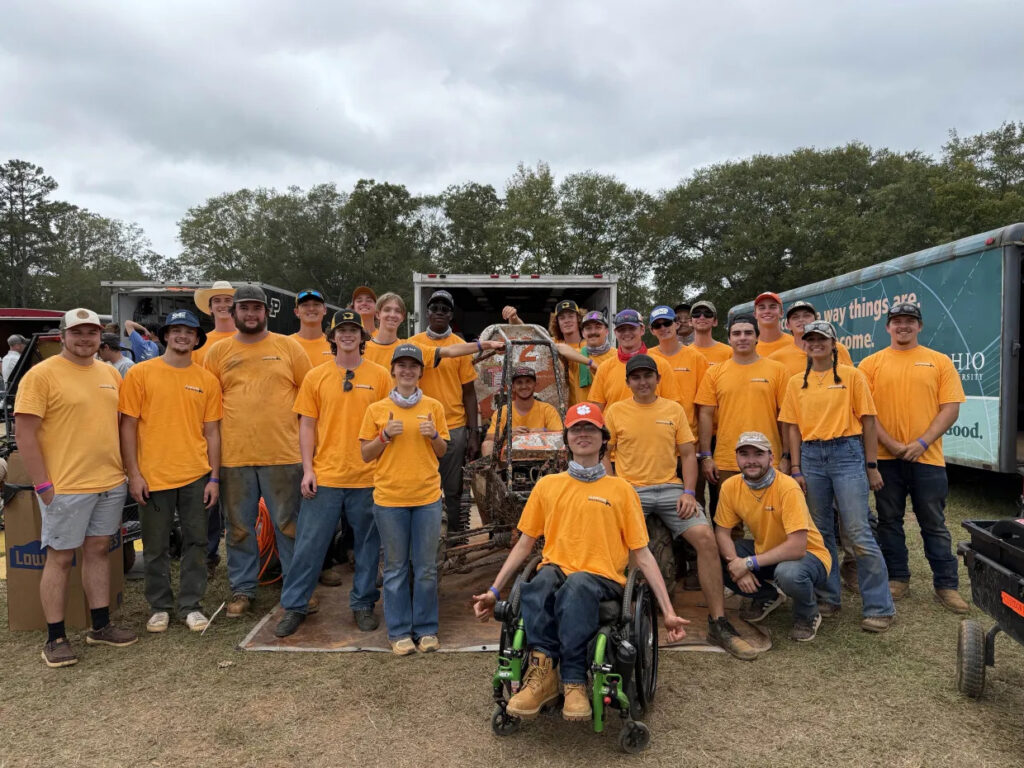
Clemson FSAE members with Tiger 25 at the 2025 competition in Michigan.
Clemson Formula SAE has been engineering its 2026 race car, Tiger 26, over the last several months, and the finishing touches are nearing completion. Tiger 26 will make its debut when the team hits the track at Michigan International Speedway on May 13.
Launched in 1998, Clemson FSAE is a student-run race team partnered with the College of Engineering, Computing and Applied Sciences. The organization provides students with real-life experience that cannot be replicated in the classroom, with opportunities in areas such as aerodynamics, business, chassis, electrical, powertrain and suspension. The event in May is part of the international FSAE series, which is hosted by the Society of Automotive Engineers (SAE). The series serves as a way for students to see their hard work come to life and compete with other students from around the globe.
With the annual event hosting thousands of students interested in engineering and motorsports, representatives from those industries attend the event to network with students and see what they are capable of firsthand. Peter Gaspich, suspension lead for Clemson FSAE, says that members of the organization have been able to gather connections at these events that later boosted them into roles with professional racing teams.
“One of our alumni is a performance engineer at [General Motors’] IndyCar program,” Kelly said. “We had a simulation performance engineer at Red Bull F1, and another simulation performance engineer at Alpine F1.”
Clemson FSAE team members working on the frame of Tiger 26.
With the opportunity to meet with industry professionals at these events, the work back at the shop in Clemson becomes even more important. When the team hits the track in Michigan, they will be facing a large variety of tests, such as skid pad, acceleration, autocross and endurance. During the several months spent engineering and building the car, the team must find the happy medium of all four of those areas to ensure their ability to be competitive throughout the entire event.
Gaspich explained that in the skid pad test, the car must complete two figure 8s of constant radius, which evaluates the “steady-state cornering ability,” which is essentially testing how much grip the car is able to make in a low-speed corner. It also evaluates the team’s ability to set up the car and make the best use of the tires. The acceleration competition is more self-explanatory. The acceleration test is practically a short drag race to evaluate how the car can accelerate from being stopped. Gaspich added that on a good day, their car goes from 0 to 60 miles per hour in about 3.5 seconds and has even gotten down to around 3.3 seconds at times.
From there, the event transitions into the autocross competition. In this event, a half-mile course is set up, and the team gets two chances with two different drivers to complete one lap and set the fastest time.
“Autocross courses, especially at Michigan, are insanely difficult,” Gaspich said. “There are even some teams out there that’ll even have a professional driver, because as long as they are a student currently enrolled at your university, they are allowed to drive the car.”
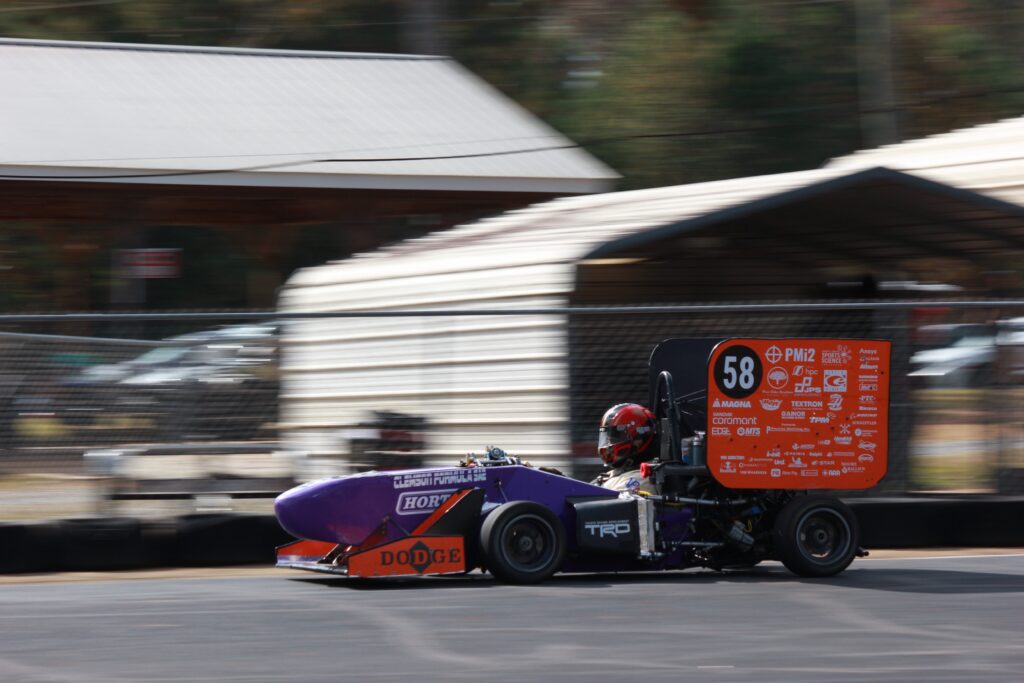
Clemson FSAE on track in the 2025 event at Michigan International Speedway.
Once the autocross event is complete, the competition transitions into the final event: endurance. The endurance event is the largest test of how well the car was built and engineered. The event is 30 straight minutes of racing, and while that doesn’t sound like much, Gaspich emphasized that at the end of the day, these cars are still completely student-built and aren’t professional-grade.
The event has been a tough one for Clemson SAE in recent years, as the team has not finished the full 30 minutes since 2022. Even then, though, the car overheated and severely reduced the top speed. The team came close to finally getting the monkey off its back in last year’s event, but fate had other plans.
“We had a pretty heartbreaking finish to endurance last year,” Gaspich said. “We were doing really good in all of our events, looking to finish at least top 20. We came in after our first stint of endurance to do the driver change, and suddenly we hear over the radio, ‘guys, we’re disqualified.’”
As it turns out, the car had been leaking just a few drops of oil, and the rules for the event specify that the cars cannot leak any fluid whatsoever. As a result, the team was told their day was done, and the chance to finally finish the endurance event had been snatched away from them once again.
As Clemson FSAE completes its Tiger 26 build, the team is optimistic about their chances to run well in and complete all the events in May. When that time comes, they are ready for the challenges and look forward to getting back on track. Students interested in joining Clemson FSAE can find them on TigerQuest or visit https://www.clemsonfsae.com/join-the-team.
As the semester progresses for Clemson Baja SAE, the team is working towards building its newest vehicle for competition later this year. However, the new vehicle is not the only thing the organization is constructing this semester.
Clemson Baja SAE was founded in 1978 and is a student-run engineering organization that designs and builds custom off-road vehicles to compete in the national Baja SAE Collegiate Design Series. The organization had become dormant following the COVID-19 pandemic, but a group of eight dedicated students were determined to bring the organization back to life in 2023.
Clemson Baja SAE racing on dirt track
Since its revival, Baja has utilized a test track in the woods behind their race shop to ensure their student-built vehicles were primed and ready to compete. Recently, though, the track was cleared and logged, completely destroying the course and making it unusable for the race team. The occurrence left Baja without a way to test their vehicles, meaning they would be unable to be sure that there were no mechanical or safety defects before traveling for competitions. That’s when Blanchard CAT and the Department of Construction Science and Management stepped in.
“This semester, we are partnering with the Construction Science department,” Tyler Odgers, president of Baja SAE, said in an interview. “Right now, they have drone scanned the entire block and they’re designing a track on their computers.”
Odgers added that Blanchard CAT has donated equipment for the construction of the track, something that would have been unfeasible for the team to afford. Just as it does for many professional race teams, funding for Clemson Baja often comes at a premium. With the need for funding, the organization cannot focus solely on engineering and manufacturing their vehicles. Odgers says that the team has begun developing a large business team in order to afford those aforementioned costs.
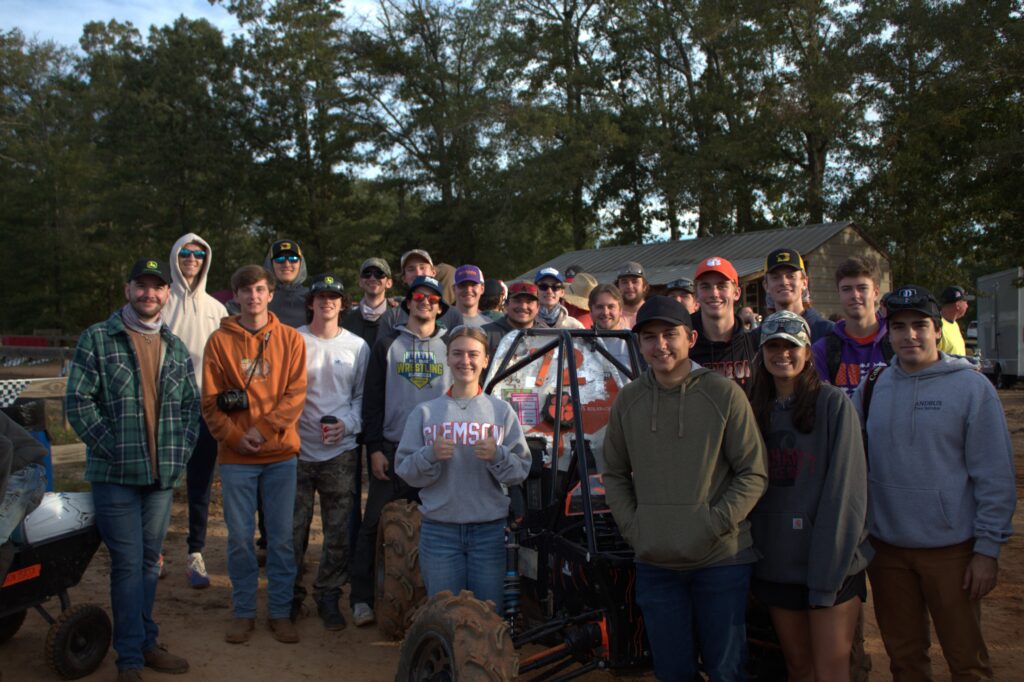
Team picture with Clemson Baja SAE car
“Obviously, we need funding, right?” Odgers said. “We have a team that is essentially putting together a packet presentation that we can just go out and give to businesses. There’s a very big communications, marketing type of thing trying to get our name out there.”
Odgers went on to say that he sees opportunities for practically any major, and that “there are very few majors that I think can’t do something with us.” As the team continues to prepare for competition and the construction of its new race vehicle and test track, emphasis will still remain on the business and communications side of the organization. Any students interested in joining Clemson Baja SAE can find them on TigerQuest or go to https://cecas.clemson.edu/bajasae/join/
The 2026 NASCAR Cup Series season kicked off in Daytona this past weekend, with the 68th running of the Daytona 500 taking place on Sunday. Among the field of 41 teams was one former Clemson Tiger pursuing a third consecutive Daytona 500 victory.
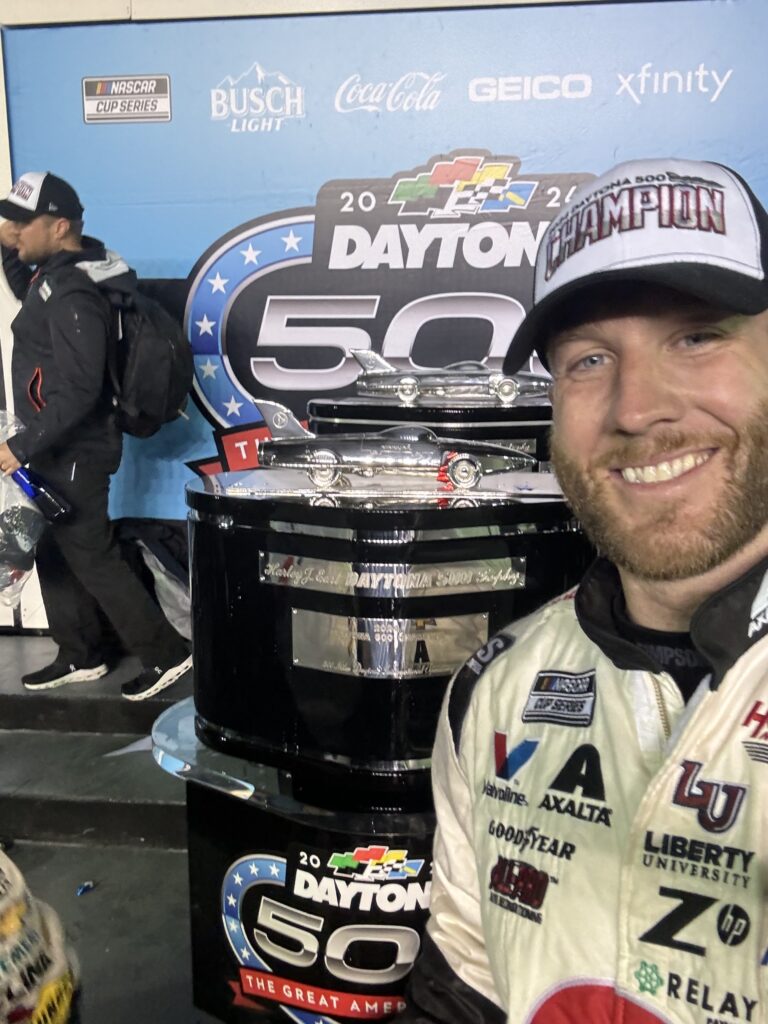
Landon Walker posing next to the Daytona 500 Harley J. Earle trophy
Landon Walker was an offensive tackle for the Tigers from 2008 until 2011 and was part of the 2010 squad that secured Dabo Swinney’s first ACC championship. Throughout his career, Walker played a total of 3,131 snaps, a record at the time, and now sits fifth on the all-time list of Clemson players. Throughout his life, Walker bled Clemson orange, as his father, Gary, was a former Clemson Tiger and part of the 1981 team that won Clemson its first National Championship.
When Walker graduated from Clemson in 2012, he had his sights set on the National Football League and intended to sign with the Cincinnati Bengals as an undrafted free agent. However, a failed physical, uncovering arthritis in his knee, brought his plans to a screeching halt. Walker eventually realized his days of playing football were behind him, but still, he refused to confine himself to a typical desk job. That’s when he received a phone call from Hendrick Motorsports.
Hendrick Motorsports is NASCAR’s most successful race team, with 320 race wins and 15 championships. Walker wasn’t being called to drive a race car – he was being asked to join the pit crew.
In a 2023 interview with The Tiger, Walker said that he was unsure of what to expect when he showed up to the team’s campus in Concord, North Carolina.
“I really had kind of a very mild understanding of what it would be and kind of got into it with the right people at the right time,” Walker said.
Walker learned quickly that the training and preparation for pit crew members was not much different than what he had done his whole life while playing football. As he began his tryouts, he was fully prepared for the tests they threw his way.
“They were doing combines, which you do in football, and testing your running skills and your power skills. Really just an overall test to see how athletic you were.”
Landon Walker and the pit crew celebrating William Byron’s Daytona 500 win
After Walker completed his tryouts, the team decided they liked what they were seeing and offered him a spot on the pit crew as a fueler. He accepted the offer and joined the team in September 2012, and he has been there ever since. Walker has achieved several feats during his 13 years with Hendrick Motorsports. For many years, though, there was one that seemed to slip away from him time and time again: The Daytona 500.
That changed in 2023, when his driver, William Byron, won that year’s running of The Great American Race. A year later, Byron would win the race once again, becoming just the fifth to win the race in back-to-back years.
Landon Walker and William Byron embracing after a Daytona 500 win
“That’s a big win that everybody wants, to put that ring on your finger,” Walker said. “It’s one of the most coveted wins in our sport, kind of our Super Bowl.”
No driver has ever won the race in three consecutive years. Alas, that record still holds after this past weekend, as Byron was unable to defend his crown once more. Still, after over a decade in the sport without a win in the sport’s most coveted race, Walker cherishes the opportunity to have been part of the race-winning team twice over.
As NASCAR revs into high gear and kicks off the 2026 season, Walker hopes to check one last box on his bucket list: becoming a NASCAR champion. There might be nine months until then, but come this November, it’s entirely possible this former Tiger might achieve just that.
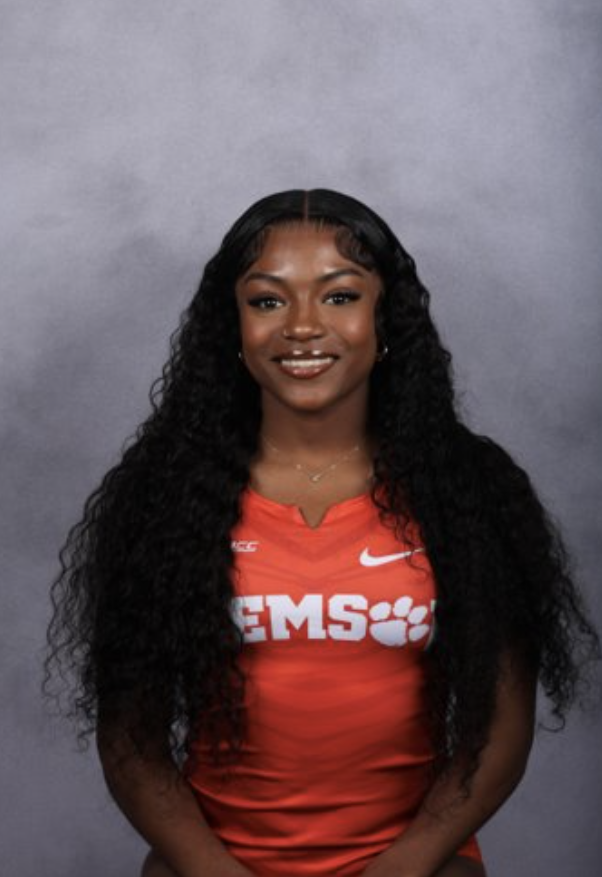
In celebration of National Girls & Women in Sports Day on February 4, the Robert H. Brooks Sports Science Institute highlights seven female student-athletes. Representing a variety of sports, these athletes share their experiences as women in sport, reflect on the role of sports science in their development, and offer advice to the next generation.
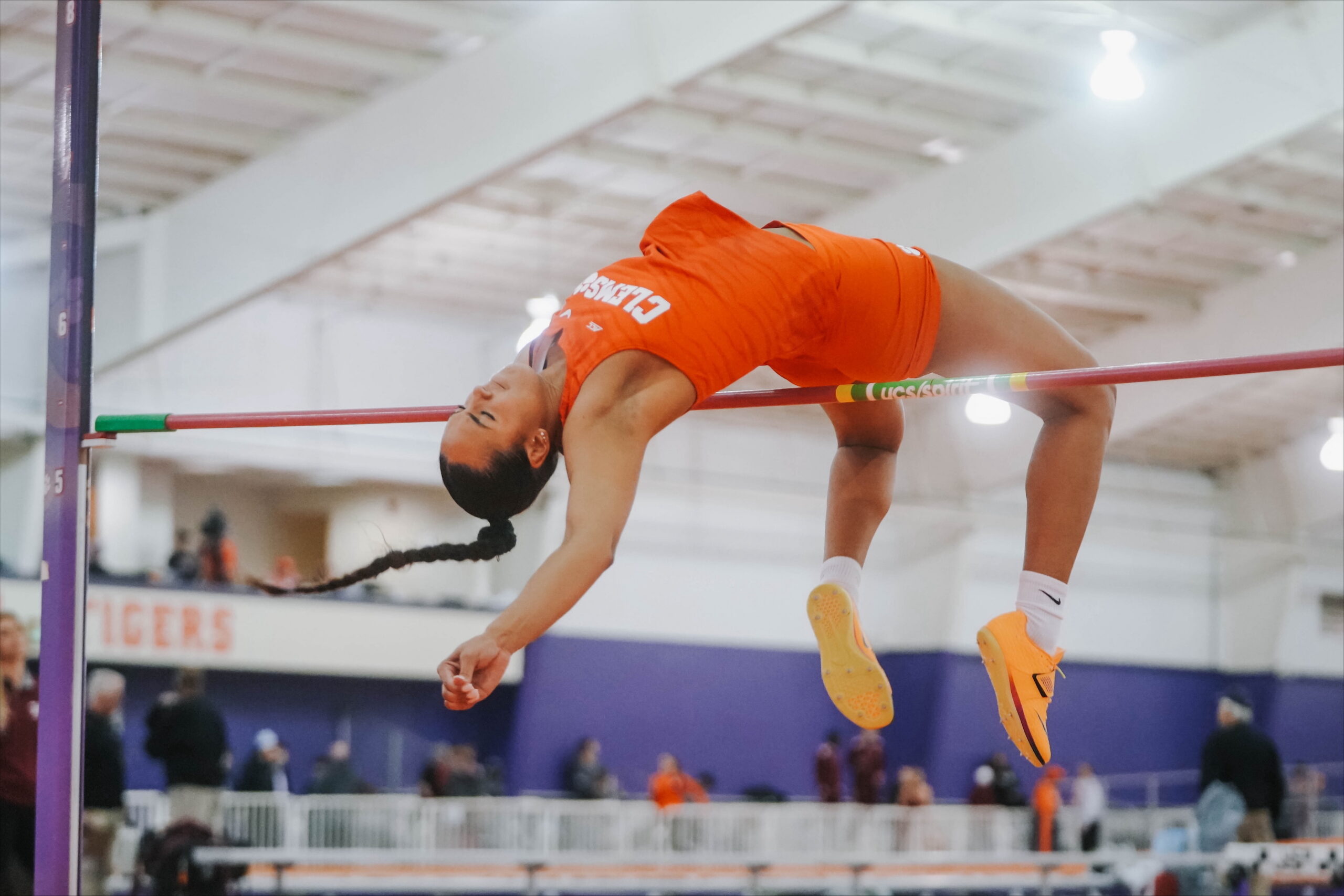
Sade Gray – Track and Field
Major: Marketing Hometown: Baton Rouge, Louisiana
What does it mean to be a woman in sports? To me, being a woman in sports means being strong, resilient, and unstoppable. It gives women the opportunity to chase goals at a high level, earn respect through work ethic, and open doors for younger girls watching. I want them to be able to think, “If she can do it, maybe I can too.”
What aspect of sports science have you found most interesting or impactful in your athletic experience? The most impactful aspect for me has been recovery and nutrition. You can train hard every day, but recovery can truly make or break performance. Getting the right nutrients to heal injuries and build power and strength has helped me put my best foot forward consistently.
What is your advice for aspiring women in sports? Believe in yourself before anyone else does. People will try to tell you who you are or limit your future, but it’s your life and your passion. Don’t give up on yourself—work hard, stay focused, and go where you are appreciated.
What has been your favorite or most interesting class taken at Clemson? One of my favorite classes has been Women’s Global Perspectives. Learning about the challenges women face around the world—especially those who don’t even have the freedom of choice—has inspired me to fully embrace the woman I’m becoming. It motivates me to pursue my dreams boldly and never let anyone take my voice.
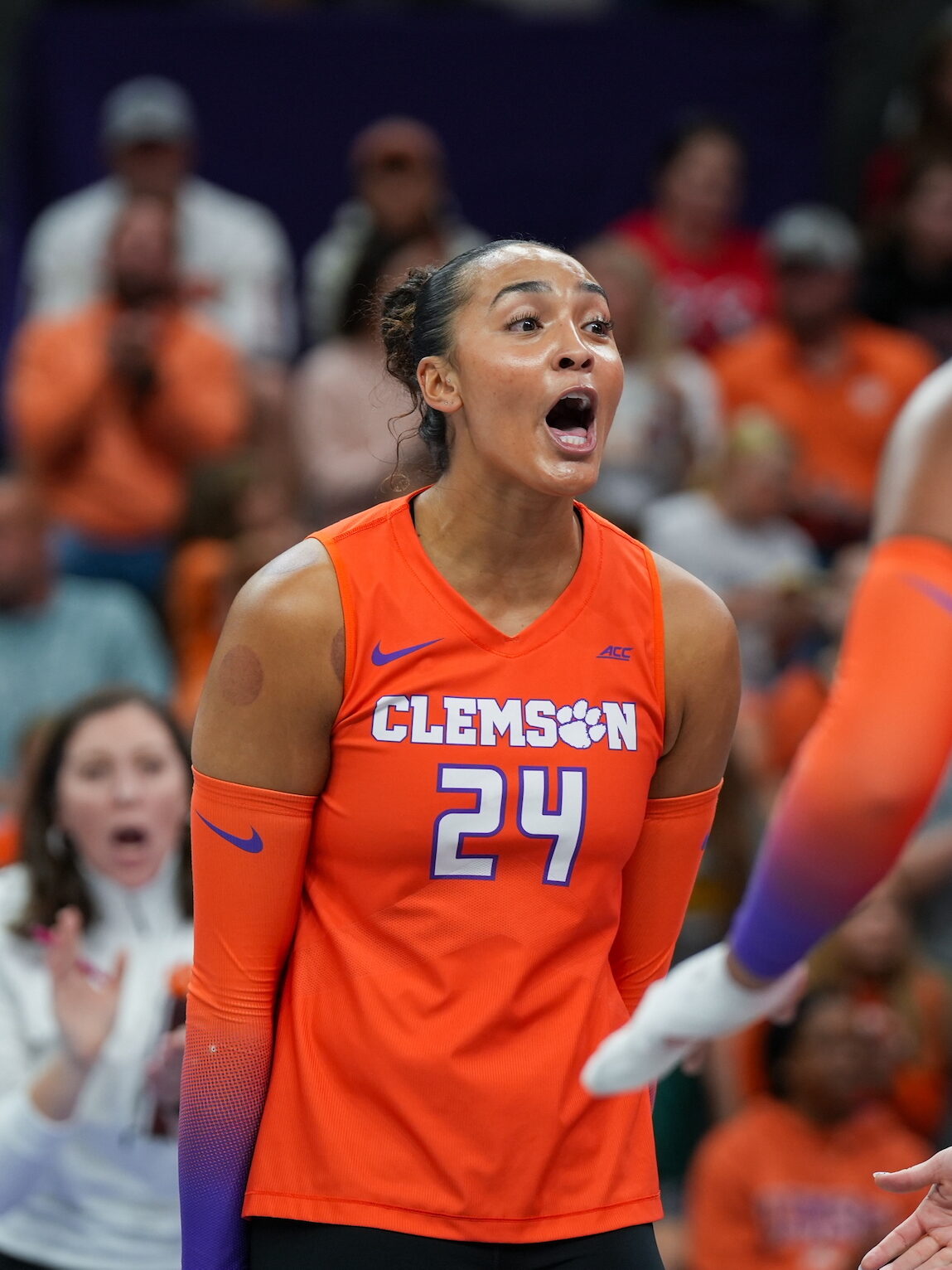
Bianca Martinez – Volleyball and Track
Major: Sociology Hometown: Omaha, Nebraska
What does it mean to be a woman in sports? For me, being a woman in sports is all about representation and feeling confident in myself. Being able to be a role model for younger female athletes and someone they can look up to and see someone living out a reality that they are dreaming about. It also means a place where I have found my confidence, and somewhere I have strived to be the best I could be, and always working towards a goal, but while still knowing who I am and my reasons for playing.
What aspect of sports science have you found most interesting or impactful in your athletic experience? Definitely has been recovery, and what specific things my body needs to be able to fully recover for another whole day of practice. I feel like being at Clemson, specifically the access we have to recovery, is absolutely amazing, and we are truly blessed here. I have learned so much about what exactly works best for me to feel my best, especially on game and competition days.
What is your advice for aspiring women in sports? My advice for aspiring women in sports is to always give yourself grace and be kind to yourself. There will be really good days and hard days, and both are part of the journey. It’s so important not to beat yourself up on the days when things don’t go as planned. Positive self-talk matters more than you realize, because the way you speak to yourself can either build your confidence or tear it down. Learning to encourage yourself the same way you would a teammate can make all the difference.
What has been your favorite or most interesting class taken at Clemson? My favorite class I’ve taken at Clemson so far is my Civil Rights History course, which I am currently enrolled in. As a Global Black Studies student, I understand how important Black history is and how critical it is that it continues to be taught accurately and intentionally. This class has helped me deepen that understanding by connecting historical movements to ongoing struggles for justice today. Professor D’Ondre Juwan Swails is also one of my favorite professors and makes the material engaging and meaningful, which makes the class genuinely exciting to be a part of.
Madison Roush – Cross Country and Track
Major: Biomedical Engineering Hometown: Greer, South Carolina
What does it mean to be a woman in sports? Being a woman in sports means having a big community of strong and inspirational women to look up to. We are all there to support one another and celebrate our accomplishments.
What aspect of sports science have you found most interesting or impactful in your athletic experience? I’ve found that the recovery aspect of running is the most interesting to me because it’s where I’ve seen the greatest success in the sport. Learning about the different ways to help muscles recover from training is fascinating, and the way my body feels after adequate recovery is night and day compared to running while not fully recovered.
What is your advice for aspiring women in sports? My biggest piece of advice is to say yes to opportunities that come your way and not be afraid to speak up and advocate for yourself. More often than not, people miss out on opportunities simply because they don’t put themselves out there or use their voice. By saying yes and asking to be involved in organizations that support women, I’ve been able to meet so many amazing and inspiring women from around the world.
What has been your favorite or most interesting class taken at Clemson? My favorite class I’ve taken at Clemson is Sports Engineering. In this course, I learned so much about the body and how it functions during training and recovery, which helped me better understand my own body and improve as a runner. It’s especially rewarding to learn material that you can directly apply to yourself, and that genuinely interests you. Dr. Harvey is also a great professor who teaches the class in an engaging way that keeps it interesting.
Tatum Short – Women’s Soccer
Major: Psychology Hometown: Las Vegas, Nevada
What does it mean to be a woman in sports? Being a woman in sports means showing up with strength, discipline, and confidence in spaces that haven’t always made room for us. It’s about resilience and showing younger girls that this path is possible and worth it.
What aspect of sports science have you found most interesting or impactful in your athletic experience? Nutrition has been the most impactful area of sports science for me because it has a direct impact on my energy, recovery, and performance on the field. Learning how to correctly fuel my body allows me to train harder, recover faster, and maintain consistency throughout the season.
What is your advice for aspiring women in sports? Believe in your abilities and don’t let anyone make you feel like you don’t belong. Work hard, stay confident, and support other women along the way.
What has been your favorite or most interesting class taken at Clemson? Women and Psychology has been the most interesting class I’ve taken at Clemson because it has taught me so much about the challenges women face around the world. It’s given me a deeper understanding of different experiences and perspectives, and how those shape women’s lives and choices.
Trinity Webb – Gymnastics
Major: Communication Hometown: Smithville, Missouri
What does it mean to be a woman in sports? Being a female athlete means a great deal to me because it represents strength, resilience, and the ability to take up space with confidence. It means embracing the pressure that comes with higher expectations and learning how to carry myself with purpose both in competition and in everyday life. As a woman in sports, I am often aware that performance is only part of how I am judged, which has pushed me to develop a strong sense of self and confidence in my identity. At the same time, being a female athlete is empowering; it gives me a voice, a platform, and the opportunity to represent younger girls who are watching and learning what is possible. For me, it means proving that women can be powerful, disciplined, and competitive while staying true to who they are and using sport to grow not only as athletes but as people.
What aspect of sports science have you found most interesting or impactful in your athletic experience? One aspect of sports science that has been most impactful in my athletic experience is nutrition, especially for female athletes. Proper fueling plays a major role in performance recovery and overall health it is often underestimated. I have learned that nutrition directly affects energy levels, injury prevention, and consistency in training. When athletes feel their bodies correctly, they are better able to recover and perform at a higher level over time. For women in sports, Understanding Nutrition has helped me view food as a tool for strength and performance rather than limitation, making it one of the most important aspects of sports science in my experience.
What is your advice for aspiring women in sports? My advice for aspiring women in sports is to trust yourself, especially during times when you may be underestimated or overlooked. There will be moments when others doubt your abilities or fail to see your potential, and learning not to let that define you is important. Confidence has to come from within, not from external validation, and that is something I am still learning myself. Growth in sports is not always linear, but believing in your worth and staying committed to your goals can make all the difference. continue to show up, work hard, and advocate for yourself, because your presence and voice matter just as much as your performance.
What has been your favorite or most interesting class taken at Clemson? My favorite class I’ve taken at Clemson has been criminal law because I enjoy learning about how the legal system works and understanding the reasoning behind laws and Court decisions. I find it interesting to see how real-life cases are analyzed and how the justice system impacts people and society, especially when it comes to justice being taken.
Shanque Williams – Track and Field
Major: Psychology Hometown: St. Elizabeth, Jamaica
What does it mean to be a woman in sports? Being a woman in sports means embracing both strength and vulnerability while constantly pushing myself to be better. It means overcoming challenges, proving my abilities, and staying confident in spaces where women are sometimes underestimated. As a female athlete, I take pride in representing where I come from and showing that women can be powerful, disciplined, and resilient. Competing as a woman in sports has taught me self-belief, perseverance, and the importance of using my voice and presence to inspire others.
What aspect of sports science have you found most interesting or impactful in your athletic experience? The most impactful aspect of sports science in my athletic experience has been recovery and injury prevention. Learning how proper recovery, rest, and monitoring fatigue affect performance has helped me understand that recovery is just as important as training. Paying attention to things like muscle soreness, sleep, and overall readiness has allowed me to take better care of my body, stay healthier throughout the season, and perform at a higher level during competition.
What is your advice for aspiring women in sports? My advice for aspiring women in sports is to stay persistent and never let stereotypes define your limits. There will be moments when people doubt your abilities or underestimate you, but those moments should fuel your motivation rather than discourage you. Stay committed to your goals, trust your work, and continue showing up even when it’s difficult. By staying consistent and believing in yourself, you not only prove others wrong, but you also create space for more women to be confident and successful in sports.
What has been your favorite or most interesting class taken at Clemson? My favorite and most interesting class at Clemson has been PSYC 2030: Fundamentals of Psychology. This class helped me better understand human behavior, mental processes, and how the mind influences performance. As both a psychology major and a student-athlete, the course has been especially meaningful because it connects directly to motivation, focus, and mental resilience in sports.
Oneka Wilson – Track and Field
Major: Parks, Tourism and Recreation Management Hometown: Portland, Jamaica
What does it mean to be a woman in sports? Being a woman in sports means pursuing passion and excellence while often overcoming inequality and stereotypes. It’s about empowerment, resilience, and claiming space in a traditionally male-dominated field.
What aspect of sports science have you found most interesting or impactful in your athletic experience? As a track athlete, nutrition has been the most impactful. Eating properly helps fuel training, improve recovery, and maintain consistent performance.
What is your advice for aspiring women in sports? Believe in your ability, advocate for yourself, and don’t be afraid to take up space. Stay disciplined, build a strong support system, and remember that your presence in sports matters.
What has been your favorite or most interesting class taken at Clemson? My favorite class at Clemson has been my PRTM EDGE class because I met a lot of new people and made friendships that are still strong today.
Clemson Tiger Racing team with their car in front of ICAR
On January 24, the American motorsports season officially kicked off with the running of the Rolex 24 at Daytona International Speedway. Among the attendees at the event was Tyson Tucker, team principal of Clemson Tiger Racing (CTR).
CTR is Clemson’s student-run endurance motorsport team, giving students of all majors and backgrounds a chance to work on a race car, and even potentially drive one. Tucker recently sat down for an interview with the Robert H. Brooks Sports Science Institute to explain the history of the organization and give insight into what this semester looks like for the team.
CTR was founded in 2023 and has continued to grow ever since. Over the previous two years, CTR has participated in track days, which are solo test runs with no real competition, to build up to their goal of endurance racing. This month, that goal comes to fruition.
“This February will be our first ever wheel-to-wheel race,” Tucker said. “That’s kind of our biggest thing for this semester. We’ve been promising this is the point we want to get to, and now we’re actually able to do that, which is really awesome.”
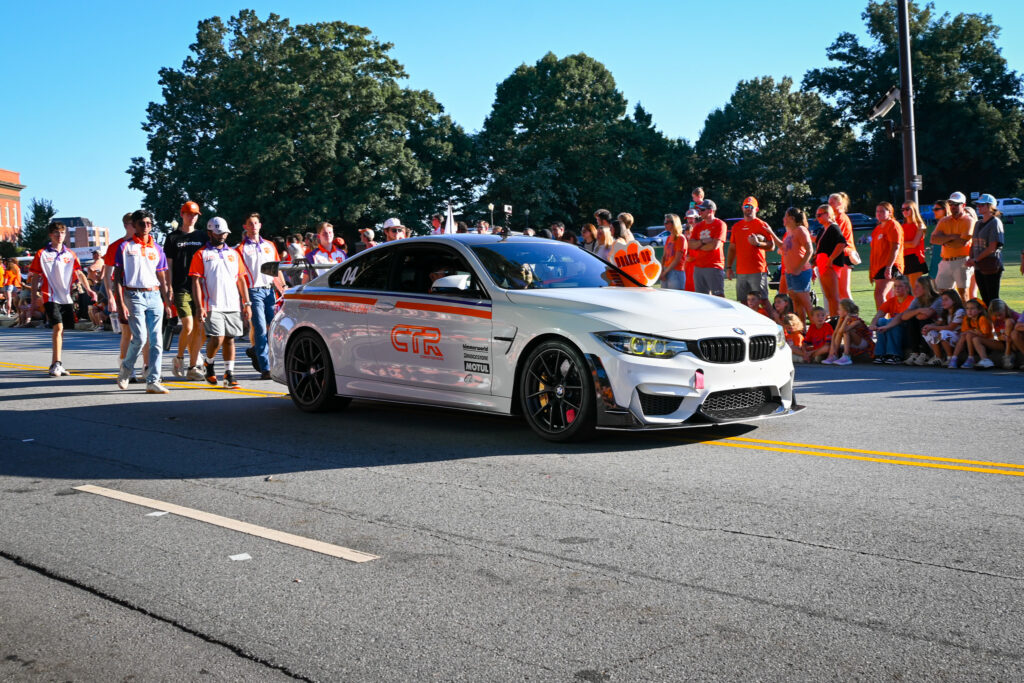
CTR car at the First Friday parade
The event will take place on February 28 at the Carolina Motorsports Park in Kershaw, South Carolina. The journey to the track has not been easy, though; as anyone familiar with the racing scene would attest to, entry into motorsports can be a costly endeavor. For that reason, teams in all facets of racing rely on sponsorship to fund their programs, and CTR is no different.
Most recently, CTR signed its newest sponsorship with Celsius to become the official energy drink of the team. Tucker explained that the continued growth of the organization is what has allowed CTR to sign deals such as this one. When he first joined the team, Tucker said there were maybe 25-30 members. As of the Spring semester, CTR is home to 100-plus students.
“It has grown immensely over the last couple of semesters, which is amazing,” Tucker added. “It’s allowed us to do a lot of really cool things, and with some of these new members we’re bringing, we’re able to reach more sponsors.”
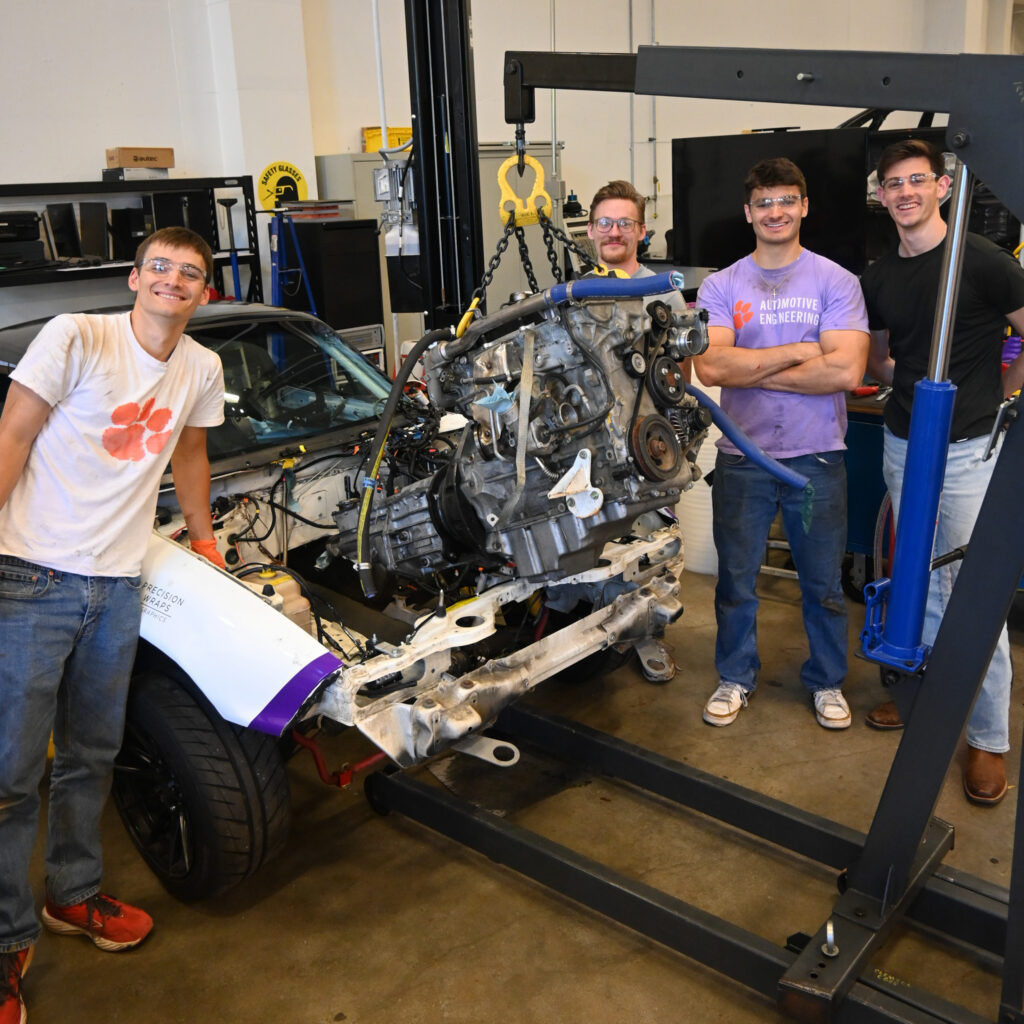
Pictured left-to-right: Samuel Desantis, Noah Miller, Matthew Flaim, Tyson Tuckerin front of their car
As the organization has grown, students with prior racing experience have been able to help prepare the team for the upcoming event. From karting to Spec Miata, there are several team members with a background in racing who hope to have the team set up for success later this month.
In addition to drivers with on-track experience, CTR is also partnered with the Collegiate Racing Series (CRS), which was co-founded by Jack Hobbs, a recent Clemson graduate and founding member of Clemson Tiger Racing. CRS partners with organizations from schools across the country, providing students with educational tools to learn about race craft, fundraising and managing a race team. Along with these resources, CRS also leases Miata race cars to student organizations to assist them in getting their program started.
With the chance to earn hands-on experience with a race team and connections to a large network within the industry through the Collegiate Racing Series, Tucker says CTR can provide amazing opportunities for students looking to find their way into motorsports. Students interested in joining or learning more about Clemson Tiger Racing can find more information on TigerQuest, or at clemsontigerracing.com.
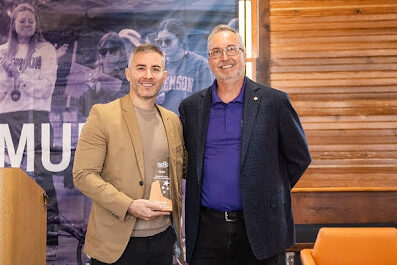
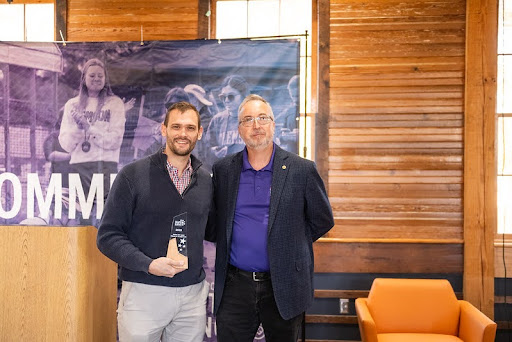
The 2025 GRIT awardees (left to right) Chris Corr, Sarah Stokowski, Felipe Tobar, and Reed Gurchiek, stand with RHBSSI interim director, John DesJardins (center), at the RECESS Friday Finale.
By Katie Gerbasich
At the conclusion of Clemson University’s Research and Creative Endeavors in the Sports Sciences (RECESS) Symposium, hosted by the Robert H. Brooks Sports Science Institute the week of November 10, 2025, four Clemson faculty were honored with 2025 GRIT Awards. These awards recognize nominated individuals or groups who distinguish themselves in various areas of sports science. A trophy was presented to the following winners.
Community and Outreach in the Sports Sciences
Felipe Tobar, Ph.D. – Department of Parks, Recreation and Tourism Management
Tobar studies the intersection of sport, tourism and heritage. He also serves as the head coach of Clemson’s Paralympic Soccer Program and co-founded the Football Tourism Institute, which aims to understand football tourism at the local and global levels.
Over the summer of 2025, Tobar travelled internationally conducting sports research. In early May, he took a group of students to Germany to study the Culture of Remembrance and Political Activism in German Football. While abroad, he conducted two research studies: one examining stickers in and around stadiums as a form of fan expression and political activism, and another exploring how German soccer clubs suppress or communicate Holocaust history.
Tobar’s inclusive and critical teaching practices earned him the 2025 Junior Tenure-Track Outstanding Teaching Award from Clemson University’s College of Behavioral, Social and Health Sciences. His commitment to experiential learning includes organizing class field trips to venues such as the Bank of America Stadium and the NASCAR Hall of Fame, facilitating networking opportunities with more than 41 sports industry professionals, and supporting undergraduate students as they participate in local sporting events.
For his dedication to both the Clemson and global community, the Institute has awarded Felipe Tobar with the GRIT Award for Community and Outreach in the Sports Sciences for the 2025-26 academic year.
“He is richly deserving of this award,” commended Greg Ramshaw, Ph.D., Tobar’s colleague in the Department of Parks, Recreation and Tourism Management.
Research in the Sports Sciences
Chris Corr, Ph.D. – Department of Educational and Organizational Leadership Development, Athletic Leadership Program
Corr’s scholarly research examines the institutional and organizational settings of collegiate athletics, with attention to the impact and outcomes of participation on various stakeholders. He serves as the executive director of the College Sport Research Institute and is the program manager for the Commission on Sport Management Accreditation.
“Dr. Chris Corr exemplifies the spirit of the GRIT Award in Research in Sports Sciences through his exceptional productivity, interdisciplinary collaboration and measurable impact on the study and practice of sport,” Sarah Stokowski, Corr’s colleague in the College of Education, said.
Over the past three years, Corr has produced an extraordinary body of scholarship, authoring or co-authoring more than 70 peer-reviewed journal articles, multiple book chapters, and numerous presentations at national and international conferences.
Corr’s work has consistently been supported by competitive funding sources, including RHBSSI, the NCAA, the Commission on Sport Management Accreditation (COSMA), and USA Ultimate, demonstrating the quality and applicability of his research.
“Equally important, Dr. Corr’s collaborative spirit enriches Clemson’s research environment,” Stokowski said. “He actively mentors graduate and undergraduate students, co-authors with emerging scholars, and engages in applied projects that extend Clemson’s land-grant mission.”
Student Engagement in the Sports Sciences
Sarah Stokowski, Ph.D. – Department of Educational and Organizational Leadership Development, Athletic Leadership Program
Recognized for her unwavering commitment to student success, Sarah Stokowski, Ph.D., has made an impact on graduate education and student engagement within the Athletic Leadership program. She has supervised more than 75 doctoral students across both the Higher Education and P12 concentrations.
“Dr. Stokowski is unbelievably passionate and committed to student learning and success,” noted her colleague from the College of Education, Chris Corr, Ph.D. “She is tremendously caring and committed to students’ scholarly achievement, and students walk away from her research methods course with a tangible academic publication and, more importantly for their professional development, an in-depth understanding of the research process.
Her commitment to publishing with students has led many graduate students to continue their education by pursuing terminal degrees.
“While Dr. Stokowski is an all-around tremendous scholar and influential member of the campus community, her commitment to student excellence and achievement is to be marveled at,” Corr said.In addition to her mentorship efforts, Stokowski was awarded a 2025 ESPN Research Fellowship by the University of Nevada, Las Vegas International Gaming Institute (IGI). Through this fellowship, she will research how student-athletes perceive and engage with online sports betting content. To learn more about her work, click here.
Friend of the Institute
Reed Gurchiek, Ph.D. – Department of Bioengineering
Gurchiek is the principal investigator in the Human Movement Biomechanics Lab (HuMBL), where his team uses standard motion capture technologies for human movement analysis and biomechanics.
A recent project, funded by RHBSSI, involved developing a passive assistive hamstring device to support muscle recovery. Read more about the work here.
Gurchiek has also been integral in collaborating with the Institute on plans for the University’s new human performance center on the ground floor of the student wellness center, which has recently broken ground.
“The Institute is very appreciative to Dr. Gurchiek for his continued leadership in the development of this new facility that will bring human performance research at Clemson to national prominence,” said John DesJardins, Ph.D., director of the Institute.
Members of AWSM gather outside the Nieri Family Student-Athlete Enrichment Center’s studio before conducting their photoshoot in October.
By Katie Gerbasich
‘Awesome’ is now a four-letter word for many female students: AWSM, or the Association of Women in Sports Media. AWSM is dedicated to empowering and supporting women interested in sports media. The Clemson chapter, advised by Department of Communication Assistant Professor and Robert H. Brooks Sports Science Institute Faculty Fellow Rikishi Smith-Rey, Ph.D., is part of the nationally recognized AWSM network of schools.
“I’m really excited to be with them now, because I feel like I have a lot to bring to them, whether it’s sharing my network or what I know about sport and media,” Smith-Rey said.
Department of Communication student Erin Mason has always had a passion for supporting women in sports. She joined AWSM as a first-year student, dreaming of the day she could work in the industry.
Erin Mason, AWSM president, stands on the field at the Tax Slayer Bowl in 2023.
“Growing up around sports, I saw how male-dominated the field was and witnessed women in sports be doubted and pushed to the side,” Mason said. “Seeing this made me want to make a positive impact on women in the industry and women looking to break into the industry.”
She initially described the club in her first year as having only a couple of meetings a semester, featuring guest speakers. Now, as president, she has helped AWSM expand.
“Watching this club grow over the years has been truly amazing,” Mason said. “Now, AWSM has over 140 active members, bi-weekly meetings, as well as drop-in meetings and other events. We provide professional development opportunities & resources consistently to all active members.”
A highlight for Mason has been the launch of its new athletic credentialing program last semester. Members now have the opportunity to apply for an accredited photo or press pass for athletic events. Following the event, members must promptly create and publish media.
The organization worked with Jeff Kallin, Senior Associate Athletic Director for Communications, to establish the importance of getting students in front of cameras and working with cameras in front of coaches. Additionally, having to learn what the sports world is like, with a quick turnaround on product time. AWSM covered 46 events across 55 different credentialed members last semester.
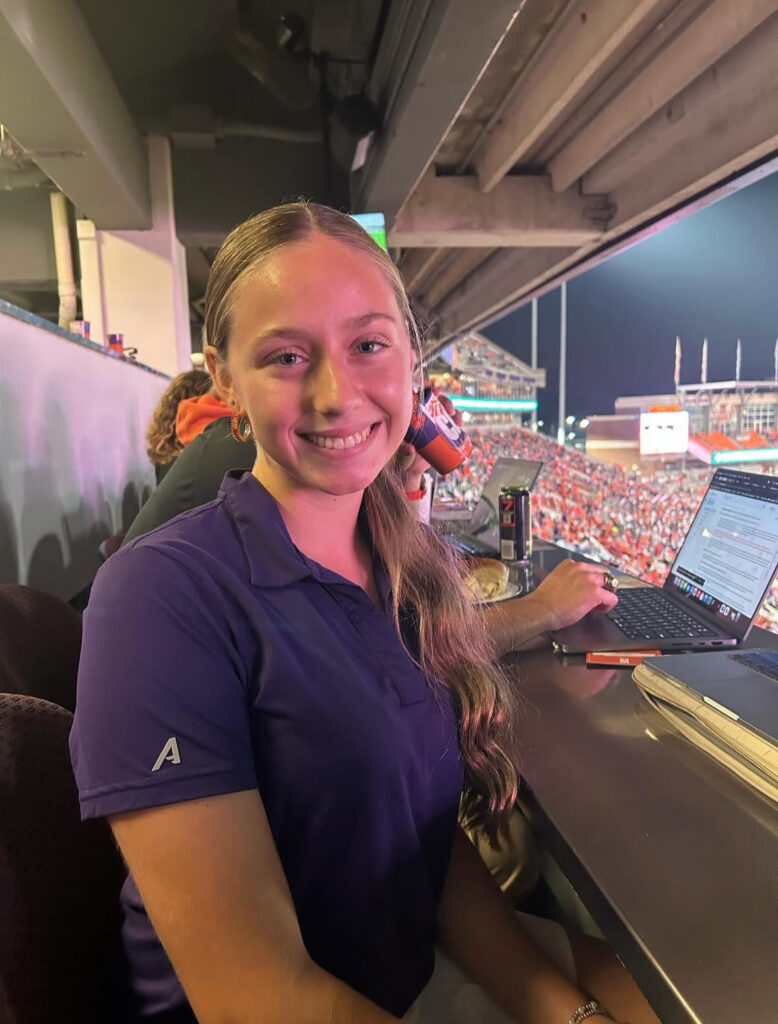
Kendall Lampman sits in the press box as a credentialed member for AWSM at the Clemson vs FSU football game. Lampman got to ask head coach Dabo Swinney a question during the post-game press conference.
“It’s a competitive process to be able to get a pass, but we have someone at every single sporting event,” Smith-Rey said.
Community Outreach Chair, Caity Eng, has been managing the credentialing experience.
“Our members have put in so much hard work, and it has been so wonderful to see them shine, whether it is their first sports photography or reporting experience, or to expand their current skills and portfolio,” Eng said.
“Seeing and hearing about everyone’s passion for sports media and their time working on the sidelines and the press box has been so fulfilling.”
Last semester, the club participated in a professional photoshoot utilizing the Nieri Family Student-Athlete Enrichment Center’s studio. Members received a camera workshop before the event. Exclusive experiences like this are what Smith-Rey believes make the organization unique.
“These students wouldn’t ever really have that opportunity if this association didn’t exist,” Smith-Rey said. “I love that it’s specific to females to give them a voice and a chance to grow.”
Female students across all majors can connect through the common thread of sport.
“You see business students talking with sports communication students, talking with engineering students, and it’s a really cool way for them to be like, ‘Oh, I didn’t think we had anything in common, but you love sports, and I love sports,’” Smith-Rey said.
Looking ahead, the organization hopes to continue strengthening its relationship with Clemson Athletics to make a greater impact on students’ professional development and the community.
“In such a male-dominated field, women in sports must stick together, support one another no matter what, and unite on issues that pertain to us,” Mason said. “As female representation continues to grow in the sports industry, I hope to be a voice and supportive figure for women in the industry.”
Happy New Year, from the Robert H. Brooks Sports Science Institute. For the Spring 2026 semester, RHBSSI welcomed three new and two returning student interns. Additionally, through the UPIC Beyond the Game program, two student-athlete interns will join the group. These students bring a multitude of experiences that will help drive new ideas that support the Institute’s mission.
Evy Lane, Communications Lead
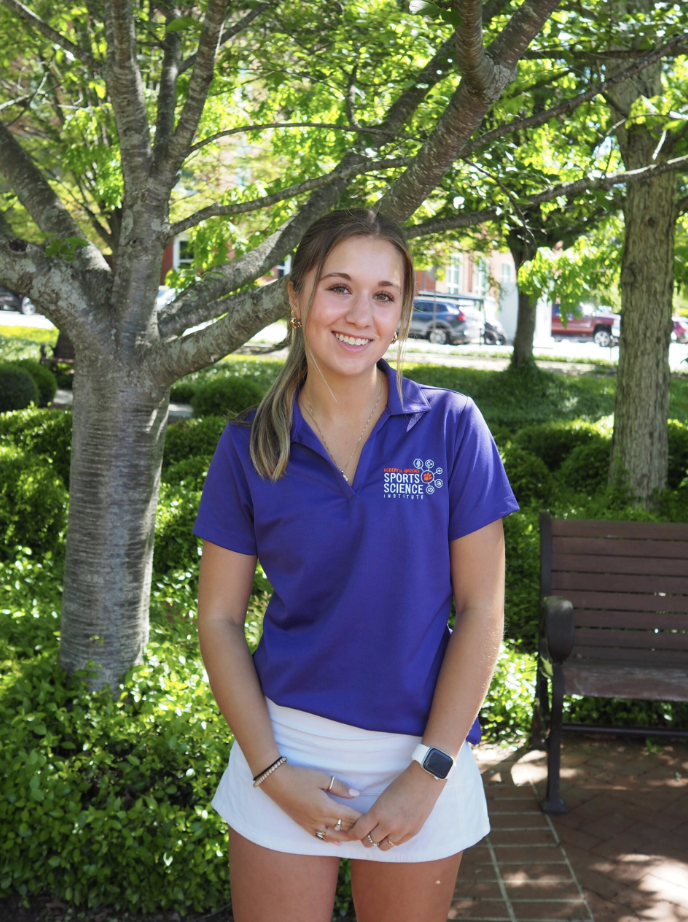
Evy Lane is a senior Marketing major and Spanish minor from Piedmont, South Carolina. In her fourth semester with the Institute, she will serve as the Communications Lead, which entails creating a content calendar and editing or posting blogs across RHBSSI social media handles. Lane has two cats, Otto and Lottie, whom she adores dearly.
Katie Gerbasich, Writer/Editor
Katie Gerbasich is a senior Sports Communication major and Women’s Leadership minor from Houston, Texas. In her third semester with the Institute, she will be assisting the team in detailing the stories of sports science endeavors. Gerbasich has prior experience with Clemson Baseball’s Sports Analytics team and has written sports articles for Tiger View Media.
Nathan Inman, Writer/Editor
Nathan Inman is a junior double majoring in Sports Communication and Marketing from Spartanburg, South Carolina. He has been involved with The Tiger student newspaper for three years and was recently appointed Assistant Sports Editor. This semester, Inman looks forward to continuing to grow as a writer and collaborating with the rest of the team.
Sofia Cordi, Events Lead
Sofia Cordi is a senior at Clemson University pursuing a B.S. in Management with an emphasis in Human Resources, a concentration in Entrepreneurship, and a Global Leadership Certificate. She serves as the Events Lead intern for The Robert H. Brooks Sports Science Institute, where she supports the planning and execution of events that foster collaboration, innovation, and community engagement across sports science and performance disciplines.
Previously, Sofia worked with Incora Health, a women’s health startup developing patented smart earrings that capture real-time biodata, where she supported community engagement, content strategy, and cross-functional initiatives. Her experience also includes work with Kognitos, a generative AI company in healthcare automation, and Clemson’s Brook T. Smith Launchpad. Sofia is passionate about innovation, strategic planning, and building meaningful connections through events and community-focused initiatives.
Katie Colton, Graphic Designer
Katie Colton is a Graphic Communications major with a minor in Brand Communications from York, South Carolina. This past year, she worked with Clemson Creative Inquiry and Undergraduate Research’s Decipher Magazine. Colton traveled to Italy over winter break.
Shanque Williams, Beyond the Game Intern
Shanque Williams is a sophomore Psychology major with a minor in Business Management. Williams is a track and field athlete from Jamaica. She’s excited to meet the team and begin working.
Kevin Collins, Beyond the Game Intern
Kevin Collins is a senior Economics major with a Minor in Business Administration from Waldorf, Maryland. He competes in shorts sprints with track and field.