From left to right, Megan Courage, Colin Jones, Robert Campos, Hannah Gilliam, Michelle Fuentes, Rachel Rogers, and Danielle Haight with their poster at the forum. Photo courtesy of Gabriela Tissera.
On April 5, students in the Department of Languages presented a project at Clemson’s annual Focus on Creative Inquiry Poster Forum. Robert Campos, Megan Courage, Elouise Cram, Michelle Fuentes, Hannah Gilliam, Danielle Haight, Colin Jones, Rebecca McConnell, and Rachel Rogers presented their research on The Fantastic in Hispanic Film. The project, mentored by Dr. Graciela Tissera, focused on the genre of science fiction and fantasy through films by world-renowned Hispanic film directors.
Rebecca McConnell and Elouise Cram with their poster at the forum. Photo courtesy of Graciela Tissera.
The analysis explored uncanny and marvelous elements related to parallel worlds, urban legends, the Lazarus syndrome, extrasensory perception, and dissociative identity, among other topics, as well as cinematic conventions and themes in fantastic films. With historical, cultural, political, and scientific contexts, the project analyzed supernatural phenomena as presented in films to determine the line between reality and unreality and the gateways between alternate worlds in order to forge an understanding of the unknown.
Gabriela Stoicea received the Dean’s Award for Excellence in Teaching.
Gabriela Stoicea, assistant professor of German, received the Dean’s Award for Excellence in Teaching. The annual dean’s awards are peer-reviewed by the college faculty awards committee. Each award comes with a plaque of recognition, placement on the list of awardees in the dean’s office and a cash award.
As one nominator commented, “[Her] classes rank among the very best that the university has to offer. … I found them to be incredibly intellectually stimulating, and other students and I often mulled over ideas from class discussions long after class had ended.”
Another wrote, “She always upheld a certain atmosphere in her classroom that encouraged productive and thought-provoking conversation. She led us as we powerfully worked through seemingly difficult topics, such as societal oppression on the individual or the complexities of moral standards.”
And, from her own teaching statement, Professor Stoicea reminds us all of this very important message: “Contributing to my students’ intellectual formation is a privilege I never take for granted, but one that I work hard to earn every single day.”
Stephen Fitzmaurice received a grant to establish the first South Carolina Educational Interpreting Center.
Stephen Fitzmaurice, assistant professor of American Sign Language, was awarded $1,011,547 from the South Carolina Department of Education to establish the first South Carolina Educational Interpreting Center at the University Center in Greenville. Clemson will partner with the South Carolina State Department of Education and the South Carolina School for the Deaf and the Blind to open the new center.
The center aims to improve the quality of educational interpreters in South Carolina by providing national skills and knowledge assessments, in-service professional development sessions, mentoring and technical assistance to educational interpreters and local school districts.
“As a nationwide leader in preparing educational interpreters,” Fitzmaurice said, “we are excited to receive this award which will go a long way not only to improving the skills of working educational interpreters in South Carolina but towards improving educational access for children who are deaf and hard of hearing across the state.”
Other faculty news:
Luca Barattoni, associate professor of Italian, gave a lecture at the Department of Cinema and Television Studies at Kadir Has University in Istanbul in December 2016. His topic was “The Relevance of the Neorealist Debate to Contemporary World Cinema.”
Joseph Mai, associate professor of French, published an article on how a contemporary French novelist uses literary experimentation to explore ways in which humans and animals are defined in relation to one another: ‘“Un tissu de mots”: Writing Human and Animal Life in Olivia Rosenthal’s Que font les rennes après Noël ?’ appeared in Mosaic: An Interdisciplinary Critical Journal: 49, 3. He also participated in the scientific committee and was an invited speaker at the World Cinema and Television in French Conference, held in September 2016 at the University of Cincinnati.
Tiffany Creegan Miller, assistant professor of Spanish, published a book chapter entitled, “Una sociedad fragmentada: la heterogeneidad maya durante el conflicto armado guatemalteco y la violencia de la ‘posguerra’ en ‘Insensatez’” in the edited volume Horacio Castellanos Moya: El diablo en el espejo, published by Ediciones Eón in Mexico and edited by María del Carmen Caña Jiménez and Vinodh Venkatesh. In other news, Miller also presented work on appropriations of Japanese cultural forms in K’iche’ Maya poetry at the Symposium on Indigenous Languages and Cultures of Latin America (ILCLA) at Ohio State University. She also was invited to be a guest lecturer for a medical Spanish class at Brown University to discuss health care initiatives in Guatemalan Maya communities.
Kim Misener Dunn, lecturer of American Sign Languages, co-authored the peer-reviewed article “Early Reading for Young Deaf and Hard of Hearing Children: Alternative Frameworks,” which was published in April 2016 in the online journal Psychology.
Salvador Oropesa, department chair and professor of Spanish, published the book chapter “Lonely Souls in ‘Solo Dios Sabe’ by Carlos Bolado: Pastoralism and Syncretic Spirituality in Times of Crisis” in The Latin American Road Movie, edited by Jorge Pérez and Verónica Garibotto. New York: Palgrave Macmillan, 2016. 121-36.
Johannes Schmidt, associate professor of German, was lead editor for a co-edited volume Herder and Religion. Contributions from the 2010 Conference of the International Herder Society at the University of Notre Dame, South Bend, Indiana (Synchron 2016). The volume includes his own contribution “Light of Nature/Light of Reason. Herder’s and Kant’s Religion Essays.” He is also included in another Herder publication with an article entitled “Johann Gottfried Herder’s Adrastea: History in Relation” (Beate Allert (ed.): Herder: From Cognition to Cultural Science(Synchron 2016).
Graciela Tissera, associate professor of Spanish, presented her research on the supernatural in Hispanic films, “Spirits Trapped between Worlds: The Devil’s Backbone by Guillermo del Toro,” and chaired a panel on film and paranormal phenomena at the Film and History Conference in Milwaukee, Wisconsin in October 2016. Tissera’s students, Jodie Holodak and Rebecca McConnell, participated in the panel to discuss their Creative Inquiry projects related to health and business topics in film and media. Tissera also attended the Film and Literature Conference organized by the University of Buenos Aires in Argentina in November 2016 to present her research paper entitled “Theories of Knowledge in the Fiction of Borges and Cortázar.”
Eric Touya, associate professor of French, published The Case for the Humanities: Pedagogy, Polity, Interdisciplinarity. Lanham: Rowman & Littlefield, December 2016. Countering the perception that the humanities are unessential, this volume contends that their well-being has not only academic but also cultural, political, and existential ramifications.
The following Department of Languages students were honored at the 2016-2017 College of Architecture, Arts and Humanities (CAAH) Honors and Awards Ceremony on April 7 in the Brooks Center Theatre. Congratulations!
Linda Wilson – Gallaudet/Clerc Award for Excellence in American Sign Language
The award is given to a student who has demonstrated outstanding expressive and receptive skills in American Sign Language, understanding and appreciation of deaf culture, and has promoted the awareness of American Sign Language both on and off campus.
Award winner Hilda Chan (center) with CAAH Dean Richard Goodstein (left) and Chair of the Department of Languages Salvador Oropesa (right). Photo courtesy of Clemson University.
CHINESE
David Kwietniewski (beginner) & Hilda Chan (achievement) – Clemson Chinese Laoshi Awards
Two students from the Chinese language program receive prizes in the amounts of $100 (Best Beginner in Chinese Language Study) and $200 (Best Achievement in the Chinese Program).
Olivia Haddad & Donald McKinnon Reece – Pacific Gateway Award for Excellence in Chinese
The Pacific Gateway Capital LLC contributes an annual award of merit with a cash prize to a junior or senior for outstanding achievement in the study of the Chinese language.
FRENCH
Joseph Willis – American Association of Teachers French Award
The French faculty of the Department of Languages annually awards a medal from the American Association of the Teachers of French and a certificate of merit in recognition of outstanding achievement in the study of French language and literature.
Award winner Joseph Willis (center) with CAAH Dean Richard Goodstein (left) and Chair of the Department of Languages Salvador Oropesa (right). Photo courtesy of Clemson University.
Danielle Ayer – Jordan Dean Award in French
This award is given to a student in French studies for outstanding academic achievement.
GERMAN
Melissa Manning – Clemson University German Club Award
The German Club presents a certificate to recognize outstanding contributions to the extra-curricular cultural programs in German at Clemson.
Sarah Waldvogel – Draexlmaier Language Award
Funded by DAA Draexlmaier Automotive of America (Duncan, SC), this cash award recognizes a multi-faceted student who has attained exceptional language proficiency in German.
ITALIAN
Sarah Marshall – Coccia Foundation Annual Award
The Italian faculty annually presents this cash award to an Italian major in recognition of outstanding achievement in the study of Italian language and literature.
SPANISH
Nicholas M. West – American Association of Teachers Spanish & Portuguese Award
The Spanish faculty presents a medal from the American Association of Teachers of Spanish and a certificate to recognize outstanding achievement in the study of Spanish language and literature.
Award winner Michelle Fuentes (center) with CAAH Dean Richard Goodstein (left) and Chair of the Department of Languages Salvador Oropesa (right). Photo courtesy of Clemson University.
LANGUAGE AND INTERNATIONAL HEALTH
Rebecca Lynn McConnell – Language and International Health Academic Honor Award
The Language and International Health Society gives this award to a Language and International Health major who demonstrates ability to perform, achieve, and excel in scholastic activities.
Emily W. Blackshire – Language and International Health Award of Excellence
The award is given to a senior Language and International Health major for outstanding academic achievements, professional conduct, and unconditional service to multicultural communities.
Elouise Giroux Cram & Michelle Fuentes – Language and International Health Award of Excellence in Research
The award is given to a Language and International Health major for outstanding academic research on international health topics.
LANGUAGE AND INTERNATIONAL TRADE
Caroline Rubino – The John Bednar Award of Excellence in French and International Trade
The Language and International Trade – French faculty annually awards a Language and International Trade – French student in recognition of outstanding achievement in the study of French and international trade.
Caroline Winbleton – Dr. Wannamaker Languages & International Trade Annual Award of Excellence
The purpose of the fund is to honor an outstanding senior majoring in Language and International Trade who has the highest overall GPA. In case of a tie, the selection is based on meritorious service to the department.
The College of Architecture, Arts and Humanities inducted 17 founding members of a new Hall of Fame celebrating alumni, faculty and friends who have made a significant impact upon the educational, research and/or service goals of the college. The induction ceremony was held March 31 at the Madren Conference Center, with 14 of the new members present.
“It was an extraordinary opportunity having so much talent, so much achievement and so much commitment in one room,” said Richard Goodstein, dean of the college. “Each member of this inaugural class will continue to serve as a beacon for all who come afterward. Each and every one will be a very tough act to follow.”
Drs. Ralph Rynes and Patricia (Pat) Wannamaker became the first representatives of the Department of Languages honored at this inaugural ceremony.
CAAH Hall of Fame inductee Ralph Rynes. Photo courtesy of Ralph Rynes.
Prior to his retirement, Dr. Ralph Rynes was a board-certified physician with over 30 years’ experience in treating the neurological aspects of Infectious Diseases. He worked primarily with individuals living with HIV and co-occurring mental health or substance use disorders. He earned a B.A. at Clemson University and an M.A. at the Universität Hamburg in Germany before completing his Doctoral degrees (MD and Ph.D.) at l’Université Denis Diderot. Dr. Rynes completed clinical and research residencies in Neurology and Neuroscience at l’Hôpital Pitié-Salpêtrière in Paris, France, followed by post-doctoral research in Brain and Cognitive Sciences at the Massachusetts Institute of Technology.
He specialized in Prion diseases and in the treatment of HIV and Hepatitis C as well as the neurobiology of substance use disorders, practicing at the Immunology Center of the USC School of Medicine, the largest infectious diseases clinic in South Carolina.
Additionally, Dr. Rynes provided cultural sensitivity training to other physicians and support staff on Latino, French-speaking African refugee, and Lesbian, Gay, Bisexual and Transgender treatment nuances, in addition to providing HIV/AIDS training and cultural sensitivity training for SC Alcohol and Drug Commissions, SC and other state’s Primary Healthcare Associations, the National Association of Addictions Counselors, the SC Health Information Management Association, SC DHEC and a host of national organizations.
He now volunteers with Doctors Without Borders in a consulting capacity, and continues to work to mitigate the stigma associated with HIV, Hepatitis C, and mental health and substance use disorders in the U.S. and in Western Europe.
Special interests include Prion diseases, the neurochemical pathways of addiction and specialized treatment issues in LGBT and Latino and African refugee populations.
Prior to retirement, he served on numerous national and international Boards, as well as serving on and chairing the Boards of the Columbia Free Medical Clinic and the Columbia Oral Health Clinic.
Of his induction into the Hall of Fame, Dr. Rynes said, “As a senior at Clemson, I had already forged my career path: MS and PhD at Georgetown, where I had already been accepted, followed by a career teaching Foreign Affairs on the university level. But Dr. Margit Sinka, my German professor at the time, changed all that by encouraging me to apply for a Fellowship to study in Germany. I was accepted, beginning a relationship with Europe and Europeans that continues to this day. I cannot imagine what my life would be like had I not had the opportunity and the encouragement to live and study in other countries. My life is so much richer and satisfying than I could ever have imagined, all thanks to a very intuitive and highly motivated Clemson professor.”
Professor emeritus Pat Wannamaker (center) is inducted at the CAAH Hall of Fame Ceremony. Presenting her with the award are CAAH Dean Richard Goodstein (left) and Chair of the Department of Languages Salvador Oropesa (right). Photo courtesy of Clemson University.
Dr. Patricia W. Wannamaker received both her B.A. and M.A. degrees from the University of South Carolina in Columbia. She taught English and German for nine years in secondary schools in the state before finishing her Ph.D. in German and linguistics at Louisiana State University in 1964.
Dr. Wannamaker finished a twenty-five year teaching career at Clemson as founding Director of the Language and International Trade (L&IT) baccalaureate degree program under the funding of the Fund for the Improvement of Post-Secondary Education (FIPSE).
During Dr. Wannamaker’s time at Clemson, the undergraduate business curricula was generally restricted to 12 hours or fewer of electives that could be used in language study. Dr. Wannamaker knew a Liberal Arts B.A. was the answer!
Studies show that liberal arts grads are well prepared to succeed in business. She envisioned a Clemson L&IT degree that would combine humanistic and technical learning to develop cultural sensitivity as a marketing tool in global business.
She formed partnerships with supporting agencies and multinational firms were also a vital part of the success of L&IT, including the S.C. State Development Board, the S.C. Ports Authority, the U.S. Department of Commerce, and the many upstate multinational firms and their parent companies around the world.
Dr. Wannamaker also invested a lot of time and effort in recruiting high school students for visits to Clemson’s campus, and more specifically to provide information to the potential future Language and
International Trade majors.
Since its inception, the L&IT program has graduated more than 1,000 undergraduate students.
Of her induction, Dr. Wannamaker said, “Thank you so much for this great honor you all have bestowed upon me. The Language and International Trade baccalaureate program has exceeded my highest expectation as founding director. Congratulations to all of you for the continuing success of every aspect of the program, including the annual L&IT trade conference which supports the all-important networking aspect of L&IT.”
Keynote speaker Lee Gill talks about the business case for diversity. Photo courtesy of Clemson University.
2017 marked the 10th anniversary of the Department of Languages‘s annual Language and International Trade (L&IT) Conference, held March 8 in the Hendrix Student Center ballrooms. The theme of this year’s conference was inclusiveness in the business world. The conference featured a keynote speech about the business case for diversity by Lee Gill, Clemson’s Chief Diversity Officer, who discussed how diversity and inclusion benefit businesses and how they can also make the Clemson community stronger and more competitive. Clemson students moderated a panel with L&IT alumni who are now working at international companies. The graduates discussed their studies at Clemson and their current work in the industry.
Students participate in roundtable discussions with local business leaders. Photo courtesy of Clemson University.
The conference gave current language students a chance to see how their studies might translate to a future career. Spanish student Bailey Taylor attended a panel discussion with local business leaders on inclusiveness, cross-cultures, and opportunities in a globalized world. “I found the session to be very thought provoking,” she said, “and it interested me in possibly minoring in Spanish.”
Conference presenters and organizers pose for a photo. Photo courtesy of Clemson University.
L&IT French student Anna Caroline Bridgeman helped organize the conference. “I really enjoyed listening to people in the international business group talk about their work experiences,” she said. “Mr. Gill’s presentation on the business case for inclusiveness was very inspiring. It was also rewarding to hear Clemson alumni talk about their job experience after graduating from Clemson. It was a great experience learning about the different job opportunities that exist for Clemson students in L&IT.”
L&IH majors Elouise Cram and Rebecca McConnell at the conference. Image courtesy of Graciela Tissera.
Language and International Health (L&IH) students Elouise Cram and Rebecca McConnell attended the Southwest Popular/American Culture Association’s 38th Annual Conference in Albuquerque, New Mexico (February 15-18, 2017) to present their research and participate in the panel organized by Dr. Graciela Tissera: Adapting Philosophers to Film. Elouise discussed the film adaptation of Gabriel García Márquez’s short story “The Saint” and Rebecca presented the cinematic interpretation of the novel Aura by Carlos Fuentes.
2017 German Summit. Photo courtesy of Clemson University.
The German Club, in cooperation with the American Association of Teachers of German of South Carolina, hosted a German Summit on February 14 in the Hendrix Student Center. Clemson University, USC-Upstate, Furman University and the College of Charleston were represented to provide information about their German programs to high school students of German and to encourage them to continue the study of this language at the college level. In all, there were 120 students from eight different high schools from the Upstate and Midlands. Events included station activities, presentations by college German programs and a panel of students and alumni from represented colleges.
Clemson ranks 16th in the nation in the number of African American undergraduate students earning a foreign language degree in 2016, according to Diverse: Issues in Higher Education. Clemson ranked 19th in 2015 and 35th in 2013. Since 2010, the magazine has published rankings of the top 100 institutions that confer the most degrees to minority students. The data are based on institutional reports collected by the U.S. Department of Education.
L&IH students at the Victoria Eugenia Hospital in Seville. (Image provided.)
Language and International Health (L&IH) students studying abroad in Seville, Spain through the Centro Internacional de Estudios Culturales (CINECU) have the opportunity to do internships at the Victoria Eugenia Hospital. The three-month, 135-hour internship allows students to directly observe the structural and functional organization of the healthcare system in Andalusia. These internships were facilitated by the Institute of Health Education, a hospital partner that organizes events and courses designed to combine practical experience with theoretical knowledge.
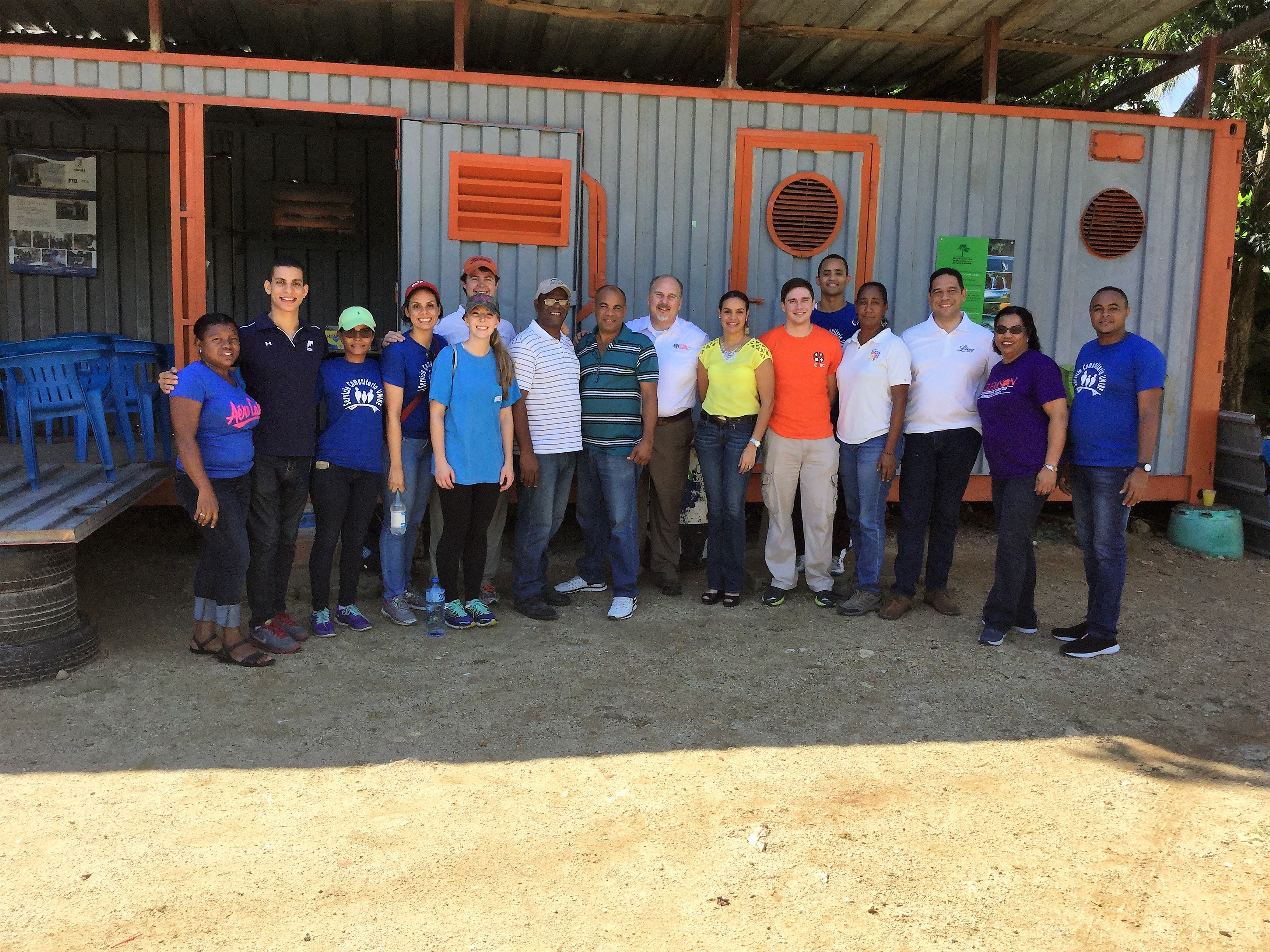
Building Healthy Communities in the Dominican Republic fall trip 2016. Photo courtesy of Arelis Moore de Peralta.
Building Healthy Communities in the Dominican Republic is an undergraduate research and study abroad Creative Inquiry (CI) project led by Dr. Arelis Moore de Peralta. The project is an interdisciplinary, holistic effort dedicated to improving the health of Las Malvinas, a poverty-stricken community in the Dominican Republic (DR). Moore de Peralta holds a joint appointment with the Department of Youth, Family and Community Studies and the Department of Languages.
A trip to Las Malvinas in November 2016 allowed for planning and partnership building with the Universidad Iberoamericana, the DR’s Ministry of Public Health, and Las Malvinas community members. Joining Moore de Peralta on the trip were David Vaughn, Professor of Practice, Clemson Engineers for Developing Countries (CEDC), and two of his students who are also program coordinators (Hunter Lee and Jack McLeod); Dr. James H. Spencer, Associate Dean of Research and Graduate Education, CAAH; and Katherine Brown, a CI Project Research Team Leader.
Building Healthy Communities in the Dominican Republic fall trip 2016. Photo courtesy of Arelis Moore de Peralta.
Community members in Las Malvinas hope for an organized community health plan and local government’s involvement in sustainable improvement projects. The Clemson CI project aims to conduct a Community Health Assessment and to develop a Community Health Improvement Plan in Las Malvinas. This experience improves students’ cultural competence and critical thinking skills, and allows them to develop evidence-based learning skills to conduct research beyond the CI class.
Building Healthy Communities in the Dominican Republic will take a spring trip in March 2017.