Donald D. Clayton, Professor Emeritus of Physics and Astronomy (March 18, 1935—January 3, 2024).
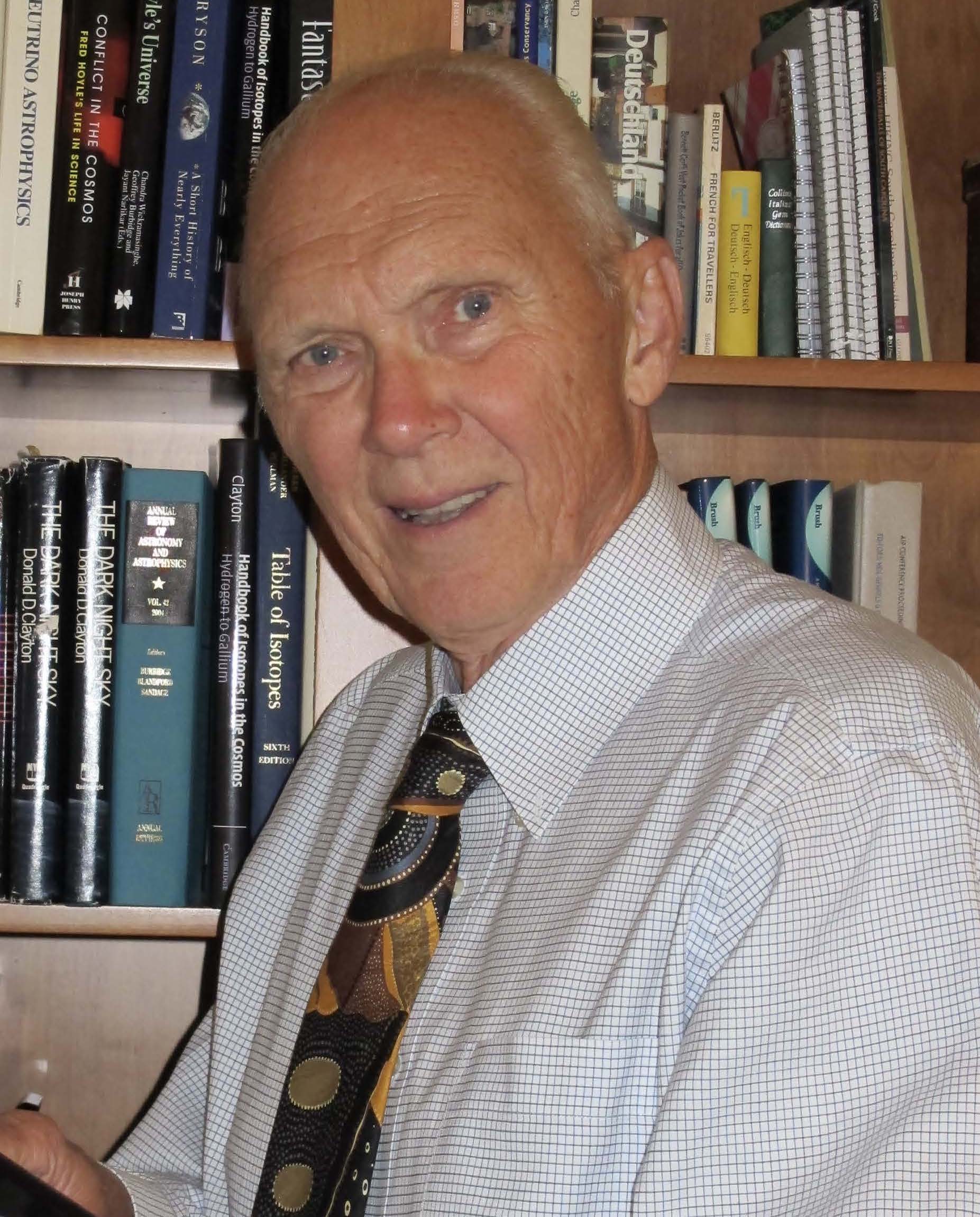
Donald Clayton was born in Shenandoah, Iowa and grew up Dallas, TX. He earned a B.S. in Physics in 1956 from Southern Methodist University, where he also played on the golf team. He then attended the California Institute of Technology, where he earned his Ph.D. under the mentorship of Nobel Laureate William Alfred Fowler in 1961. After two years as a postdoctoral fellow there, he became one of the founding faculty members of Rice University’s Department of Space Science (later Space Physics and Astronomy) in 1963. He established nuclear astrophysics there, publishing many seminal ideas in gamma-ray astronomy and cosmochemistry, and developed and published his famous textbook Principles of Stellar Evolution and Nucleosynthesis. During his Rice tenure, as Andrew Hays Buchanan Professor of Astrophysics, he also held visiting positions in Cardiff, UK, and enjoyed sabbatical leaves at Cambridge, Heidelberg, and Durham University, UK.
In 1989, Clayton moved to Clemson University, tasked with developing an astronomy program. He established a group in nuclear astrophysics and gamma-ray astronomy, which thrives today. He hosted many renowned physicists and astronomers as visitors to Clemson, and he developed the unique Photo Archive in Nuclear Astrophysics. His advice helped guide department chairs and deans in Clemson’s development of its research culture. Clayton retired in 2007, but remained active in research until very recently. He wrote several books, including a science fiction novel, a scientific memoir, and a handbook of the isotopes.
Among Clayton’s many scientific accomplishments, he developed the first quantitative analysis of the slow neutron capture process for forming heavy elements in stars, he predicted many of the effects of radioactivity in supernovae, including that gamma rays from it would be detectable, and he explained how radioactivity abundances evolved in the interstellar medium. Clayton advanced new ideas of nuclear astrophysics manifested in meteorites, including of radioactive chronometers, of stardust particles – dust grains that survived from formation in stars to their incorporation in solar system bodies, and of cosmic chemical memory – that isotopic signatures of stellar nucleosynthesis could be recovered even when the dust carriers had not survived. These ideas received much pushback from the meteoritic community over more than a decade, but Clayton was later awarded the Leonard Medal, the highest honor of the Meteoritical Society, in 1991.
In his Nobel address, Fowler said, “Of my 50 graduate students who have contributed to the field I must single out Donald D. Clayton.”
A Memorial Service will be on March 16, 2024 at 11:00 am at Seneca Presbyterian Church in Seneca, SC. The Donald D. Clayton Memorial Fund for support of graduate student research in astrophysics and meteoritics has been established in his memory.
