Contributing author: Dr. Zee Ahmed, Clemson University
The two-spot cotton leafhopper (TSCL) continued to receive attention during the 2026 season as researchers across the southeastern U.S. worked to better understand its biology and management. A recent GrowerTalks article by Muhammad Z. “Zee” Ahmed of Clemson University and Shimat V. Joseph of the University of Georgia brings together what we have learned and what hibiscus growers should consider going into the next production season.
Why Hibiscus Matters
Hibiscus is not necessarily the crop most severely affected by TSCL. However, movement of hibiscus through the ornamental plant trade can provide a pathway for the pest to reach new locations.
This makes nursery monitoring particularly important. Keeping hibiscus free of TSCL can protect plant quality while also reducing the potential movement of the pest from nurseries into landscapes and agricultural production areas.
Know the Symptoms Before You Spray
TSCL feeding causes a characteristic injury known as hopperburn. On hibiscus, symptoms can begin as pale yellowing along leaf margins and progress to bronzing, browning and curling. Severely affected leaves may eventually drop. Please see our field guide in the GrowerTalks article published on November 28, 2025.
Because these symptoms can resemble nutritional or other plant-health problems, confirming the presence of the insect is important before making a management decision.
Adults are small and bright green, with two distinctive black spots near the ends of the wings. Yellow sticky cards placed above the canopy provide a simple way to monitor adults. Growers can also examine symptomatic terminals by tapping foliage over a white tray or collecting insects from terminals for identification.
What Recent Research Is Telling Us
Research conducted during the rapid response to TSCL has started filling important information gaps.
Recent studies have examined population genetics, insecticide efficacy, and biological control. Clemson research has also evaluated management options for TSCL on hibiscus, while other studies have examined insect growth regulators and parasitoids associated with the pest.
The results provide growers with several important lessons:
- Early detection remains one of the most important management tools.
- Both adults and developing nymphs need to be considered when building a management program.
- Several insecticides can provide rapid suppression of TSCL populations.
- Insect growth regulators may provide additional tools for targeting immature stages.
- Rotating insecticide modes of action is important for protecting effective chemistries.
- Native parasitoids attacking TSCL eggs have been identified, although their contribution to biological control requires additional research.
From a New Pest to a Regional Response
The response to TSCL has expanded well beyond a single crop or state.
Clemson scientists and collaborators have combined field surveys, genetic research, insecticide trials and Extension efforts to develop practical information for growers. A multistate effort has also brought together university researchers, Extension specialists, government agencies and industry partners to improve detection, diagnostics, monitoring and management.
This rapid-response approach was outlined earlier in Entomology Today in “Two-Spot Cotton Leafhopper: Researchers Build Rapid-Response Framework for New Invasive Pest.” The article traces the response from initial grower reports and early detection through genetic research, insecticide trials, regional collaboration, and Extension outreach.
Clemson News highlighted this coordinated effort in “New invasive pest spurs rapid scientific response,” published April 29, 2026. The article describes how Clemson scientists, led by Zee Ahmed, organized a rapid-response framework after TSCL emerged as a concern in South Carolina.
Additional Clemson News coverage, “Clemson scientist secures USDA funding to help protect South Carolina from invasive pests,” published August 10, 2026, describes USDA-APHIS-supported research led by Ahmed on TSCL and spotted lanternfly. The projects focus on strengthening early detection, monitoring, and management of invasive pests.
The regional response is also highlighted in the Southern IPM Center article, “Two-Spot Cotton Leafhopper Working Group: A Regional Framework for Rapid & Applied Response.” The article describes the multistate TSCL Working Group organized by Zee Ahmed through a Southern IPM Center Working Group grant (Project S26-075), along with the development of shared resources, Stop2SCL.org, and regional priorities for coordinated research, Extension, and regulatory efforts.
Offrange, an independent agricultural publication from Ambrook, also featured TSCL in “Pests in the Wind” The article includes observations from Zee Ahmed that TSCL appeared later in the 2026 season in South Carolina, but was being found again in cotton fields, highlighting the continuing challenge posed by this invasive pest.
These efforts demonstrate why invasive pest management increasingly requires coordination across commodities and state boundaries.
What Growers Can Do
When chemical control is needed, growers can consider products that have demonstrated efficacy against TSCL in published studies discussed in our recent GrowerTalks article, provided the product is currently labeled for the intended use. Always read and follow the current pesticide label, including all directions, restrictions and precautions. The label takes precedence over research results or recommendations discussed here. For operations shipping hibiscus across state lines, careful scouting and management can help reduce the risk of moving TSCL on infested plant material.
Want to Hear More?
Listen to Zee Ahmed discuss how the Two-Spot Cotton Leafhopper Working Group came together, the priorities identified for this emerging invasive pest, and how IPM can guide a coordinated regional response in the Southern IPM Center’s This Is IPM podcast.
Read the Full Article
The complete article, “A Season of Two-Spot Cotton Leafhopper on Hibiscus,” by Muhammad Z. “Zee” Ahmed and Shimat V. Joseph was published in GrowerTalks on October 30, 2026.
The article provides additional information on TSCL identification, hopperburn symptoms, monitoring, biology, insecticide efficacy, biological control and the regional response to this emerging pest.
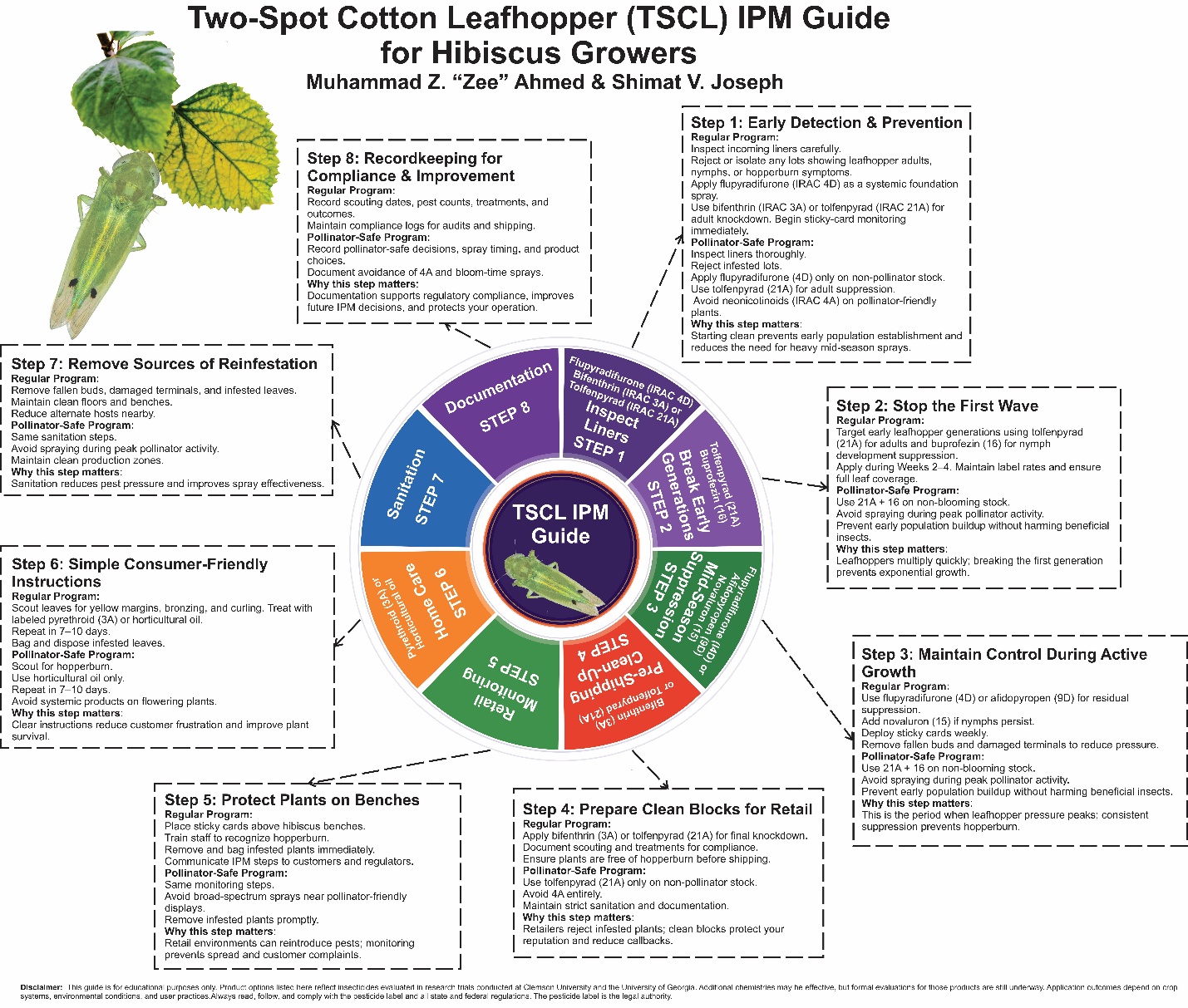
Figure 1. Two-spot cotton leafhopper (TSCL) IPM guide for hibiscus growers. The eight-step program integrates early detection, management of adults and nymphs, preparation of clean plants for retail, continued monitoring, sanitation, and recordkeeping. The guide also distinguishes between regular and pollinator-safe management considerations throughout the production cycle. Prepared by Muhammad Z. “Zee” Ahmed and Shimat V. Joseph.

