Physics and Astronomy Blog

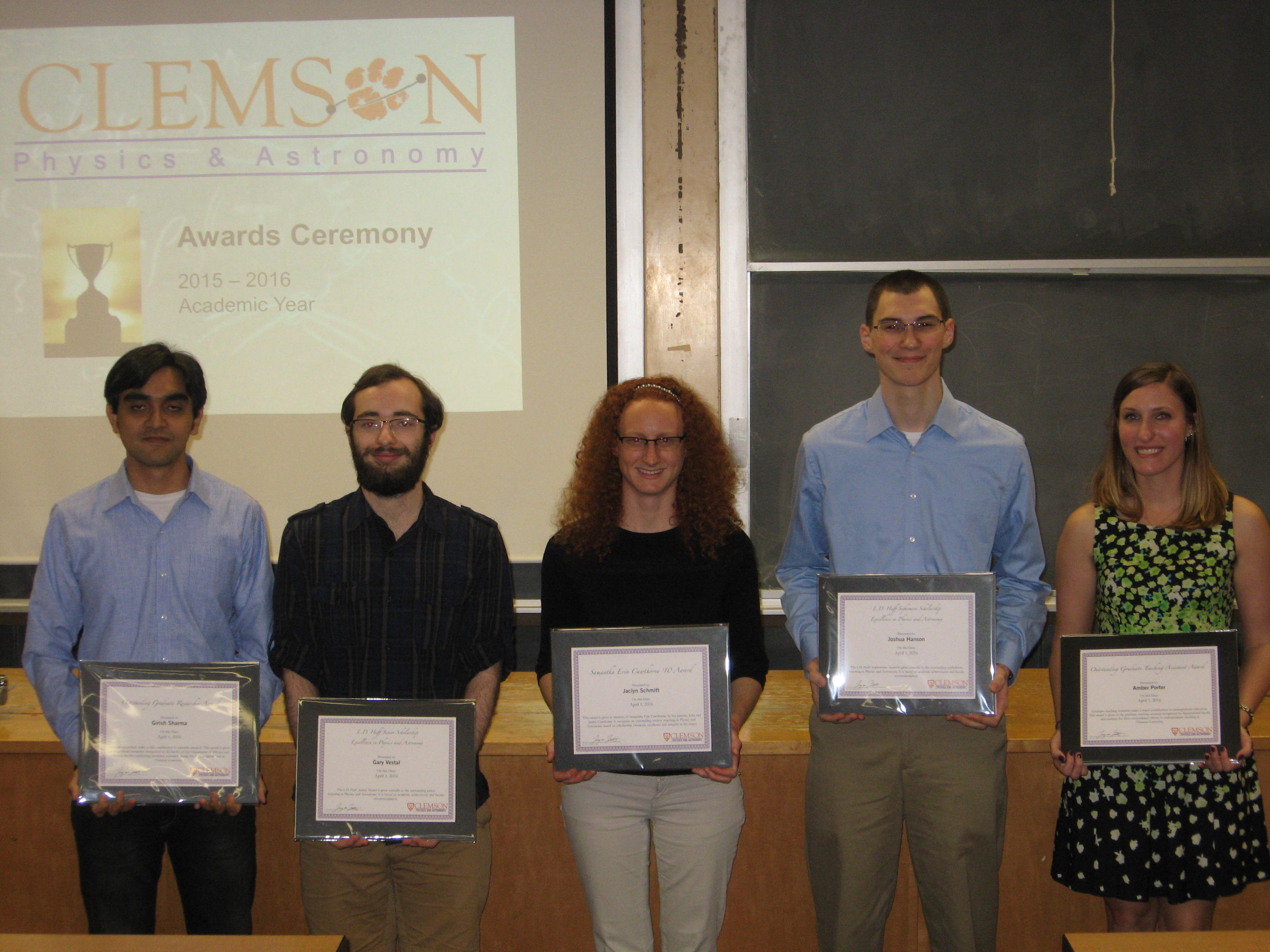
2016 Student Awards Ceremony held April 1st

2016 Student Awards Receipents
Girish Sharma, Gary Vestal, Jaclyn Schmitt, Joshua Hanson, and Amber Porter. Not shown: Emily Thompson.

The Department of Physics & Astronomy honored this year’s departmental award recipients in its annual ceremony on April 1 and also acknowledged college-level and national scholarship awardees. Department awardees names are forwarded to the college for consideration in the CoES awards.

 Department of Physics and Astronomy
  • Outstanding Graduate Researcher: Girish Sharma
  • Outstanding Graduate Teaching Assistant: Amber Porter
  • L.D. Huff Junior Award: Gary Vestal
  • L.D. Huff Sophomore Award: Joshua Hanson
  • Erin Samantha Cawthorne Award: Jaclyn Schmitt
  • SPS Senior Award: Emily Thompson
College of Engineering and Science
  • Outstanding Graduate Researcher: Girish Sharma (Condensed Matter, advisor: Professor Sumanta Tewari)
  • Outstanding Teaching Assistant: Dhruva Kulkarni (Condensed Matter, advisor: Professor Chad Sosolik)
  • Outstanding Senior in the Sciences: Emily Thompson
  • Outstanding Junior in the Sciences: Gary Vestal
NSF Graduate Research Fellowship Program – Emily Thompson
Congratulations to all our students!

P & A senior Emily Thompson is awarded an NSF Graduate Fellowship

Emily Thompson, a graduating senior, is awarded an National Science Foundation’s Graduate Research Fellowship. The NSF Graduate Research Fellowship Program recognizes and supports outstanding graduate students in NSF-supported science, technology, engineering, and mathematics disciplines who are pursuing research-based Master’s and doctoral degrees at accredited United States institutions. For the 2016 competition, NSF received close to 17,000 applications, and made 2,000 award offers. Fellows benefit from a three-year annual stipend of $34,000 along with a $12,000 cost of education allowance for tuition and fees (paid to the institution), opportunities for international research and professional development, and the freedom to conduct their own research at any accredited U.S. institution of graduate education they choose.

The Department of Physics & Astronomy would like to congratulate Ms. Thompson on her accomplishments and outstanding work at Clemson and are excited to be see her research, science, and discovery in the years to come.

A Message from the Department Chair

Change is coming to Clemson Physics and Astronomy. The creation of a new College of Science is the most significant element of the university’s college reorganization plan. There are both opportunities and risks for Physics and Astronomy in this plan. We will move from the largest college to a relatively small one, with four other like-minded departments. Most of the essential work of the university: teaching, research, and service, are accomplished by the faculty in departments. Colleges, at their best, simply facilitate this work. It is becoming clear that the new college will have to be constructed over the next several months mostly by the faculty and leadership of the Science and Mathematics departments, rather than by the central administration. This will be a challenge in our environment of limited resources, but we will have the opportunity to define our priorities and values. We learned from the previous reorganization twenty-one years ago that for a sound department to thrive a reasonably well-organized college can be more important than shared philosophy. Now we have a chance to develop both. We have enjoyed a successful run in the current College of Engineering and Science, including many fruitful collaborations with researchers who will remain in CoES. We expect to continue those, and to develop new and stronger connections to our Life Sciences units. Watch this space to see how it turns out. At least the next few Chair’s messages will be authored by Terry Tritt, who is taking over as Interim Chair.

Physics Department Incorporated into New College of Science

After twenty-one years in the College of Engineering and Science, Clemson Physics and Astronomy will move to the College of Science in 2016. We will join the departments of Biological Sciences, Chemistry, Genetics and Biochemistry, and Mathematical Sciences in the new college. This structure becomes official on July 1, 2016 for business, fiscal, and personnel matters, and after the August graduation for academic matters. The two Life Sciences departments are moving out of the College of Agriculture, Forestry, and Life Sciences. The present college structure emphasizes applications over curiosity-driven science, but Clemson University is making a renewed commitment to fundamental scientific research.

The apparent convergence of math and physical science principles and techniques with forefront problems in the science of living systems presents a significant opportunity for the new college. These five units share not only core research values, but similar educational cultures as well. Mathematics and science general education courses, taken by every Clemson undergraduate, will be housed in the new college, as will the many service courses taken by all STEM majors. Seemingly inevitable enrollment increases have very similar impacts on all the departments in the College of Science. Graduate teaching assistants in these units are essential instructors in hundreds of laboratories, recitations, and lectures every semester.

The current Chair of Physics & Astronomy, Dr. Mark Leising, has moved to Interim Dean of the College of Science as of December 1, 2015. He will oversee the development of budgets, tenure and promotion practices, bylaws, business and research services, and student advising over the next seven months. Leising joined Clemson in 1991 as an assistant professor. He held a Humboldt Fellowship from 1997 to 1998 in Garching, Germany. In 2011, he became Interim Chair of the university’s Physics and Astronomy Department and was named Chair in 2013. He has directed Clemson’s astronomy labs and the Clemson Planetarium since 1994. Moreover, Leising was inducted into the Thomas Green Clemson Academy of Scientists and Engineers in 2014.

Terry Tritt, professor of Physics and Astronomy, has taken over as Interim Chair. While Physics and Astronomy has fared well in the College of Engineering and Science, with many productive collaborations with researchers, the faculty regards this change as a significant opportunity for new directions and improved support for the department.

2015 Physics and Astronomy Student Awards

Our outstanding students are winning honors and awards again. Emily Thompson (Junior) is a winner of the Barry M. Goldwater Scholarship and the Outstanding Junior in Science in the College of Engineering and Science. Marharyta (Margo) Petukh is the Outstanding Graduate Researcher in the College of Engineering and Science.

Biophysics student Marharyta (Margo) Petukh has been named Clemson University’s Outstanding Graduate Researcher for 2015.

Clemson Team Returns to Poker Flat Research Range for MTeX Mission

The Spring 2013 issue of Schrödinger’s Tiger described the Department’s participation in the newly awarded NASA sounding rocket experiment “MTeX,” led by the University of Alaska to study turbulence in the mesosphere-lower thermosphere region. During the holiday break of 2014/2015 I was fortunate enough to travel with Clemson coinvestigator Dr. Gerald Lehmacher to Fairbanks for a one-week period to see firsthand the preparation for the launch of two sounding rockets with MTeX science payloads at the Poker Flat Research Range. With the launch window opening a week after our visit, we mainly oversaw the assembly of the payloads and prepared the CONE ionization gauge before it became inaccessible under the nosecone. The MTeX mission aimed to explore ways in which meteorological conditions can influence the impact of solar radiation received by the atmosphere.

With neutral density as a tracer, turbulence measurements during specific atmospheric conditions of a mesospheric inversion layer allow us to identify a representative distribution of turbulence activity and, thus, better characterize turbulent transport in the upper atmosphere between 60 and 120 km. Two rockets were launched on January 26, 2015 at 00:13 and 00:46 a.m. in order to obtain in situ measurements of turbulence, density and temperature. With the CONE ionization gauge, turbulence is identifiable as small oscillations of 0.1 to 1% in the observed ion current, which is proportional to density. The remaining instruments in the science package (positioned on the four deployable booms) measured aspects of atmospheric plasma using different forms of Langmuir probes, as well as an impedance probe. As a significantly cheaper and as yet unproven method of measuring turbulence and density variations, a three-axis MEMS accelerometer was included in the payload, the subject of my research for the past few semesters. The plasma and accelerometer experiments were built by Embry-Riddle Aeronautical University. Working with Dr. Lehmacher, the Sounding Rocket Instrumentation Creative Inquiry section has explored how we might be able to use the output of the sensitive accelerometer to provide a further means of measuring the atmospheric drag and density. With micro-g resolution and 5 kHz sampling rate, I have previously characterized the amount of noise present in the signal by spectral analysis on data from drop tests performed from the breezeway, as well as at rest in the lab. With the rockets having recently flown we now have flight data and will use it to potentially verify some structures seen by CONE and later calculate drag coefficients of the rocket in flight. The observed accelerometer shows 35 seconds of in-flight measurements. During this period of time, the rocket is being configured for the upward leg science window of the flight. We first see a period of intense modulation from the rocket engine which tapers off as the second stage motor burns out. Then spin effects and precession of the rocket’s velocity vector are visible from 40 seconds to 50 seconds. At this point the nosecone is ejected from the payload. When the nosecone and its shroud clear all the instruments, it is pushed out of the same trajectory as the payload by ejecting a slug radially at high velocity. The despin stage then brings down the rotation rate to 2 Hz followed by booms deploying and payload separation in rapid succession. As final preparation for measurement, attitude control systems further adjust the spin rate and orientation.

Another part of my experience was the lidar which was also at Poker Flat. This technology was used to measure the telltale temperature structure indicative of a mesospheric inversion layer needed for launch. Using powerful pulsed solid-state and dye lasers, certain atmospheric constituents left from meteorite trails are excited and the resulting photons are collected or, (in case of a Rayleigh lidar), backscatter from nitrogen and oxygen is observed to determine counts and doppler shifts at heights from 40 km to over 100 km. With the Rayleigh lidar, a brilliant green beam was visible shooting into the atmosphere that was truly an amazing sight. The facility also operates an iron lidar, which requires an ultraviolet laser and is, thus, invisible to the human eye. We stayed into the night to watch as a team of graduate students and Dr. Richard Collins, who is also the principal investigator of MTeX, calibrated and operated the system and obtained a temperature profile in preparation for the launch window.

Lastly we did indulge in a bit of tourist allure on our expedition to the final frontier. Heavily layered and armed with a rudimentary knowledge of photography, we stayed late into the night atop Ester Dome to watch the aurora. The hours of 10 p.m. to 2 a.m. were filled with spurts of activity in green from atomic oxygen, as well as periods of nothing more than a dull glow. After tweaking a few camera settings, we obtained some reasonably picturesque scenes of green ribbons decorating the sky. Then as we gave up for the night already quite content with the show, we were blown away by striking white and pink streaks which writhed and darted about at a rapid pace. These colors only show up as a combination of the same green and a red also produced by atomic oxygen at higher altitudes only visible during periods of high solar fluxes.

– Brandon Burkholder, Graduating Senior 2015
Clemson Nanomaterials Center Celebrates Nanotechnology Day

It is said that the excitement of learning separates youth from old age, and that we stay young as long as we are learning. A true testament to this statement was the recent “Nanotechnology Day,” cohosted by the Clemson Nanomaterials Center (CNC) and the Roper Mountain Science Center (RMSC) in Greenville, South Carolina. On March 14, 2015, “Pi Day,” as it is called (for its similarity to the ubiquitous irrational number π), attracted about 800 visitors aged 7 to 70 years, who attended the Nanotechnology Day event despite the pouring rain. While it was raining outside, it was enthusiasm and curiosity that was pouring inside the RMSC. The enthusiasm of kids and senior citizens alike reaffirmed the fact that no matter Clemson Nanomaterials Center Faculty and Research Group how old you are, learning about about things at the nanoscale is definitely fun.

To captivate the enthusiasm and unleash the imagination of its young visitors, CNC brought its nanolab to the doorstep and illustrated intriguing physics phenomena through simple experiments. Some such activities included: the art of levitation, which demonstrated a floating piece of graphene on magnets, (much like the magic carpet of the Arabian nights); the extraction of graphene from graphite in pencil that won the Nobel prize (pencil to Nobel); and, the magic of ferro fluids, the power of nano-sponges, the nano -movers and shakers (nano diving-board like cantilevers), just to name a few. Other nano activities using the RMSC’s Network Nano Days Physical Kit from the Nanoscale Informal Science Education (NISE) grant were also included. The audience was awed by the possibility of delivering nanomedicine and storing energy using nanomaterials. Indeed, many of them truly learned, despite its size, that nanotechnology is no small thing. “It was a really fun and exciting experience to teach kids about nanoscience,” remarked Dr. Sriparna Bhattacharya, Research Assistant Professor at CNC, “I believe learning went both ways. We learned as much as they did.”

Anthony Childress, a Physics and Astronomy graduate student, and a member of CNC, presented “The Magic of Nanomaterials,” a thirty-minute talk where he introduced the interesting physical phenomena at the nano-level. The audience, which included both kids and seniors, was thrilled and asked him many interesting questions. He concluded his talk with a live demonstration of making nanosweets (nanocarbons from sugar and drain cleaner) that undoubtedly piqued the interest of everyone. “Clemson is being recognized as an international center of excellence for nanomanufacturing,” said Dr. Apparao M. Rao, Director of CNC, “One of our goals is to convey the excitement of cutting-edge research developed at CNC to K-12 and undergraduate students through programs such as the Nanotechnology Day.”

“We intend to develop a larger workforce in South Carolina and the nation,” explained Dr. Ramakrishna Podila, Assistant Professor of Physics at Clemson. “We want to train the next generation scientist to solve future challenges in the fields of energy and biomedicine through innovations in nanoscience.”
