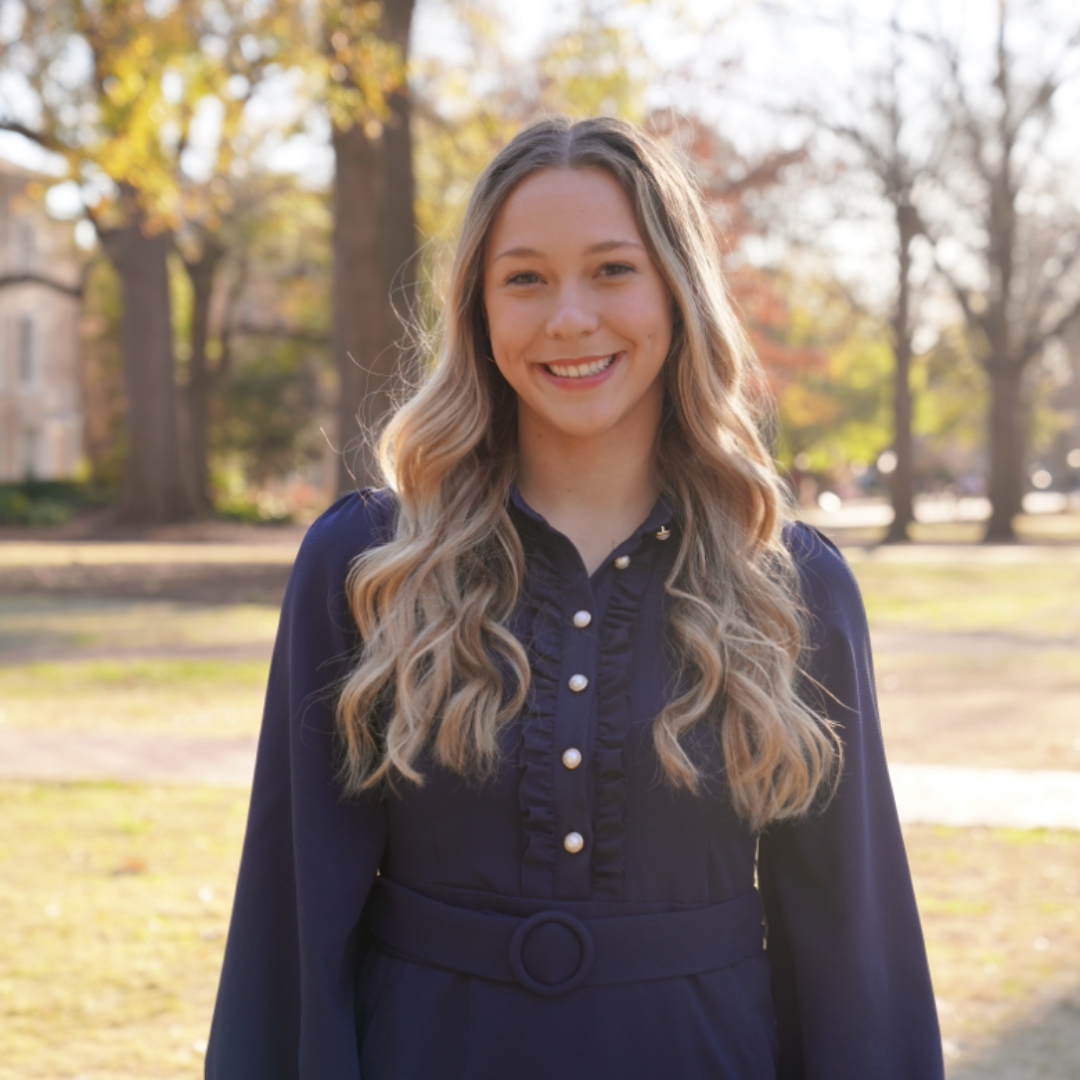
Freshman Elizabeth Polatty’s upbringing in a multicultural home, along with minor health challenges in childhood, drew her not only to Clemson, but also to science and biochemistry.
“I grew up in a multicultural Ukrainian-American family, which shaped how I see the world and why I’m drawn to science that serves people, especially across language and access barriers…I’ve always been repping orange and purple and cheering on the Tigers from my living room or from Memorial Stadium.”
Growing up in a Clemson family definitely steered Elizabeth when she was looking at colleges, however, when she was admitted into the National Scholars Program (NSP), it really sealed the deal for her.
“What made it a definite yes was being accepted into the National Scholars Program in the Clemson Honors College last spring. NSP has already made Clemson feel smaller in the best way! It’s given me an incredible community, pushed me to grow, and helped me plug into opportunities that match what I care about.”
Curiosity is truly what led Elizabeth to biochemistry — a desire to understand what unfolds at the molecular level and how that insight can translate into stronger prevention and more thoughtful care. Elizabeth is fascinated by how science connects to real-life health. This curiosity stems from personal health experiences, including numerous ENT appointments for hearing issues during her early childhood.
“The smell of sterile hallways takes me right back to childhood. I spent a lot of time in doctors’ offices and hospitals, and I still remember how much a calm voice, steady hands, and clear explanations could change an overwhelming moment into one that felt manageable. Those experiences didn’t just make me admire medicine; they made me curious about the science underneath it.”
As a freshman she was able to explore that curiosity by joining Dr. Michael Sehorn’s lab studying DNA repair, specifically homologous recombination (HR), and how the proteins RAD51 and DMC1 are regulated.
“The research looks at how cells keep their genomes stable by fixing DNA double-strand breaks (DSBs) that can happen from radiation, chemicals, or problems during DNA replication. It is exciting to be a part of the team and contribute to a bigger question. It’s made me feel like I belong in the scientific community here, even as a first-year student.”

In addition, Elizabeth has joined organizations that combine science with service, acting as the Chief Outreach Officer for Advancing Rural Communities through STEM Education (ARCS-Ed), a 501(c)(3) nonprofit that travels to rural and underserved middle schools to share about and make STEM feel exciting and accessible.
“We provide hands-on activities and lessons that help students actually do science, not just hear about it. I love it because it reminds me why representation and early exposure matter. I came from a rural community and a Title 1 school where STEM opportunities were limited. Thus, it’s been really meaningful to help students see themselves in STEM and leave with the confidence that they belong in those spaces, too.”
This winter break Elizabeth also had the opportunity to shadow Dr. Kevin Rust and Dr. Thomas Valenti at the Greenwood ENT Clinic during their office visits and surgeries at an ENT clinic.
“Their precision and calmness in surgery, and the way they communicate with patients during appointments, showed me how much trust a physician builds through their presence.”

Growing up in a multicultural home, science and medicine are not Elizabeth’s only interests. Additionally, she is deeply interested in discourse and rhetoric.
“I really enjoy learning languages and engaging with different cultures, which was sparked by my mom, who immigrated here from Ukraine, where the rest of my family still lives. Growing up around multiple languages and environments made me naturally curious about how people communicate.”
This interest has shaped how Elizabeth spends her time at Clemson outside of the classroom and lab – one of these ways is participating with Every Campus a Refuge (ECAR).
“…[ECAR] has been especially meaningful to me because it allows me to serve refugee families as they acclimate and resettle in the Clemson community. This semester, I joined a Creative Inquiry team that works directly with resettled families and helps teach ESL classes for English learners.”

Being part of ECAR has helped Elizabeth connect service with biochemistry and motivated her to think about a future that combines medicine with international and community-based work.
“After I graduate, I plan to attend medical school and pursue a career as a physician. The moments that have meant the most to me are when someone feels seen, heard and cared for, especially when language or cultural barriers could have made them feel invisible. Long-term, I hope to practice medicine and combine science with compassion, communication, and advocacy.”
