Physics and Astronomy Blog

Stephen Kaeppler receives the NSF CAREER Award

Stephen Kaeppler, an assistant professor of physics and astronomy, will receive a five-year National Foundation CAREER Grant of $721,601 to continue his research into observational and modeling investigations of pulsating aurora electrodynamics. 

What are Auroras? They are unimaginable light shows that shower the north and south poles. They occur due to the interaction of charged particles from the sun with atoms in the upper atmosphere. They are known as the “aurora borealis/australis” or the Northern/Southern lights. Kaeppler’s research is focused on pulsating auroras. He will be able to continue his work and fund more educational opportunities for Clemson undergraduates.

Credit: Andrew Pepper

Adapted from: 
Clemson researcher studying pulsating aurora electrodynamics receives NSF CAREER Award | Clemson News

Dr. Chad Sosolik appointed chair of the Department of Physics and Astronomy

Chad has been a part of the department for 20 years and has been interim department chair twice during his time at Clemson. His invaluable leadership and experience have landed him the position of department chair, effective April 1st. 

“Physics and Astronomy at Clemson University is poised to expand and contribute to the overall University mission in positive and transformative ways, with prominent academic, research and outreach efforts. I am honored to have the chance to guide us on this journey, leveraging our continued excellence to support groundbreaking scientific discoveries that will positively impact all the communities we serve.” -Chad Sosolik

Adapted from: 
Chad Sosolik appointed chair of the Department of Physics and Astronomy | Clemson News

Clemson Elementary School Science Fair

On March 8th, 2024, we had volunteers from the Clemson University’s Department of Physics and Astronomy prepare the Clemson Elementary school science fair winners for their presentations at regionals. This proved to be a great success because these students won 4 out of 10 of the awards that were given out that day! We are all so proud of these students and thankful to our volunteers that make time to help with events like these. Encouraging children to pursue their interests in STEM related fields is extremely important! Our department has supported Clemson Elementary School with their science fair for the past 10 years and we will gladly continue supporting events like these.

Clemson astrophysicist’s research could shed light on the search for dark matter.

Alex McDaniel, a postdoctoral, and Marco Ajello, an associate professor, in the Clemson University Department of Physics and Astronomy.

Alex McDaniel is a postdoctoral fellow in the Clemson University’s Department of Physics and Astronomy and his collaborators search dwarf galaxies for dark matter “that self-annihilates into ordinary matter and gamma rays, a form of light at the highest energy levels. Dwarf galaxies are ideal for study because they are small, rich in dark matter and mostly lack other astrophysics phenomena such as gas, dust and supernova that could contaminate the findings.” McDaniel explains that they specifically look for these because they can give a clear signal or can help rule out certain particle theories. 

Read more here: 
Clemson astrophysicist’s research could provide a hint in the search for dark matter | Clemson News

Studying a bright gamma-ray burst from neutron star merger, astronomers discover heavy elements.

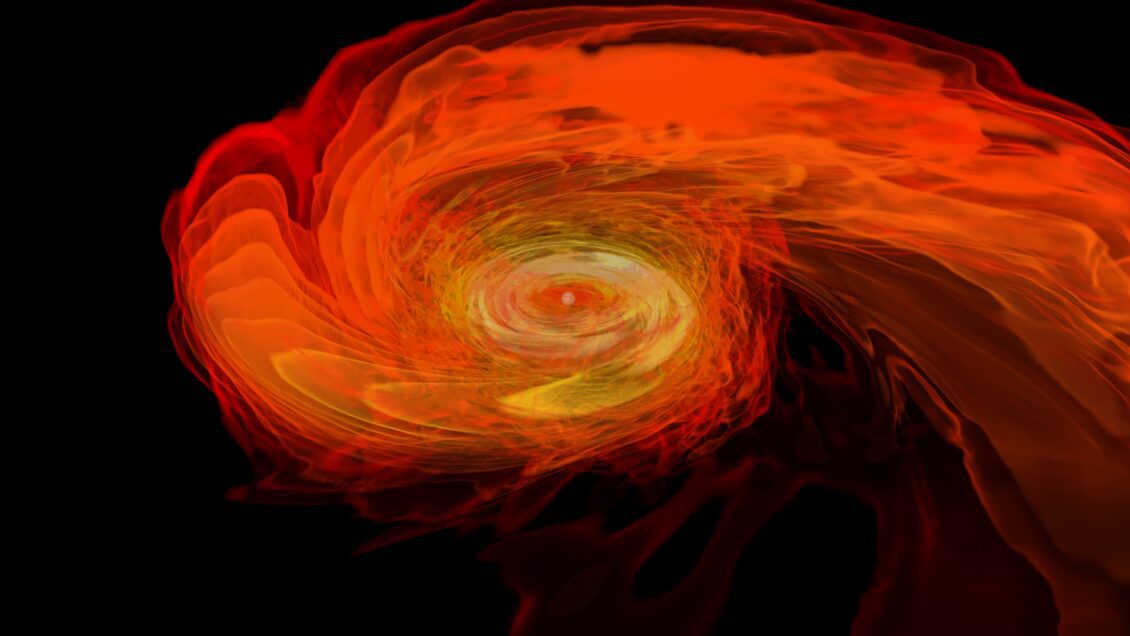
Illustration courtesy of Luciano Rezzolla, University of Frankfurt, Germany

Dieter Hartmann and an international team of astronomers “obtained observational evidence for the creation of rare heavy elements in the aftermath of a cataclysmic explosion triggered by the merger of two neutron stars.” They were studying a massive gamma-ray burst named GRB230307A, which was first detected on March 7, 2023. Scientists discovered that this burst resulted from two neutron stars merging in a distant galaxy. 

“The breakthrough discovery puts astronomers one step closer to solving the mystery of the origin of elements that are heavier than iron.”

Adapted from:
Astronomers discover heavy elements after bright gamma-ray burst from neutron star merger | Clemson News

Self-extinguishing batteries could reduce the risk of deadly and costly battery fires

Apparao Rao, Clemson University and Bingan Lu, Hunan University

“In a newly published study, we describe our design for a self-extinguishing rechargeable battery. It replaces the most commonly used electrolyte, which is highly combustible – a medium composed of a lithium salt and an organic solvent – with materials found in a commercial fire extinguisher.

An electrolyte allows lithium ions that carry an electric charge to move across a separator between the positive and negative terminals of a lithium-ion battery. By modifying affordable commercial coolants to function as battery electrolytes, we were able to produce a battery that puts out its own fire.”

Read more here: 
Self-extinguishing batteries could reduce the risk of deadly and costly battery fires | Clemson News