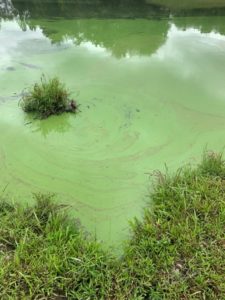
Questions about pond weeds are common throughout the summer. As water temperatures warm, cyanobacteria blooms can occur more frequently. While there are many cyanobacteria species that can look different in a pond – all are capable of producing toxins, so care should be taken to avoid or limit contact with these blooms as much as possible. The Land Grant Press (LGP) article Introduction to Harmful Algal Blooms (HABs) in South Carolina Freshwater Systems provides more detailed information.
The CU Plant & Pest Diagnostic Clinic can evaluate samples to confirm if a bloom is cyanobacteria and will provide specific control recommendations. See Submitting an Algae Sample for Identification for more information. In the meantime, there are a couple do it yourself tests that help indicate if a bloom is cyanobacteria; instructions are provided in the recently published HGIC Fact Sheet Do It Yourself: Visual Indicators, Stick Test, and Jar Test for Cyanobacteria.
Water planning efforts continue throughout the state to ensure plentiful, clean water for future generations. The recently published LGP article Water Withdrawal Regulations in South Carolina provides an overview to increase understanding of the current rules. The SC Department of Natural Resources is leading creation of River Basin Councils in each of SC’s eight major river basins; these Councils will work over a two-year period to draft a River Basin Plan. The Edisto RBC is nearing completion of the first draft of the Edisto River Basin Plan. The Broad River Basin Council started meeting earlier this year and is currently accepting applications for representatives from Local Government, Industry, or Economic Development.
Upcoming events include the SC Water Chats webinars focusing on Source Water Protection (Free! 9/20 and 9/22, @1:00pm) and several free Adopt-A-Stream volunteer water quality monitoring trainings are offered in Spartanburg this fall. See the Clemson Extension Events Calendar for the latest water-related event information.





 Carolyn Dawson is the new Area Forestry Extension Agent for Spartanburg County. Although she has been with Clemson Extension for over 10 years, her responsibilities recently expanded to include Spartanburg and Cherokee counties.
 We are very pleased to announce that Mr. Colin Crippen has accepted the offer to become the 4-H Youth Development Agent for Spartanburg County, and he is very excited to join the 4-H family!
 I’ve been busy helping several new small-sized farms across the upstate get established and prepare for planting next spring. I also assisted with a nematode survey of all the upstate peach farms in conjunction with Churimani Kanal, Ph.D., and his graduate student. This work will continue next year.