HEATHER NIX
Upstate Water Resource Agent
CHRISTOPHER LeMASTER
Area Livestock & Forage Agent
As we move into the warmer months, ensuring cattle have access to fresh, clean water is a primary management concern. Many producers rely on surface water sources; however, this practice introduces risks, most notably Harmful Algal Blooms (HABs), which can have rapid and fatal consequences for livestock.
What are Harmful Algal Blooms (HABs)?
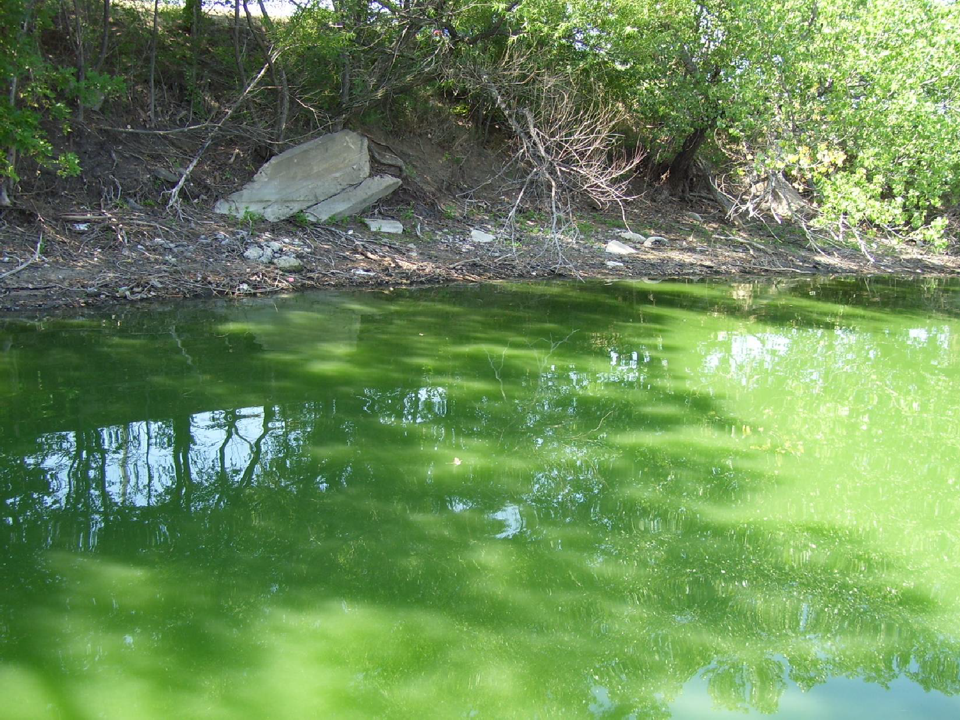
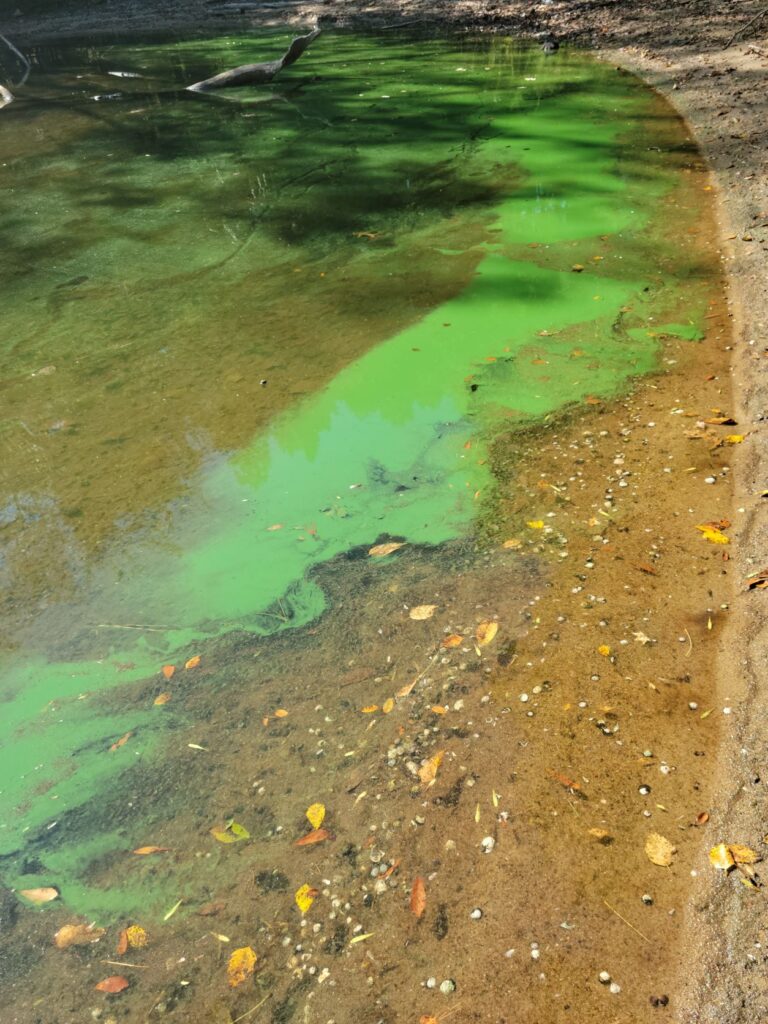
HABs include rapid overgrowths of cyanobacteria (formerly called blue-green algae) in water bodies. Unlike true algae, cyanobacteria can produce toxins that are harmful to humans, pets, and livestock. These blooms may appear as a “spilled paint” scum, pea soup, grass clippings, or thick mats on the water surface and can vary in color from blue to bright green to brownish-red.
Effects on Cattle
Cyanobacteria can produce over 1,000 types of poisonous compounds, known as cyanotoxins, which are released when the cells die and rupture. Cyanotoxins can attack the skin, liver, cells, or nervous system and can produce symptoms within minutes, days, or months following exposure. Health impacts depend on specific cyanotoxin(s), concentration, route of exposure (ingestion, contact, etc.), and length of exposure. Symptoms can vary widely, in livestock watch for skin rash or increased sensitivity to sun exposure, diarrhea, weakness, respiratory distress, muscle tremors, premature births, or fetal death.
Prime Conditions for HAB Growth
Cyanobacteria thrive when environmental conditions provide a “perfect storm” for growth:
- Stagnant Water: Still or low-flow water, such as farm ponds or backwater areas.
- Nutrient Rich: High levels of phosphorus and nitrogen, possibly from fertilizer runoff or direct manure input.
- Warm Temperatures: Prolonged sunlight and warm water temperatures (above 77ºF) during warm weather.
How to Monitor for HABs
In 2025, the South Carolina Department of Environmental Services (SCDES) issued its first Recreational Watch after identifying toxin-producing HAB species in Lake Hartwell on April 30th, with the latest Recreational Advisory issued for Lake Thurmond on November 25th. Because of this wide window, producers should regularly inspect ponds and other water sources, especially on the downwind pond edges where wind and waves concentrate the blooms.
- The Stick Test: If you can lift the algae out of the water with a stick, it is likely non-toxic filamentous algae. If it breaks apart and cannot be lifted or coats the stick like paint, it may be cyanobacteria.
- The Jar Test: Place a water sample in a clear jar and refrigerate it overnight. If the algae floats to the surface, it is a strong indicator of cyanobacteria.
- Submit a Sample: A Clemson University lab can confirm identification and provide management recommendations for $20 (in-state); samples can be dropped off at any county Extension office. Results typically take 7-10 business days. See Submitting an Algae Sample for Identification (https://hgic.clemson.edu/factsheet/submitting-an-algae-sample-for-identification/) for more information.
Action Steps: Response and Recovery
If you suspect a bloom is present, take immediate action to protect your herd:
- Remove Animals (and People): Immediately exclude livestock from the suspected water source using temporary fencing or by moving the herd to a different pasture.
- Provide Alternative Water: Ensure animals have access to a clean, reliable supply, such as well water or a municipal source. Note: Be aware that even “clean” sources can become contaminated if equipment (troughs, hoses, or buckets) has been exposed to the bloom. Be sure water (in troughs) is regularly refreshed and thoroughly clean and flush any shared infrastructure.
- Report to the Clemson HAB Response Team: Contact your local Livestock or Water Resource Agent immediately. Our statewide response team can assist with rapid sampling and positive identification to determine if the bloom is toxic. Having pictures of the pond (or water source) and a water sample (including potential HAB growth) may be helpful.
References
- Do It Yourself: Visual Indicators, Stick Test, and Jar Test for Cyanobacteria. (2022). Nix HB, Hains J, Sahoo D, & White SA. HGIC 1899. Home & Garden Information Center by Clemson Extension. https://hgic.clemson.edu/factsheet/do-it-yourself-visual-indicators-stick-test-and-jar-test-for-cyanobacteria/
- Harmful Algal Blooms: Prevention, Response, and Avoidance Manual (2023). Nix, H., Sahoo, D., White, S. A., Hains, J., & Busari, I. Clemson Cooperative Extension. https://dc.statelibrary.sc.gov/entities/publication/1daac8c5-90c7-4c58-a1f4-7189188c085a
- Livestock Ponds in South Carolina. (2023). Davis RH, Nix HB, White SA, & Smith WB. LGP1156. Clemson University Land-Grant Press. https://lgpress.clemson.edu/publication/livestock-ponds-in-south-carolina/
- Livestock Water Quality. Clemson University Land-Grant Press.
- Submitting an Algae Sample for Identification. (2025). Nix HB, Hains J, Williamson M, & Low D. HGIC 1889. Home & Garden Information Center by Clemson Extension. https://hgic.clemson.edu/factsheet/submitting-an-algae-sample-for-identification/
Photo Credit: Emily Bores, SCDES


 Hello! My name is Mallory Fulmer, and I am the new Newberry County 4-H Youth Development Agent. I am from Prosperity, South Carolina. I grew up in Newberry County and attended Newberry College where I received my degree in early childhood education. After graduating, I completed my master’s degree in reading with a focus in early childhood literacy. I am so excited for this new opportunity and look forward to serving Newberry County as the new 4-H Youth Development Agent! I look forward to providing Newberry 4-H members with lots of exciting project, club, and workshop opportunities! Make sure to follow us on Facebook to see all the fun events we will have this year!

 2025 is off to a great start so far for Newberry County 4-H. We brought in the new year with a new agent by hosting a NYE baking workshop for youth in our county. 4-H’ers got the opportunity to mix, measure, and decorate holiday themed treats to take home and share with their families. Newberry County 4-H also has two clubs that have started up this year. The Cooking Club and STEM Club, both being offered to clovers and juniors. This year in the Cooking Club we are cooking by colors. Each meeting we make a new recipe that is the color we have selected. So far this year we have made blue cloud bread and pizza roses! Aside from having fun with color recipes, club members are learning fundamental kitchen skills and cooking techniques. STEM club is also off to a great start. We have learned about the importance of strong foundations in buildings during earthquakes by designing and building our own towers and simulating earthquakes. At STEM club we love bringing science, technology, engineering, and mathematics to life by providing club members with fun hands-on learning opportunities. This spring we will be starting Embryology in partnership with teachers from Newberry County School District. We have had a blast incubating our own chicks in preparation for the project! As summer approaches we will have more workshop and camp opportunities. Be on the lookout for updates!