Christopher LeMaster Livestock & Forage Agent Cherokee, Spartanburg, Union Counties
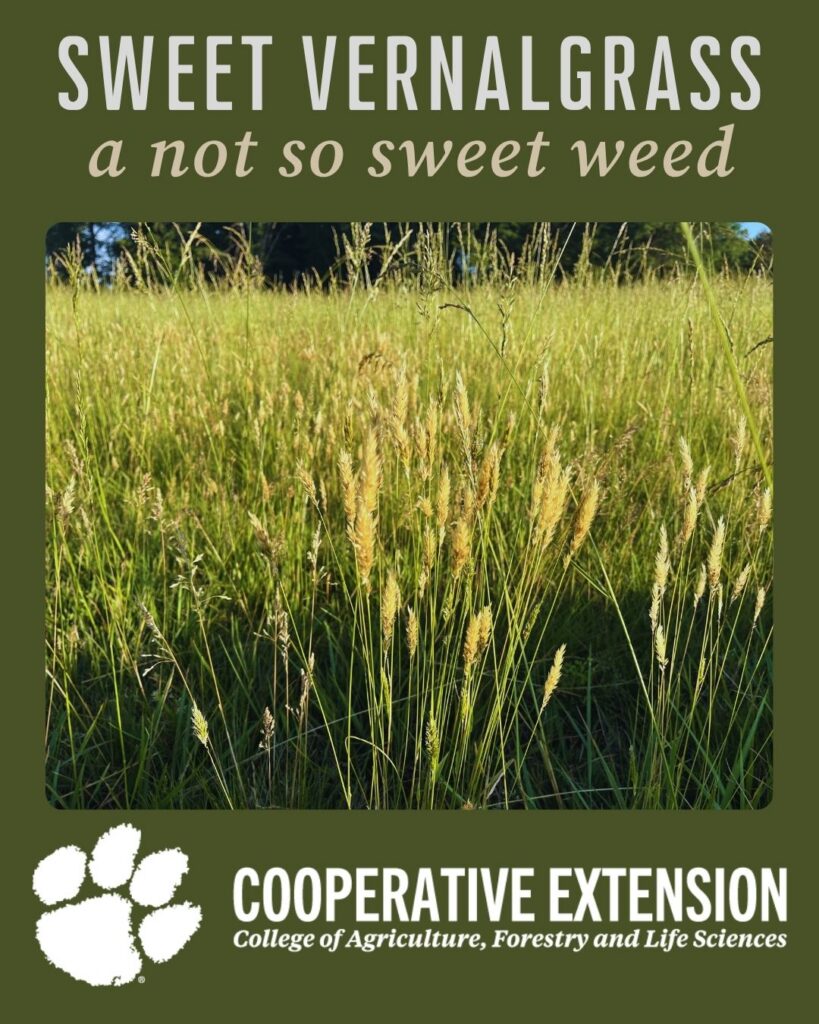
By 9:30 this morning, I had already received three phone calls about sweet vernalgrass taking over fescue pastures.
On my drive to work, there is a hay field I pass regularly that tells the whole story. The field is a low-input field that is seldom fertilized, and over the last several years I have watched it slowly transition from mostly tall fescue to mostly sweet vernalgrass.
That change did not happen overnight — and unfortunately, it will not be corrected overnight either.
What Is Sweet Vernalgrass?
Sweet vernalgrass was originally introduced as an ornamental grass because of its sweet, vanilla-like smell. Today, most livestock producers consider it a weed because it is simply unproductive. While livestock will graze it, it does not produce the forage volume or quality we expect from a productive fescue stand.
Sweet vernalgrass also contains coumarin compounds, which are responsible for its characteristic sweet smell. Under certain conditions, particularly in improperly cured or moldy hay, those compounds can be converted by fungi into dicoumarol, a compound that can interfere with normal blood clotting. While this is generally not considered a major concern under normal grazing conditions, poorly cured hay containing high amounts of sweet vernalgrass may present a greater risk.
Sweet Vernalgrass Is Often a Symptom
Like many weeds, sweet vernalgrass is often an indicator species.
When it begins to invade a pasture, it is usually telling us something about the condition of the field:
Soil pH may be too low
Fertility levels may be lacking
Most importantly, the fescue is not healthy enough to compete
A thick, vigorous stand of tall fescue is the best defense against sweet vernalgrass. Healthy fescue simply does not leave much room for it to spread.
Why There Is No Easy Fix
At this point in the season, most sweet vernalgrass has already headed out. Because of that, there is really no benefit to trying to treat it now.
Additionally, there are currently no labeled herbicides that will selectively remove sweet vernalgrass from a fescue stand without damaging the desirable forage. As is often the case, taking a grass out of a grass crop is difficult.
That means our focus now needs to shift toward strengthening the fescue stand.
Focus on Strengthening the Fescue
As we move into the summer months, we want to place that fescue in the best possible position to survive heat and dry weather stress. Avoid overgrazing or cutting hay too short, as that only weakens the stand further and creates more opportunity for sweet vernalgrass to expand.
Hopefully, we will receive timely rainfall this fall so producers can take advantage of fall fertility applications and promote strong fall, winter, and spring growth. Improving soil fertility and encouraging vigorous fescue growth will gradually help thicken the stand and improve competition against sweet vernalgrass.
When Renovation May Be Necessary
In fields with severe patches of sweet vernalgrass, some producers may consider spot-spraying affected areas with glyphosate during late winter or early spring while the sweet vernalgrass is actively growing and before seedheads emerge.
Because glyphosate is non-selective, desirable forage in treated areas will also be affected, but in heavily infested patches there may be little productive fescue remaining to preserve. Following treatment, producers can focus on correcting soil fertility and reseeding those areas with desirable forage species during the fall.
In some situations, producers may also need to evaluate whether partial renovation is enough or if complete renovation of the hayfield would be more effective long-term.
Are other grassy weeds such as foxtail also becoming a problem?
Oftentimes, the same low-input fields where sweet vernalgrass begins to gain an advantage on fescue are also the fields where foxtail becomes problematic later in the summer. Like sweet vernalgrass, foxtail presents another challenge because it is a grassy weed growing within a grass crop, leaving producers with limited herbicide options.
When multiple grassy weeds are becoming established and desirable forage stands continue to thin, a complete renovation may sometimes be the most practical and economical long-term solution.
Every Field Is Different
There is no one-size-fits-all recommendation for sweet vernalgrass management.
Renovation can be expensive, but continuing to manage a low-producing hayfield also carries a significant cost over time in reduced forage production and hay quality.
Producers who are dealing with sweet vernalgrass issues are encouraged to contact their local Extension office so we can evaluate the situation on a case-by-case basis and discuss the most practical and economical options for their operation.
Unfortunately, there is no silver bullet for sweet vernalgrass control. Long-term management comes back to the basics: proper fertility and maintaining a dense, healthy stand of fescue.
CHRISTOPHER LeMASTER JR, Clemson Extension Livestock & Forages Agent
After a dry spring, many producers are asking the same question: how do we make up lost forage?
For a lot of operations this year, the answer is summer annuals.
Why summer annuals?
Summer annuals are fast-growing, high-quality forages that can help fill gaps when perennial systems fall short. In the Southeast, they’re typically planted from April through June and can be used for grazing, baleage, or hay.
Under good conditions, they can produce 5,000 to 10,000 pounds per acre with 15%+ crude protein—a strong option coming out of a poor spring. They are an excellent alternative to the increased risk of fescue toxicity across the summer months. Of course, that still depends on rainfall and management.
Even with risk, farmers are planting.
This isn’t a low-risk move.
Ongoing drought, elevated fuel and fertilizer prices make this a difficult decision. After looking at several extension enterprise budgets, some summer annuals could easily land in the $200/acre ballpark. However, doing nothing has a cost too!
Start with your goal.
Before planting, think about what you need most:
Dry hay – Possible, but challenging due to thick stems. Higher seeding rates and a mower conditioner can help.
Baleage – Strong option for hard-to-dry crops. Ensilation can also decrease nitrates
Grazing – A great way to stretch forage, improve cattle performance, and give Fescue pastures a break heading into fall and punch through the summer slump.
Don’t overlook mixtures.
Mixtures are getting more attention—and for good reason.
Adding legumes can:
Reduce nitrogen needs
Maintain yield and quality
Improve soil health and resilience
They can also help buffer against drought and extend the grazing season. Just keep in mind that herbicide options may be more limited.
A quick word on risk
Not all summer annuals handle stress the same.
Pearl millet offers good drought tolerance and avoids prussic acid risk (though nitrates are still possible).
Sorghum and sorghum-sudan can be high-yielding but require careful management due to prussic acid and nitrate concerns.
Crabgrass performs well but needs consistent moisture
Final thoughts
Summer annuals aren’t a silver bullet—but they can help bridge the forage gap after a dry spring.
This isn’t an exhaustive list—just a starting point.
If you’re trying to decide what fits your operation, reach out or check out our other forage resources. We’re happy to help you think through your options.
MATT FISCHER, Clemson Extension Livestock & Forage Economist CHRISTOPHER LeMASTER JR, Clemson Extension Livestock & Forages Agent
Drought changes the math—fast.
In a D3 (extreme) drought, especially when paired with a 50% spike in fertilizer and fuel costs, the old hay production playbook doesn’t just struggle—it can quietly put you out of business. This isn’t just about surviving one tough season. It’s about protecting your land, your forage stands, and your financial position for the next year.
Low Yields Can Cause Your Cost per Bale to Explode
In a normal year, your equipment, labor, and overhead are spread across a solid number of bales. That’s what keeps your cost per bale manageable.
But drought flips that equation.
If you’re only producing 25% of your typical yield, your fixed cost per bale doesn’t just go up—it can quadruple.
Your reality doesn’t change:
Your tractor payment is still due
Your labor still costs what it costs
Your time hasn’t gotten any cheaper
Trying to sell hay at “normal” prices in this environment isn’t competitive—it’s unsustainable.
The Soil “Loan” You May Not Realize You’re Taking
Every bale you remove is taking nutrients with it—nitrogen, phosphorus, and potassium. In a good year, those nutrients are replaced. In a drought year with high input costs, that replacement often gets delayed… or skipped.
If your hay price doesn’t cover nutrient removal, replacement fertilizer, and application costs, then you’re not just selling hay—you’re mining your soil.
Think of it as a loan from your land: you gain short-term cash flow, but you build long-term fertility debt. And like any loan, it eventually comes due.
Mowing vs. Harvest
One of the toughest calls in a drought year is whether to harvest at all.
There are times when mowing and leaving the forage as residue creates more value than baling it. It helps conserve soil moisture, protects stand health, and reduces long-term damage.
Over-harvesting drought-stressed forage—especially fescue—can thin or even kill your stand. And once that happens, you’re looking at re-establishment costs that far outweigh the value of a few bales.
A Reality Check on Spring Fescue Yield
At this point in the season, spring yield potential for fescue is largely set. Even if we catch some rain, don’t expect meaningful increases in hay yield for this cutting.
In a grazing situation, however, there may be some opportunity for regrowth. If we’re able to clip mature seed heads and receive timely rainfall, we may see some regrowth—provided temperatures remain mild.
Choosing not to harvest now and waiting on future growth is, in many ways, a bet on fall production. And like any bet, it carries risk.
I don’t recommend making that bet unless you have a backup plan—whether that’s identifying an alternate hay source or having stored hay that will hold its quality in the barn. As with anything, it’s smart to hedge your bet.
Another way to hedge that risk is by looking at summer annuals to help replace some of the yield loss we’ve experienced this spring. We’ll take a closer look at summer annual options in our next blog post.
The Reality of a Tight Hay Market
This isn’t just happening on your farm—it’s regional.
In a widespread drought:
Yields are down everywhere
Supply is tight
Demand stays strong
Buying hay becomes difficult. And when you do find it, trucking costs can rival the value of the hay itself.
That’s why local hay carries a premium—lower freight, faster access, and more reliability.
Price for Survival, Not Tradition
Pricing hay based on “what it’s always been” is a losing strategy in a year like this.
Instead:
Calculate your true cost per bale
Adjust for reduced yield
Build in a margin that protects your operation
Because if your price doesn’t cover your costs, maintain soil fertility, and protect your forage stands, you’re not running a business—you’re liquidating one.
The Bigger Picture: Staying in Business Next Year
Right now, the goal isn’t maximizing production.
It’s:
Preserving your soil
Protecting your stands
Maintaining financial stability
That may mean making uncomfortable decisions:
Charging more than you ever have
Cutting less than you want
Walking away from marginal harvests
Bottom line: Sit down with a pencil. Run your numbers honestly. Price your hay based on reality—not tradition.