Christopher LeMaster
Livestock & Forage Agent
Cherokee, Spartanburg, Union Counties
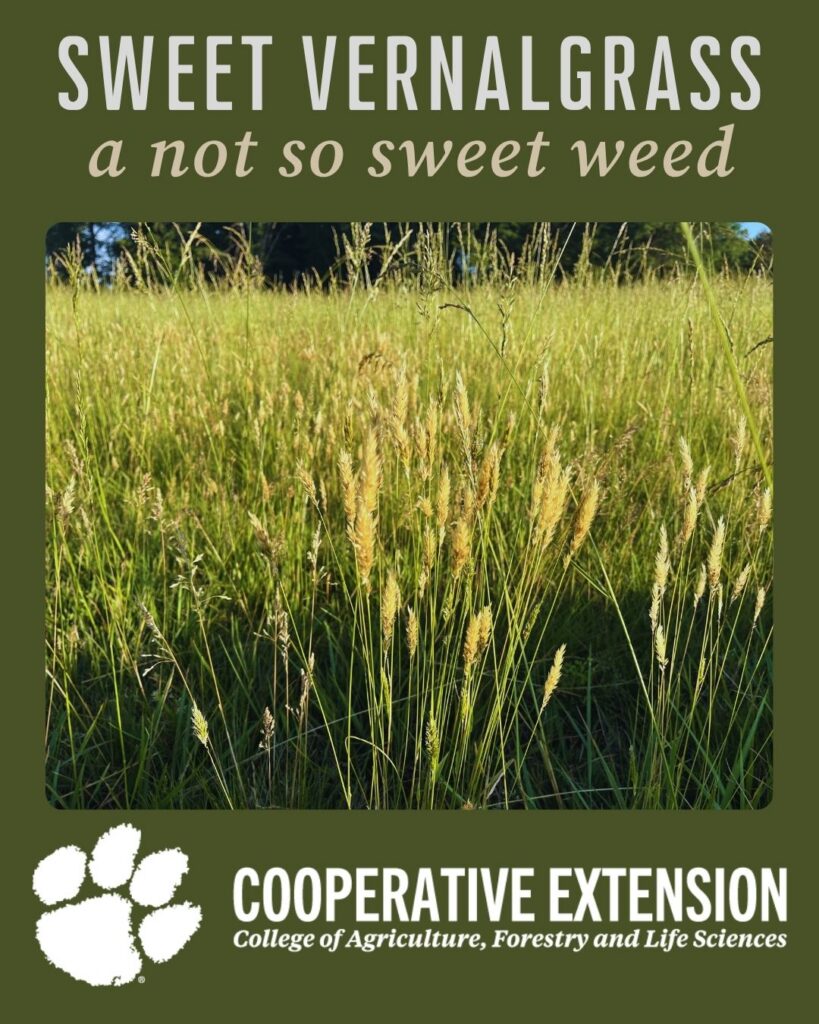
By 9:30 this morning, I had already received three phone calls about sweet vernalgrass taking over fescue pastures.
On my drive to work, there is a hay field I pass regularly that tells the whole story. The field is a low-input field that is seldom fertilized, and over the last several years I have watched it slowly transition from mostly tall fescue to mostly sweet vernalgrass.
That change did not happen overnight — and unfortunately, it will not be corrected overnight either.
What Is Sweet Vernalgrass?
Sweet vernalgrass was originally introduced as an ornamental grass because of its sweet, vanilla-like smell. Today, most livestock producers consider it a weed because it is simply unproductive. While livestock will graze it, it does not produce the forage volume or quality we expect from a productive fescue stand.
Sweet vernalgrass also contains coumarin compounds, which are responsible for its characteristic sweet smell. Under certain conditions, particularly in improperly cured or moldy hay, those compounds can be converted by fungi into dicoumarol, a compound that can interfere with normal blood clotting. While this is generally not considered a major concern under normal grazing conditions, poorly cured hay containing high amounts of sweet vernalgrass may present a greater risk.
Sweet Vernalgrass Is Often a Symptom
Like many weeds, sweet vernalgrass is often an indicator species.
When it begins to invade a pasture, it is usually telling us something about the condition of the field:
- Soil pH may be too low
- Fertility levels may be lacking
- Most importantly, the fescue is not healthy enough to compete
A thick, vigorous stand of tall fescue is the best defense against sweet vernalgrass. Healthy fescue simply does not leave much room for it to spread.
Why There Is No Easy Fix
At this point in the season, most sweet vernalgrass has already headed out. Because of that, there is really no benefit to trying to treat it now.
Additionally, there are currently no labeled herbicides that will selectively remove sweet vernalgrass from a fescue stand without damaging the desirable forage. As is often the case, taking a grass out of a grass crop is difficult.
That means our focus now needs to shift toward strengthening the fescue stand.
Focus on Strengthening the Fescue
As we move into the summer months, we want to place that fescue in the best possible position to survive heat and dry weather stress. Avoid overgrazing or cutting hay too short, as that only weakens the stand further and creates more opportunity for sweet vernalgrass to expand.
Hopefully, we will receive timely rainfall this fall so producers can take advantage of fall fertility applications and promote strong fall, winter, and spring growth. Improving soil fertility and encouraging vigorous fescue growth will gradually help thicken the stand and improve competition against sweet vernalgrass.
When Renovation May Be Necessary
In fields with severe patches of sweet vernalgrass, some producers may consider spot-spraying affected areas with glyphosate during late winter or early spring while the sweet vernalgrass is actively growing and before seedheads emerge.
Because glyphosate is non-selective, desirable forage in treated areas will also be affected, but in heavily infested patches there may be little productive fescue remaining to preserve. Following treatment, producers can focus on correcting soil fertility and reseeding those areas with desirable forage species during the fall.
In some situations, producers may also need to evaluate whether partial renovation is enough or if complete renovation of the hayfield would be more effective long-term.
Are other grassy weeds such as foxtail also becoming a problem?
Oftentimes, the same low-input fields where sweet vernalgrass begins to gain an advantage on fescue are also the fields where foxtail becomes problematic later in the summer. Like sweet vernalgrass, foxtail presents another challenge because it is a grassy weed growing within a grass crop, leaving producers with limited herbicide options.
When multiple grassy weeds are becoming established and desirable forage stands continue to thin, a complete renovation may sometimes be the most practical and economical long-term solution.
Every Field Is Different
There is no one-size-fits-all recommendation for sweet vernalgrass management.
Renovation can be expensive, but continuing to manage a low-producing hayfield also carries a significant cost over time in reduced forage production and hay quality.
Producers who are dealing with sweet vernalgrass issues are encouraged to contact their local Extension office so we can evaluate the situation on a case-by-case basis and discuss the most practical and economical options for their operation.
Unfortunately, there is no silver bullet for sweet vernalgrass control. Long-term management comes back to the basics: proper fertility and maintaining a dense, healthy stand of fescue.
