Christopher LeMaster Livestock & Forage Agent Cherokee, Spartanburg, Union Counties
By 9:30 this morning, I had already received three phone calls about sweet vernalgrass taking over fescue pastures.
On my drive to work, there is a hay field I pass regularly that tells the whole story. The field is a low-input field that is seldom fertilized, and over the last several years I have watched it slowly transition from mostly tall fescue to mostly sweet vernalgrass.
That change did not happen overnight — and unfortunately, it will not be corrected overnight either.
What Is Sweet Vernalgrass?
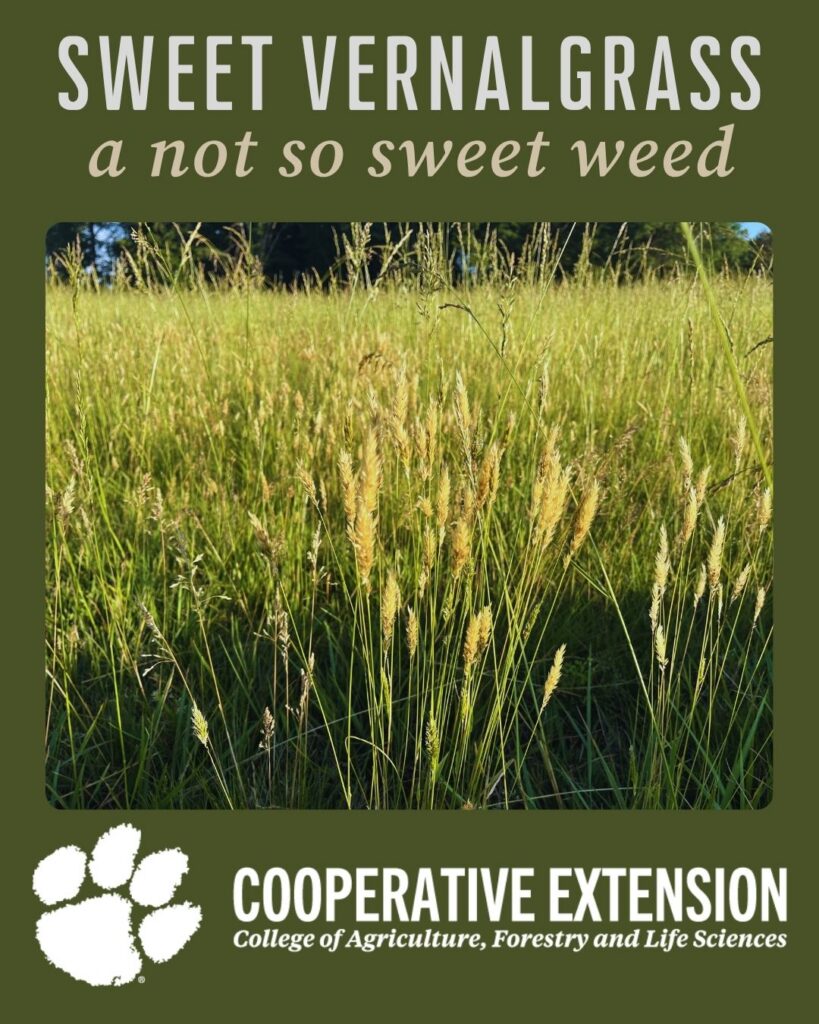
Sweet vernalgrass was originally introduced as an ornamental grass because of its sweet, vanilla-like smell. Today, most livestock producers consider it a weed because it is simply unproductive. While livestock will graze it, it does not produce the forage volume or quality we expect from a productive fescue stand.
Sweet vernalgrass also contains coumarin compounds, which are responsible for its characteristic sweet smell. Under certain conditions, particularly in improperly cured or moldy hay, those compounds can be converted by fungi into dicoumarol, a compound that can interfere with normal blood clotting. While this is generally not considered a major concern under normal grazing conditions, poorly cured hay containing high amounts of sweet vernalgrass may present a greater risk.
Sweet Vernalgrass Is Often a Symptom
Like many weeds, sweet vernalgrass is often an indicator species.
When it begins to invade a pasture, it is usually telling us something about the condition of the field:
Soil pH may be too low
Fertility levels may be lacking
Most importantly, the fescue is not healthy enough to compete
A thick, vigorous stand of tall fescue is the best defense against sweet vernalgrass. Healthy fescue simply does not leave much room for it to spread.
Why There Is No Easy Fix
At this point in the season, most sweet vernalgrass has already headed out. Because of that, there is really no benefit to trying to treat it now.
Additionally, there are currently no labeled herbicides that will selectively remove sweet vernalgrass from a fescue stand without damaging the desirable forage. As is often the case, taking a grass out of a grass crop is difficult.
That means our focus now needs to shift toward strengthening the fescue stand.
Focus on Strengthening the Fescue
As we move into the summer months, we want to place that fescue in the best possible position to survive heat and dry weather stress. Avoid overgrazing or cutting hay too short, as that only weakens the stand further and creates more opportunity for sweet vernalgrass to expand.
Hopefully, we will receive timely rainfall this fall so producers can take advantage of fall fertility applications and promote strong fall, winter, and spring growth. Improving soil fertility and encouraging vigorous fescue growth will gradually help thicken the stand and improve competition against sweet vernalgrass.
When Renovation May Be Necessary
In fields with severe patches of sweet vernalgrass, some producers may consider spot-spraying affected areas with glyphosate during late winter or early spring while the sweet vernalgrass is actively growing and before seedheads emerge.
Because glyphosate is non-selective, desirable forage in treated areas will also be affected, but in heavily infested patches there may be little productive fescue remaining to preserve. Following treatment, producers can focus on correcting soil fertility and reseeding those areas with desirable forage species during the fall.
In some situations, producers may also need to evaluate whether partial renovation is enough or if complete renovation of the hayfield would be more effective long-term.
Are other grassy weeds such as foxtail also becoming a problem?
Oftentimes, the same low-input fields where sweet vernalgrass begins to gain an advantage on fescue are also the fields where foxtail becomes problematic later in the summer. Like sweet vernalgrass, foxtail presents another challenge because it is a grassy weed growing within a grass crop, leaving producers with limited herbicide options.
When multiple grassy weeds are becoming established and desirable forage stands continue to thin, a complete renovation may sometimes be the most practical and economical long-term solution.
Every Field Is Different
There is no one-size-fits-all recommendation for sweet vernalgrass management.
Renovation can be expensive, but continuing to manage a low-producing hayfield also carries a significant cost over time in reduced forage production and hay quality.
Producers who are dealing with sweet vernalgrass issues are encouraged to contact their local Extension office so we can evaluate the situation on a case-by-case basis and discuss the most practical and economical options for their operation.
Unfortunately, there is no silver bullet for sweet vernalgrass control. Long-term management comes back to the basics: proper fertility and maintaining a dense, healthy stand of fescue.
Christopher LeMaster, Jr. Livestock & Forage Agent Cherokee, Spartanburg, & Union Counties
We don’t usually associate tall fescue with nitrate toxicity in the spring. However, the current D3 drought conditions have changed the equation. This is not only a “summer problem,” but cool-season grasses—such as tall fescue or winter annuals—can pose a risk under these specific conditions.
If you applied high levels of nitrogen this spring to catch a flush of growth that never came, the risk in your fescue fields is real. Without rain, the plant couldn’t convert that nitrogen into growth. It simply accumulated in the lower portion of the plant. Now that we are finally seeing some rain, that “stuck” nitrogen is being pulled into the plant at a rapid rate.
The Spike
It is a common misconception that the danger passes as soon as the grass turns green again. In reality, research shows that nitrate levels typically spike 2 to 3 days after a drought-ending rain. This is the most dangerous window for your livestock.
The One-Week Rule: While the spike is most acute in the first 48 to 72 hours, we recommend waiting at least one week before grazing or harvesting. This allows the plant time to resume normal metabolism and begin “growing out” of that initial nitrate flush.
Hay is “Locked In”: Nitrates do not dissipate in dry hay. Once your mower hits the field, you are locked in at that nitrate level forever.
Silage/Fermentation: If you are putting up high-moisture forage or baleage, the fermentation process can reduce nitrate levels by 40% to 60%, but this should still be verified with a test.
Don’t Guess—Test
If you have fields with a high nitrogen history that are currently recovering from drought, I strongly recommend sampling the standing forage before you cut.
Get a Representative Sample: Take “grab samples” from multiple areas of the field, specifically focusing on the lower portions of the plant where nitrates concentrate.
Utilize the Lab: Bring your samples to your local Extension Office or send them directly to the Agricultural Service Laboratory. They can provide a precise analysis of nitrate-nitrogen levels.
Check the Backlog: We may also consider testing outside of that initial one-week window. Once the plant has had time to work through the backlog of accumulated nitrogen, a follow-up sample can confirm if the forage has returned to an acceptable or safe range for harvest.
Next Steps
If your test results come back with an elevated nitrate level, we can work on a plan to safely manage that forage. Whether that means diluting the feed with other forages, adjusting your grazing strategy, or simply waiting a few more days for the plant to balance out, there are ways to keep your herd safe.
Have questions about how to pull a proper sample or interpret your lab results? Reach out to your local livestock and forage agent today.
The H5N1 assists extension professionals in maintaining their role as trusted messengers by keeping them up to date on research based H5N1 information. The project also provides agents with uniform key messages, adjusted recommendations as conditions change, and simple, easily adopted measures to help reduce the spread of H5N1. Tina Horn, York County Extension Livestock and Forage Agent is serving as the lead on this H5N1 EXCITE National Project Team.
The Extension Collaborative on Immunization Teaching and Engagement (EXCITE) is a national program of the Extension Foundation. One of EXCITE’s current projects is an H5N1 educational effort. Working with the National Center for Farmworker Health, CDC, and USDA NIFA, the EXCITE H5N1 National Project Team is providing educational resources and opportunities for extension professionals and agents working with dairy farmers and farmworkers. The goal is to increase their knowledge of H5N1 by educating them about human and animal health issues related to H5N1 and enhancing on-farm prevention practices to reduce H5N1 disease.
Tina Horne Livestock and Forages Agent State Dairy Program Coordinator thorn@clemson.edu